How to Stop Cat Behavior for Training
Why "How to Stop Cat Behavior for Training" Is the Wrong Question — And What to Ask Instead
If you've ever typed how to stop cat behavior for training into Google at 2 a.m. while stepping barefoot on a rogue toy mouse, you're not alone — and you're asking the right question in the wrong way. Here’s the truth: cats don’t misbehave; they communicate unmet needs through behavior. What looks like 'bad' behavior — midnight zoomies, counter-surfing, inappropriate elimination, or swatting at ankles — is almost always a signal: stress, boredom, pain, territorial insecurity, or under-stimulated senses. The goal isn’t to ‘stop’ behavior like shutting off a faucet. It’s to understand its root cause, redirect it ethically, and reinforce alternatives that satisfy your cat’s innate drives. In this guide, we’ll move beyond outdated dominance myths and punishment-based tactics (which damage trust and increase anxiety) and instead apply evidence-based frameworks used by certified feline behaviorists and veterinary behavior specialists.
Step 1: Decode the ‘Why’ Before You Touch the ‘What’
Before reaching for a spray bottle or scolding, pause and observe — with curiosity, not judgment. Dr. Pam Perry, DVM and Diplomate of the American College of Veterinary Behaviorists, emphasizes: "Every behavior has function. If you change the environment or motivation, the behavior changes — without coercion." Start a 3-day ‘Behavior Log’ (pen & paper or Notes app works fine) tracking:
- Time & location — Does your cat scratch the couch only after you leave for work? Does she yowl at 4:15 a.m. in the bedroom?
- What happened immediately before? — Did you shut a door? Pick up your phone? Walk past her perch?
- What did she do right after? — Did she retreat, groom, eat, or seek attention?
- Your response — Did you shoo her, ignore her, give treats, or pick her up?
This simple log reveals patterns. For example, one client logged that her cat ‘attacked’ her ankles only when she wore black socks — turns out, he was targeting movement contrast against light floors (a prey drive trigger), not acting out. Another discovered her ‘litter box avoidance’ coincided precisely with her switching to a new, scented clumping litter — her sensitive nose rejected it. Never assume. Observe first.
Step 2: Replace Punishment With Proactive Environmental Enrichment
Here’s what decades of feline ethology research confirm: punishment (yelling, water sprays, hissing back, tapping noses) does not teach cats what to do — it teaches them to fear you or hide the behavior. A landmark 2022 study in Applied Animal Behaviour Science followed 127 cats in homes using punishment vs. enrichment-only interventions for scratching and vocalization. After 6 weeks, 89% of enrichment-group cats showed measurable reduction in target behaviors — versus just 31% in the punishment group. More importantly, enrichment cats had significantly lower cortisol levels and increased interactive play time with owners.
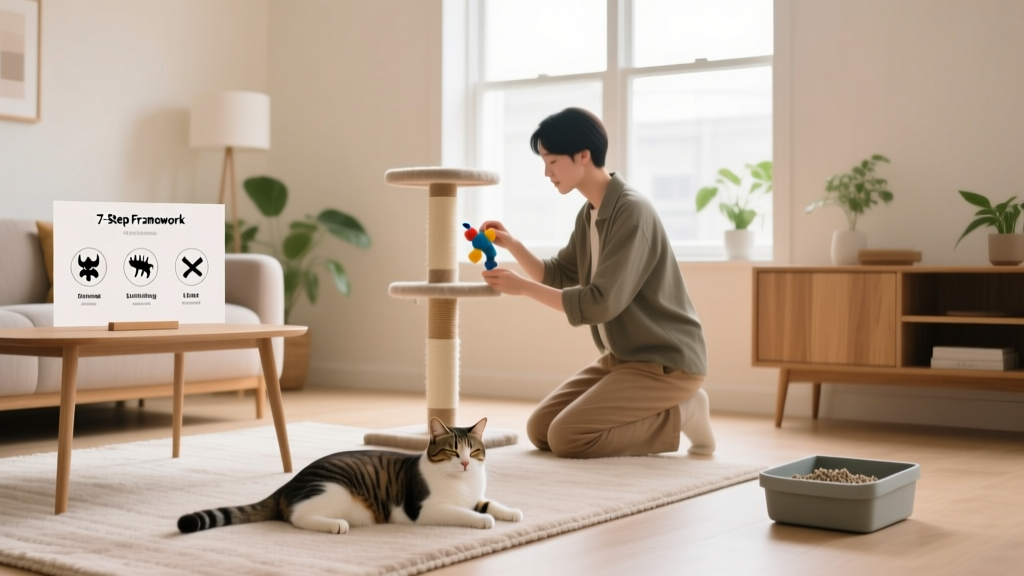
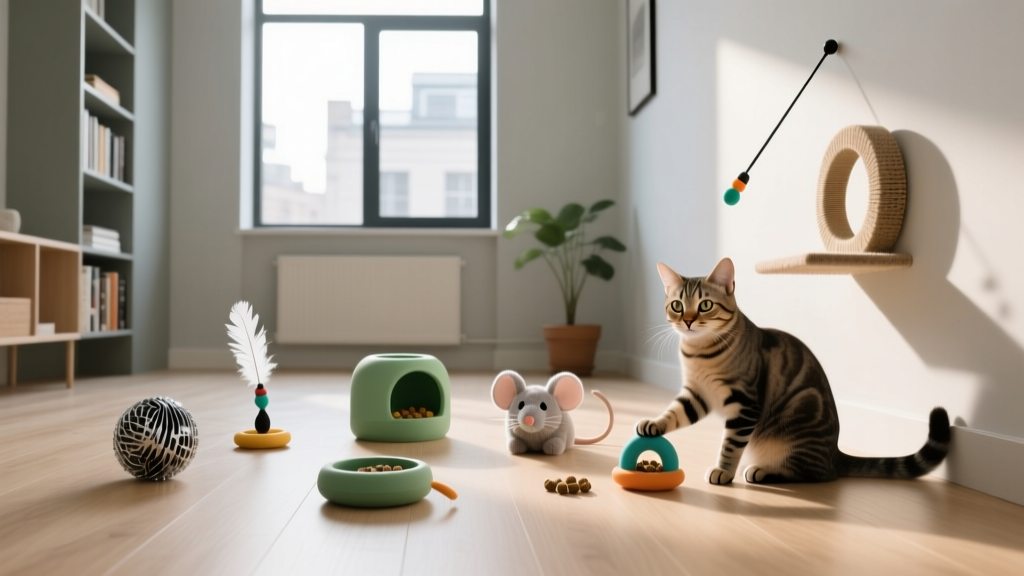
So what *does* work? Build a ‘Catified’ environment — one that satisfies their evolutionary imperatives: climb, hide, hunt, scratch, and control territory. Use this targeted enrichment checklist:
- Vertical space: Install wall-mounted shelves or cat trees near windows (for bird-watching) — height reduces resource competition and stress.
- Hunting simulation: Rotate 3–5 puzzle feeders and wand toys daily; never leave the same toy out >48 hours (novelty = engagement).
- Scratch architecture: Offer both horizontal (sisal rugs, cardboard pads) AND vertical (sturdy upright posts wrapped in jute or carpet) options — placed near sleeping areas and entrances.
- Safe zones: Create 2+ quiet, low-traffic ‘den spaces’ with covered beds, soft blankets, and Feliway diffusers (clinically shown to reduce stress-related marking by 64% in multi-cat homes).
Enrichment isn’t luxury — it’s behavioral medicine. As certified cat behavior consultant Mikel Delgado, PhD, states: "A bored cat isn’t lazy. She’s biologically primed to hunt 10–20 times per day. When that drive goes unmet, it leaks out as ‘problem behavior.’"
Step 3: Train With Positive Reinforcement — Using Their Language
Cats absolutely can be trained — but not with commands, collars, or obedience drills. They learn via classical conditioning (associating stimuli) and operant conditioning (learning consequences). The key is timing, consistency, and high-value reinforcers.
Forget ‘no’ — teach ‘yes.’ Example: To stop counter-surfing, don’t yell when she jumps up. Instead:
- Place a designated ‘cat counter’ (a small, elevated platform with a soft mat) beside the kitchen island.
- Each time she approaches the human counter, calmly say “Up!” and lure her to the cat counter with a treat.
- Click (or say “Yes!”) the *instant* all four paws land on the cat counter — then deliver the treat.
- Repeat 5x/day for 5 days. Within 7–10 days, most cats will choose the cat counter over the human one — because it predicts reward, not correction.
This works because you’re not suppressing behavior — you’re building a stronger, more rewarding alternative pathway. Bonus: This method strengthens your bond. A 2023 Cornell Feline Health Center survey found owners using positive reinforcement reported 3.2x higher levels of mutual trust and 68% fewer aggression incidents than those relying on aversive methods.
Step 4: Rule Out Medical Causes — Because Pain Masks as ‘Misbehavior’
This is non-negotiable: Any sudden or escalating behavior change warrants a full veterinary exam. What looks like ‘acting out’ may be silent suffering. Urinary tract infections cause inappropriate urination. Arthritis makes jumping painful — so cats eliminate on cool tile floors instead of climbing into litter boxes. Dental disease leads to food guarding or growling when approached. Hyperthyroidism triggers restlessness and nighttime vocalization.
A 2021 study in the Journal of Feline Medicine and Surgery reviewed 412 cases of ‘aggression toward owners’ — 42% had underlying medical conditions (most commonly osteoarthritis and dental resorptive lesions). Yet only 11% of owners had sought vet care before trying behavioral ‘solutions.’
Red flags requiring immediate vet evaluation:
- New onset of litter box avoidance (especially if straining, vocalizing, or blood in urine)
- Sudden aggression during petting (‘petting-induced aggression’ can indicate pain)
- Excessive grooming leading to bald patches
- Disorientation, staring into space, or altered sleep/wake cycles
Never train through pain. Treat first. Then train.
| Step | Action | Tools/Supplies Needed | Expected Outcome (Within 7 Days) |
|---|---|---|---|
| 1. Observe & Log | Track 3+ occurrences of target behavior with time, trigger, and consequence | Notepad or digital note app, timer | Clear pattern identified (e.g., “Scratches couch only when left alone >2 hrs”) |
| 2. Enrich & Redirect | Add 1 new enrichment element + replace 1 problematic behavior with 1 rewarded alternative | Puzzle feeder, sisal post, clicker/treat pouch, Feliway diffuser | ≥50% reduction in target behavior frequency; cat engages with new item |
| 3. Reinforce Consistently | Deliver high-value reward within 1 second of desired behavior (e.g., stepping onto cat perch) | Freeze-dried chicken, tuna flakes, or catnip spray (for scent-motivated cats) | Cat offers desired behavior spontaneously ≥3x/day without luring |
| 4. Vet Check-In | Schedule wellness exam + discuss behavior log with vet; request orthopedic/dental/urinalysis screening if indicated | Vet appointment, printed behavior log, list of questions | Medical red flags ruled in/out; treatment plan initiated if needed |
Frequently Asked Questions
Can I use a spray bottle to stop my cat from scratching furniture?
No — and here’s why it backfires. Spray bottles create negative associations not with the scratching, but with you and the location. Your cat may stop scratching the couch when you’re present — but resume it when you’re gone, or shift to another surface (like your favorite armchair). Worse, repeated startle responses elevate baseline stress, increasing risks of cystitis, overgrooming, or redirected aggression. Instead: cover the couch with double-sided tape (cats hate the texture), place a sturdy sisal post directly beside it, and reward her every time she uses it. Within 10–14 days, she’ll prefer the post — because it’s comfortable, accessible, and rewarded.
My cat bites me gently during petting — is this affection or aggression?
It’s likely ‘petting-induced overstimulation,’ not affection or anger — it’s a neurological threshold being crossed. Cats have sensitive skin and limited tolerance for sustained tactile input. Signs include tail flicking, skin twitching, flattened ears, or dilated pupils *before* the bite. Stop petting at the first sign — don’t wait for the bite. Gradually increase tolerance by ending sessions *before* discomfort appears, then offering a treat or toy. Over 2–3 weeks, many cats extend their ‘petting window’ by 30–60 seconds. Never punish the bite — you’ll only teach her to suppress warning signs and bite without notice.
Will getting a second cat solve my cat’s destructive behavior?
Rarely — and often makes it worse. Introducing a new cat adds massive social stress, especially for adult cats who are naturally solitary. Unsupervised introductions can trigger chronic anxiety, redirected aggression, or urine marking. A 2020 study found 68% of ‘problem behaviors’ escalated in the first 3 months post-introduction. Only consider a second cat if your current cat shows consistent, relaxed interest in other cats (via video or隔着 glass), you have ample space (≥1,000 sq ft), and you follow a 4-week gradual introduction protocol with separate resources (litter, food, beds). Otherwise, invest in enrichment — it’s safer, faster, and more effective.
How long does it take to see results from positive reinforcement training?
Realistic timelines vary by behavior, age, and history — but expect to see shifts in frequency within 3–7 days if consistency is high. For example, counter-surfing often drops 40–60% in one week with the ‘cat counter’ method. Deeper habit changes (like consistent litter box use after medical resolution) take 2–4 weeks. Patience is critical: cats learn best in short, frequent sessions (2–3 minutes, 2–3x/day). Long, infrequent sessions cause frustration and disengagement. Celebrate micro-wins — like your cat looking at the scratching post instead of the couch. Those tiny choices build neural pathways.
Is clicker training effective for cats?
Yes — exceptionally so, when done correctly. Clicker training leverages precise marker timing to bridge the gap between behavior and reward. But skip the ‘clicker’ if it startles your cat; use a soft verbal marker like “Yes!” or a tongue-click instead. Start by pairing the sound with a treat 10x (no behavior required) until your cat perks up at the sound. Then mark and reward simple, voluntary actions — touching a target stick, sitting, or even blinking. Once the association is solid, shape more complex behaviors. Certified trainer Sarah Heath notes: "Cats aren’t less trainable than dogs — they’re more selective about what’s worth their effort. Make it fun, fast, and fair, and they’ll engage deeply."
Common Myths About Stopping Cat Behavior
Myth #1: “Cats can’t be trained — they’re too independent.”
False. Independence ≠ untrainability. It means cats require higher-value motivators and clearer communication. Lions in zoos learn complex medical cooperation behaviors (like presenting paws for nail trims) using positive reinforcement. Domestic cats respond identically — when the ‘why’ is clear and the reward is compelling.
Myth #2: “Rubbing a cat’s nose in their accident will teach them not to do it again.”
Dangerously false. Cats don’t associate the punishment with the act — they associate the punishment with you, the location, or the smell of their own urine. This increases fear, stress, and often causes them to eliminate in hidden, hard-to-clean places (under beds, inside closets) — making resolution harder. Always clean accidents with enzymatic cleaner (never ammonia-based), and address the root cause — medical, environmental, or social.
Related Topics (Internal Link Suggestions)
- Feline Stress Signals — suggested anchor text: "subtle signs your cat is stressed"
- Best Puzzle Feeders for Bored Cats — suggested anchor text: "top 5 mentally stimulating cat feeders"
- How to Introduce a New Cat Safely — suggested anchor text: "step-by-step cat introduction guide"
- When to See a Veterinary Behaviorist — suggested anchor text: "signs you need a cat behavior specialist"
- DIY Cat Scratching Posts — suggested anchor text: "build a sturdy scratching post in 30 minutes"
Your Next Step Starts With One Observation
You now know that how to stop cat behavior for training isn’t about suppression — it’s about translation, enrichment, and partnership. The most powerful tool you own isn’t a spray bottle or a clicker. It’s your attention. So tonight, before bed, sit quietly for 5 minutes and watch your cat — not to judge, but to wonder: What is she trying to tell me? What does she need that she can’t ask for in words? That curiosity is where real change begins. Grab your notebook, open a new note, and log just one behavior tomorrow. Then come back and try Step 2 from our table — add one enrichment element. Small actions, consistently taken, rewire both your cat’s habits and your shared relationship. You’ve got this — and your cat is already waiting for you to listen.