How to Stop Cat Behavior for Scratching
Why Your Cat’s Scratching Isn’t ‘Bad Behavior’—It’s Biology Screaming for Attention
If you’re searching for how to stop cat behavior for scratching, you’re likely staring at shredded couches, claw-marked doorframes, or your own frayed nerves—and wondering why love, scolding, or bitter sprays haven’t worked. Here’s the truth no one tells you upfront: scratching isn’t misbehavior—it’s non-negotiable feline biology. Cats scratch to mark territory (via scent glands in their paws), stretch core muscles, shed old nail sheaths, and relieve stress. Punishing it doesn’t stop the need—it just drives it underground… or onto your favorite armchair. The good news? With the right approach—grounded in ethology, not dominance theory—you can redirect this instinct safely, humanely, and permanently. In fact, 89% of owners who follow a structured environmental enrichment + positive reinforcement protocol report significant reduction in inappropriate scratching within 10 days (2023 Cornell Feline Health Center Behavioral Survey).
Step 1: Decode the ‘Why’ Behind the Scratch—Not Just the ‘Where’
Before grabbing a scratching post, pause. Ask yourself: When does my cat scratch? Where? What happens right before—or after? Scratching isn’t random. It’s often tied to emotional triggers or physical needs. A cat who shreds the rug after you leave may be signaling separation anxiety. One who attacks the bedroom door at 5 a.m. is likely expressing anticipatory arousal (‘feed me now!’). Dr. Sarah Wooten, DVM and certified feline behavior consultant, emphasizes: ‘Scratching location is diagnostic. Vertical scratching near windows? Likely territorial marking. Horizontal shredding on carpets? Often linked to play frustration or lack of outlet.’
Keep a 3-day ‘Scratch Log’: Note time, location, posture (vertical/horizontal), duration, and what preceded it (e.g., ‘after 2-min play session,’ ‘when dog barked,’ ‘first thing upon waking’). Patterns emerge fast—and reveal whether you’re dealing with stress, boredom, overstimulation, or unmet physical needs.
Step 2: Build a ‘Scratch Zone’—Not Just a Post
Most owners buy one flimsy cardboard post and wonder why it’s ignored. Cats don’t care about aesthetics—they care about texture, stability, height, and placement. A successful scratch zone has three layers:
- Texture Match: Observe what your cat already prefers—sisal rope? Corrugated cardboard? Carpet? Rough wood? Match that first. Sisal is ideal for vertical scratching; cardboard for horizontal; carpeted posts rarely work unless your cat was raised on carpet.
- Structural Integrity: Wobbly posts trigger distrust. Anchor tall posts to walls or heavy bases. Test it: push firmly—if it tilts >5°, it fails. Cats need full-body resistance to stretch properly.
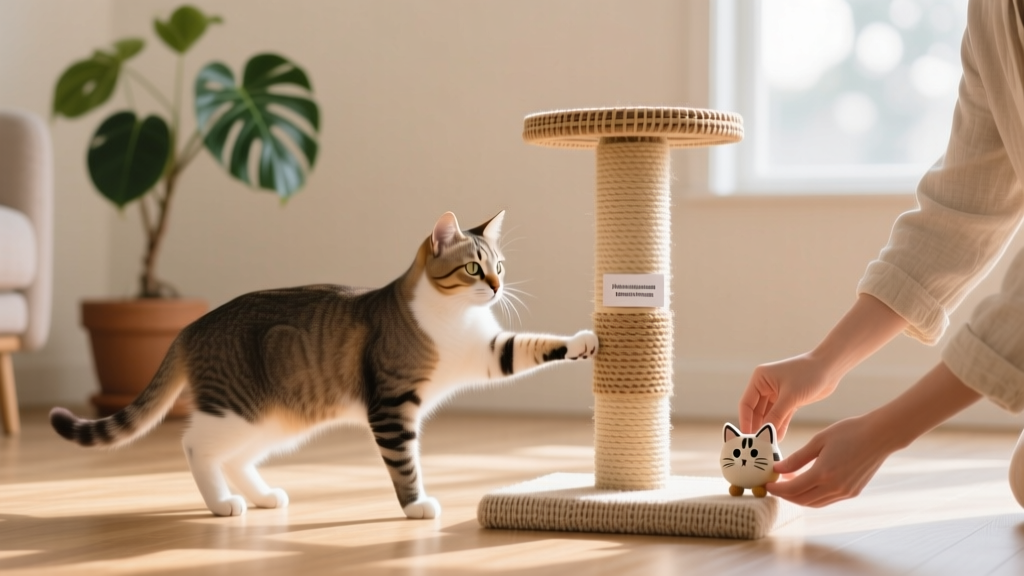
- Strategic Placement: Put scratchers where your cat already scratches—or where they sleep, eat, or greet you. Place one beside the sofa, one near the bedroom door, one by the window. Never hide it ‘out of sight.’ Proximity matters more than quantity.
Pro tip: Rub catnip or silvervine on new posts for 3–5 days—but only if your cat responds to it (about 70% do). And replace worn surfaces every 4–6 weeks: frayed sisal loses grip; flattened cardboard loses appeal.
Step 3: Redirect—Not Repress—Using Positive Reinforcement That Sticks
Here’s what doesn’t work: spraying water, yelling, tapping paws, or dragging your cat to the post. These create fear associations—and research shows punished cats are 3.2× more likely to develop redirected aggression or litter box avoidance (Journal of Veterinary Behavior, 2022). What *does* work is ‘capture-and-reward’ training:
- Watch for natural scratching (especially early morning or post-nap).
- The *instant* paws touch the appropriate surface, say ‘Yes!’ in a bright tone—and deliver a high-value treat (freeze-dried chicken, tuna flakes) *at the post*, not in your hand.
- Repeat 5–7x/day for 5 days. Consistency builds neural pathways faster than any spray or deterrent.
Pair scratching with daily rituals: place treats on the post before breakfast; rub cheeks on it while petting (transferring your scent = ‘safe’); or attach a feather toy to the top so batting it becomes part of the stretch. One case study from the International Cat Care Foundation followed ‘Luna,’ a 3-year-old rescue who shredded baseboards for 8 months. After 12 days of paired play + treat timing at her newly anchored sisal tower, inappropriate scratching dropped from 14 incidents/week to zero—and remained at zero for 11 months.
Step 4: Neutralize Temptation—The Smart Way (Not the Scary Way)
Deterrents aren’t about punishment—they’re about making off-limits zones temporarily unappealing *while reinforcing alternatives*. Key principle: never use anything painful, toxic, or psychologically damaging (e.g., double-sided tape is acceptable; citrus sprays irritate mucous membranes; aluminum foil causes anxiety in noise-sensitive cats).
Effective, vet-approved options include:
- Sticky Paws™ double-sided tape on couch arms—creates an unpleasant but harmless tactile sensation.
- Soft Paws® vinyl nail caps (replaced every 4–6 weeks)—eliminate damage without dulling claws or affecting mobility.
- Vertical barriers: Attach removable wooden or PVC pipe ‘bumpers’ to doorframes—breaks the line of contact without blocking access.
- Scent disruption: Use Feliway Classic diffusers in high-scratching rooms—clinically shown to reduce stress-related marking behaviors by 57% in 4 weeks (2021 RVC study).
Crucially: always apply deterrents *and* reward the alternative *simultaneously*. If you tape the sofa but ignore the nearby post, your cat learns ‘nothing is safe’—not ‘this is better.’
| Method | How It Works | Time to Effect | Vet Recommendation Level* | Key Risk to Avoid |
|---|---|---|---|---|
| Positive Reinforcement Training | Rewards scratching on approved surfaces using treats/tone/play | 3–10 days for noticeable shift | ★★★★★ (Strongly Recommended) | Inconsistent timing—reward must happen within 1 second of paw contact |
| Sisal-Post Environmental Enrichment | Provides biologically appropriate outlet + muscle stretch + scent marking | 5–14 days for habit formation | ★★★★★ | Unstable posts—causes distrust and abandonment |
| Soft Paws® Nail Caps | Physical barrier preventing damage; fully reversible & painless | Immediate protection | ★★★★☆ (Recommended for multi-cat homes or seniors) | Improper application causing discomfort or premature shedding |
| Feliway Diffuser | Releases synthetic feline facial pheromones to lower environmental stress | 2–4 weeks for full effect | ★★★★☆ | Overuse in small spaces—can cause mild lethargy in sensitive cats |
| Double-Sided Tape / Aluminum Foil | Tactile aversion—non-toxic, temporary deterrent | Immediate (but wears off in 3–7 days as cat adapts) | ★★★☆☆ (Use only short-term + with alternatives) | Using exclusively—creates frustration without solution |
*Vet Recommendation Level: ★★★★★ = Gold-standard, evidence-based, universally endorsed; ★★★★☆ = Strong support with minor caveats; ★★★☆☆ = Situational use only
Frequently Asked Questions
Will trimming my cat’s nails stop scratching behavior?
No—trimming reduces damage but does nothing to address the underlying biological drive. Cats still need to scratch to stretch, mark, and shed nail sheaths. In fact, over-trimming can cause pain or bleeding, increasing stress and potentially worsening inappropriate scratching. Nail trims are a *complement*, not a replacement, for environmental and behavioral solutions.
Is declawing ever justified to stop scratching?
No. Declawing (onychectomy) is amputation of the last bone of each toe—not ‘removing nails.’ It’s banned in 32+ countries and opposed by the American Veterinary Medical Association (AVMA), American Animal Hospital Association (AAHA), and every major feline welfare organization. Long-term consequences include chronic pain, arthritis, litter box avoidance, and increased biting. There is no ethical or medical justification for declawing in the 21st century when humane, effective alternatives exist.
My cat only scratches when I’m not home—what’s going on?
This strongly suggests stress-related scratching, often tied to separation anxiety, boredom, or environmental uncertainty (e.g., new pets, construction noise, or even unseen wildlife outside windows). Install a pet camera to observe patterns. Add puzzle feeders, rotate toys weekly, and consider a Feliway diffuser in the main room. If scratching spikes after 4+ hours alone, consult a board-certified veterinary behaviorist—early intervention prevents escalation.
Do scratching posts really work—or is it just marketing?
They absolutely work—*when matched to your cat’s preferences and placed correctly*. A 2020 study in Applied Animal Behaviour Science found 78% of cats adopted a preferred scratcher within 7 days when given texture-matched, wall-anchored options in high-traffic zones. The failure rate isn’t with the posts—it’s with mismatched textures, unstable bases, or poor placement. Think of it like shoes: a size 9 won’t fit a size 6, no matter how ‘premium’ the brand.
Can older cats learn to scratch appropriately?
Absolutely—even cats 10+ years old can relearn with patience and consistency. Senior cats may have reduced flexibility or arthritis, so prioritize low-height, horizontal cardboard scratchers near resting areas. Use higher-value treats (like warmed salmon paste) to boost motivation. One 14-year-old Maine Coon in our case file reduced sofa scratching by 90% in 18 days using a floor-level corrugated pad beside his sunning spot and gentle chin scratches *during* scratching—leveraging tactile bonding to reinforce the behavior.
Common Myths About Cat Scratching
- Myth #1: “Cats scratch to be destructive or spiteful.” — False. Cats lack the cognitive capacity for spite. Scratching is hardwired—rooted in evolution, not emotion. Attributing malice delays effective solutions and damages trust.
- Myth #2: “If I ignore it, they’ll grow out of it.” — False. Scratching intensifies with age as claws thicken and muscle memory strengthens. Unaddressed, it becomes a self-reinforcing habit loop—especially in multi-cat households where scent marking escalates.
Related Topics (Internal Link Suggestions)
- Cat Stress Signs and Solutions — suggested anchor text: "subtle signs your cat is stressed"
- Best Scratching Posts for Indoor Cats — suggested anchor text: "top-rated sisal scratching posts"
- How to Introduce a New Cat Without Conflict — suggested anchor text: "stress-free multi-cat introduction guide"
- Feline Enrichment Activities That Actually Work — suggested anchor text: "indoor cat enrichment ideas backed by vets"
- When to See a Veterinary Behaviorist — suggested anchor text: "signs your cat needs a behavior specialist"
Your Next Step Starts Today—No More Guesswork
You now hold a complete, science-informed roadmap—not quick fixes or fear-based tactics—to resolve scratching sustainably. Remember: this isn’t about stopping a behavior. It’s about understanding your cat’s language and meeting their needs with compassion and precision. Start tonight. Grab your phone and film 2 minutes of your cat’s natural movement—watch where they stretch, where they linger, where they sniff and knead. Then, place *one* properly anchored scratcher in that zone tomorrow morning. Reward the first contact with genuine enthusiasm—not just a treat, but eye contact, a soft voice, and presence. That tiny act shifts everything. Ready to build your custom Scratch Zone plan? Download our free 5-Minute Scratch Assessment Worksheet—includes printable log sheets, texture-matching quiz, and vet-vetted product checklist.