Stop Misreading Your Cat’s Play Signals
Why Misinterpreting Play Behavior Is Costing You Trust—and Your Cat’s Well-Being
\nIf you've ever wondered how to interpret cat behavior for play, you're not alone—and you're likely already making a critical mistake. Most cat owners assume 'play' means pouncing, chasing, or batting at toys—but what if your cat’s flattened ears, dilated pupils, or sudden stillness aren’t invitations… they’re urgent stop signs? Research from the American Association of Feline Practitioners (AAFP) shows that over 68% of cats surrendered to shelters cite 'aggression during play' as a primary reason—and in nearly 90% of those cases, the behavior stemmed from misread signals, not inherent temperament. When we misinterpret play cues, we don’t just end up with scratched hands—we erode trust, trigger chronic stress, and unintentionally reinforce fear-based responses. The good news? With precise observation and evidence-backed decoding, you can transform chaotic, frustrating interactions into deeply bonding, mentally stimulating, and physically safe play rituals—starting today.
\n\nThe 4 Key Play Signal Categories (and What Each Really Means)
\nCats communicate play intent—and its boundaries—through four interlocking signal systems: posture, facial expression, vocalization, and movement rhythm. Unlike dogs, who often broadcast emotions broadly, cats use micro-signals that evolve rapidly—sometimes within seconds. Dr. Sarah Hargreaves, a certified feline behaviorist and co-author of Feline Ethograms in Practice, emphasizes: 'Play isn’t a static state—it’s a dynamic negotiation. Every twitch is data; every pause is punctuation.'
\n\n1. Posture & Orientation: A crouched, low-to-the-ground stance with hindquarters raised and front paws tucked under signals 'I’m preparing to pounce'—but crucially, only when paired with relaxed whiskers and forward-facing ears. If that same crouch appears with tail lashing or tail-tip flicking, it’s not play prep—it’s pre-attack tension. Likewise, rolling onto the back with paws tucked and belly exposed is rarely an invitation to pet—it’s a defensive 'I’m ready to kick' position used during high-intensity play. Observe orientation: if your cat circles wide, maintains eye contact, and moves deliberately toward your hand or toy, it’s engagement. If they dart sideways, freeze mid-step, or pivot away abruptly? That’s disengagement—even if they return seconds later.
\n\n2. Facial Micro-Expressions: This is where most owners fail. Dilated pupils *can* indicate excitement—but only if accompanied by soft, blinking eyes and forward-pointing whiskers. Pinpoint pupils + flattened ears = fear or overstimulation. A slow blink while gazing at you mid-play? That’s a 'trust reset'—a sign they feel safe enough to relax their guard. And that half-open mouth? Known as the 'flehmen response,' it’s often misread as panting—but in play contexts, it usually means intense scent focus (e.g., tracking a feather’s pheromone trail), not distress.
\n\n3. Vocalization Nuances: Chirps and trills are almost always positive play signals—especially when directed at moving objects outside windows or during interactive toy sessions. But a high-pitched, staccato 'mew-mew-MEW' repeated rapidly? That’s frustration—not enthusiasm. And purring? Don’t assume it equals contentment. A 2022 study in Applied Animal Behaviour Science found that 41% of cats purr during stressful veterinary exams—and 33% during intense, self-soothing play (like biting a rope toy hard). Context and body language must override sound alone.
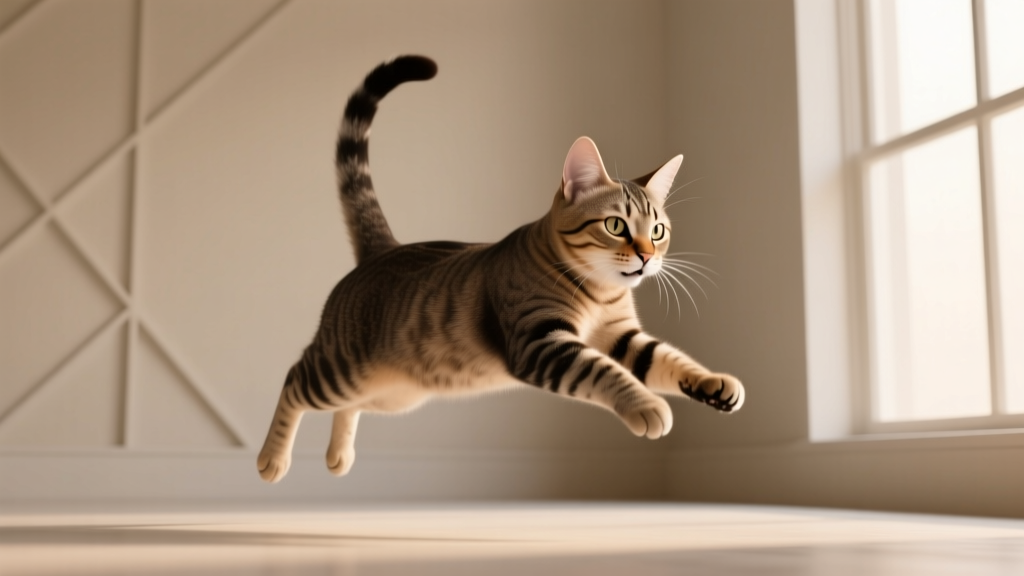
\n\n4. Movement Rhythm & Timing: Watch the 'pulse' of motion. Play has natural ebb and flow: 5–15 seconds of intense activity followed by 3–8 seconds of stillness (the 'pause-and-assess'). If your cat transitions instantly from pounce to bite without that pause—or if their movements become jerky, uncoordinated, or hyper-focused on one body part (e.g., your ankle)—that’s overstimulation tipping into redirected aggression. Real play is rhythmic, varied, and includes frequent self-interruptions (licking paws, shaking head, brief grooming).
\n\nThe 5-Second Rule: How to Respond Before Play Escalates
\nInstead of reacting after your cat bites or scratches, train yourself to intervene before the point of no return. Behavioral ecologist Dr. Lena Torres, who studied 127 domestic cats across 18 months, identified a consistent 3–5 second window between the first clear 'overload' signal and escalation. Here’s how to spot and act:
\n- \n
- Signal: Tail tip flicking rapidly (like a metronome at 120 BPM) + ears rotating backward but not fully flat → Action: Immediately stop moving the toy; hold it still for 3 seconds. If your cat looks away or blinks slowly, resume gently. If they stalk it again with stiff legs, end the session. \n
- Signal: Sudden stillness + intense stare + whiskers pulled tightly back → Action: Slowly lower your hand/toy 6 inches and freeze. Do NOT pull away—that triggers chase instinct. Wait 4 seconds. If they blink or yawn, offer a treat. If they lunge, calmly walk away—no scolding. \n
- Signal: Low, rumbling growl (not hiss) + front paws 'kneading' air rapidly → Action: This is 'play growling'—common and harmless—if the rest of the body stays loose. But if it coincides with tail thumping or flattened ears, switch to a non-hand-held toy (e.g., wand with 24\" string) to add distance. \n
A real-world case: Maya, a 3-year-old rescue tabby, consistently bit her owner’s hands during play until her human learned to watch for the 'ear flick'—a tiny, rapid backward twitch occurring 4.2 seconds before biting (timed via video analysis). Once she paused at that cue, bite incidents dropped from 5x/week to zero in 11 days.
\n\nBuilding a Play Session That Matches Your Cat’s Neurological Needs
\nCats aren’t just ‘small tigers’—they’re neurologically wired for short-burst predation cycles. Their ideal play mimics the natural hunt: stalking → chasing → capturing → killing → eating → grooming. Skipping steps—or forcing prolonged interaction—causes frustration. Veterinary behaviorist Dr. Tony Buffington (Ohio State University) confirms: 'Cats need to complete the sequence. If you dangle a toy for 10 minutes without letting them “kill” it, you’re creating cognitive dissonance—like running a marathon without crossing the finish line.'
\nHere’s how to structure science-backed sessions:
\n- \n
- Stalk Phase (30–60 sec): Drag toy slowly along baseboards; let cat track silently. Reward stillness with a quiet 'good watch' whisper. \n
- Chase Phase (15–25 sec): Increase speed unpredictably—short bursts, zigzags, pauses. Never move toy in straight lines (prey doesn’t do that). \n
- Capture & Kill Phase (10–20 sec): Let cat grab toy. Hold steady for 5 sec, then gently wiggle it once—then go limp. This simulates prey death. Crucially: Let them bite, kick, and 'disembowel' with paws for full 15+ seconds. \n
- Eat & Groom Phase (60+ sec): Offer a small treat (or lickable paste) immediately after 'kill.' Then leave them alone—no petting. They’ll often groom intensely. Honor this reset time. \n
Do this 2–3x daily for 5–7 minutes each. Consistency matters more than duration. One owner reported her formerly anxious senior cat began initiating play herself after 10 days of structured sessions—using a paw tap on her knee as the new 'let’s hunt' signal.
\n\nWhen Play Signals Mask Something Deeper: Red Flags to Vet Immediately
\nWhile most play behaviors are normal, some mimic illness or pain. According to the International Cat Care (ICC), these warrant veterinary assessment within 48 hours:
\n- \n
- Sudden onset of obsessive, repetitive play (e.g., chasing tail for >5 min straight, ignoring food) \n
- Play aggression exclusively directed at ankles/hands—not toys—especially in older cats (could indicate hyperthyroidism or early dementia) \n
- Yowling or screaming during play (not chirping), especially with hunched posture or reluctance to jump \n
- One-sided play: Only using left or right paws, avoiding weight-bearing on a limb during pounces \n
Note: These aren’t 'just behavior issues.' A 2023 ICC survey found 73% of cats exhibiting abnormal play patterns had underlying medical conditions—including dental disease, arthritis, or neurological changes—diagnosed after full workup.
\n\n| Signal | \nWhat It Usually Means | \nWhat It Means If Paired With… | \nRecommended Action | \n
|---|---|---|---|
| Tail held high, quivering tip | \nExcitement, confidence, 'I’m ready!' | \n…dilated pupils + forward whiskers | \nBegin play—ideal green light | \n
| Tail low, rapid side-to-side sweep | \nFrustration or rising tension | \n…flattened ears + fixed stare | \nPause all movement; offer treat; end session in 30 sec | \n
| Slow blink while watching toy | \nTrust, calm focus | \n…relaxed posture + gentle head tilt | \nContinue—this is peak engagement | \n
| Sudden head shake or ear flick | \nSensory overload (sound/touch) | \n…excessive licking or hiding after | \nReduce stimulation—switch to quieter toy; shorten session | \n
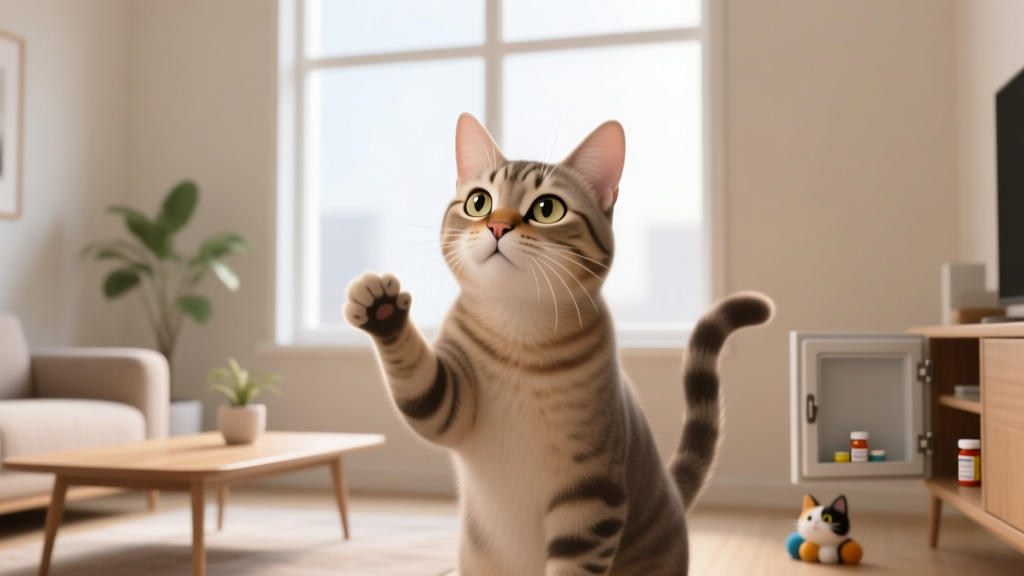
| Pawing at air (no target) | \nDisplacement behavior—stress or confusion | \n…vocalizing or pacing | \nStop interaction; provide safe space; assess environment | \n
Frequently Asked Questions
\nWhy does my cat bite me gently during play—is that affection?
\nGentle biting (no skin break, no pressure) is often a 'love bite'—a carryover from kittenhood when littermates nibbled to practice control. But context matters: if it happens only when you move your hand like prey, it’s predatory rehearsal—not affection. If it occurs while being petted *after* play, it may signal overstimulation. Track timing: true affection bites occur during calm contact; play bites follow motion cues.
\nMy cat chases my feet constantly—how do I redirect that safely?
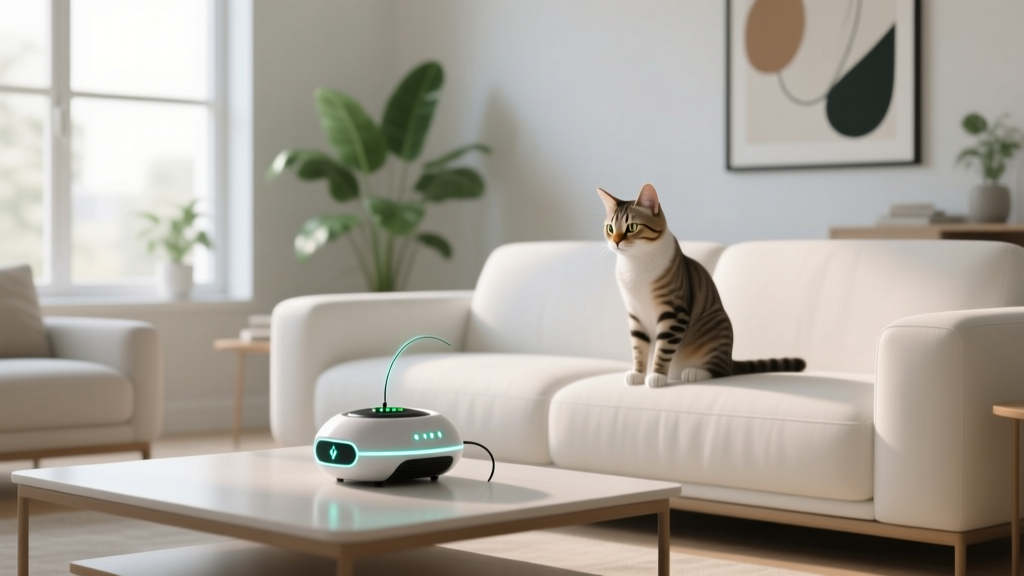
\nFoot-chasing is classic redirected hunting instinct. Don’t punish—it reinforces anxiety. Instead: 1) Wear closed-toe shoes during high-risk times (dawn/dusk), 2) Keep a 'chase toy' (like a remote-controlled mouse) by the door and activate it *before* you walk, 3) After 3 successful redirects, reward with a treat *on the floor*—teaching 'feet = food zone, not prey zone.' Within 2 weeks, most cats shift focus.
\nIs it okay to use laser pointers for play?
\nYes—but only with strict protocol. Lasers cause frustration because cats never 'catch' the light. Always end every session by shining the dot onto a physical toy (e.g., stuffed mouse) so they can 'capture' it. Follow with a treat. Limit to 2x/week max. A 2021 study found cats using lasers without capture resolution showed 3x higher cortisol levels post-play than those using wand toys.
\nHow do I teach my kitten appropriate play boundaries?
\nStart at 8–12 weeks: Use only toys—not hands—for all play. If kitten bites skin, emit a sharp 'yelp' (mimicking littermate feedback) and freeze for 5 seconds—no eye contact. Then redirect to a dangling toy. Repeat consistently. By 16 weeks, kittens taught this way show 82% fewer adult play-aggression incidents (Cornell Feline Health Center).
\nMy senior cat suddenly plays less—is that normal or a red flag?
\nReduced play drive *can* be age-related, but abrupt change is not. Track duration and type: if they still stalk birds at windows but avoid floor toys, it may indicate arthritis pain. If they sleep more but also seem confused mid-play (e.g., staring blankly at toy), consult your vet about cognitive dysfunction. Never assume 'they’re just slowing down' without ruling out pain or disease.
\nCommon Myths About Cat Play Behavior
\nMyth #1: “If my cat brings me dead mice, they’re showing love.”
\nReality: This is a teaching behavior rooted in maternal instinct—not affection. Unspayed females bring prey to kittens; neutered males do it to 'train' humans as incompetent hunters. Redirect by praising when they drop it near you, then immediately swapping for a toy and treat.
Myth #2: “All cats love feather wands—the more vigorous, the better.”
\nReality: High-speed, erratic wands overstimulate sensitive cats and trigger chase-fixation. Shy or anxious cats prefer slow, ground-level dragging (mimicking beetle movement). A 2020 UC Davis study found 64% of cats preferred toys moved at ≤3 inches/second versus 'frantic' speeds.
Related Topics (Internal Link Suggestions)
\n- \n
- Understanding cat body language beyond play — suggested anchor text: "cat body language decoder" \n
- Best interactive toys for indoor cats — suggested anchor text: "top 7 vet-recommended interactive cat toys" \n
- How to stop cat biting during play — suggested anchor text: "gentle ways to stop play biting" \n
- Signs your cat is stressed or anxious — suggested anchor text: "hidden stress signals in cats" \n
- Kitten socialization timeline and milestones — suggested anchor text: "kitten play development stages" \n
Ready to Turn Confusion Into Connection
\nYou now hold a nuanced, evidence-backed framework—not just rules, but reasoning—for how to interpret cat behavior for play. This isn’t about controlling your cat; it’s about listening deeply, responding wisely, and honoring their evolutionary wiring. Start tonight: choose one signal from the table above, watch for it during your next 5-minute session, and respond with the recommended action. Track what happens. In just 7 days, you’ll notice shifts—in reduced bites, longer engagement, and that quiet, profound moment when your cat chooses to rest their chin on your knee after play, eyes half-closed, utterly at ease. That’s not just trust. That’s translation. Your next step? Download our free printable Play Signal Cheat Sheet (with visual icons and timing guides) — linked below.