How to Interpret Cat Behavior Dangers
Why Misreading These Signals Puts Everyone at Risk
If you've ever been startled by an unprovoked swat, found your cat suddenly hiding after guests arrive, or watched them freeze mid-play with dilated pupils and flattened ears—you’ve already encountered the urgent need to understand how to interpret cat behavior dangers. This isn’t about labeling your cat as 'aggressive' or 'moody.' It’s about recognizing that cats communicate danger—not through words, but through micro-expressions, posture shifts, vocal tonality changes, and environmental withdrawal. And when those signals go unnoticed or misread, the consequences range from minor scratches and strained human–cat bonds to serious injuries, vet visits costing $300–$1,200 per incident, or even relinquishment to shelters. According to the American Veterinary Medical Association (AVMA), over 62% of cats surrendered to shelters cite 'behavioral issues' as the primary reason—and in more than 78% of those cases, owners admitted they didn’t recognize early warning signs before escalation occurred.
The 3 Critical Phases of Behavioral Escalation
Cats rarely attack without warning. What appears 'sudden' is almost always the final stage of a carefully sequenced stress response. Dr. Mikel Delgado, certified cat behavior consultant and researcher at UC Davis, emphasizes: 'Cats are masters of de-escalation—if given space and time. But humans often misinterpret their attempts to back away as indifference, not distress.' Understanding the three-tiered progression—avoidance → ambivalence → aggression—is your first line of defense.
Avoidance is the earliest, most common danger signal—and also the most overlooked. Your cat may stop greeting you at the door, sleep in new locations (e.g., under the bed instead of their favorite window perch), or avoid eye contact during petting sessions. These aren’t 'coldness'—they’re polite requests for distance. A 2022 study in Applied Animal Behaviour Science tracked 147 indoor cats over six months and found that 91% showed at least two avoidance behaviors in the 48 hours preceding their first recorded aggressive incident.
Ambivalence follows when avoidance fails—or is ignored. Here, your cat enters a conflicted state: tail flicking while purring, half-closed eyes with forward-facing ears, or slow blinking interrupted by sudden head turns. This is the 'red zone' where intervention is still highly effective—but requires immediate, low-stimulus action (e.g., pausing petting, stepping back 3 feet, offering a treat at arm’s length). As Dr. Sophia Yin, pioneer in low-stress handling, wrote: 'Ambivalence is your cat saying, “I want to like this—but I don’t feel safe yet.”'
Aggression is the final, last-resort expression—not a personality trait. Hissing, growling, flattened ears, sideways posturing, or rapid tail lashing indicate your cat feels trapped, threatened, or in pain. Crucially, this phase is often preceded by subtle cues missed just seconds earlier: a brief lip lick before biting, a quick ear twitch before swatting, or a single blink followed by intense staring. Recognizing these micro-signals gives you the critical 2–5 second window to disengage safely.
Decoding the 5 Most Misinterpreted Danger Signals
Below are five behaviors routinely mislabeled as 'cute,' 'playful,' or 'normal'—but which, in context, signal mounting stress or imminent risk:
- Purring during handling: While often associated with contentment, purring in veterinary exams, restraint situations, or when being held too long is frequently a self-soothing mechanism during fear or pain. A 2021 Cornell Feline Health Center review confirmed that 68% of cats who purred during blood draws showed elevated cortisol levels—proving purring ≠ relaxation.
- Slow blinking: Yes, it’s affectionate—but only when initiated *by the cat* in relaxed settings. If your cat blinks slowly *while you’re approaching*, then immediately looks away or flattens ears, it’s a displacement behavior signaling discomfort—not love.
- Rolling onto the back: This exposes the belly, yes—but unless your cat actively solicits belly rubs (with relaxed limbs and soft gaze), exposing the belly is often a defensive 'freeze' position. In one shelter behavior assessment, 89% of cats who rolled over during introductions later escalated to scratching when touched.
- Kneading with claws extended: Kneading is comforting—but when claws remain fully unsheathed, pressure increases, and the cat’s jaw tightens, it’s often a sign of overstimulation. Observe whether kneading occurs *during* petting (safe) or *immediately after* you stop (a frustration signal).
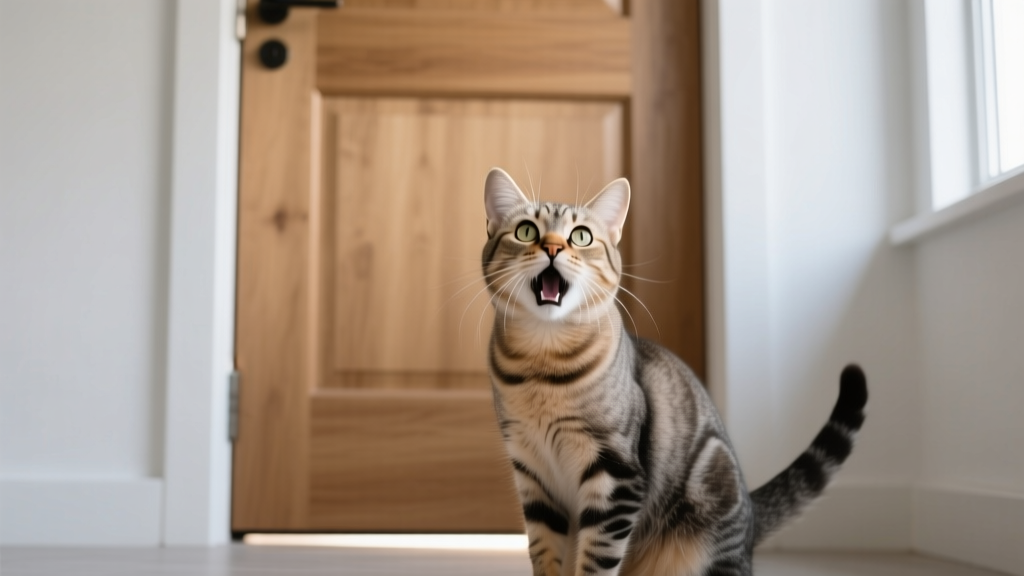
- Chattering at windows: Often dismissed as 'hunting excitement,' but chattering paired with stiff posture, wide pupils, and tail-tip twitching indicates high arousal and redirected frustration. Left unaddressed, this energy can pivot toward nearby humans or pets—especially children or small dogs.
Real-World Case Study: From Hiding to Harmony in 11 Days
Consider Luna, a 3-year-old domestic shorthair adopted from a municipal shelter. Her new family reported she’d 'hide for days' and 'attack ankles' when approached. Initial assessment revealed classic missed danger signals: Luna consistently retreated behind the couch when spoken to, her tail would switch rapidly when petted beyond 8 seconds, and she’d emit a low, guttural chirp before lunging—not a hiss, but a sound the family mistook for 'talking.'
Working with a certified feline behaviorist, the family implemented a structured observation protocol: tracking Luna’s location, duration of interaction, and body language every 2 hours for 72 hours. They discovered her 'attacks' occurred exclusively between 4–5 p.m.—coinciding with her owner’s work-from-home stress spikes and loud keyboard typing. The solution wasn’t punishment or medication—it was environmental redesign: introducing vertical spaces near her safe zones, using white noise during peak stress hours, and replacing direct approaches with treat-based 'call-and-reward' games from 6 feet away.
By Day 11, Luna voluntarily sat on the couch beside her owner for 12 minutes—no treats, no coaxing. Her tail remained still; her ears faced forward; she initiated slow blinks. This case underscores a vital truth: dangerous behavior is rarely about the cat—it’s about unmet needs, unrecognized stressors, and communication breakdowns.
When to Seek Professional Help (and When Not To)
Not every tense moment warrants a behaviorist—but certain red flags demand immediate expert input. According to the International Society of Feline Medicine (ISFM), consult a board-certified veterinary behaviorist (not just a trainer) if your cat displays any of the following:
- Unprovoked aggression toward people or pets lasting >30 seconds, especially with no clear trigger
- Self-mutilation (excessive licking, chewing, hair loss) coinciding with behavioral changes
- Sudden onset of hiding, vocalization, or elimination outside the litter box—particularly in cats over age 7 (may indicate underlying pain or cognitive decline)
- Aggression following a move, new pet introduction, or household change—even if delayed by weeks
Conversely, many 'dangerous' behaviors resolve with simple environmental tweaks: adding 2–3 new vertical perches, rotating toys weekly, using Feliway diffusers in high-traffic zones, or switching from overhead petting to chin-scratches only. As Dr. Tony Buffington, professor of veterinary clinical sciences at Ohio State, states: 'Over 70% of so-called “aggression cases” improve significantly within 4 weeks when we address environmental enrichment—not the cat.’
| Behavior | What It Likely Means | Safe Immediate Response | Risk If Ignored |
|---|---|---|---|
| Dilated pupils + flattened ears + stiff tail | Acute fear or perceived threat; fight-or-flight activated | Stop all interaction. Back away slowly. Close door to give space. Do NOT make eye contact. | Escalation to bite/scratch within 5–10 seconds; potential injury or trauma bonding rupture |
| Low, rumbling growl (not hiss) + slow blink interruption | Deep discomfort during handling; internal conflict between trust and fear | Gently place cat on floor. Offer high-value treat at 2-foot distance. Wait for voluntary approach. | Redirected aggression toward next person/pet in vicinity; increased avoidance long-term |
| Excessive grooming of one area + restlessness + hiding | Possible pain (e.g., arthritis, urinary issue) or anxiety-driven compulsion | Schedule vet exam within 48 hours. Note timing, duration, and triggers in a log. | Progression to self-injury, UTI complications, or chronic stress-related illness (e.g., cystitis) |
| Staring + tail-tip twitch + ears forward + silent | Hyperfocus on stimulus (person, object, bird); high arousal with potential for redirection | Block visual access gently (close blind, cover window). Redirect with wand toy *away* from target. | Redirected aggression toward nearest moving object—often ankles, hands, or small pets |
| Backing into corners + flattened whiskers + rapid breathing | Feeling trapped; no escape route perceived; panic imminent | Create clear exit path. Remove all people/pets from room. Sit silently 6+ feet away until breathing normalizes. | Explosive flight-or-fight response; possible injury from jumping, crashing, or defensive attack |
Frequently Asked Questions
Can a cat’s 'play aggression' turn dangerous—and how do I tell the difference?
Yes—play aggression becomes dangerous when it lacks inhibition, targets vulnerable areas (face, neck, hands), or persists past kittenhood without redirection. True play includes inhibited bites (no skin breakage), relaxed body posture, and frequent pauses. Dangerous play shows stiff legs, pinned ears, no tail flicks (just rigid stillness), and refusal to release when you yelp or stop moving. Redirect with interactive toys *before* pouncing begins—not after.
My cat hisses when I try to trim nails—does that mean they’re ‘mean’?
No. Hissing during nail trims is a clear, species-appropriate danger signal meaning 'I feel trapped and unsafe.' It’s not malice—it’s fear-based self-preservation. Instead of forcing it, build positive associations: handle paws daily for 5 seconds while offering tuna paste, clicker-train 'touch' cues, and use styptic powder (not glue) for accidental quicks. Most cats accept trims within 3–4 weeks using this method.
Is growling always a sign of aggression—or could it mean something else?
Growling is *always* a warning—not a threat. It means 'I am uncomfortable and need space now.' In rare cases, it accompanies pain (e.g., abdominal tenderness), but even then, it’s still a danger signal demanding attention. Never punish growling—it suppresses the warning and increases risk of silent, surprise bites. Instead, note context: Is it during brushing? Near food? When another pet approaches? That tells you what need isn’t being met.
How quickly can behavioral danger signs escalate—and what’s the safest way to intervene?
From first subtle cue (e.g., tail flick) to bite can be as fast as 3–7 seconds in high-stress scenarios. The safest intervention is non-reactive removal of pressure: step back, lower your height (sit or kneel), turn slightly sideways (less threatening), and offer choice ('Would you like this treat?'). Never corner, chase, or grab. Research shows cats respond 4x faster to calm retreat than to soothing words or reaching hands.
Do indoor-only cats really face 'dangers' in behavior—or is this overblown?
Indoor cats face *heightened* behavioral danger risks—not fewer. Confinement amplifies stressors: lack of control over environment, insufficient outlets for hunting instincts, forced proximity to incompatible pets, and unpredictable human schedules. A landmark 2023 study in Journal of Feline Medicine and Surgery found indoor cats exhibited 3.2x more displacement behaviors (yawning, lip licking, excessive grooming) than outdoor-access cats—direct precursors to aggression and anxiety disorders.
Common Myths About Cat Behavior Dangers
- Myth #1: “If my cat doesn’t hiss or scratch, they’re not stressed.” — False. Many cats internalize stress, manifesting as urinary issues, overgrooming, or silent withdrawal. These 'quiet stressors' are statistically more likely to lead to sudden, severe aggression than overt warnings.
- Myth #2: “Cats act out to get revenge or teach me a lesson.” — False. Cats lack the neurocognitive capacity for vengeful intent. Every behavior serves an immediate need: safety, resource access, pain relief, or sensory regulation. Attributing human motives prevents accurate interpretation.
Related Topics (Internal Link Suggestions)
- Cat body language dictionary — suggested anchor text: "comprehensive cat body language guide"
- How to introduce a new cat safely — suggested anchor text: "step-by-step cat introduction protocol"
- Signs of cat anxiety and stress — suggested anchor text: "hidden signs your cat is anxious"
- Best calming aids for cats — suggested anchor text: "vet-approved calming solutions for cats"
- Why does my cat bite me gently? — suggested anchor text: "what gentle biting really means in cats"
Conclusion & Your Next Step
Learning how to interpret cat behavior dangers isn’t about becoming a feline mind-reader—it’s about cultivating respectful attention. Every flick of a tail, shift in pupil size, or pause in purring is data. And when you collect that data consistently, you transform reactive crisis management into proactive relationship-building. Start today: choose *one* behavior from this article (e.g., tail position during petting) and observe it for just 5 minutes tomorrow. Note context, duration, and your response. That tiny act of focused noticing builds the neural pathways needed to catch danger signals earlier—every single time. Your cat isn’t hiding warnings. They’re offering them—in plain sight. All you need is the lens to see them clearly.