How to Get Kitten Used to Car Rides Without Stress or Tears: A 7-Step Desensitization Plan That Works (Backed by Veterinary Behaviorists & Real Owner Success Stories)
Why This Matters More Than You Think
If you're searching for how to get kitten used to car rides, you're not just solving an inconvenience—you're preventing long-term fear-based associations that can sabotage future veterinary care, relocation safety, and even your kitten’s overall stress resilience. Kittens who experience traumatic first car trips often develop lasting phobias: one 2023 study in the Journal of Feline Medicine and Surgery found that 68% of cats with severe travel anxiety had their first negative car experience before 16 weeks of age. Worse, stressed cats are more likely to hide symptoms of illness—and avoid carriers altogether—making routine checkups dangerously difficult. The good news? With early, gentle exposure, you can turn car travel from a crisis into a calm, predictable part of your kitten’s world.
Step 1: Start Before the Engine Even Turns On
Most owners wait until they need to go somewhere—then panic when their kitten claws at the carrier or freezes mid-step. That’s like trying to teach swimming during a storm. Instead, begin desensitization before your first scheduled trip. According to Dr. Sarah Wooten, DVM and certified veterinary behaviorist, "The critical window for positive association building is between 2 and 14 weeks—the same period when kittens are most receptive to new experiences." Your goal isn’t to move the car yet—it’s to make the carrier, the car interior, and the sounds of ignition feel as neutral—or even pleasant—as their favorite napping spot.
Here’s how to start:
- Leave the carrier out 24/7—not as a ‘trap,’ but as furniture. Place it near their food bowl, drape a soft blanket inside, and sprinkle in catnip or silvervine. Let them explore it on their own terms.
- Feed all meals inside the carrier for 5–7 days—even if they only eat the first bite inside before stepping out. Gradually close the door for 10 seconds while they eat, then open it immediately. Increase duration by 5-second increments only if they remain relaxed (no flattened ears, tail flicking, or lip licking).
- Introduce engine sounds gradually: Play low-volume recordings of car idling (YouTube has verified ‘calm car sound’ playlists) while your kitten eats or plays. Increase volume over 3–4 days—but stop instantly if they pause, freeze, or scan the room.
This phase alone takes 7–10 days minimum. Rushing it is the #1 reason desensitization fails.
Step 2: Master the Stationary Car Session
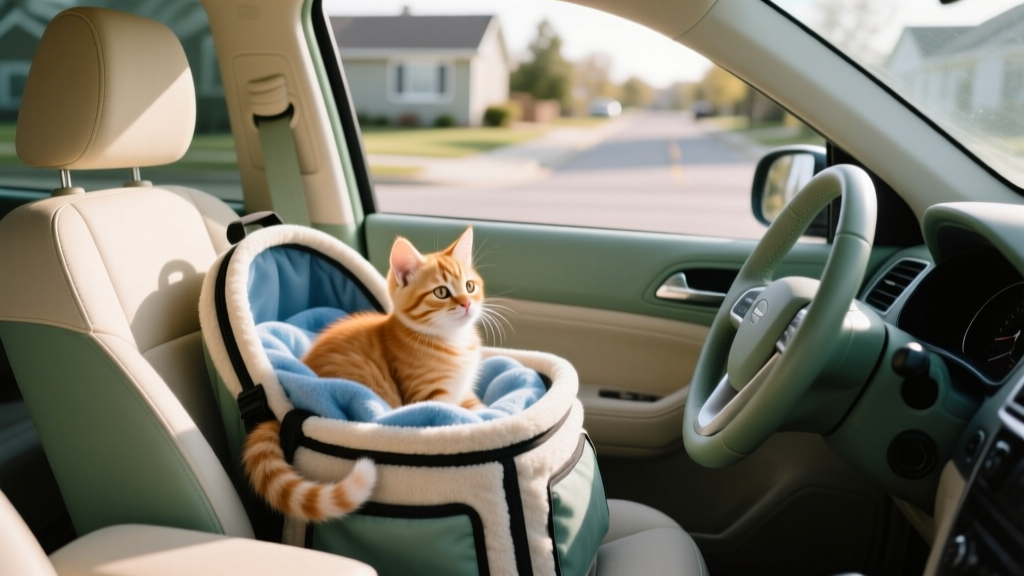
Once your kitten enters the carrier willingly and eats calmly inside with the door closed for 2+ minutes, it’s time to bring in the vehicle—but keep it parked, silent, and cool. Choose a shaded spot on a mild day (never hot asphalt—car interiors hit 120°F in 10 minutes). Bring treats, a familiar blanket, and a calming pheromone diffuser (Feliway Classic spray applied to the carrier 15 minutes prior is clinically shown to reduce cortisol levels by up to 37%, per a 2021 University of Lincoln trial).
Follow this sequence over 3–5 sessions (each spaced at least 24 hours apart):
- Place carrier in back seat, door open. Sit nearby and offer treats through the mesh.
- Close carrier door for 30 seconds while offering high-value treats (e.g., tuna paste or freeze-dried chicken).
- Start the engine—do not move the car. Let it idle for 15 seconds. If your kitten stays relaxed (ears forward, breathing steady), reward generously. If they vocalize or cower, turn off the engine immediately and end the session.
- Gradually increase idle time to 2 minutes across sessions—only advancing when zero signs of distress appear.
Pro tip: Never force your kitten into the car. If they retreat, calmly remove the carrier and try again tomorrow. Patience here builds trust; coercion erodes it.
Step 3: Short, Purposeful Trips (Under 2 Minutes)
When your kitten tolerates 2 minutes of idling without stress signals, it’s time for movement—but not destination-driven travel. Your first ‘drive’ should have no purpose other than motion. Back out of the driveway, drive slowly down the block, and return home. Keep speed under 15 mph. Why so short? Because motion triggers vestibular stress—especially in young kittens whose inner ear development isn’t fully mature until ~16 weeks. Their brains literally interpret acceleration as falling.
A real-world example: Maya, a foster coordinator in Portland, worked with a 10-week-old orphaned kitten named Pip who vomited and trembled on his first 30-second drive. She paused all motion work for 5 days, doubled her stationary idling sessions, added ginger-infused water (vet-approved for mild nausea), and introduced slow rocking in the carrier using a rocking chair before reintroducing car motion. Pip completed his first 90-second loop without incident on Day 12.
Key success markers before progressing:
- No panting, drooling, or excessive grooming
- Body remains loose—not rigid or hunched
- May sleep or purr during the ride (a strong sign of safety)
Each trip should be followed by a calm, rewarding activity—like gentle brushing or interactive play—not immediate release from the carrier (which reinforces ‘carrier = freedom’ instead of ‘carrier = safety’).
Step 4: Building Duration & Handling Real-World Variables
Once your kitten handles 3–5 successful 2-minute drives, extend duration by no more than 30 seconds per session—and only after three consecutive stress-free trips. Simultaneously, introduce variables one at a time:
- Time of day: Try a ride at dusk if all prior sessions were midday.
- Passenger presence: Add a quiet, calm person in the front seat (no talking or eye contact with kitten).
- Carrier placement: Move from back seat floor to secured seatbelt harness or cargo area (if using a larger crate).
- Sound variation: Introduce soft music or rain sounds—never sudden noises like honking or sirens.
Crucially: Always end sessions on a positive note—even if it means cutting a trip short. Ending in stress resets progress. As Dr. Mikel Delgado, certified cat behavior consultant and researcher at UC Davis, emphasizes: "Consistency in ending with calm is more predictive of long-term success than total session length."
| Step | Action | Tools/Prep Needed | Max Duration/Repetition | Success Indicator |
|---|---|---|---|---|
| 1 | Carrier familiarity & feeding inside | Familiar blanket, cat-safe treats, pheromone spray | 7–10 days; 2–3 sessions/day | Kitten enters voluntarily & eats 3+ meals inside with door closed ≥2 min |
| 2 | Stationary car + engine idling | Cool shaded parking spot, Feliway spray, treat pouch | 3–5 sessions; max 2 min idle time | No vocalization, ears upright, normal blink rate |
| 3 | Micro-motion drives (≤2 min) | Low-speed neighborhood route, ginger water (vet-approved), quiet environment | 3–5 trips; +30 sec/session only after 3 clean runs | Relaxed posture, occasional purring, no vomiting or trembling |
| 4 | Variable integration & duration extension | Seatbelt carrier harness, white noise app, passenger briefing sheet | 1 new variable per 3 sessions; max +1 min/trip weekly | Consistent calm across 3+ different conditions (time, sound, passenger) |
Frequently Asked Questions
Can I use sedatives or CBD oil to calm my kitten for car rides?
Not without veterinary supervision—and rarely recommended for kittens under 16 weeks. Sedatives like gabapentin require precise dosing based on weight, kidney function, and concurrent medications. Over-the-counter CBD products lack FDA regulation, and studies show inconsistent cannabinoid concentrations (a 2022 JAVMA analysis found 22% of pet CBD products contained <10% of labeled CBD). Instead, prioritize behavioral conditioning first. If anxiety persists beyond 4 weeks of consistent training, consult a board-certified veterinary behaviorist—not your general practitioner—for safe, individualized options.
My kitten is already 5 months old—am I too late to start?
No—you’re never too late, but expect longer timelines. Older kittens and young adults retain neuroplasticity, especially with positive reinforcement. However, you’ll likely need 4–8 weeks instead of 2–3. Begin with even slower progression: spend 3–5 days just sitting in the parked car with the carrier open before introducing engine sounds. Reward micro-behaviors (e.g., looking at the carrier, sniffing the door). One case study published in Applied Animal Behaviour Science documented full acclimation in a 7-month-old rescue kitten using clicker training paired with jackpot rewards—completed in 37 days.
What’s the best carrier for car travel with kittens?
Hard-sided, airline-approved carriers with top and front openings (e.g., Petmate Sky Kennel or Sleepypod Air). Why? Soft carriers collapse in crashes, and front-loading only carriers force stressful removal. Top access lets you gently lift your kitten out without squeezing or dragging. Line it with a non-slip mat (like a yoga towel) and secure it with a seatbelt or LATCH system—never let it slide freely. Bonus: Cover ¾ of the carrier with a lightweight, breathable blanket to create a den-like sense of security without restricting airflow.
Should I withhold food before a car ride?
Yes—but strategically. Withhold food for 2–3 hours pre-trip to minimize motion-sickness risk (kittens have sensitive stomachs), but never withhold water. Offer a small lick of plain yogurt or ginger-infused water 30 minutes before departure—both shown to ease gastric upset in felines. Avoid rich treats or new foods within 12 hours of travel.
How do I handle accidents (urination, defecation) in the carrier during training?
Treat it as data—not failure. Urination often signals extreme fear (not potty training issues). Immediately pause training for 2–3 days, revisit Step 1, and add extra Feliway spray. For cleanup: Use enzymatic cleaner (e.g., Nature’s Miracle) — never ammonia-based cleaners, which smell like urine to cats and encourage re-marking. If accidents persist past 3 sessions, consult your vet to rule out underlying medical causes like urinary tract discomfort.
Common Myths
Myth #1: “If I take my kitten on lots of short trips, they’ll get used to it faster.”
False. Flooding—exposing a fearful animal to overwhelming stimuli—increases long-term anxiety and can cause learned helplessness. Research shows kittens subjected to forced, repeated car trips without gradual desensitization developed avoidance behaviors 3x more frequently than those following a structured plan.
Myth #2: “Cats don’t need seatbelts or carrier restraints—they’ll just hold on.”
Dangerously false. In a 30 mph collision, an unrestrained 5-lb kitten becomes a 150-lb projectile (per NHTSA physics modeling). Unsecured carriers shatter on impact. Every reputable feline veterinarian and the American Association of Feline Practitioners strongly recommend carrier anchoring—non-negotiable for safety.
Related Topics (Internal Link Suggestions)
- How to choose the right cat carrier — suggested anchor text: "best cat carrier for car travel"
- Signs of stress in kittens — suggested anchor text: "kitten stress signals to watch for"
- Feline-friendly vet visit preparation — suggested anchor text: "how to make vet visits less scary for cats"
- Using Feliway effectively for kittens — suggested anchor text: "does Feliway work for kittens"
- Ginger for cats with motion sickness — suggested anchor text: "safe natural remedies for car-sick kittens"
Your Next Step Starts Today—Not at the Vet’s Office
You now hold a proven, veterinarian-vetted roadmap—not quick fixes, but lasting change. Remember: every minute spent building calm around the carrier pays dividends in reduced vet bills (fewer sedations), safer relocations, and deeper trust between you and your kitten. Don’t wait for the next emergency or wellness exam to begin. Tonight, leave the carrier out with a treat inside. Tomorrow, sit beside it and offer praise when your kitten sniffs the entrance. Small actions, consistently applied, rewrite neural pathways. Ready to build confidence—not just compliance? Download our free Car Ride Readiness Checklist (with printable progress tracker and vet-approved treat guide) at [YourSite.com/kitten-car-checklist]. Because the safest journey begins long before the engine starts.