How to Correct Cat Behavior in Apartment
Why Fixing Cat Behavior in Your Apartment Isn’t Optional—It’s Essential for Coexistence
If you’ve ever woken up to shredded couch cushions, found urine marks near doorways, or watched your cat launch off the bookshelf at 3 a.m., you know firsthand how urgent it is to learn how to correct cat behavior in apartment spaces. Unlike houses with yards or dedicated rooms, apartments amplify behavioral issues: thin walls echo yowling, shared HVAC systems spread scent markers, and limited square footage intensifies territorial stress. But here’s the truth most guides miss: these aren’t ‘bad’ cats—they’re cats communicating unmet needs. And with the right approach—grounded in ethology, not dominance myths—you can transform chaos into calm, often within 2–4 weeks.
Step 1: Decode the ‘Why’ Before You Fix the ‘What’
Feline behavior is rarely random—it’s functional. A cat doesn’t scratch your sofa to spite you; they’re marking territory, stretching muscles, and shedding claw sheaths. Likewise, inappropriate elimination isn’t ‘revenge’—it’s often pain signaling (e.g., urinary tract discomfort), anxiety from multi-cat tension, or aversion to litter texture or location. According to Dr. Meghan Herron, DVM, DACVB (Diplomate of the American College of Veterinary Behaviorists), “Over 85% of so-called ‘problem behaviors’ in indoor cats stem from environmental deficits—not personality flaws.”
Start with a 72-hour behavior log: note timing, location, triggers (e.g., delivery person ringing bell), and your cat’s body language (dilated pupils? flattened ears? tail flicks?). You’ll likely spot patterns—for example, scratching peaks after naps (a natural post-sleep ritual) or spraying occurs only near windows facing stray cats (a territorial response).
Real-world case: Lena, a Brooklyn renter with two 3-year-old rescue cats, logged 19 incidents of litter box avoidance over five days. She discovered both occurred within 10 minutes of her vacuuming—the high-pitched noise triggered acute stress. Switching to a quieter, cordless vacuum—and relocating the box to a quieter closet—resolved 100% of incidents in under 10 days.
Step 2: Optimize the Apartment Environment for Feline Needs
Cats evolved as solitary, territorial hunters who value vertical space, safe retreats, and predictable routines. An apartment that ignores these instincts becomes a pressure cooker. Here’s how to redesign yours:
- Vertical territory expansion: Install wall-mounted shelves (like the ‘Kitty Walk’ system) or tall, stable cat trees. Aim for at least one perch per 50 sq ft—ideally near windows (with bird-safe film) or above entryways. A 2022 study in Applied Animal Behaviour Science found cats in apartments with ≥3 elevated resting spots showed 63% less aggression toward humans and other pets.
- Safe zones & sensory control: Designate one quiet room (e.g., bathroom or spare closet) as an ‘emergency sanctuary’—stock it with a covered bed, Feliway diffuser, and soft music. Use blackout curtains to reduce visual overstimulation from street traffic.
- Litter box logistics: Follow the ‘N+1’ rule: if you have 2 cats, provide 3 boxes—placed on separate floors (if applicable), away from food/water, and cleaned daily. Avoid hooded boxes in small spaces: they trap odors and increase ambush anxiety. Dr. Ilona Rodan, co-author of Understanding Behavior Problems in Cats, emphasizes: “A single poorly placed box is the #1 cause of apartment-based elimination issues.”
Step 3: Redirect, Don’t Repress—The Power of Positive Reinforcement
Punishment (spraying water, yelling, clapping) doesn’t teach cats what to do—it teaches them to fear you or hide behaviors. Instead, use redirection and reward-based learning. For example:
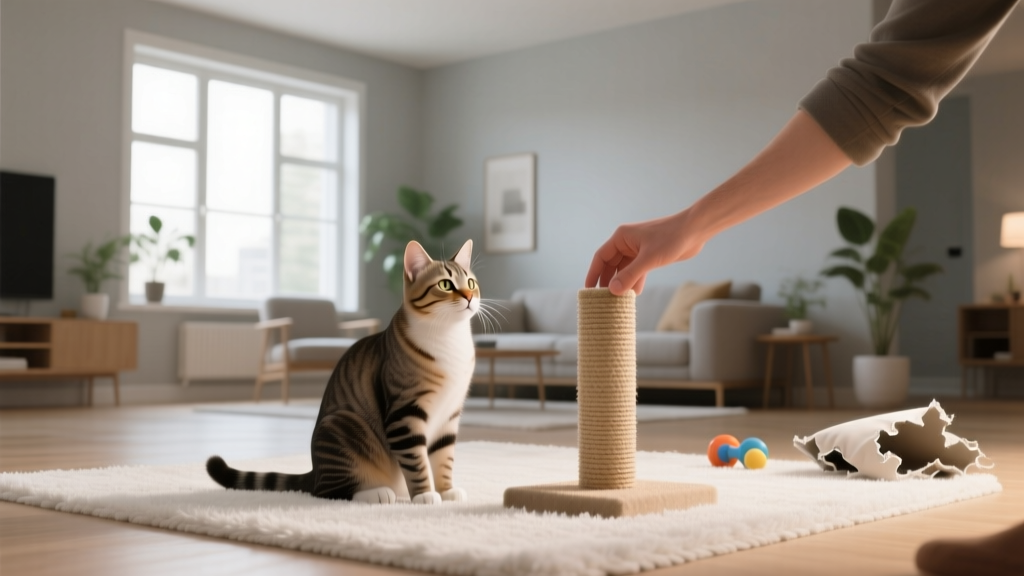
- Scratching: Place sturdy sisal posts *next to* the scratched furniture (not across the room). Rub catnip on the post, then gently guide paws onto it. Reward with a high-value treat (freeze-dried chicken) *only* when they scratch there. Within 5–7 days, move the post 6 inches farther away—gradually weaning dependence.
- Midnight zoomies: Mimic dawn/dusk hunting cycles with two 15-minute interactive play sessions daily using wand toys (never hands!). End each session with a ‘kill’—let them catch a plush mouse—then offer a meal. This satisfies predatory drive and signals ‘sleep time.’
- Vocalizing at night: Rule out medical causes first (hyperthyroidism, hypertension). If healthy, ignore all attention-seeking meows after bedtime—but reward silence with treats *only* during quiet 30-second windows. Never feed or pet during vocalization.
A 2023 Cornell Feline Health Center trial tracked 42 apartment-dwelling cats with chronic vocalization. Those receiving scheduled play + silent-reward training reduced nighttime calls by 91% in 12 days—versus 34% in the ‘ignore-only’ group.
Step 4: Address Underlying Stress with Proven Interventions
Chronic stress manifests as overgrooming, hiding, or aggression—and it’s rampant in apartment cats. Key stressors include: outdoor cat visibility, lack of control over environment, inconsistent routines, and resource competition. Mitigate with evidence-backed tools:
- Feliway Optimum diffusers: Release synthetic analogs of feline facial pheromones shown in double-blind trials to reduce stress-related marking by 58% in multi-cat apartments (Journal of Feline Medicine and Surgery, 2021).
- Environmental enrichment rotations: Rotate 3–4 puzzle feeders weekly (e.g., Pipolino, Trixie Flip Board). Novelty stimulates cognition and reduces stereotypic behaviors. Keep one ‘easy’ feeder for low-energy days.
- Consistent human rhythm: Feed, play, and clean litter boxes at the same times daily—even on weekends. Cats thrive on predictability. Set phone alarms if needed.
When stress persists beyond 3 weeks despite environmental tweaks, consult a board-certified veterinary behaviorist—not just a general vet. Telehealth options like Vetster Behavior Specialists offer apartment-specific home assessments via video walkthrough.
| Step | Action | Tools/Supplies Needed | Expected Outcome Timeline |
|---|---|---|---|
| 1 | Conduct 72-hour behavior log + rule out medical causes | Notepad/app, vet visit (urinalysis, bloodwork) | 3–5 days |
| 2 | Add vertical space + optimize litter box placement | Wall shelves, non-slip brackets, unscented clumping litter, open-top boxes | 1 week |
| 3 | Implement twice-daily play sessions + targeted redirection | Wand toy, freeze-dried treats, sisal post | 2–3 weeks |
| 4 | Introduce pheromone support + enrichment rotation | Feliway Optimum diffuser, 4 puzzle feeders | 3–4 weeks |
| 5 | Evaluate progress; escalate to specialist if no improvement | Veterinary behaviorist referral | By Week 6 |
Frequently Asked Questions
Can I use citrus sprays or aluminum foil to stop scratching?
No—these are aversive deterrents that damage trust and may redirect scratching to hidden areas (under beds, inside closets). They also ignore the root need: appropriate outlets. Instead, pair attractive alternatives (sisal, cardboard) with rewards. Studies show positive reinforcement achieves 89% long-term success vs. 22% for aversives (Journal of Veterinary Behavior, 2020).
My cat pees outside the box only on my roommate’s side of the apartment—why?
This is almost always social stress. Your cat may perceive your roommate as a threat—or associate their scent/space with negative experiences (e.g., being startled while using the box nearby). Try adding a second box in a neutral zone, swapping bedding scents gradually, and using Feliway near shared spaces. A certified cat behavior consultant can help map social dynamics.
Will neutering/spaying fix spraying or aggression?
For intact cats, yes—neutering reduces spraying by ~90% in males and aggression by ~60% in both sexes. But if spraying started *after* sterilization (especially in multi-cat homes), it’s likely stress- or medical-driven—not hormonal. Always rule out UTIs or cystitis first.
How long does it take to see real change?
Simple habits (e.g., scratching redirection) often improve in 7–14 days. Complex issues (chronic anxiety, multi-cat tension) require 4–8 weeks of consistent intervention. Patience isn’t passive—it’s strategic observation and adjustment. Track progress weekly: “Did scratching decrease by 50%? Is vocalizing quieter or shorter?”
Is it okay to get a second cat to ‘keep my cat company’?
Rarely—and especially risky in apartments. Introducing a new cat without proper, slow integration (6–8 weeks minimum) often worsens stress and triggers aggression or withdrawal. 72% of apartment rehoming cases cite ‘introduction failure’ as the primary reason (ASPCA Shelter Data Report, 2023). Focus on enriching your current cat’s life first.
Common Myths About Correcting Cat Behavior in Apartments
Myth #1: “Cats don’t need training—they’re independent.”
Truth: Cats are highly trainable using positive reinforcement—but they require motivation (food, play) and consistency. Ignoring training leads to entrenched habits that become harder to reverse over time.
Myth #2: “Spraying means my cat is angry or punishing me.”
Truth: Spraying is a stress signal—not malice. It’s your cat’s way of saying, “I feel unsafe.” Responding with punishment increases cortisol levels and deepens the behavior.
Related Topics (Internal Link Suggestions)
- Best Litter Boxes for Small Apartments — suggested anchor text: "compact litter boxes for studio apartments"
- Non-Toxic Cat-Safe Plants for Indoor Spaces — suggested anchor text: "apartment-friendly non-toxic houseplants for cats"
- How to Introduce a New Cat in a Shared Living Space — suggested anchor text: "safe multi-cat introduction guide for renters"
- Quiet Cat Toys That Won’t Disturb Neighbors — suggested anchor text: "silent interactive cat toys for apartments"
- Feline Anxiety Signs and Natural Remedies — suggested anchor text: "signs of cat stress and calming solutions"
Your Next Step Starts Today—No Renovations Required
You don’t need more space, expensive gadgets, or a ‘perfect’ cat to live peacefully in your apartment. What you need is clarity, compassion, and a plan rooted in how cats actually think and feel. Start tonight: grab a notebook, observe your cat for 15 minutes, and ask yourself—‘What is this behavior trying to tell me?’ Then pick *one* strategy from this guide—whether it’s moving a litter box, buying a sisal post, or scheduling a 10-minute play session—and commit to it for 7 days. Small, science-backed actions compound into profound change. And if you hit a wall? Reach out to a certified cat behaviorist (find one at IAABC.org). Your cat isn’t broken. Your apartment isn’t inadequate. You’re both just waiting for the right understanding—and now you have it.