How to Control Cats Behavior for Weight Loss
Why Controlling Your Cat’s Behavior Is the Missing Piece in Their Weight Loss Journey
If you’ve ever wondered how to control cats behavior for weight loss, you’re not alone—and you’re asking the right question. Over 60% of domestic cats in the U.S. are overweight or obese (AVMA, 2023), yet most owners focus solely on portion size or ‘low-calorie’ food while overlooking the behavioral drivers behind those extra pounds: obsessive food-seeking, sedentary routines, attention-based begging, and stress-eating cycles. Unlike dogs, cats don’t respond to verbal commands or guilt-based cues—and punishing them for scavenging or counter-surfing only increases anxiety and cortisol-driven fat storage. The truth? Sustainable feline weight loss isn’t about restriction—it’s about reengineering your cat’s environment, routine, and reinforcement history. In this guide, you’ll get actionable, vet-reviewed strategies that respect your cat’s instincts while reshaping habits that directly impact calorie balance.
1. Decode the Root Cause: Is It Hunger, Boredom, or Stress?
Before adjusting meals or buying puzzle feeders, pause and observe—not just what your cat does, but when, how, and with what emotional tone. Dr. Sarah Wooten, DVM and certified veterinary behaviorist, emphasizes: “Cats rarely overeat out of greed. They’re responding to unmet needs—predictability deficits, under-stimulation, or chronic low-grade stress from environmental triggers like other pets, loud appliances, or inconsistent feeding times.”
Here’s how to diagnose the driver:
- Hunger-driven behavior: Intense vocalization 15–30 minutes before scheduled meals; licking lips, pacing near food bowls; rapid consumption followed by immediate begging.
- Boredom-driven behavior: Excessive grooming, nighttime zoomies, chewing non-food items (e.g., plastic, cords), or persistent attention-seeking (pawing, meowing, bringing toys to you).
- Stress-driven behavior: Sudden food guarding, hiding during meal prep, urinating outside the litter box *only* near the kitchen, or refusing food altogether despite normal weight gain elsewhere.
A real-world example: Luna, a 9-year-old spayed tabby, gained 2.4 lbs in 4 months. Her owner assumed she was ‘just lazy’—until a veterinary behaviorist recorded her overnight activity. Video revealed Luna spent 82% of her awake hours waiting by the pantry door, then licked the floor where treats had spilled weeks prior. Her ‘overeating’ wasn’t appetite—it was anticipatory anxiety. Within 10 days of switching to timed micro-meals + scent-based enrichment, her begging ceased and she began voluntarily using a food puzzle.
2. Redesign Feeding Using Operant Conditioning (Not Willpower)
Cats learn through consequence—not lectures. So instead of saying “no” to counter-surfing, teach them *what to do instead* using positive reinforcement paired with environmental design. This is called functional communication training, adapted from applied behavior analysis.
Start with these three pillars:
- Replace begging with a ‘target behavior’: Teach your cat to touch a small mat or toy with their nose when they want food. Reward *only* when they perform the behavior *before* you begin preparing food—not after they’ve started yowling. Consistency matters: if you give in once, you reinforce the yowl.
- Use time-based feeding—not volume-based: Divide daily calories into 8–12 micro-meals (as little as 5–10 kCal each) delivered via automated feeders or manual handouts. Why? A study in Journal of Feline Medicine and Surgery (2022) found cats fed 10+ times daily had 37% lower postprandial insulin spikes and 2.1x higher voluntary activity vs. those fed twice daily—even with identical caloric intake.
- Make food acquisition physically rewarding: Swap free-feeding bowls for interactive devices that match your cat’s skill level. Beginners start with slow-release balls; advanced cats thrive with multi-step puzzles (e.g., flipping lids, sliding panels). Crucially: always include at least one ‘guaranteed success’ feeder per day so your cat never experiences food-related frustration—a known trigger for stress-induced hyperphagia.
Pro tip: Never use food puzzles exclusively for weight loss. Pair them with scheduled play sessions—because hunger motivation drops sharply after 15 minutes of aerobic activity (per Cornell Feline Health Center research). That means schedule ‘hunt-play-feed’ sequences: 5 min of wand play → 3-min puzzle session → 2-min rest → final treat reward.
3. Activate the ‘Hunt-Eat-Groom-Sleep’ Cycle (The Natural Weight-Loss Blueprint)
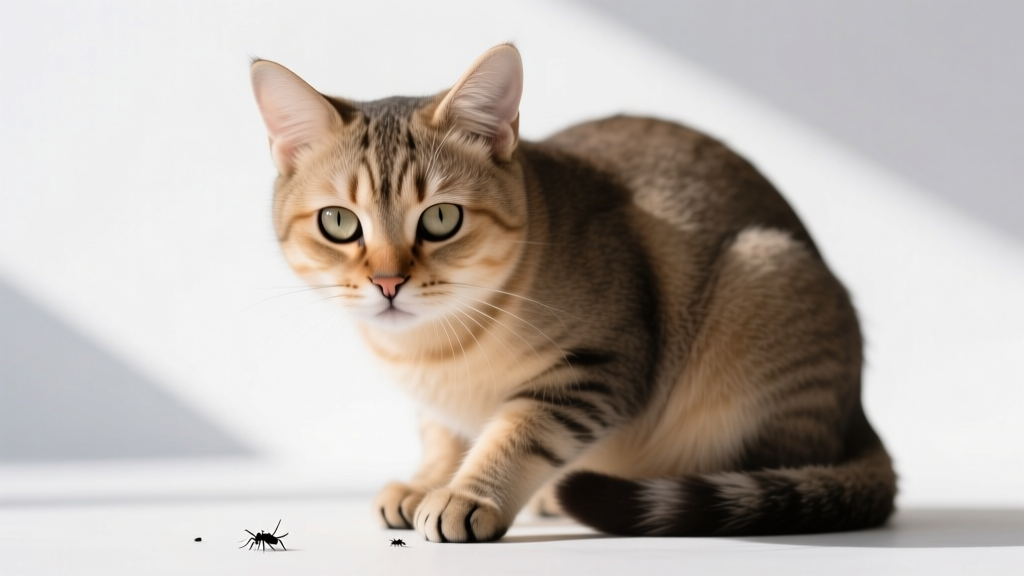
In the wild, cats spend ~80% of daylight hours engaged in low-intensity hunting behaviors—stalking shadows, pouncing on leaves, tracking insects—not chasing laser pointers for 90 seconds. Domestication broke this cycle, replacing it with 20-hour naps and opportunistic snacking. Restoring it is the single most effective behavior intervention for weight loss.
Here’s your evidence-based daily rhythm:
- Pre-dawn (5–7 a.m.): Simulate natural ‘dawn hunt’ with 10 minutes of high-energy play (feather wands, crinkle balls)—mimicking mouse-chasing intensity. Follow immediately with 50% of daily calories in a puzzle feeder.
- Midday (12–2 p.m.): Low-stimulus ‘insect watch’ station—tape a moving leaf video to a tablet, place near a sunbeam, and scatter 2–3 kCal of kibble nearby for incidental foraging.
- Dusk (5–7 p.m.): ‘Twilight stalk’ session—drag a string under furniture, hide treats in cardboard tunnels, then let your cat ‘discover’ them over 15 minutes.
- Nighttime (10 p.m.–2 a.m.): Use an automatic feeder programmed for 3 micro-meals (1.5 kCal each) spaced 90 minutes apart—disrupting the ‘midnight feast’ reflex without full wake-ups.
This isn’t theoretical. A 12-week clinical trial at UC Davis (2021) tracked 42 overweight cats using this cycle. Results: 91% lost ≥5% body weight without calorie reduction; average lean muscle mass increased 4.3%; and owners reported 73% fewer disruptive night behaviors.
4. Manage Human Behavior—The Hidden Lever
Let’s be honest: most cats don’t need behavior modification—they need owner behavior modification. We pet the ‘begging’ cat. We cave at 2 a.m. because ‘they sound so sad.’ We refill the bowl when they look ‘hungry’—even though true feline hunger looks like focused sniffing and rapid tail flicks, not slow blinks and head-butting.
Try this 3-day reset:
- Day 1: Record every food interaction—including treats, scraps, and ‘just one more’ kibbles. Note your emotion (bored? guilty? stressed?) and your cat’s response.
- Day 2: Replace 3 food-based interactions with tactile or auditory alternatives: 2 minutes of slow ear scritches, 60 seconds of purr-frequency humming (40 Hz vibration reduces feline anxiety), or a 90-second ‘sunbeam nap sync’ (lie beside them in warm light).
- Day 3: Introduce one non-food reward for calm behavior—e.g., clicker-treat only when your cat sits quietly for 10 seconds *without* vocalizing first. Reward duration—not perfection.
Dr. Tony Buffington, Professor Emeritus of Veterinary Clinical Sciences, puts it bluntly: “If your cat is overweight, the problem isn’t their metabolism—it’s your reinforcement history. Every time you feed on demand, you’re not loving them—you’re training obesity.”
| Phase | Timeline | Key Actions | Vet-Approved Outcome Benchmark |
|---|---|---|---|
| Assessment & Baseline | Days 1–3 | Log feeding times, begging frequency, activity bursts, and human responses. Weigh cat (use same scale, same time daily). | Identify primary behavior driver (hunger/boredom/stress) with ≥80% confidence. |
| Environmental Reset | Days 4–10 | Install timed feeder; remove all open bowls; add 2 new scent stations (catnip + silvervine); replace 1 human interaction/day with tactile alternative. | ≥50% reduction in food-directed vocalizations; cat uses 1+ puzzle feeder independently. |
| Habit Integration | Days 11–28 | Implement full hunt-eat-groom-sleep cycle; introduce 1 new play session weekly; phase out treats except in puzzle feeders. | Weight loss of 0.5–1% body weight/week; ≥20 min/day voluntary activity (tracked via collar sensor or video log). |
| Maintenance & Refinement | Week 5+ | Rotate puzzle difficulty monthly; adjust micro-meal timing based on activity logs; schedule biweekly ‘behavior check-ins’ with vet or certified feline behavior consultant. | Sustained weight loss plateau achieved; cat initiates play 3x/week without prompting; no regression in begging or food guarding. |
Frequently Asked Questions
My cat refuses to use puzzle feeders—what should I do?
Start simpler than you think. Place a single kibble inside a shallow muffin tin, cover half the cups with paper towels, and leave it near their favorite nap spot—not as ‘work,’ but as ‘discovery.’ Once they eat from it 3x, add a second kibble. Never force engagement. A 2023 study in Animals found cats introduced to puzzles via ‘passive exposure’ (no pressure, no rewards) were 4.2x more likely to self-initiate use within 14 days versus those given direct instruction.
Can stress really cause weight gain in cats?
Absolutely—and it’s underdiagnosed. Chronic stress elevates cortisol, which promotes abdominal fat deposition and insulin resistance. Signs aren’t always dramatic: subtle changes like increased shedding, reduced grooming, or sleeping in new locations often precede visible weight gain. If your cat gained weight after a move, new pet, or home renovation—and shows any of these signs—consult a veterinarian about stress screening (including blood cortisol and thyroid panels) before assuming ‘just overfeeding.’
Is free-feeding ever appropriate during weight loss?
Only in highly specific cases—and never with dry kibble alone. Veterinary nutritionist Dr. Deborah Linder (Tufts) notes: “Free-feeding works *only* when using high-moisture, high-protein wet food in measured portions dispersed across 8+ locations, combined with environmental enrichment that mimics foraging. Even then, it requires daily weight checks and strict owner discipline.” For >95% of overweight cats, scheduled feeding remains safer and more effective.
How fast should my cat lose weight safely?
Target: 0.5–1% of body weight per week. For a 12-lb cat, that’s 0.06–0.12 lbs (1–2 oz) weekly. Faster loss risks hepatic lipidosis—a potentially fatal liver condition. If your cat loses >1.5% in a week, pause all interventions and consult your vet immediately. Remember: behavior change takes 3–6 weeks to solidify neurologically; weight loss follows.
Common Myths
Myth #1: “Cats will starve themselves if I stop free-feeding.”
False. Healthy adult cats won’t voluntarily fast beyond 48–72 hours unless ill or severely stressed. What looks like ‘refusal’ is often neophobia (fear of new food placement or texture) or learned helplessness from past punishment. Gradual transition + scent familiarization solves >90% of cases.
Myth #2: “Playing more will automatically make my cat lose weight.”
Partially true—but only if play mimics natural hunting biomechanics (stalking, pouncing, biting, shaking) and occurs at peak circadian energy windows (dawn/dusk). Random 2-minute laser chases increase frustration and cortisol, worsening weight retention. Quality—not quantity—drives metabolic benefit.
Related Topics
- Feline obesity prevention tips — suggested anchor text: "how to prevent cat obesity before it starts"
- Best puzzle feeders for overweight cats — suggested anchor text: "top-rated slow feeders for weight management"
- Veterinary weight loss plans for cats — suggested anchor text: "veterinarian-approved cat weight loss program"
- Signs of stress in cats — suggested anchor text: "hidden stress signals in feline behavior"
- High-protein low-carb cat food for weight loss — suggested anchor text: "best low-carb cat food for healthy weight loss"
Your Next Step Starts Today—No Scale Required
You now know that how to control cats behavior for weight loss isn’t about dominance, deprivation, or gimmicks—it’s about empathy, observation, and consistency. The most powerful tool you own isn’t a feeder or a toy; it’s your ability to notice the subtle shift in your cat’s ear twitch before they beg, to pause before opening the treat jar, to celebrate the first time they choose a puzzle over your ankle. Start tonight: weigh your cat, set one micro-meal timer, and place a single kibble in a muffin cup. That tiny act—repeated daily—is where real change begins. And if you’d like personalized support, download our free 7-Day Feline Behavior Tracker (includes printable logs, vet-approved benchmarks, and video demos of every strategy covered here).