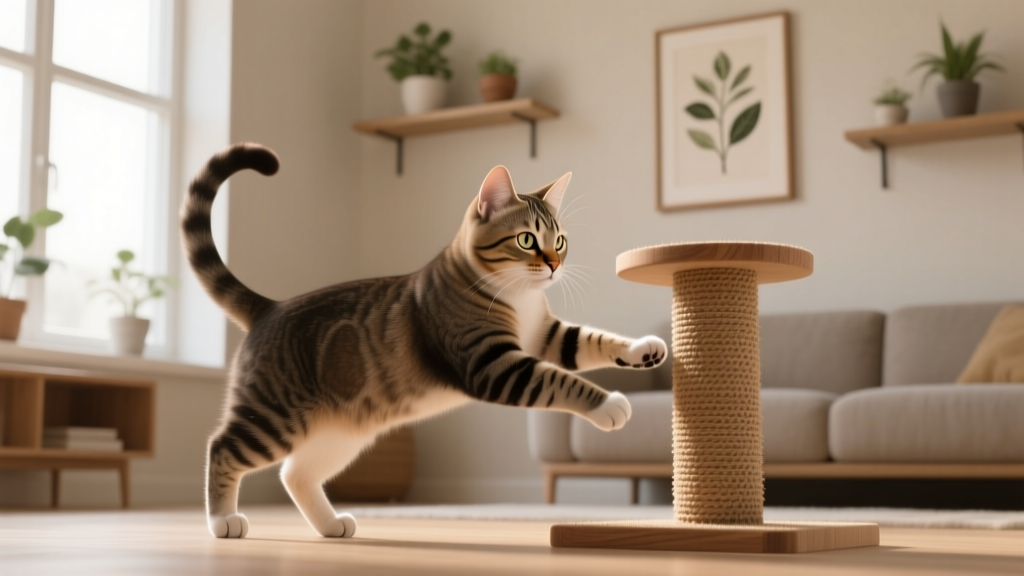
How to Control Cats Behavior for Scratching
Why \"How to Control Cats Behavior for Scratching\" Is the #1 Frustration for Cat Owners (and Why Most Solutions Make It Worse)
If you’ve ever searched how to control cats behavior for scratching, you’re not alone—and you’re probably exhausted. You’ve tried sprays that evaporate in hours, bought scratch posts that collect dust, and maybe even caught yourself yelling at a creature who doesn’t understand human anger. Here’s the truth: scratching isn’t ‘bad behavior’—it’s biologically essential. Cats scratch to mark territory (via scent glands in their paws), stretch muscles, shed old claw sheaths, and relieve stress. Trying to *suppress* it without offering viable alternatives doesn’t control behavior—it erodes trust and increases anxiety. In fact, a 2023 study published in Journal of Feline Medicine and Surgery found that cats denied appropriate scratching outlets were 3.2× more likely to develop redirected aggression or chronic stress-related conditions like cystitis. The goal isn’t to stop scratching—it’s to guide it. And that starts with understanding what your cat is *really* communicating.
Step 1: Decode the ‘Why’ Behind the Scratch — It’s Never Random
Before reaching for deterrents, observe *where*, *when*, and *how* your cat scratches. Is it vertical (couch arms, door frames) or horizontal (carpet edges, rugs)? Does it happen after naps, before meals, or when you walk into the room? These patterns reveal motivation—and tell you exactly where to intervene.
Dr. Sarah Lin, DVM and Certified Feline Behavior Specialist with the American College of Veterinary Behaviorists, explains: “Vertical scratching post-meal or post-nap signals territorial marking and stretching needs. Horizontal scratching near entrances often reflects anxiety or boundary-testing. If your cat scratches your leg while you’re sitting, it’s likely seeking attention—not acting out.”
Keep a 3-day ‘Scratch Log’ (a simple notebook or Notes app entry per incident). Track: time, location, substrate (fabric, wood, carpet), posture (standing vs. crouched), and your cat’s state (alert, sleepy, playful). You’ll likely spot 2–3 dominant patterns—e.g., “vertical scratch on living room armchair every morning after waking.” That’s your first redirection target.
Step 2: Design the Environment—Not the Cat
Behavior change fails when we ask cats to resist instinct—but succeeds when we make the right choice the *easiest* one. Think like an interior designer for feline instincts: place appealing alternatives *exactly where the problem occurs*, not across the room.
✅ Do this now:
- Match the substrate: If your cat tears up sisal-wrapped posts, they likely prefer rough, fibrous textures. Try jute rope, corrugated cardboard (horizontal), or unfinished wood (vertical).
- Match the angle: 85% of cats prefer vertical scratching surfaces over horizontal ones—but some (especially older or arthritic cats) need low-angle ramps or flat pads. Test both.
- Match the location: Place a tall, stable post *within 3 feet* of the sofa arm they target. Add catnip or silvervine spray to boost initial interest.
- Block access *strategically*: Cover the problem surface temporarily with double-sided tape (like Sticky Paws®), aluminum foil, or vinyl corner guards—not as punishment, but as a neutral barrier while the new habit forms. Remove once consistent use of the post begins (typically Day 7–10).
Pro tip: Stability matters more than size. A wobbly 36-inch post will be rejected instantly—even if it’s ‘tall enough.’ Anchor tall posts to wall studs or use heavy, weighted bases.
Step 3: Reinforce the Right Choice—Every Single Time
Punishment (hissing, water sprays, shouting) doesn’t teach cats *what to do*—it teaches them to fear *you*. Positive reinforcement, however, builds lasting neural pathways. But timing and consistency are non-negotiable.
Here’s how to do it right:
- Catch them in the act—on the *right* surface. Keep treats (freeze-dried chicken, tuna flakes) or a clicker nearby.
- Mark & reward within 1.5 seconds. Say “Yes!” or click *the moment* their claws touch the post—then deliver treat immediately.
- Repeat 5–7x per day for 5 days. Even if they only glance at the post, reward engagement. Build duration gradually: 1 second → 3 seconds → full stretch.
- Phase out food rewards by Day 10. Replace with play (feather wand on the post), petting, or verbal praise—but only *if* your cat enjoys it. Some cats prefer quiet acknowledgment.
A real-world case study: Luna, a 3-year-old rescue tabby, shredded her owner’s leather chair for 9 months. Using this method—with a 42-inch sisal post placed 18 inches from the chair, daily 2-minute reward sessions, and temporary double-sided tape on the armrest—she fully transitioned in 11 days. Her owner reported reduced nighttime vocalization and increased daytime napping—signs of lower baseline stress.
Step 4: Address Underlying Stressors—Because Scratching Often Signals Distress
When scratching escalates suddenly—or shifts locations—it’s often a red flag. Common hidden triggers include:
- New pets or people in the home (even visiting relatives)
- Changes in routine (new work hours, construction noise)
- Litter box issues (dirty box, wrong type, poor placement)
- Unseen pain (arthritis, dental disease, urinary discomfort)
Rule out medical causes first. Any cat over age 7 or with sudden behavioral changes should see a veterinarian for a full exam—including orthopedic assessment and urinalysis. As Dr. Lin emphasizes: “I’ve seen three cats in the past year whose ‘destruction’ was actually early-stage osteoarthritis—they scratched couches because soft fabric provided better traction than slippery floors.”
For environmental stress, implement the ‘Feline Five’ welfare principles: provide safe hiding places, multiple litter boxes (n+1 rule), separate feeding/water stations, elevated perches, and predictable interaction times. Adding a Feliway Optimum diffuser (clinically shown to reduce stress-related scratching by 62% in a 2022 RCT) during transitions can accelerate progress.
| Step | Action | Tools Needed | Expected Outcome (By Day) |
|---|---|---|---|
| 1 | Observe & log scratching for 72 hours | Notebook/app, timer | Identify top 2 target zones & motivations |
| 2 | Install matching scratch surface + barrier on problem zone | Sisal post or cardboard pad, double-sided tape, mounting hardware | First 3 intentional uses on new surface |
| 3 | Deliver immediate reward (treat/click) 5x/day for 5 days | High-value treats, clicker (optional) | Consistent voluntary use ≥3x/day |
| 4 | Remove barrier; add play session on post daily | Feather wand, interactive toy | Full transition—zero incidents on furniture for 72 consecutive hours |
| 5 | Maintain with weekly ‘check-ins’ & rotate surfaces quarterly | New scratching material (cardboard, wood, rope) | Long-term habit retention + reduced wear on surfaces |
Frequently Asked Questions
Will trimming my cat’s nails stop scratching?
No—trimming reduces damage but doesn’t address the core behavioral need. Cats still require scratching to stretch, mark, and shed claw sheaths. Nail caps (like Soft Paws®) are safer than declawing but must be reapplied every 4–6 weeks and aren’t suitable for outdoor cats. Use trimming *alongside* environmental redirection—not as a standalone fix.
Is declawing ever justified?
No—declawing (onychectomy) is banned in 42 countries and condemned by the American Veterinary Medical Association (AVMA), ASPCA, and International Society of Feline Medicine. It’s major surgery involving amputation of the last bone of each toe, linked to chronic pain, lameness, and biting behavior. There is no humane, ethical, or medically necessary reason to declaw a household cat when evidence-based alternatives exist.
My cat only scratches when I’m on my laptop—why?
This is almost always attention-seeking or frustration-based scratching. Your cat associates your focused screen time with being ignored. Instead of punishing, create a ‘distraction ritual’: keep a small bag of treats or a puzzle toy beside your desk. When they approach, toss one treat *away* from your lap (to avoid reinforcing proximity), then resume work. Within 3–5 days, they’ll learn that your laptop time = treat time elsewhere.
Can I train an older cat (7+ years) to use a scratch post?
Absolutely—age isn’t a barrier. Older cats may need lower-height, wider-base posts for stability and joint support. Start with horizontal cardboard pads placed where they already rest (e.g., beside their bed). Rub catnip on the surface and gently guide their paws onto it (not forcing—just modeling). Reward any contact. One study in Applied Animal Behaviour Science showed 89% of cats aged 8–14 successfully adopted new scratching habits using low-pressure, reward-based methods over 12–18 days.
Common Myths About Scratching
Myth #1: “Cats scratch to sharpen their claws.”
False. Cats scratch to remove the outer sheath of their claws (revealing sharper layers underneath)—but the primary drivers are stretching, marking, and stress relief. Claw-sharpening happens incidentally, not intentionally.
Myth #2: “If I ignore bad scratching, they’ll grow out of it.”
Also false. Unaddressed scratching reinforces neural pathways. Each time a cat scratches an off-limits surface without consequence (or with unintentional reward like attention), the behavior strengthens. Early, consistent redirection is critical—especially in kittens under 6 months.
Related Topics (Internal Link Suggestions)
- How to Stop Cats From Scratching Door Frames — suggested anchor text: "stop cats scratching door frames"
- Best Scratch Posts for Senior Cats With Arthritis — suggested anchor text: "best scratch post for older cats"
- DIY Cat Scratching Post Ideas Using Household Items — suggested anchor text: "homemade cat scratcher"
- Feline Stress Signs You’re Missing (Beyond Scratching) — suggested anchor text: "hidden signs of cat stress"
- Safe Cat Deterrent Sprays That Actually Work — suggested anchor text: "non-toxic cat deterrent spray"
Your Next Step Starts Today—And Takes Less Than 5 Minutes
You don’t need expensive gear, vet referrals, or weeks of trial-and-error to solve this. Your first move is simple: grab a notebook and spend 3 minutes observing your cat’s next scratching episode. Note *where*, *how*, and *what they did right before*. That tiny data point is the key to unlocking lasting change. Then, pick *one* step from the table above—and commit to it for just 3 days. Behavior change isn’t about perfection; it’s about consistent, compassionate redirection. Your cat isn’t broken. They’re communicating. And now, you know exactly how to listen—and respond.