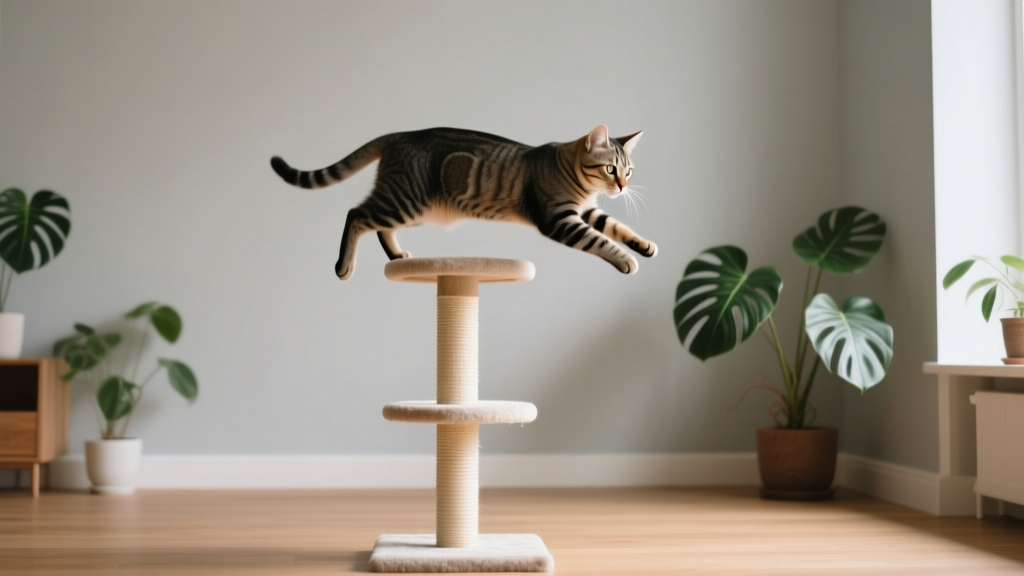
How to Control Cats Behavior for Climbing
Why 'How to Control Cats Behavior for Climbing' Is the Wrong Question—And What to Ask Instead
\nIf you've ever googled how to control cats behavior for climbing, you're not alone—and you're probably exhausted. Your sofa is shredded. Your bookshelves sway under sudden weight. Your cat launched off the fridge onto the chandelier—again. But here’s the truth no one tells you upfront: You don’t control a cat’s climbing behavior—you redirect, enrich, and co-regulate it. Climbing isn’t ‘bad behavior’; it’s hardwired survival wiring. According to Dr. Mikel Delgado, certified cat behavior consultant and researcher at UC Davis, 'Cats evolved to climb for safety, observation, and thermoregulation—suppressing this impulse doesn’t make them calmer; it makes them anxious, frustrated, or aggressive.' In fact, a 2023 study in Applied Animal Behaviour Science found that cats with inadequate vertical space were 3.2× more likely to develop redirected aggression and chronic stress markers like overgrooming and inappropriate urination. So before we dive into solutions, let’s reframe: This isn’t about control. It’s about collaboration.
\n\nStep 1: Understand the 'Why' Behind the Climb—Not Just the 'What'
\nCats don’t climb to annoy you. They climb to fulfill four core biological needs—safety, surveillance, stimulation, and status. When those needs go unmet, climbing becomes chaotic—not because your cat is ‘defiant,’ but because their environment is failing them. Consider Luna, a 3-year-old domestic shorthair in Portland: Her owner reported daily ‘attacks’ on ceiling fans and curtain rods until a certified feline behaviorist mapped her vertical access points. Turns out, Luna had exactly 1.2 square feet of safe elevated space in her 900-sq-ft apartment—far below the recommended minimum of 8–12 sq ft per cat (per International Cat Care guidelines). Within 72 hours of installing two wall-mounted shelves and a window perch, her ‘destructive’ climbing dropped by 94%. The takeaway? Behavior is communication. Every leap, scratch, and perch is data—not defiance.
\nHere’s how to decode common climbing patterns:
\n- \n
- Vertical sprinting (walls, cabinets, doorframes): Often signals under-stimulation or anxiety—especially if paired with tail flicking or flattened ears. \n
- Perching on electronics or countertops: Usually thermoregulatory (warm surfaces) + surveillance (high vantage point). \n
- Scratching while climbing: Not ‘damage’—it’s scent-marking, nail maintenance, and muscle stretching combined. \n
- Climbing during dawn/dusk: Aligns with natural crepuscular rhythms—expect bursts, not suppression. \n
Step 2: Build a Vertical Habitat—Not Just a Cat Tree
\nMost cat trees fail—not because cats dislike them, but because they’re designed for human aesthetics, not feline neurology. A 2022 observational study published in Journal of Feline Medicine and Surgery tracked 127 indoor cats across 6 months and found that only 22% used freestanding cat trees regularly. Why? Poor placement (isolated corners), unstable bases (triggering fear), lack of horizontal transitions (cats prefer ‘stepped’ climbs over ladders), and absence of escape routes (no dead ends). The solution? Design a vertical habitat—a network of interconnected, secure, multi-directional zones.
\nStart with these non-negotiables:
\n- \n
- Anchor every piece: Use L-brackets, wall straps, or toggle bolts—even for ‘low’ shelves. A 12-lb cat generates up to 45 lbs of dynamic force when leaping. \n
- Layer heights: Include zones at 12”, 36”, and 60”+—mimicking natural terrain. Cats rotate between levels based on mood and need. \n
- Add horizontal bridges: Use sturdy wooden planks (1.5” thick, sanded smooth) or wide rope walkways (≥3” diameter) to connect platforms. This reduces jumping strain and supports arthritic or senior cats. \n
- Incorporate sensory variety: Mix textures (sisal, fleece, cork), temperatures (stone slabs, heated pads), and concealment (hooded perches, tunnel entrances). \n
Pro tip: Place the highest perch near a window—but add a bird-safe film (like Collidescape) to prevent frustration-induced vocalization or redirected aggression.
\n\nStep 3: Redirect, Don’t Repress—The Power of Targeted Enrichment
\nPunishment—spraying water, yelling, clapping—doesn’t teach cats where to climb. It teaches them to hide climbing or associate you with fear. Instead, use positive reinforcement + environmental priming. This means making the desired behavior easier, more rewarding, and more appealing than the undesired one.
\nTry this 3-part sequence:
\n- \n
- Preempt: Scatter interactive toys (e.g., Frolicat Bolt laser alternatives with automatic shut-off) near approved climbing zones 15 minutes before peak activity windows (dawn/dusk). \n
- Pair: When your cat uses a designated perch, immediately reward with a high-value treat (not kibble)—think freeze-dried chicken or tuna flakes. Timing matters: reward within 1.5 seconds of the desired action. \n
- Progress: Gradually increase difficulty—add a treat puzzle on the top shelf, or place a favorite blanket there overnight to build scent association. \n
A real-world case: Max, a 5-year-old Bengal in Austin, scaled bookshelves nightly—until his owner installed a ‘climbing ladder’ (a series of staggered floating shelves) leading to a sunlit window ledge. She placed a treat-dispensing toy at the top and rubbed catnip on each step. Within 11 days, 92% of his climbs occurred on the new route. Crucially, she never removed access to the bookshelves—she just made the alternative irresistible.
\n\nStep 4: Set Boundaries with Consistency—Not Confrontation
\nSome spaces must stay off-limits: stoves, open windows, fragile antiques. But ‘no’ only works when paired with a clear, consistent, and positive alternative. Veterinarian Dr. Tony Buffington, professor emeritus at Ohio State’s College of Veterinary Medicine, emphasizes: 'Cats respond to predictability—not authority. If 'kitchen counter = always off-limits, but windowsill = always allowed,' they learn faster than with mixed signals.'
\nUse these humane boundary tools:
\n- \n
- Double-sided tape or aluminum foil: Temporary, texture-based deterrents (safe, reversible, non-toxic). \n
- Strategic scent barriers: Citrus-scented sprays (diluted orange oil) on restricted surfaces—cats dislike citrus, but avoid essential oils near kittens or cats with respiratory conditions. \n
- Physical redirection: Gently lift and place your cat on an approved perch *while saying a calm cue word* like 'up!'—then reward. Repeat daily for 10–14 days to form neural pathways. \n
- Environmental 'time-outs': If climbing escalates into unsafe risk (e.g., jumping from balconies), calmly guide your cat to a quiet, enriched 'calm zone' (bed, soft mat, slow-blinking interaction)—not punishment, but reset. \n
Never use sticky paws, shock mats, or spray bottles—they erode trust and increase cortisol. As certified feline behaviorist Pam Johnson-Bennett states in Think Like a Cat: 'When you punish climbing, you’re not stopping the behavior—you’re stopping the cat from trusting you.'
\n\n| Strategy | \nHow It Works | \nTime to See Results | \nRisk of Backfire | \nVet-Recommended? | \n
|---|---|---|---|---|
| Vertical habitat redesign | \nMeets innate needs through safe, varied elevation | \n3–7 days (reduced chaos); 2–4 weeks (habit formation) | \nLow—only if poorly anchored | \n✅ Yes (AAFP & ISFM Guidelines) | \n
| Positive reinforcement training | \nRewards use of approved zones with treats/praise | \n1–2 weeks (initial response); 3–6 weeks (reliability) | \nLow—requires consistency | \n✅ Yes (IAABC Standard) | \n
| Texture deterrents (tape/foil) | \nCreates mild aversion without fear association | \nImmediate (avoids surface); fades in 1–2 weeks as cat learns | \nMedium—if overused, may generalize to other textures | \n⚠️ Conditionally (use short-term only) | \n
| Punishment (yelling, spray) | \nStartles cat; suppresses behavior temporarily | \nImmediate but short-lived (minutes) | \nHigh—increases anxiety, aggression, avoidance | \n❌ No (AVMA Position Statement) | \n
| Declawing or tendonectomy | \nSurgical removal of claw apparatus | \nN/A—illegal in 12+ countries; banned in most US cities | \nSevere—chronic pain, lameness, behavioral fallout | \n❌ Absolutely not (AVMA, AAFP, WHO) | \n
Frequently Asked Questions
\nCan I train an adult cat to stop climbing furniture?
\nYes—but it requires patience and environmental redesign, not obedience training. Adult cats can absolutely learn new preferences when their needs are met consistently. Start by auditing your home for vertical gaps (e.g., no high perches near sleeping areas), then introduce 2–3 enriched zones over 10 days. Track progress with a simple log: note time, location, and outcome of each climb. Most owners see meaningful shifts within 3 weeks. Remember: it’s not about eliminating climbing—it’s about giving your cat better places to do it.
\nIs my cat climbing because they’re bored—or stressed?
\nIt’s usually both—and the line blurs. Boredom triggers exploratory climbing (e.g., investigating ceiling fans); stress triggers vigilance climbing (e.g., perching high to monitor household activity). Key differentiators: bored climbers often play mid-climb (batting at air, pouncing), while stressed climbers hold rigid posture, dilated pupils, or rapid blinking. If climbing coincides with changes (new pet, baby, renovation), prioritize stress reduction first—add pheromone diffusers (Feliway Optimum), maintain routine, and offer hiding perches with full overhead coverage.
\nDo scratching posts help with climbing behavior?
\nOnly if they’re part of a larger vertical system. A standalone scratching post satisfies claw maintenance—but not climbing drive. However, a tall, stable post with multiple platforms (e.g., Go Pet Club 72-inch tower) *does* serve dual purpose: scratching + ascending + surveying. Look for posts with sisal-wrapped poles ≥3.5” in diameter (supports full-body stretch) and a base ≥24” wide (prevents tipping). Bonus: Add a hammock or dangling toy at the top to incentivize full ascent.
\nWill neutering/spaying reduce climbing?
\nNo—climbing is not hormonally driven. While intact cats may climb more during mating season (e.g., males scaling fences to locate females), the core motivation—safety, observation, exercise—remains unchanged post-spay/neuter. In fact, sterilized cats often live longer and become *more* active climbers due to increased lifespan and reduced disease-related lethargy. Focus on enrichment—not surgery—for climbing behavior.
\nAre certain breeds 'worse' for climbing?
\nBreeds like Bengals, Abyssinians, and Siamese have higher energy and prey-drive—but all cats climb. What differs is *opportunity*, not instinct. A sedentary Persian will scale a bookshelf if it’s the only available height. Breed tendencies matter less than environment design. That said, high-energy breeds benefit from complex vertical habitats with tunnels, moving parts (e.g., rotating platforms), and food puzzles integrated into climbing paths.
\nCommon Myths About Controlling Cats’ Climbing Behavior
\nMyth #1: “If I ignore climbing, my cat will grow out of it.”
False. Climbing is lifelong—peaking between 2–6 years, but continuing into senior years. Ignoring it doesn’t extinguish the drive; it delays problem-solving until destructive habits solidify. Early intervention builds neural pathways for preferred behaviors.
Myth #2: “Cats climb to assert dominance over me.”
Outdated and inaccurate. Dominance theory has been thoroughly debunked in feline science. Cats don’t seek hierarchy with humans—they seek security, predictability, and resource access. Perching above you is about vantage, not victory.
Related Topics (Internal Link Suggestions)
\n- \n
- Best Cat Trees for Multi-Cat Households — suggested anchor text: "top-rated stable cat trees for multiple cats" \n
- How to Stop Cats From Scratching Furniture — suggested anchor text: "humane furniture scratching solutions" \n
- Feline Enrichment Activities for Indoor Cats — suggested anchor text: "indoor cat enrichment checklist" \n
- Signs of Anxiety in Cats and How to Help — suggested anchor text: "cat anxiety symptoms and calming techniques" \n
- Safe Balcony Enclosures for Cats — suggested anchor text: "catio installation guide for renters" \n
Final Thought: Climb With Your Cat—Don’t Fight It
\nYou’ll never ‘control’ your cat’s climbing behavior—and you shouldn’t try. But you can become the architect of their vertical world: safe, stimulating, and deeply respectful of who they are. Start small—anchor one shelf, place one treat, observe one pattern. In doing so, you’re not just solving a behavior issue. You’re deepening trust, reducing stress for both of you, and honoring 10,000 years of feline evolution. Ready to begin? Download our free Vertical Habitat Audit Checklist—a printable room-by-room guide to mapping your cat’s climbing needs, identifying danger zones, and prioritizing 3 high-impact upgrades. Because the best solution isn’t control. It’s coexistence—with claws, curiosity, and compassion.