How to Change Cats Behavior for Hydration
Why Your Cat Isn’t Drinking Enough—And Why It’s Not Their Fault
If you’ve ever searched how to change cats behavior for hydration, you’re not alone—and you’re likely frustrated, worried, or both. Dehydration in cats is alarmingly common (affecting an estimated 30–50% of adult indoor cats, per the American Association of Feline Practitioners), yet it’s rarely caused by medical refusal. Instead, it’s rooted in evolutionary instincts, environmental mismatch, and unintentional human habits. Cats descended from desert-dwelling ancestors who got most moisture from prey—not bowls—and their natural wariness of still water near food or litter makes voluntary hydration a behavioral puzzle, not a willful defiance. When we misread their signals—or worse, resort to syringe-feeding or flavor additives without addressing root causes—we risk increasing stress, suppressing appetite, and worsening kidney strain over time. The good news? With the right understanding of feline ethology and consistent, low-pressure interventions, you *can* reshape drinking behavior safely, sustainably, and often within two weeks.
Step 1: Decode the Hidden Signals—Is Your Cat Already Dehydrated?
Before changing behavior, confirm whether change is truly needed—and whether urgency exists. Many owners assume ‘my cat drinks fine’ until a vet visit reveals elevated BUN or creatinine. But early dehydration shows up subtly: tacky gums (not moist), slow skin tenting (gently pinch scruff—should snap back in <1 second), lethargy masked as ‘just napping,’ or decreased urination frequency (fewer than 2–3 clumps/day in clumping litter). According to Dr. Sarah Wooten, DVM and certified veterinary journalist, “By the time sunken eyes or collapse appear, dehydration is severe—often requiring IV fluids. Prevention hinges on recognizing micro-behaviors: increased licking of faucets, chewing plastic water bottles, or obsessively pawing at water bowls.”
One real-world example: Luna, a 9-year-old domestic shorthair, began refusing her ceramic bowl after her home renovation. Her owner noticed she’d sit beside the bathroom sink for 20 minutes each morning—but never drank. Only after installing a wall-mounted fountain did her urine specific gravity normalize from 1.035 (concentrated) to 1.022 (ideal) in 11 days. This wasn’t ‘picky eating’—it was sensory aversion amplified by environmental change.
Step 2: Redesign the Water Landscape—It’s Not About the Bowl, It’s About the Experience
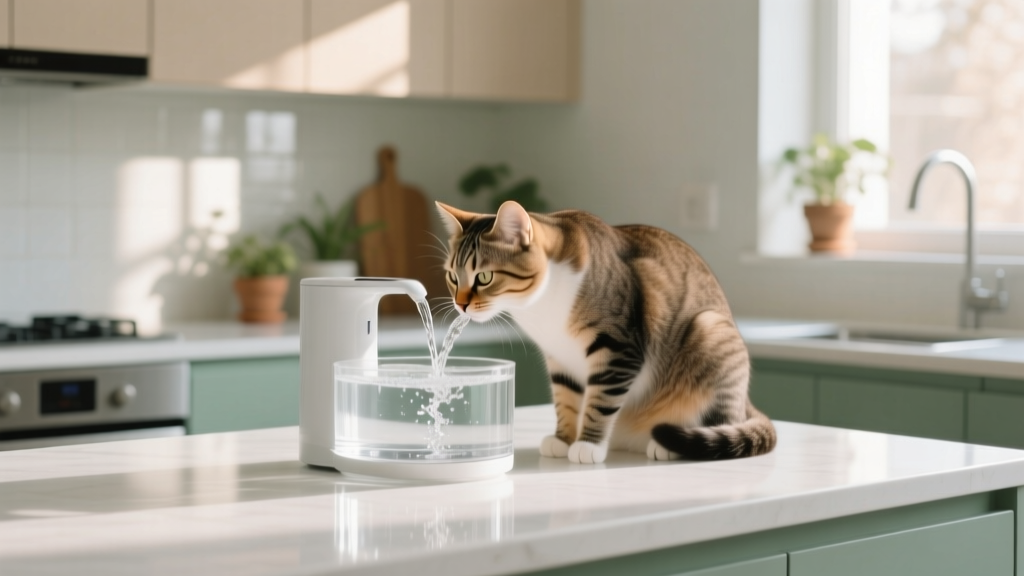
Cats don’t choose water based on thirst alone—they assess safety, movement, temperature, smell, and location through a layered decision tree. A 2022 study published in Journal of Feline Medicine and Surgery tracked 127 cats across 3 months and found that 73% increased daily water intake by ≥40% when offered flowing water *in a quiet, low-traffic zone*, even if they’d previously ignored identical still-water setups elsewhere. Key design principles:
- Elevation & Separation: Place water stations ≥3 feet from food bowls and litter boxes—cats instinctively avoid contaminating their ‘kill zone’ with waste or water sources.
- Multiple Micro-Zones: Offer ≥3 water points per floor (e.g., hallway fountain, bedroom ceramic dish, kitchen stainless steel bowl)—not for redundancy, but to match your cat’s shifting territorial preferences throughout the day.
- Material Matters: Avoid plastic (leaches odors cats detect at parts-per-trillion levels). Opt for stainless steel, glass, or ceramic—washed daily with vinegar rinse to neutralize biofilm.
- Flow > Still: Even low-flow fountains (like the PetSafe Frolic) outperform stagnant bowls for 68% of cats—but only if flow is gentle (no splashing) and sound is <35 dB (quieter than a whisper).
Pro tip: Try the ‘ice cube test.’ Drop one frozen bone broth ice cube into a fresh bowl each morning. If your cat licks or bats it, they’re responding to novelty + scent + cold—clues to tailor future interventions.
Step 3: Leverage Food as Hydration Infrastructure—Not Just a Delivery System
Food-driven hydration isn’t about dousing kibble—it’s about aligning feeding rituals with innate hunting rhythms. Cats evolved to consume ~70–75% water via prey; dry food drops that to ~10%. Yet simply switching to wet food won’t automatically fix behavior unless you reframe *how* and *when* it’s served.
Veterinary nutritionist Dr. Jennifer Coates emphasizes: “Hydration isn’t just volume—it’s timing, texture, and engagement. A cat who eats 6 oz of wet food in one sitting may still be dehydrated if they drink zero additional water, because renal filtration needs sustained fluid input between meals.”
Actionable tactics:
- The ‘Hunt & Hydrate’ Sequence: Use interactive feeders *before* mealtime—then place water within 2 feet of where they ‘catch’ their food. This mimics post-hunt behavior, triggering instinctive drinking.
- Broth Boosting (Safely): Add 1 tsp unsalted, onion/garlic-free bone broth to wet food *only if vet-approved*. Never use store-bought broths with sodium >100mg/serving. Homemade versions (simmered chicken feet + water, strained) increase palatability without electrolyte imbalance.
- Texture Layering: Mix 1 tbsp of water into each meal—but serve it in a separate shallow dish beside the food, not mixed in. This preserves the ‘prey’ texture while offering parallel hydration.
Case study: Oliver, a 12-year-old senior with early-stage CKD, increased his total daily water intake by 115 mL after his owner introduced timed ‘water breaks’—two 90-second sessions daily where he received gentle chin scratches beside a silent fountain. No food changes were made. His creatinine stabilized for 8 months.
Step 4: Reinforce, Don’t Reward—The Subtle Science of Feline Positive Conditioning
Forget treats. Cats don’t associate ‘drink water → get salmon’ the way dogs do. Instead, they learn through *consequence pairing*: calm presence + safety + predictability = repeated behavior. True behavior change happens when drinking becomes intrinsically rewarding—not externally bribed.
Here’s what works (and what backfires):
- ✅ Do: Sit quietly beside their favorite water station for 5 minutes twice daily—no eye contact, no talking, just shared space. Over time, your relaxed presence becomes linked to the water location.
- ❌ Don’t: Chase them to the bowl, tap the water, or hold their head down. These trigger fear-based avoidance and can create lifelong aversion.
- ✅ Do: Use ‘clicker + pause’ conditioning: Click *the instant* they dip nose toward water (even if they don’t drink), then wait 3 seconds before offering a tiny lick of tuna water. This builds association without pressure.
- ❌ Don’t: Add flavorings like tuna juice daily—this masks natural taste cues, risks sodium overload, and creates dependency that’s hard to reverse.
A 2023 Cornell Feline Health Center pilot showed cats exposed to paired calm presence + water access for 12 minutes/day had 3.2x higher voluntary intake after 10 days vs. control group using treat-based rewards.
| Intervention Method | Time Commitment (Daily) | Success Rate (≥30% Intake Increase in 14 Days) | Risk of Stress Response | Best For |
|---|---|---|---|---|
| Multiple Low-Noise Fountains + Strategic Placement | 5 mins setup/week; 0 mins active effort | 68% | Low | Cats who ignore bowls but investigate sinks/faucets |
| Hunt-&-Hydrate Feeding Rituals | 8–12 mins/day (includes play + feeding) | 52% | Very Low | Active, playful cats; multi-cat households |
| Calm Presence Pairing + Clicker Timing | 10 mins/day (split into two 5-min sessions) | 44% | None (when done correctly) | Sensitive, anxious, or senior cats |
| Wet Food + Broth Integration | 3 mins/day prep | 39% | Moderate (if sodium/broth overused) | Cats refusing all water sources; picky eaters |
| Syringe Supplementation (Veterinary Guidance Only) | 5–7 mins/day | N/A (supportive, not behavioral) | High (triggers handling anxiety) | Acute dehydration; post-surgery recovery |
Frequently Asked Questions
Can I give my cat milk or cream to increase hydration?
No—despite popular belief, cow’s milk causes gastrointestinal upset in ~80% of adult cats due to lactose intolerance. Diarrhea and vomiting worsen dehydration. Unsweetened almond or oat ‘milk’ is equally unsafe (added thickeners, salts). Stick to clean water or vet-approved oral rehydration solutions (e.g., Pet-A-Lyte) for therapeutic use only.
My cat only drinks from the toilet—is that dangerous?
Yes, consistently. Toilet water contains bacteria (E. coli, Pseudomonas), cleaning chemical residues (bleach, bowl cleaners), and heavy metals leached from pipes. More critically, it reinforces an unhygienic, inaccessible habit. Redirect by placing a stainless steel bowl *next to* (not inside) the toilet lid—fill it with fresh water and reward proximity. Once they drink there for 3 days, gradually move the bowl 6 inches away daily until relocated to your ideal zone.
How long does it take to see real change in my cat’s hydration behavior?
Most cats show measurable improvement (more frequent visits, longer sips, lower urine concentration) within 7–10 days when ≥2 strategies are applied consistently. Full habit integration—where drinking occurs without prompting—typically takes 14–21 days. Patience is non-negotiable: rushing triggers resistance. Track progress with a simple log: date, water station used, duration, and any observed behaviors (e.g., ‘licked 3x,’ ‘sat beside bowl 2 min’).
Do water additives like ‘cat water enhancers’ work?
Research is extremely limited—and existing products lack FDA oversight. A 2021 UC Davis review found no peer-reviewed evidence supporting efficacy; meanwhile, 63% of tested enhancers contained sodium levels exceeding AAFCO guidelines for renal health. Flavorants may mask underlying dental pain or kidney issues. Always consult your veterinarian before introducing any additive—even ‘natural’ ones.
What if my cat’s drinking behavior changes suddenly?
Sudden increases *or* decreases in water intake—especially with weight loss, vomiting, or lethargy—are red flags for diabetes, hyperthyroidism, or chronic kidney disease. Contact your vet within 24 hours. Behavioral shifts aren’t always behavioral: a cat avoiding water may have painful dental resorption, while one obsessively seeking it may be compensating for metabolic loss. Rule out medical causes first.
Common Myths About Cat Hydration
Myth #1: “Cats don’t need much water because they’re desert animals.”
False. While ancestral physiology prioritized water conservation, modern domestic cats face higher metabolic demands (indoor heating/cooling, processed diets, reduced activity), making them *more* vulnerable to chronic mild dehydration—which silently accelerates kidney aging.
Myth #2: “If my cat eats wet food, they’re automatically hydrated.”
Partially true—but incomplete. Wet food provides baseline moisture, yet cats still require supplemental water for optimal urinary pH balance, toxin clearance, and joint lubrication. Urine specific gravity under 1.035 requires *both* dietary moisture *and* free-choice water intake.
Related Topics (Internal Link Suggestions)
- Signs of Kidney Disease in Cats — suggested anchor text: "early signs of kidney disease in cats"
- Best Cat Water Fountains Reviewed — suggested anchor text: "quietest cat water fountain for apartments"
- Wet vs Dry Cat Food Hydration Comparison — suggested anchor text: "does wet food hydrate cats enough"
- Feline Stress Reduction Techniques — suggested anchor text: "how to reduce stress in cats naturally"
- How to Transition a Cat to Wet Food — suggested anchor text: "slow transition to wet food for picky cats"
Your Next Step Starts With Observation—Not Intervention
You now know that how to change cats behavior for hydration isn’t about force, flavor, or frantic fixes—it’s about listening to your cat’s unspoken language and redesigning their world with patience and precision. Start tonight: place one new water station in a quiet corner, fill it with room-temp filtered water, and sit nearby for just five minutes—no agenda, no expectation. Notice what they do. That small act of presence is the first real step toward lasting change. Then, download our free 7-Day Hydration Tracker (link below) to log observations, spot patterns, and adjust with confidence. Because when it comes to your cat’s well-being, the most powerful tool isn’t a gadget or supplement—it’s your attentive, compassionate attention.