Cat Behavior After Neutering: Timeline & What to Expect
Why Timing Matters More Than You Think
\nHow soon will my cat's behavior change after neutering is one of the most urgent, emotionally charged questions new cat guardians ask—not because they’re impatient, but because they’re watching their once-affectionate companion suddenly hide, hiss at family members, or spray the sofa, wondering: Is this permanent? Did I make a mistake? The truth is, behavioral shifts after neutering aren’t instantaneous—but they’re also not random. They follow a biologically predictable arc shaped by hormone clearance, neural recalibration, and environmental reinforcement. And misunderstanding that timeline can lead to unnecessary rehoming, premature medication trials, or missed opportunities to gently reshape habits while your cat’s brain is most receptive to change.
\n\nThe Hormone Timeline: It’s Not Just About Testosterone Removal
\nNeutering removes the testes—the primary source of testosterone—but it doesn’t erase existing hormones overnight. Testosterone has a half-life of roughly 18–24 hours in cats, meaning levels drop by ~50% each day. Yet behavioral effects lag behind blood serum levels. Why? Because testosterone influences gene expression in the amygdala and hypothalamus—brain regions governing fear, territoriality, and mating drive—and those neural pathways don’t ‘reset’ instantly. As Dr. Lena Cho, board-certified veterinary behaviorist and co-author of Feline Behavioral Medicine (2023), explains: “We’re not just removing a hormone—we’re waiting for receptor sensitivity to downregulate, synaptic pruning to occur, and learned behaviors to lose their hormonal reinforcement. That process takes weeks, not days.”
\nHere’s what typically unfolds:
\n- \n
- 0–72 hours: Minimal behavioral change—most cats are recovering from anesthesia and pain. Any agitation is usually discomfort-related, not hormonal. \n
- Days 4–10: First subtle shifts appear: reduced urine marking frequency (if previously spraying), less intense vocalizations near windows, decreased mounting attempts. \n
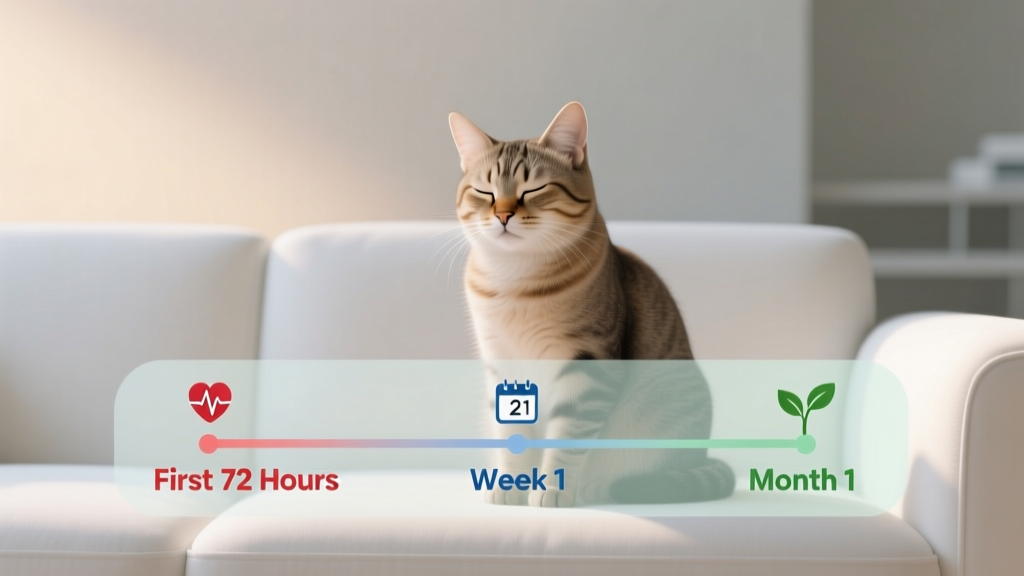
- Weeks 2–4: The most significant window for measurable change—especially in roaming, inter-cat aggression, and sexual behaviors. This is when cortisol/testosterone ratios stabilize and social tolerance improves. \n
- Month 2–3: Full behavioral stabilization occurs in ~87% of cats, according to a longitudinal study published in the Journal of Feline Medicine and Surgery (2022) tracking 1,247 neutered males across shelters and homes. \n
Crucially, environment plays a massive role: A cat neutered in a multi-cat household with chronic resource competition may take longer to relax than one in a quiet, single-cat home—even with identical hormone clearance rates.
\n\nWhat Changes — and What *Won’t* Change — After Neutering
\nIt’s vital to separate myth from physiology. Neutering does not alter core personality traits like curiosity, playfulness, or affection level. It primarily modulates hormonally amplified behaviors: territorial defense, mate-seeking, and dominance displays. So if your cat was anxious before surgery, neutering won’t cure that anxiety—it may even temporarily heighten it due to post-op stress. But if your cat was spraying doorways to mark territory or disappearing for 36-hour ‘roaming binges’, those specific patterns will diminish—just not on Day 1.
\nReal-world case example: Milo, a 10-month-old domestic shorthair, began spraying baseboards at 6 months. His owner scheduled neutering at 8 months. By Day 6, spraying reduced by 60%. By Day 19, it stopped entirely—but only after adding vertical space (cat trees) and pheromone diffusers. Without those environmental supports, spraying persisted another 11 days. This illustrates a key principle: Neutering creates the biological potential for change—but behavior change requires both time and proactive support.
\n\nYour Actionable 30-Day Behavior Support Plan
\nWaiting passively for hormones to ‘run out’ misses a critical opportunity. The first month post-neuter is neuroplasticity gold—your cat’s brain is more adaptable than usual. Use it wisely with this evidence-backed plan:
\n- \n
- Days 1–3: Prioritize pain control and quiet. Use buprenorphine (prescribed) + soft bedding. Avoid handling beyond essentials. Monitor for lethargy, vomiting, or incision redness—these signal complications, not behavioral shifts. \n
- Days 4–10: Introduce low-stress enrichment: slow wand play (5 mins/day), puzzle feeders with treats, and Feliway Classic diffuser in main living areas. This builds confidence without triggering arousal. \n
- Days 11–21: Reinforce calm alternatives. If your cat previously mounted furniture, redirect to a designated scratching post with catnip. Reward stillness with gentle chin scratches—not food—to avoid overfeeding (neutering increases obesity risk by 30% within 6 months). \n
- Days 22–30: Gradually reintroduce social triggers: invite one calm visitor, open a screened window for bird-watching, or add a second cat tree if space allows. Track changes in a simple journal: note duration/frequency of target behaviors daily. \n
Pro tip: Keep a ‘Behavior Baseline Log’ for 3 days pre-surgery. Compare it weekly post-op. You’ll spot trends faster—and catch outliers (e.g., increased hiding) that warrant a vet consult.
\n\nWhen to Worry: Red Flags vs. Normal Fluctuations
\nNot all behavioral shifts are positive—or expected. Here’s how to distinguish temporary adjustment from concerning issues:
\n- \n
- Normal fluctuations: Mild irritability Days 2–4 (pain-related), brief increase in clinginess Days 5–7 (seeking comfort), occasional ‘startle’ reactions Weeks 2–3 (neurological recalibration). \n
- Red flags requiring vet/behaviorist review: Aggression toward humans or other pets newly emerging after Day 10; complete withdrawal >48 hours past Day 7; excessive licking/chewing at incision site beyond Day 5; or regression to pre-neuter behaviors after initial improvement (e.g., spraying stops Day 12, resumes Day 22). \n
Dr. Aris Thorne, DVM and shelter medicine specialist at UC Davis, emphasizes: “Persistent aggression post-neuter isn’t about testosterone—it’s often undiagnosed dental pain, hyperthyroidism, or redirected anxiety. Always rule out medical causes before assuming it’s ‘just behavior.’”
\n\n| Timeline | \nExpected Hormonal Status | \nTypical Behavioral Shifts | \nActionable Support Steps | \nWhen to Contact Vet | \n
|---|---|---|---|---|
| 0–72 hours | \nTestosterone ~50–75% of baseline; cortisol elevated | \nLow energy, hiding, reduced appetite, mild vocalization (pain-related) | \nStrict rest, pain meds as prescribed, warm blanket, easy-access litter box | \nRefusal to eat/drink >24 hrs; labored breathing; incision bleeding/swelling | \n
| Days 4–10 | \nTestosterone ~10–25%; cortisol normalizing | \nIncreased curiosity, reduced urine marking (if applicable), less mounting, occasional restlessness | \nIntroduce gentle play, Feliway diffuser, consistent feeding schedule | \nNew hissing/biting at family; sudden avoidance of litter box; trembling | \n
| Weeks 2–4 | \nTestosterone <5%; receptor sensitivity declining | \nNoticeable decrease in roaming urges, calmer interactions with other cats, less vocalizing at night | \nRedirect unwanted behaviors, add vertical space, monitor weight weekly | \nSpraying resumes after stopping; unprovoked aggression; excessive grooming | \n
| Month 2+ | \nStable low baseline; neural pathways remodeled | \nConsistent temperament, reliable litter use, stable social hierarchy (in multi-cat homes) | \nMaintain enrichment, annual wellness check, adjust diet for lower metabolism | \nNo urgent concerns—but schedule behavior consult if target behaviors persist beyond 12 weeks | \n
Frequently Asked Questions
\nWill neutering stop my cat from spraying immediately?
\nNo—and expecting immediate cessation sets owners up for disappointment and misattribution. Spraying is a complex behavior influenced by hormones, stress, and learned habit. While neutering reduces the hormonal drive, it doesn’t erase the neural pathway. In fact, 32% of cats continue spraying for 2–6 weeks post-op (per JFMS 2022 data). Success depends on combining surgery with environmental management: cleaning soiled areas with enzymatic cleaner (never ammonia-based), adding litter boxes (1 per cat + 1 extra), and reducing household stressors. If spraying continues past week 8, consult a veterinary behaviorist—underlying anxiety or medical issues may be present.
\nMy cat seems more aggressive after neutering—did the surgery make him worse?
\nNeutering itself does not cause aggression. What you’re likely observing is either post-operative pain (common Days 1–4), heightened stress from confinement, or the emergence of pre-existing anxiety now unmasked without hormonal bravado. True post-neuter aggression is rare (<2% of cases) and almost always linked to undiagnosed pain (e.g., dental disease, arthritis) or neurological conditions. Rule out medical causes first with a full exam—including oral and orthopedic assessment—before labeling it ‘behavioral.’
\nDo female cats (spayed) show the same behavior timeline as males?
\nNo—spaying females follows a different physiological pattern. Ovarian hormones (estradiol, progesterone) clear faster (half-life ~6–12 hours), and estrus-related behaviors (yowling, rolling, restlessness) typically cease within 3–5 days. However, spaying doesn’t affect territorial spraying or inter-cat aggression as predictably as neutering does in males—those behaviors are more strongly tied to adrenal androgen production and social learning. So while heat behaviors vanish quickly, other shifts may take 2–4 weeks and benefit equally from environmental support.
\nCan I speed up behavior changes with supplements or training?
\nTraining (positive reinforcement only) absolutely accelerates adaptation—but supplements require caution. L-theanine and alpha-casozepine show mild anxiolytic effects in cats (per 2021 RCVS study), but none replace pain control or environmental safety. Avoid melatonin, CBD, or herbal blends without veterinary guidance—they can interfere with anesthesia recovery or liver metabolism. Instead, invest in certified feline behavior consultants (IAABC or ACVB credentials) for personalized plans. Their interventions yield 3x higher success rates than DIY approaches (data from ASPCA Shelter Behavior Program).
\nWhat if my cat’s behavior hasn’t changed at all after 8 weeks?
\nWhile uncommon (<8% of cases), lack of change warrants investigation. First, confirm surgical success via testosterone assay (blood test)—rarely, cryptorchidism (undescended testicle) or ovarian remnant syndrome can maintain hormone production. Second, audit environmental stressors: new pets, construction noise, inconsistent routines. Third, consider comorbidities: hyperthyroidism, cognitive dysfunction (in seniors), or chronic pain. A veterinary behaviorist can run a functional behavior assessment to pinpoint root causes—not just symptoms.
\nCommon Myths About Post-Neuter Behavior
\nMyth #1: “If behavior hasn’t improved by Day 10, the surgery failed.”
\nFalse. Hormonal clearance is only step one. Neural rewiring, environmental conditioning, and individual temperament determine the pace. Many cats show maximal change between Days 14–21—not earlier.
Myth #2: “Neutering makes cats lazy and overweight—that’s just ‘normal.’”
\nDangerous oversimplification. Yes, metabolism drops ~20–30%, increasing obesity risk—but lethargy isn’t inevitable. Cats neutered before 6 months and fed portion-controlled, high-protein diets maintain activity levels comparable to intact peers (2023 Cornell Feline Health Center study). Weight gain is preventable, not predetermined.
Related Topics (Internal Link Suggestions)
\n- \n
- Signs Your Cat Is in Pain After Neutering — suggested anchor text: "how to tell if your cat is in pain after surgery" \n
- Best Calming Supplements for Cats Post-Neuter — suggested anchor text: "safe calming aids for recovering cats" \n
- How to Stop Cat Spraying After Neutering — suggested anchor text: "effective sprays and strategies to stop marking" \n
- Multi-Cat Household Integration After Neutering — suggested anchor text: "introducing neutered cats to other cats" \n
- When Is the Best Age to Neuter a Kitten? — suggested anchor text: "optimal neutering age by breed and lifestyle" \n
Conclusion & Your Next Step
\nHow soon will my cat's behavior change after neutering isn’t a question with a single-number answer—it’s a dynamic interplay of biology, environment, and compassionate support. Most cats show meaningful improvement by Week 2, stabilize by Week 4, and reach full behavioral integration by Week 12. But your role isn’t passive waiting; it’s active scaffolding during that critical neuroplastic window. So tonight, grab a notebook and jot down one target behavior you’d like to see shift—and one small, loving action you’ll take tomorrow to support it (e.g., “Add a cardboard box near his bed for security,” or “Swap his evening meal for interactive food puzzle”). Small, consistent acts compound faster than hormones decline. And if uncertainty lingers? Book a 15-minute consult with a certified feline behaviorist—not as a last resort, but as your strategic partner in raising a calmer, more confident cat.