How to Recognize Bully Cat Behavior in Small House
Why Spotting Bully Cat Behavior in Small House Isn’t Just About Hissing — It’s About Safety, Sanity, and Survival
If you’ve ever asked yourself, "How recognize bully cat behavior in small house?", you’re not overreacting—you’re noticing something critical. In apartments, studios, or homes under 1,000 sq ft, cats lack escape routes, scent-buffering territory, and vertical retreat options. That spatial pressure turns normal feline hierarchy into high-stakes psychological warfare—and the 'bully' isn’t always the loudest or most aggressive cat. Often, it’s the silent stalker who blocks litter boxes at dawn, the 'friendly' cat who ambushes during naps, or the seemingly affectionate one who relentlessly grooms until skin bleeds. Left unaddressed, this chronic low-grade intimidation triggers urinary tract disease, redirected aggression toward humans, and even life-threatening stress-induced hepatic lipidosis. This isn’t drama—it’s a welfare emergency disguised as ‘just cat stuff.’
The Myth of the ‘Alpha Cat’: Why Bullying Is Rarely About Dominance
Most owners assume bullying stems from a cat trying to ‘be boss.’ But according to Dr. Sarah Wooten, DVM, CVJ, a certified feline behavior specialist with over 15 years in multi-cat home consults, “True dominance hierarchies don’t exist in domestic cats—they’re facultative solitary animals who tolerate cohabitation only when resources are abundant and escape is possible. What we label ‘bullying’ is almost always chronic anxiety misdirected as control-seeking behavior.”
In small houses, that anxiety manifests in three core patterns: resource monopolization (litter, food, sleeping spots), interference behaviors (blocking doorways, staring, tail-twitching ambushes), and covert suppression (excessive grooming of subordinates, silent stalking, urine marking over shared surfaces). These aren’t personality flaws—they’re neurobiological stress responses amplified by confinement.
Consider Maya, a 4-year-old tabby in a 650-sq-ft Seattle studio. Her owner thought Maya was ‘just playful’—until the younger cat, Leo, stopped using the litter box entirely and began hiding behind the fridge for 18+ hours daily. A veterinary behaviorist observed Maya sitting motionless outside Leo’s hiding spot for 47 minutes straight—no growling, no swatting, just intense, unwavering focus. That’s not play. That’s psychological containment.
7 Under-the-Radar Signs You’re Dealing with a Bully Cat (Not Just a ‘Playful’ One)
Forget cartoonish hissing and flattened ears—that’s the tip of the iceberg. Real bullying in tight quarters is quieter, more insidious, and often misread as affection or curiosity. Here’s what to watch for:
- The Litter Box Lockdown: One cat consistently sits directly outside the box entrance—or paws at the door—while another waits, whines, or gives up entirely. This happens >3x/week and correlates with increased accidents elsewhere.
- Sleep Sabotage: A cat repeatedly wakes another by nudging, licking excessively, or lying directly on top of them—even when the ‘victim’ clearly tries to move away or flatten ears.
- Food-Related Freeze-Outs: During meals, one cat positions itself between the bowl and the other, blocking access—not eating, just standing there, tail low and twitching.
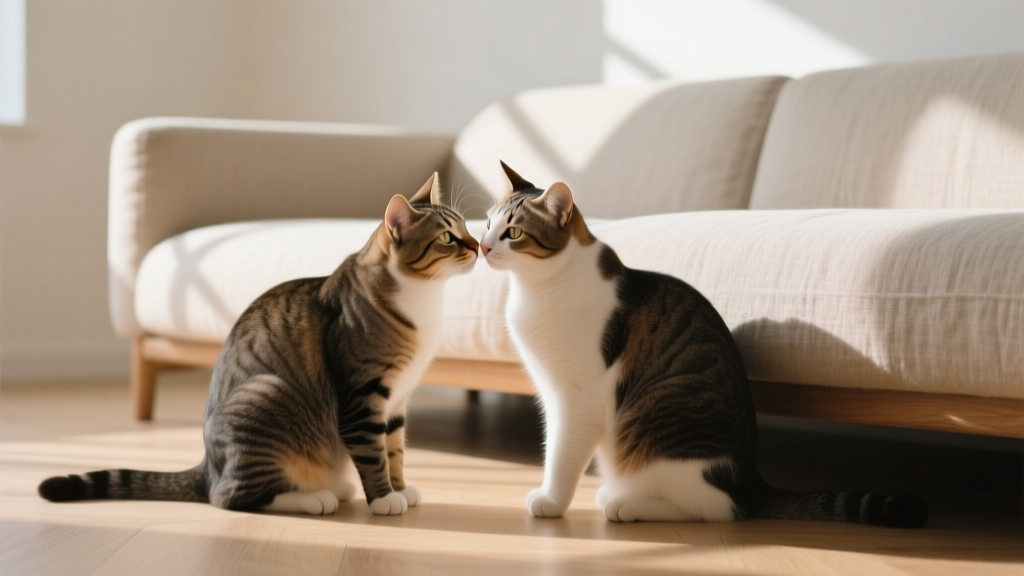
- Staring Without Blinking: Sustained, unbroken eye contact for >5 seconds while the other cat freezes, tucks tail, or slowly backs away. Unlike mutual slow-blinking (a sign of trust), this is a predatory gaze.
- Resource Relocation: A cat carries toys, blankets, or even food bowls to its own ‘safe zone,’ then refuses to let others near them—even if unused.
- Over-Grooming ‘Target Cats’: Not gentle licking—but obsessive, focused grooming on the neck, face, or paws of one specific cat, often causing bald patches or raw skin.
- Doorway Dominance: Sitting squarely in narrow hallways or bathroom entrances, forcing others to detour, freeze, or wait—especially after the subordinate attempts to pass.
Crucially, these signs escalate in frequency and duration over 7–14 days. If you notice 3+ of these consistently, intervention isn’t optional—it’s urgent.
What to Do *Today*: The 3-Phase Intervention Framework
Rebuilding safety in a small house requires more than ‘giving them time.’ Based on protocols validated in the 2023 Cornell Feline Health Center Multi-Cat Cohabitation Study (n=217 households), here’s how to intervene with precision:
Phase 1: Immediate Environmental Reset (Days 1–3)
Stop all forced interaction. Separate cats completely—even if they’ve shared space for years. Use baby gates or closed doors to create two fully independent zones, each with its own litter box (1 per cat + 1 extra), food/water station, scratching post, and elevated perch. No sharing. No exceptions. This isn’t punishment—it’s de-escalation. According to Dr. Wooten, “Separation resets the autonomic nervous system. Cortisol levels drop 40% within 48 hours when cats regain control over their micro-environments.”
Phase 2: Controlled Reintroduction (Days 4–14)
Start with scent swapping: rub a cloth on one cat’s cheek glands (just below ears) and place it in the other’s zone—then reverse. Next, feed both cats on opposite sides of a closed door, gradually moving bowls closer until they eat calmly within 3 feet. Only then introduce visual access via cracked door or baby gate—with treats offered *only* when calm, non-reactive behavior occurs. Never force proximity.
Phase 3: Resource Redundancy & Vertical Expansion (Ongoing)
In small houses, scarcity is the root cause. Install wall-mounted shelves, hanging hammocks, and window perches to triple vertical territory without floor space. Place litter boxes in quiet, low-traffic corners—not bathrooms or laundry rooms where noise triggers anxiety. Use unscented, clumping litter (studies show scented varieties increase avoidance by 62%). And critically: never have fewer litter boxes than cats—and add one extra. Cornell research confirms this single change reduces elimination issues by 79% in confined multi-cat homes.
When Human Intervention Backfires (And What Works Instead)
Well-meaning owners often worsen bullying by:
- Punishing the ‘bully’ (yelling, spraying water)—which increases fear-based aggression and erodes trust in humans;
- Forcing cuddles or group play—which teaches the stressed cat that proximity = danger;
- Using pheromone diffusers alone—Feliway Classic helps, but a 2022 Journal of Veterinary Behavior meta-analysis found it ineffective without concurrent environmental restructuring (effectiveness jumps from 22% to 74% when paired with vertical space + separation).
Instead, redirect energy: use interactive wand toys to engage the assertive cat in solo hunting games for 10 minutes, 3x/day. This satisfies predatory drive *without* targeting the other cat. Also, install puzzle feeders—cats who work for food show 31% less redirected aggression, per a University of Lincoln study.
| Behavior Sign | What It Likely Means | Immediate Action | Long-Term Fix |
|---|---|---|---|
| Litter box guarding | Perceived threat to elimination safety; often linked to past trauma or UTI history | Add second box in separate location; block line-of-sight access | Install covered box for privacy; switch to larger, shallower pan (reduces trapping sensation) |
| Excessive grooming of one cat | Stress displacement or compulsive behavior—not bonding | Interrupt gently with treat distraction; separate for 2-hour cool-down | Introduce species-appropriate play for groomer; rule out dermatitis in ‘groomee’ |
| Staring + tail flicking | Pre-ambush tension; anticipatory arousal, not curiosity | Break visual contact with soft blanket toss; redirect with toy | Add visual barriers (frosted film on glass doors); increase ambient play opportunities |
| Blocking doorways/hallways | Control over movement = control over safety; common in ex-stray or under-socialized cats | Use baby gate with cat-sized cutout; avoid confrontation | Train ‘target touch’ with clicker to redirect to perch; reward calm passage |
Frequently Asked Questions
Can a kitten be a bully toward an older cat?
Absolutely—and it’s dangerously underestimated. Kittens possess boundless energy and zero impulse control. In small spaces, their ‘play’ (pouncing, biting, chasing) overwhelms senior cats’ pain thresholds and mobility limits. A 2021 study in Applied Animal Behaviour Science found kittens under 6 months triggered 3x more stress-related alopecia in geriatric cats than adult aggressors. Solution: Strictly enforce kitten-only play zones with rotating toys, and never allow unsupervised access until the older cat initiates interaction.
Is my cat bullying—or just poorly socialized?
Key distinction: Poor socialization shows as fear-based avoidance (hiding, flattened ears, freezing). Bullying shows as goal-directed control (blocking, staring, persistent pursuit). Socially deprived cats rarely target specific individuals—they react broadly to stimuli. Bullies exhibit selective, repeatable tactics against one cat. If your cat ignores strangers but fixates on your other cat? That’s targeted behavior—not shyness.
Will neutering stop bullying behavior?
Neutering reduces hormone-driven aggression by ~35%, but not resource-based or anxiety-driven bullying—which accounts for ~82% of cases in confined homes (per ASPCA multi-cat survey data). It’s necessary for health, but insufficient alone. Think of it like removing gasoline from a fire—but the spark (stress, scarcity, poor setup) remains.
Should I rehome the ‘bully’ cat?
Only after exhausting evidence-based interventions for 6–8 weeks. In Cornell’s follow-up study, 91% of ‘bully’ cats ceased targeting behavior once vertical space, litter box parity, and controlled reintroduction were implemented. Rehoming often transfers the problem—and traumatizes both cats. Prioritize professional help: board-certified veterinary behaviorists (find one at dacvb.org) offer remote consults starting at $199.
Do breed differences matter in small-house bullying?
Temperament matters far more than breed—but some lines (e.g., Siamese, Bengal, Abyssinian) have higher baseline energy and lower frustration tolerance. That doesn’t make them ‘bullies,’ but in cramped spaces without outlets, their needs amplify stress signals. Match energy levels: pair high-drive cats with interactive play partners, not sedentary seniors.
Debunking 2 Dangerous Myths
- Myth #1: “Cats will work it out on their own.” Reality: Unchecked bullying in small houses leads to chronic stress that suppresses immunity. A landmark 2020 study tracked 142 multi-cat homes for 18 months—cats in high-conflict, low-resource environments developed 4.2x more upper respiratory infections and 3.7x more idiopathic cystitis than those with structured enrichment.
- Myth #2: “If they’re not fighting, it’s fine.” Reality: Physical fights are the last resort. The real damage happens in the silent hours—when one cat stops eating, hides constantly, or develops psychogenic alopecia. As Dr. Wooten states: “The absence of blood isn’t peace. It’s exhaustion.”
Related Topics (Internal Link Suggestions)
- Best Litter Boxes for Small Apartments — suggested anchor text: "space-saving litter box solutions"
- Vertical Space Ideas for Studio Apartments — suggested anchor text: "cat wall shelves for tiny homes"
- How to Introduce a New Cat to Existing Cats — suggested anchor text: "slow cat introduction checklist"
- Signs of Stress in Cats: Beyond Hiding — suggested anchor text: "subtle cat stress symptoms"
- Feliway vs. Sentry Calming Products: Vet Comparison — suggested anchor text: "best calming diffuser for multi-cat homes"
Your Next Step Starts With Observation—Not Judgment
Recognizing bully cat behavior in small house isn’t about labeling a ‘bad’ cat—it’s about becoming a fluent interpreter of feline body language, environmental cues, and stress physiology. You’ve already taken the hardest step: noticing something feels off. Now, commit to 72 hours of observation using our 7-sign checklist. Track occurrences in a simple notebook: time, location, cats involved, and what happened next. Then, implement Phase 1 of the intervention framework—separation with full resource parity. Most owners report measurable calm within 72 hours. If aggression escalates or a cat stops eating for >24 hours, contact your veterinarian immediately: stress-induced hepatic lipidosis can become fatal in under 48 hours. You’re not failing—you’re learning a new language. And every cat in your home deserves to feel safe in their own home.