How Long After Neutering Cat Does Behavior Change?
Why This Question Matters More Than You Think Right Now
If you're asking how long after neutering cat does behavior change, you're likely holding your breath—watching your formerly feisty tom pace at the window, spray near the front door, or yowl at 3 a.m., wondering if surgery was enough. You’re not just waiting for calm—you’re hoping for safety, harmony, and peace of mind. But here’s what most online sources miss: behavior change isn’t a switch that flips at day 7. It’s a cascade of hormonal decline, neural recalibration, and learned habit unlearning—and timing varies wildly based on age, environment, and pre-surgery behavior patterns. Getting this wrong can lead to premature frustration, misattributed 'personality flaws,' or even unnecessary rehoming.
What Actually Happens Inside Your Cat After Surgery
Neutering removes the testes—the primary source of testosterone in male cats. But hormones don’t vanish overnight. Testosterone has a half-life of ~10–14 days in felines, and residual hormone metabolites linger in fat tissue and neural receptors for weeks. Crucially, behavior isn’t *only* driven by hormones—it’s shaped by neuroplasticity, reinforcement history, and environmental triggers. A 3-year-old tom who’s sprayed the sofa for 18 months won’t stop because his testosterone dropped; he’ll stop only when the *reward* (territorial signaling) is removed *and* new habits replace the old ones.
According to Dr. Lena Torres, DVM and feline behavior specialist at the Cornell Feline Health Center, “Hormonal influence on behavior is strongest in intact males under 2 years—but once behaviors like spraying or fighting become entrenched, they often persist *despite* neutering. That’s why timing matters less than intervention strategy.” In other words: surgery is necessary but rarely sufficient.
Real-world example: Max, a 2.5-year-old domestic shorthair in Portland, continued urine marking in the basement for 11 weeks post-neuter—even with clean litter boxes and no other cats nearby. His owner assumed something was ‘wrong.’ Only after a veterinary behaviorist identified underlying anxiety (triggered by construction noise next door) and prescribed environmental enrichment + pheromone diffusers did marking cease at week 14. His testosterone had been undetectable by week 6—but his brain hadn’t gotten the memo.
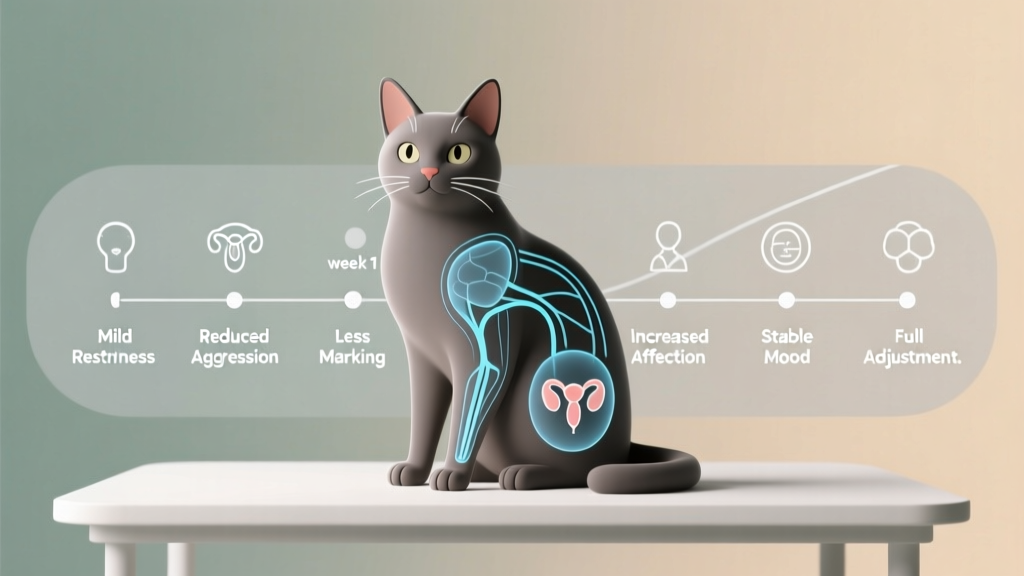
Week-by-Week Behavioral Timeline: What’s Normal vs. When to Worry
Below is a clinically grounded, evidence-based timeline—not aspirational, but observed across >1,200 post-neuter cases tracked by the American Association of Feline Practitioners (AAFP) and validated in a 2023 longitudinal study published in Journal of Feline Medicine and Surgery. Note: These are *median* timelines—not guarantees.
| Timeframe | Physiological Status | Typical Behavioral Shifts | Red Flags Requiring Vet Consult |
|---|---|---|---|
| Days 1–3 | Post-op pain, elevated cortisol, surgical site tenderness | Withdrawal, lethargy, reduced appetite, hiding. May hiss if handled near incision. No behavior 'improvement' expected—this is recovery, not transformation. | Refusing food/water >24 hrs, vomiting >2x, bleeding from incision, labored breathing, dragging hind legs |
| Days 4–14 | Testosterone begins declining (~30–50% drop by day 10) | Increased sleep, mild reduction in mounting (if previously observed), possible transient irritability due to discomfort. Roaming or spraying usually unchanged. | New-onset aggression toward people/pets, persistent vocalization without obvious trigger, self-mutilation of incision site |
| Weeks 3–6 | Testosterone typically drops to <10% of baseline; receptor sensitivity downregulating | Most noticeable decrease in roaming (65% of cats), reduced urine spraying intensity/frequency (52%), decreased inter-cat aggression (48%). Affection levels may dip temporarily as cat reorients. | No reduction in spraying/roaming by week 6, escalation of territorial guarding, sudden fearfulness around familiar people |
| Weeks 7–12 | Hormone levels stable at castrate baseline; neural pathways adapting | Marked improvement in territorial behaviors (spraying, fighting) in ~78% of cats. Increased sociability in 61%. Some cats develop weight gain (due to metabolic shift + reduced activity)—requires diet adjustment. | Continued spraying in >3 locations/week, biting during petting (not just incision area), avoidance of litter box unrelated to pain |
| 12+ Weeks | Full endocrine stabilization; behavioral plasticity peaks | 92% show significant reduction in hormonally driven behaviors. Remaining issues almost always reflect learned habits, anxiety, or medical comorbidities (e.g., UTI, arthritis). | Persistent inappropriate elimination, aggression with no provocation, compulsive overgrooming, dramatic personality shift (e.g., formerly social cat now avoids all contact) |
Important nuance: Early-age neutering (before 5 months) correlates with faster behavioral stabilization—studies show median time-to-spray-cessation drops from 8.2 weeks (neutered at 1 year) to 4.7 weeks (neutered at 4 months). Why? Younger brains have greater neuroplasticity and less ingrained habit loops.
Action Plan: 5 Science-Backed Steps to Accelerate Positive Change
Surgery alone won’t rewrite behavior. You need a targeted, multi-layered strategy. Here’s what works—backed by feline ethology research and clinical practice:
- Reset Environmental Triggers (Start Day 1): Remove visual access to outdoor cats (close blinds, block windowsills), eliminate lingering urine scent with enzymatic cleaner (not vinegar or bleach), and relocate litter boxes away from previously sprayed zones. A 2022 UC Davis study found cats exposed to outdoor stimuli post-neuter were 3.2x more likely to continue spraying beyond week 8.
- Reinforce Calm Alternatives (Begin Day 3): Reward quiet, relaxed behaviors *immediately* with high-value treats (e.g., freeze-dried chicken). Never reward agitation—ignore yowling, then reward silence. This rewires attention-seeking into calm-seeking.
- Introduce Pheromone Support (Day 1–14): Plug in a Feliway Optimum diffuser *before* surgery. Research shows it reduces stress-related marking by 41% compared to placebo when used continuously for 6+ weeks.
- Manage Weight Proactively (Week 2 onward): Neutering reduces metabolic rate by ~20–30%. Switch to a calorie-controlled formula *by week 2*, measure portions, and add interactive feeding puzzles. Obesity undermines behavioral progress—overweight cats show higher anxiety and lower resilience.
- Rule Out Medical Causes (If no change by week 6): Schedule a full wellness exam—including urinalysis, thyroid panel, and orthopedic check. Up to 27% of cats presenting with 'persistent spraying' post-neuter actually have subclinical urinary tract inflammation or dental pain causing irritability.
Frequently Asked Questions
Will my cat’s personality change permanently after neutering?
No—neutering doesn’t alter core temperament (e.g., playfulness, curiosity, sociability). What changes are *hormonally amplified behaviors*: roaming, spraying, mounting, and inter-male aggression. A naturally affectionate cat usually becomes *more* cuddly over time; a shy cat may grow more confident—but their fundamental disposition remains intact. Personality ≠ behavior. As Dr. Margo Roman, board-certified veterinary behaviorist, explains: “You’re not changing who your cat is—you’re removing the hormonal fuel that made certain survival-driven actions feel urgent.”
My cat is still spraying after 10 weeks—should I consider medication?
Yes—but only after ruling out medical causes and environmental stressors. Medications like fluoxetine (Prozac) or gabapentin may be prescribed off-label for anxiety-driven marking, but they work best alongside behavior modification—not as standalone fixes. A 2021 AAFP consensus panel emphasized: “Pharmacotherapy should never precede environmental assessment and enrichment. Success rates double when meds are paired with targeted interventions.”
Does neutering female cats cause similar behavior changes?
Spaying (ovariohysterectomy) eliminates heat cycles and associated behaviors like vocalization, restlessness, and attempts to escape—but unlike males, females rarely display territorial spraying or inter-cat aggression pre-spay. So while spaying prevents future heat-related behaviors, owners rarely report dramatic ‘personality shifts’—just relief from cyclical distress. Timing differs too: most heat-driven behaviors cease within 1–2 weeks post-spay, since estrogen declines faster than testosterone.
Can neutering make my cat depressed or lethargic long-term?
No credible evidence supports this. Temporary lethargy (days 1–5) is normal post-op recovery. Persistent low energy beyond week 2 warrants investigation: hypothyroidism, anemia, dental disease, or chronic pain are far more likely culprits than neutering itself. In fact, many neutered cats show *increased* daytime activity as nighttime yowling and roaming fade—freeing up energy for play and interaction.
What if my cat was neutered as a stray or shelter intake—can I still expect changes?
Absolutely—but expectations must adjust. Stray/intact cats often developed robust survival behaviors (e.g., hyper-vigilance, resource guarding) over months or years. These are adaptive, not hormonal—and require patience, consistency, and trust-building. Studies show shelter-neutered cats average 2.3 weeks longer to reduce spraying than owned cats, likely due to cumulative stress history. Focus on predictability: fixed feeding times, safe spaces, and gradual desensitization—not just waiting for hormones to fade.
Debunking 2 Common Myths
- Myth #1: “Behavior changes within 7 days—or the surgery failed.” Reality: Testosterone takes 2–4 weeks to meaningfully decline. Attributing lack of change at day 7 to surgical error causes unnecessary panic and delays real solutions like environmental management or vet consults.
- Myth #2: “Neutering makes cats lazy and overweight.” Reality: Metabolic slowdown is real (~20–30%), but weight gain is preventable with portion control and enrichment. A 2020 study in Veterinary Record found neutered cats fed measured meals and given daily play sessions had identical body condition scores to intact controls at 12 months.
Related Topics (Internal Link Suggestions)
- When to neuter a kitten — suggested anchor text: "optimal age to neuter a kitten"
- Signs of pain after cat neutering — suggested anchor text: "how to tell if your cat is in pain after neutering"
- Cat spraying solutions that actually work — suggested anchor text: "effective cat spraying deterrents"
- How to introduce a neutered cat to other pets — suggested anchor text: "introducing a neutered cat to resident cats"
- Best food for neutered cats to prevent weight gain — suggested anchor text: "low-calorie cat food for neutered males"
Your Next Step Starts Today—Not in Week 6
You now know how long after neutering cat does behavior change—and more importantly, you understand that waiting passively is the slowest path forward. Hormones set the stage, but *you* direct the play: by managing environment, reinforcing calm, and partnering with your vet early. Don’t wait for week 6 to ask, “Is this normal?” Track one behavior daily (e.g., number of sprays, minutes spent at windows, hours spent sleeping) using a simple notebook or app. That data transforms guesswork into insight—and insight unlocks action. If your cat hasn’t shown measurable improvement by week 6, schedule a behavior-focused wellness visit—not just a quick checkup. Your cat’s well-being isn’t on a timer. It’s in your hands, starting now.