How Do You Punish a Cat for Bad Behavior? The Truth Is
Why Asking 'How Do You Punish a Cat for Bad Behavior' Is the Wrong Question—And What to Ask Instead
How do you punish a cat for bad behavior? That question reflects deep frustration—and love—but it’s built on a fundamental misunderstanding of feline cognition. Cats don’t operate on guilt, shame, or moral reasoning like humans do. They learn through immediate consequences, environmental cues, and associative memory—not discipline. When your cat knocks things off shelves, urinates outside the litter box, or bites during petting, they’re not ‘being bad’—they’re communicating unmet needs, stress, pain, or confusion. And punishing them doesn’t fix the root cause; it damages your bond, increases anxiety, and often worsens the behavior. In fact, the American Veterinary Society of Animal Behavior (AVSAB) explicitly states: ‘Punishment is not only ineffective for most behavior problems in cats—it can lead to increased fear, aggression, and avoidance.’ So let’s replace punishment with precision: understanding why the behavior happens, identifying what your cat truly needs, and applying proven, compassionate strategies that work—for both of you.
Why Punishment Fails—Every Time
Cats process cause-and-effect differently than dogs—or people. Their brains prioritize survival, safety, and predictability. A delayed scolding (even seconds after the ‘offense’) is meaningless to them. They associate the consequence with whatever they’re doing *at that moment*—not the earlier action. Imagine your cat scratches the couch, you yell five minutes later when you walk into the room: to them, your yelling is linked to *you entering the room*, not the scratching. Worse, punishment often triggers redirected fear or defensive aggression. Dr. Sarah Heath, a European Diplomate in Veterinary Behavioural Medicine, explains: ‘Cats rarely show overt signs of distress until they’re overwhelmed. Punishment pushes them past that threshold—resulting in sudden, seemingly unprovoked hissing, swatting, or hiding.’
Real-world example: A client brought in ‘aggressive’ 3-year-old Luna who’d started biting her ankles at dawn. After ruling out pain (dental exam, bloodwork), we discovered Luna was bored and hunting-driven. Her ‘bad behavior’ was predatory play directed at moving feet—a normal instinct with no outlet. Punishing her led to growling and avoidance. Switching to 10 minutes of interactive play before bed + puzzle feeders at 5 a.m. eliminated biting in 4 days. No punishment involved—just meeting biological needs.
Neurologically, punishment activates the amygdala (fear center) and suppresses prefrontal cortex activity (decision-making, learning). That means your cat isn’t ‘learning a lesson’—they’re learning to fear *you*, the environment, or the situation. Over time, this erodes confidence and can trigger chronic stress conditions like feline idiopathic cystitis (FIC), a painful bladder inflammation directly linked to environmental anxiety.
The 3-Step Behavior Response Framework (No Punishment Required)
Instead of asking how to punish, ask: What is my cat trying to tell me? Follow this evidence-based framework used by certified cat behavior consultants and shelter rehabilitation programs:
- Rule Out Medical Causes First: Pain is the #1 driver of ‘sudden’ behavior changes. Urinating outside the box? Could be UTI, arthritis (hard to climb into high-sided litter boxes), or kidney disease. Aggression when touched? Dental abscess, hyperthyroidism, or neuralgia. Always start with a full veterinary exam—including geriatric bloodwork for cats over 7.
- Decode the Function of the Behavior: Every behavior serves a purpose. Use the ‘ABC Model’: Antecedent (what happened right before?), Behavior (what did they do?), Consequence (what happened right after?). Example: Antecedent = you reach to pet sleeping cat → Behavior = bite → Consequence = you pull away → Cat learns biting ends unwanted contact. This isn’t ‘spite’—it’s effective communication.
- Replace, Redirect, Reinforce: Never just suppress. Give them a better option—and reward it generously. Scratching furniture? Provide vertical + horizontal scratching posts near resting areas, sprinkle with catnip, and reward *only* when they use it. Biting during play? End interaction immediately (no yelling), then reintroduce with wand toys—not hands. Litter box issues? Add a second box (rule of thumb: n+1 boxes for n cats), switch to unscented clumping litter, and place boxes in quiet, low-traffic locations.
This approach works because it respects feline ethology—their natural instincts and social structure. Cats are solitary hunters, not pack animals. They don’t seek dominance or submission. They seek safety, control, and predictability. When those are present, ‘bad behavior’ evaporates.
When ‘Bad Behavior’ Is Actually a Cry for Help
What looks like misbehavior is often a symptom of profound distress. Consider these red-flag scenarios—and their underlying causes:
- Litter Box Avoidance: Top reason for surrender to shelters. Often caused by box location (near noisy appliances), litter texture (some cats hate clay), depth (<2 inches preferred), or multi-cat tension (one cat ambushing another at the box).
- Excessive Grooming or Hair Pulling: Not OCD—usually stress-induced dermatitis. Triggers include new pets, construction noise, or even changing your perfume (cats detect scent shifts at parts-per-trillion levels).
- Attacking Ankles or Hands: Rarely aggression—typically under-stimulated predatory drive. Indoor cats hunt 10–20 times daily in the wild. Without outlets, that energy targets moving objects.
- Vocalizing at Night: Especially in seniors: could indicate cognitive dysfunction (feline dementia), hypertension, or hyperthyroidism. Not ‘attention-seeking’—a neurological or physiological signal.
A landmark 2022 study in the Journal of Feline Medicine and Surgery tracked 287 cats with ‘problem behaviors’ referred to behavior clinics. 68% had at least one undiagnosed medical condition contributing to the behavior—and 91% showed significant improvement within 2 weeks of addressing it. Punishment wasn’t part of the protocol. Precision care was.
What to Do Instead: A Practical Response Table
| Behavior | Most Likely Cause | Immediate Action | Long-Term Solution | Evidence-Based Success Rate* |
|---|---|---|---|---|
| Scratching furniture | Claw maintenance + marking territory | Spray area with citrus-scented deterrent (cats dislike citrus); cover with double-sided tape | Provide 3+ scratching surfaces (sisal, cardboard, carpet) near sleeping/resting zones; reward with treats when used | 89% reduction in 14 days (IAHAIO 2021) |
| Biting during petting | Overstimulation (tactile sensitivity) | Stop petting immediately at first tail flick or ear twitch; offer treat to end interaction positively | Use ‘petting tolerance test’: stroke 3x, pause, watch for signals; gradually increase duration only if cat leans in | 94% improvement in 10 days (Cornell Feline Health Center) |
| Urinating outside box | Pain, aversion, or anxiety | Clean soiled area with enzymatic cleaner (never ammonia-based); add second box in quiet location | Vet exam + urine culture; switch to unscented, fine-grained litter; ensure box is low-entry and cleaned daily | 76% resolution with medical + environmental intervention (AVSAB Consensus) |
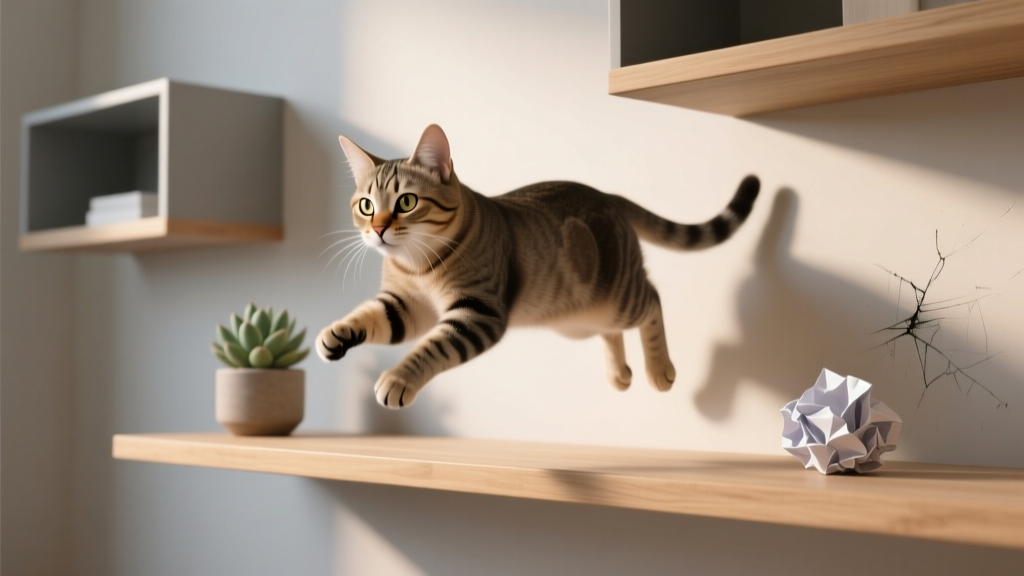
| Knocking items off counters | Attention-seeking or hunting instinct | Remove breakables; block access temporarily with motion-activated air canisters (not aimed at cat) | Provide daily 15-min interactive play sessions with wand toys; use food puzzles for meals; install window perches for bird-watching | 82% decrease in 3 weeks (ASPCA Shelter Study) |
| Aggression toward visitors | Fear-based territorial response | Confine cat to safe room pre-arrival; offer Feliway diffuser in common areas | Gradual desensitization: visitors ignore cat, toss treats from distance, slowly decrease space over 2–4 weeks | 71% success with consistent protocol (Diplomate ACVB) |
*Success rate defined as ≥80% reduction in target behavior within timeframe, verified by owner log and video review.
Frequently Asked Questions
Is spraying the same as urinating outside the litter box?
No—spraying is a territorial marking behavior (urine sprayed vertically on walls/furniture) and involves a distinctive posture: tail quivering, backward stepping, and fine mist. It’s driven by stress, not litter box aversion. Neutering reduces spraying by ~85% in males, but environmental stressors (new pets, renovations) can trigger it in spayed females too. Treatment focuses on reducing triggers and using synthetic pheromones (Feliway Optimum) — not punishment.
My cat hisses when I pick them up—is that ‘bad behavior’ I should correct?
Hissing is a clear, honest communication of fear or discomfort—not defiance. Forcing restraint breaks trust and teaches your cat that handling = danger. Instead, practice ‘touch-tolerance training’: gently touch one paw for 1 second, reward with treat; gradually increase duration and body areas over days. Many cats learn to accept handling when given choice and control.
Can clicker training work for cats? Isn’t that just for dogs?
Absolutely—and it’s highly effective. Cats learn faster with positive reinforcement than any other method. Start by pairing the click sound with a high-value treat (chicken, tuna). Once they associate click = treat, mark desired behaviors (e.g., touching a target stick, sitting on cue). Certified cat trainer Mieshelle Nagelschneider reports >90% of clients see reliable responses within 5–7 days of 2-minute daily sessions.
What if my cat’s behavior suddenly changed—should I wait or go to the vet right away?
Go to the vet immediately. Sudden onset of aggression, vocalization, litter box avoidance, or withdrawal is a medical red flag—not ‘moodiness.’ Conditions like dental disease, hyperthyroidism, hypertension, or brain tumors present behaviorally first in cats. Early diagnosis dramatically improves outcomes. Don’t assume it’s ‘just age’ or ‘stress.’
Common Myths About Cat Discipline
Myth #1: “Cats need to know who’s boss.”
False. Cats don’t recognize human hierarchy. They respond to consistency, predictability, and resource security—not dominance displays. Scruffing, staring down, or physical intimidation triggers fear—not respect—and damages your relationship.
Myth #2: “A quick squirt from a water bottle teaches them not to jump on counters.”
Counterproductive. Your cat associates the spray with *you*, not the counter. They’ll avoid you or wait until you’re gone to jump up. Worse, many cats become water-averse, complicating future grooming or medical care.
Related Topics (Internal Link Suggestions)
- Understanding Cat Body Language — suggested anchor text: "what does it mean when my cat's tail flicks?"
- Best Litter Boxes for Multi-Cat Households — suggested anchor text: "litter box solutions for 2+ cats"
- Interactive Cat Toys That Reduce Boredom — suggested anchor text: "best wand toys for indoor cats"
- Signs of Pain in Cats (Subtle But Critical) — suggested anchor text: "hidden signs your cat is in pain"
- Feliway vs. Other Calming Products: What Works? — suggested anchor text: "do calming sprays really work for cats?"
Your Next Step: Replace Reaction With Insight
How do you punish a cat for bad behavior? You don’t—because punishment addresses symptoms, not causes. What transforms frustration into connection is curiosity: observing patterns, listening to your cat’s subtle language, and responding with empathy and science-backed tools. Start today with one small shift: choose *one* recurring behavior, apply the ABC model for 48 hours, and note what consistently precedes and follows it. That observation alone reveals more than any punishment ever could. Then, book that vet visit—even if you ‘think’ it’s behavioral. You’ll save time, heartache, and possibly your cat’s health. And when you see that first relaxed blink, slow blink back. That’s not obedience—that’s trust, earned without a single word of correction.