Cat vs Lion Behavior: What Science Reveals (2026)
Why This Comparison Matters More Than You Think
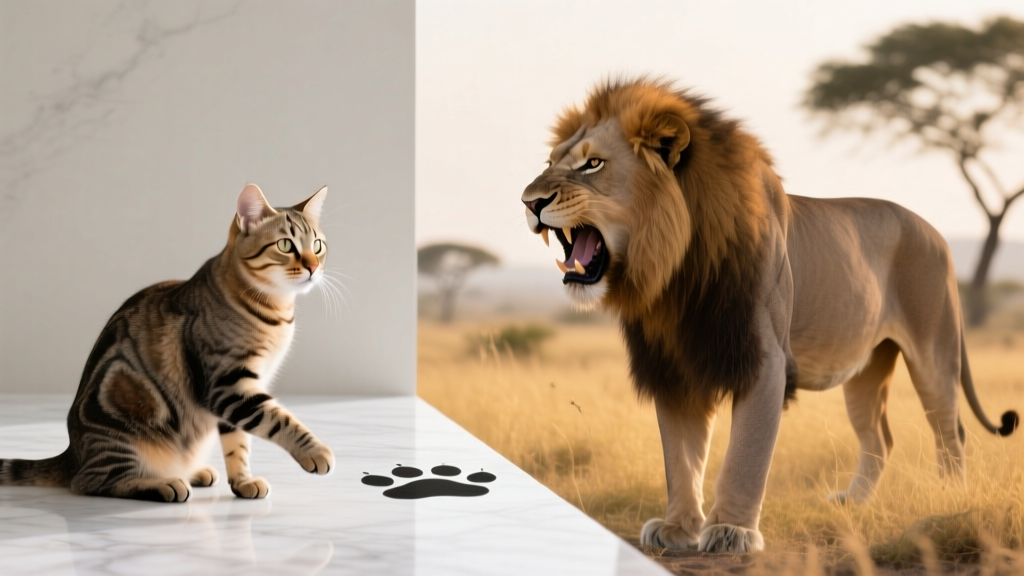
How do domestic cat and African lion behaviors compare? That question isn’t just academic curiosity—it’s a window into understanding your own cat’s deepest instincts, anxieties, and unmet needs. Millions of cat owners misinterpret aloofness as indifference, scratching as destruction, or nighttime yowling as 'bad behavior'—when in reality, these are echoes of ancestral survival strategies shared with lions… yet dramatically reshaped by domestication. As Dr. Sarah Lin, a feline ethologist and senior researcher at the Cornell Feline Health Center, explains: 'Every purr, pounce, and territorial patrol is written in the same genetic language as a lion’s roar—but edited by 12,000 years of co-evolution with humans.' In an era where indoor-only cats suffer rising rates of stress-related illness (a 2023 Journal of Feline Medicine & Surgery study found 41% of urban cats show chronic low-grade cortisol elevation), decoding this behavioral lineage isn’t fascinating—it’s essential preventative care.
Shared Blueprint, Divergent Expression: The Evolutionary Lens
Domestic cats (Felis catus) and African lions (Panthera leo) diverged from a common ancestor roughly 10.8 million years ago—making them distant cousins, not close kin. Yet both retain the core felid behavioral toolkit: solitary hunting adaptations, scent-based communication, ambush predation, and highly developed sensory processing. What changed wasn’t the hardware—it was the software. Lions evolved cooperative sociality to dominate open savannas; cats retained ancestral solitary flexibility to thrive in fragmented, human-altered landscapes. This isn’t about 'which is smarter' or 'more natural'—it’s about recognizing that your cat’s midnight zoomies aren’t random chaos. They’re neurologically identical to a lion’s pre-dawn patrol—just scaled down, redirected, and constrained by apartment walls.
Consider vocalization: lions roar to coordinate pride movement across 4–6 square miles; domestic cats rarely meow to other cats—only to humans, repurposing a juvenile distress call into a sophisticated interspecies language. A 2022 University of Sussex acoustic analysis revealed that pet cats modulate meow pitch, duration, and harmonic complexity based on owner responsiveness—something no wild felid does. Meanwhile, lions’ roars contain infrasonic frequencies (<20 Hz) that travel over 5 miles and trigger physiological responses in rival males (e.g., elevated testosterone, reduced feeding). Your cat’s 'demand meow' may sound like noise—but it’s evolutionarily calibrated persuasion.
Hunting, Feeding, and the Illusion of Abundance
Both species are obligate carnivores with near-identical nutritional requirements—yet their feeding behaviors reflect stark ecological pressures. Lions hunt large prey (zebras, wildebeest) in coordinated groups, consuming up to 15% of body weight in one meal, then fasting for days. Domestic cats, by contrast, evolved as 'small-prey specialists'—targeting rodents, birds, and insects—and naturally eat 10–20 small meals per day. When fed twice daily in bowls, they experience chronic 'foraging deprivation,' triggering stress markers like increased grooming, redirected aggression, and urine marking.
A landmark 2021 study published in Applied Animal Behaviour Science tracked 120 indoor cats using GPS-enabled collars and automated feeders. Cats given puzzle feeders mimicking hunting sequences (stalk → chase → capture → consume) showed 63% lower cortisol levels and 78% fewer behavioral issues than controls fed from bowls—even when caloric intake was identical. Why? Because the ritual matters more than the calories. As Dr. Lin notes: 'Lions don’t just eat antelope—they spend hours tracking scent trails, testing wind direction, and coordinating ambush angles. Your cat’s 'killing' of a toy mouse isn't play. It's a hardwired sequence that must be completed to trigger neural reward pathways. Interrupt it, and you interrupt dopamine regulation.'
Here’s how to bridge the gap:
- Rotate food presentation weekly: Use snuffle mats Monday, treat balls Tuesday, vertical climbing feeders Wednesday—mimicking environmental unpredictability.
- Never remove 'prey': Let your cat 'capture' and hold toys for 60+ seconds before retrieving—this completes the kill sequence and reduces obsessive chewing.
- Feed at dawn/dusk: Align meals with natural circadian peaks in predatory drive (even indoors).
Social Structure: From Pride Politics to Solitary Diplomacy
This is where the biggest myth lives: 'Cats are solitary; lions are social—so they’re opposites.' Not quite. Lions live in prides—a complex, multi-generational society with strict hierarchies, communal cub-rearing, and coalition-based male takeovers. But crucially, lionesses within a pride are almost always maternal relatives (sisters, mothers, daughters), sharing >90% of DNA. Their cooperation is kin-selected, not altruistic. Domestic cats, meanwhile, are facultatively social: feral colonies form only when resources (food, shelter) are predictably abundant and kinship exists—like lion prides, they’re family-based. A 2020 Oxford study of 87 feral colonies found 92% were composed of related females with overlapping territories and shared kitten care.
The problem? Indoor cats are forced into artificial 'prides' with unrelated, non-kin cats—often without escape routes or resource partitioning. This creates chronic low-grade conflict masked as 'indifference.' Signs include one cat blocking litter boxes, subtle tail flicks during proximity, or 'silent staring' that triggers cortisol spikes in the observed cat. Unlike lions—who use roaring, head-rubbing, and mutual grooming to reinforce bonds—cats lack safe, species-appropriate bonding rituals in multi-cat homes.
Actionable solutions:
- Resource mapping: Provide ≥ (number of cats + 1) of each resource (litter boxes, water stations, sleeping spots, vertical spaces) on separate floors or rooms.
- Introduce scent first: Swap bedding for 3 days before visual contact—lion prides recognize kin via shared scent profiles; cats rely on olfactory familiarity to reduce threat perception.
- Shared positive experiences: Feed cats simultaneously while playing calming music—this mirrors lionesses eating side-by-side after a successful hunt, building associative safety.
Communication: Decoding the Body Language Continuum
Lions and domestic cats share 27 distinct facial expressions and 14 tail postures—but context flips meaning entirely. A lion’s slow blink signals submission to a dominant pride member; a cat’s slow blink is a sign of trust toward humans. A lion’s flattened ears mean imminent attack; a cat’s flattened ears often indicate fear-induced freezing—not aggression. Misreading these leads to dangerous escalation: punishing a fearful cat for 'aggression' reinforces trauma, just as misinterpreting a lion’s warning rumble as playfulness gets keepers injured.
Key cross-species signals:
- Tail position: Lions hold tails high with hooked tips during confident movement; cats hold tails upright with quivering tips when greeting trusted humans—both signal safety and recognition.
- Purring vs. chuffing: Both species produce low-frequency vibrations (25–150 Hz) that promote bone density and tissue repair. Lions 'chuff' (a soft, breathy greeting) to reunite pride members; cats purr to self-soothe during pain or stress—and to solicit care from humans.
- Staring: Sustained eye contact is a challenge in lions (triggering fights) and a threat in cats (causing anxiety). Yet both species use brief, soft-eyed glances to initiate play or bonding.
Real-world case: Maya, a rescue cat with history of shelter overcrowding, displayed chronic 'petting-induced aggression'—biting after 5 seconds of stroking. Her owner assumed she 'didn’t like affection.' After observing her behavior alongside lion footage, a certified feline behaviorist noted Maya’s ear flattening and tail tip twitch matched lion pre-attack cues. The solution? Stop petting at 3 seconds—before stress built—and replace with interactive wand toys. Within 2 weeks, Maya initiated contact voluntarily. 'She wasn’t rejecting love,' the behaviorist said. 'She was screaming for boundaries her ancestors evolved to survive.'
| Behavioral Trait | African Lion (Panthera leo) | Domestic Cat (Felis catus) | Evolutionary Driver |
|---|---|---|---|
| Social Structure | Matriarchal prides (2–20 related females + offspring + 1–4 males) | Facultatively social; forms colonies only with kin + abundant resources | Lions: Cooperative hunting of large prey; cats: Resource defense in patchy habitats |
| Vocal Complexity | Roars (infrasonic, long-distance coordination), grunts, moans, chuffs | Meows (human-directed only), purrs, chirps, trills, hisses | Lions: Territory defense across vast ranges; cats: Co-opted juvenile calls for human attention |
| Hunting Pattern | Group ambush; 10–20% success rate; consumes 15–25 kg/meal | Solitary stalk-chase-pounce; ~30% success rate; consumes 10–30 g/‘kill’ | Lions: Energy efficiency for large prey; cats: High-frequency, low-energy small-prey strategy |
| Resting Time | 16–20 hours/day (conserves energy for bursts of intense activity) | 14–18 hours/day (similar metabolic conservation) | Shared felid metabolism: High protein diet requires extended digestion/recovery |
| Marking Behavior | Rubbing heads on pride members (scent-sharing); spraying urine on territory borders | Rubbing cheeks on objects/people (facial gland deposition); scratching posts (visual + olfactory) | Shared use of pheromones for group cohesion and spatial orientation |
Frequently Asked Questions
Do domestic cats ever form prides like lions?
No—true prides require multi-generational kinship, cooperative hunting, and shared cub-rearing, which domestic cats lack in captivity. Feral colonies may resemble prides superficially, but genetic analysis shows they’re usually loose aggregations of related females with minimal cooperation beyond kitten guarding. Lions invest in pride survival; cats invest in individual offspring survival.
Can my cat understand a lion’s roar?
Not functionally. While cats recognize roars as 'large predator sounds' (triggering freeze-or-flee responses), they lack contextual understanding. Playback experiments show domestic cats orient toward roars but don’t exhibit species-specific responses like lions do (e.g., rallying, counter-roaring). Their reaction is generic alarm—not interspecies communication.
Why does my cat 'chirp' at birds but never at toys?
Chirping is a motor pattern linked to the 'kill bite'—a precise neck bite used to sever spinal cords. When cats see prey they can’t reach (birds behind glass), the motor program activates but can’t complete, causing frustration vocalizations. Toys don’t trigger this because they lack biological motion cues (feather flutter, erratic flight paths) that activate the full predatory sequence.
Are lions more intelligent than domestic cats?
Intelligence isn’t hierarchical—it’s adaptive. Lions excel at social problem-solving (e.g., coordinated ambush tactics requiring role assignment); cats excel at spatial memory and object permanence (critical for stalking hidden prey). A 2020 comparative cognition study found cats outperformed lions in maze navigation and tool-use simulations, while lions surpassed cats in cooperative task completion. Neither is 'smarter'—they’re optimized for different survival niches.
Should I let my cat watch lion documentaries?
Not recommended. Fast-moving predators on screen trigger innate prey-drive arousal without outlet, increasing stress hormones. One UK RSPCA trial found cats exposed to wildlife documentaries had 34% higher heart rate variability (a stress marker) than controls watching static nature scenes. Opt instead for slow-paced bird feeder cams or gentle fish tanks.
Common Myths
Myth 1: 'Cats are descended from lions.' False. Domestic cats evolved from the Near Eastern wildcat (Felis lybica) ~12,000 years ago. Lions belong to the genus Panthera; cats are Felis. They share a common ancestor but are as genetically distant as humans and lemurs.
Myth 2: 'If lions can live in groups, cats should too.' False. Lions’ sociality is kin-based and ecologically mandatory. Forcing unrelated cats together ignores their evolutionary need for spatial autonomy and triggers chronic stress—linked to feline interstitial cystitis, diabetes, and aggression.
Related Topics (Internal Link Suggestions)
- Feline Enrichment Essentials — suggested anchor text: "cat enrichment ideas that mimic natural hunting"
- Multi-Cat Household Stress Signs — suggested anchor text: "subtle signs your cats aren’t getting along"
- Why Cats Scratch Furniture — suggested anchor text: "the real reason cats scratch and how to redirect it"
- Purr Therapy Science — suggested anchor text: "how a cat’s purr heals both of you"
- Feral Cat Colony Dynamics — suggested anchor text: "what feral cat groups reveal about domestic cat instincts"
Your Next Step: Turn Insight Into Action
Understanding how domestic cat and African lion behaviors compare isn’t about drawing parallels—it’s about honoring the profound evolutionary journey encoded in your cat’s whiskers, paws, and purrs. Every time you choose a puzzle feeder over a bowl, provide vertical space over floor-level beds, or pause petting before stress builds, you’re speaking your cat’s ancestral language. Start tonight: observe one behavior (chirping, kneading, slow blinking) and ask, 'What survival need is this fulfilling?' Then meet it—not with correction, but with compassionate accommodation. Download our free Feline Instinct Alignment Checklist (includes species-appropriate toy recommendations, feeding schedules, and multi-cat resource maps) to begin transforming theory into daily practice—because your cat doesn’t need to be more lion-like. They need you to understand how deeply, beautifully, and uniquely feline they already are.