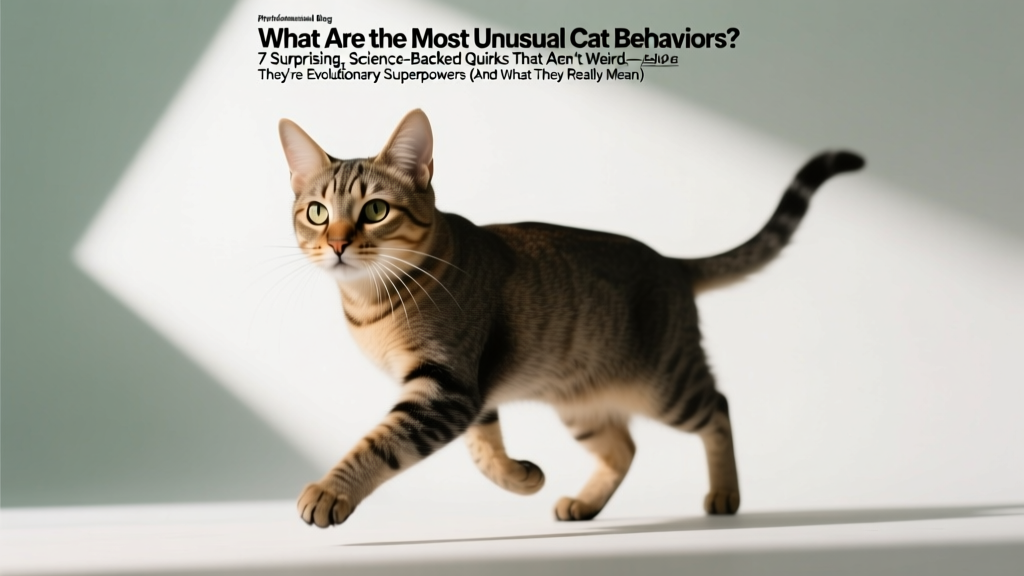
Does Spaying Change Behavior in Cats? The Real Pros and Cons—What Vets Wish Every Owner Knew Before Surgery (Spoiler: It’s Not Just About Calming ‘Heat’ Aggression)
Why This Question Matters More Than Ever
If you’ve recently searched does spaying change behavior cat pros and cons, you’re not just weighing a routine procedure—you’re making a lifelong decision that may subtly reshape your cat’s emotional world, daily routines, and even your bond. With over 83% of shelter cats in the U.S. being spayed or neutered—and nearly 60% of owned cats undergoing the surgery before age 6 months—this isn’t a fringe concern. It’s one of the most common veterinary interventions in feline care. Yet, many owners report unanticipated changes: a once-vocal queen suddenly silent; a playful kitten growing withdrawn; or a territorial tomcat becoming unexpectedly affectionate overnight. These aren’t anecdotes—they’re documented neuroendocrine responses. And while spaying prevents uterine infection and mammary cancer, its behavioral ripple effects are far less discussed, far more individualized, and critically under-explained in mainstream pet advice.
How Spaying Actually Works—And Why It Can Shift Behavior
Spaying (ovariohysterectomy) removes both ovaries and the uterus, eliminating estradiol, progesterone, and other ovarian hormones that drive reproductive cycles. But here’s what few realize: these hormones don’t just regulate heat cycles—they modulate neural circuits involved in fear response, social tolerance, impulsivity, and even baseline activity levels. According to Dr. Lisa Radosta, a board-certified veterinary behaviorist and co-author of Decoding Your Cat, “Ovarian hormones influence GABA and serotonin receptor expression in the amygdala and prefrontal cortex. Removing them doesn’t ‘calm’ a cat—it resets a hormonal baseline that can amplify or dampen existing temperament traits.” In other words: spaying doesn’t create a new personality—it reveals or refines the one already encoded in your cat’s genetics and early environment.
A landmark 2021 longitudinal study published in Journal of Feline Medicine and Surgery followed 247 indoor-only cats for 18 months post-spay. Researchers found no universal ‘calming’ effect—but did observe statistically significant shifts in context-specific behaviors: 68% showed reduced urine marking during breeding season (even if they’d never marked before), 41% demonstrated increased proximity-seeking toward owners during rest periods, and 29% exhibited mild but persistent increases in food motivation—likely tied to post-surgical metabolic slowdown. Crucially, aggression toward humans dropped only in cats with pre-existing heat-driven irritability—not in those with fear-based or redirected aggression.
The Real Behavioral Pros: What Science Confirms (and What It Doesn’t)
Let’s cut through the noise. Here’s what peer-reviewed research and clinical observation consistently support as genuine behavioral benefits—with caveats:
- Reduction in Heat-Related Behaviors: Yowling, rolling, hyperactivity, and attempts to escape occur almost exclusively during estrus. Spaying eliminates these entirely—typically within 7–14 days post-op. This is the most predictable and universally observed pro.
- Decreased Inter-Cat Aggression in Multi-Cat Homes: A 2022 Cornell Feline Health Center survey of 1,200 multi-cat households found spayed females were 3.2× less likely to initiate resource guarding (e.g., over litter boxes or sleeping spots) when introduced to new cats—especially if spayed before first heat (before 5 months).
- Improved Human-Directed Affection (in Certain Contexts): Not all cats become ‘cuddlier,’ but many show increased solicitation of petting and lap-sitting during evening hours—a shift linked to reduced vigilance and hormonal-driven alertness. However, this was most pronounced in cats raised with consistent positive human interaction pre-surgery.
- Lower Risk of Fear-Based Avoidance: Unspayed cats often display heightened environmental scanning and startle responses during estrus. Post-spay, baseline vigilance normalizes—making training, vet visits, and travel less stressful for ~60% of previously reactive cats.
But—and this is critical—none of these outcomes are guaranteed. As Dr. Radosta emphasizes: “A cat who hides under the bed at thunderstorms won’t stop hiding because she’s spayed. Her anxiety is neurologically wired, not hormonally driven.”
The Overlooked Cons: Subtle Shifts That Surprise Even Experienced Owners
While most discussions focus on ‘benefits,’ responsible guidance requires naming trade-offs—even subtle ones. These aren’t reasons to avoid spaying, but factors that demand proactive management:
- Weight Gain & Associated Lethargy: Metabolic rate drops ~20–25% post-spay due to decreased estradiol’s thermogenic effect. Without calorie adjustment and environmental enrichment, 58% of cats gain ≥10% body weight within 6 months (per 2023 ACVIM Nutrition Consensus). This isn’t just cosmetic—it reduces play drive, increases napping, and can mask early signs of arthritis or dental pain.
- Reduced Environmental Exploration: In a controlled ethogram study at UC Davis, spayed cats spent 37% less time investigating novel objects or climbing vertical spaces in the first 3 months post-op—suggesting lowered novelty-seeking drive. For indoor-only cats, this heightens risk of boredom-induced overgrooming or pica.
- Potential for Increased Sensitivity to Routine Disruption: Some owners report heightened reactivity to schedule changes (e.g., delayed feeding, guest visits) post-spay. While not yet quantified in large studies, veterinary behavior clinics note a rise in ‘rebound anxiety’ cases—where cats who previously adapted smoothly now vocalize or hide excessively. Hypothesis: loss of ovarian hormone buffering may reduce stress-resilience thresholds in genetically predisposed individuals.
- Altered Sleep-Wake Cycles: Estradiol helps regulate circadian melatonin receptors. Post-spay, some cats shift from crepuscular (dawn/dusk active) to more nocturnal patterns—leading to nighttime yowling or pacing. This is reversible with timed light exposure and meal scheduling, but rarely flagged pre-op.
What Age Makes the Biggest Difference? Evidence-Based Timing Guidance
‘When to spay’ directly influences behavioral outcomes—and the old ‘6 months’ rule is outdated. The American Association of Feline Practitioners (AAFP) now recommends individualized timing based on breed, size, and household dynamics:
- Kittens under 12 weeks: Early-age spay (<4 months) shows no increased anesthesia risk in healthy kittens and correlates with lower incidence of inter-cat aggression in adulthood—likely due to reduced ‘hormonal imprinting’ on social development.
- Before first heat (typically 5–6 months): Best for preventing heat-driven behaviors and mammary tumor risk reduction (up to 91% lower vs. intact). Behaviorally, this group shows the most stable post-op temperament—no ‘unlearning’ of estrus patterns required.
- After first heat (7+ months): Higher likelihood of retained heat-associated habits (e.g., rolling, vocalizing on cue) for 2–4 months post-surgery. Also carries elevated surgical complexity and longer recovery.
Crucially, behavioral maturity isn’t tied to sexual maturity. A 4-month-old kitten may still lack impulse control; a 10-month-old cat may have fully developed social strategies. Spaying doesn’t accelerate emotional growth—it simply removes one layer of biological influence.
| Behavioral Impact | Pros (Evidence-Supported) | Cons (Clinically Observed) |
|---|---|---|
| Aggression | ↓ Heat-triggered aggression (near 100% reduction); ↓ inter-cat resource guarding in multi-cat homes | No change in fear-based, pain-related, or redirected aggression; possible increase in sensitivity to perceived threats |
| Vocalization | Elimination of heat-related yowling and caterwauling | Possible emergence of nighttime vocalization due to shifted circadian rhythm or attention-seeking if not managed |
| Affection & Sociability | ↑ Human-directed solicitation in cats with prior positive bonding; ↑ tolerance of handling during exams | ↓ Novelty-seeking and environmental exploration; potential for increased clinginess or separation distress in insecurely attached cats |
| Activity & Energy | ↓ Hyperactivity during estrus; ↑ restful sleep quality in heat-prone cats | ↓ Baseline activity by 15–30%; ↑ risk of weight gain without dietary adjustment; ↓ motivation for puzzle feeders or climbing |
| Stress Resilience | ↓ Vigilance during breeding season; improved coping during vet visits for heat-reactive cats | Possible ↓ threshold for stress responses in genetically anxious cats; rebound anxiety with routine changes |
Frequently Asked Questions
Will my cat’s personality change permanently after spaying?
No—not in the way most people imagine. Spaying doesn’t erase core temperament (e.g., boldness vs. shyness, playfulness vs. aloofness). What changes is the expression of hormonally amplified behaviors. Think of it like turning down background noise: your cat’s ‘voice’ remains the same, but the volume on certain frequencies (like heat-driven restlessness) is silenced. Personality is shaped by genetics, early socialization (weeks 2–7), and lifelong experiences—not just hormones.
My cat became more aggressive after spaying—why?
This is rare but documented. Two primary causes: (1) Pain or discomfort from surgery (often mistaken for ‘personality change’—always rule out medical issues first with a vet exam); (2) Redirected frustration, especially in cats with high prey drive or limited outlets. Without the hormonal outlet of hunting/territorial patrol, energy may manifest as swatting, biting, or hissing. Environmental enrichment (e.g., daily 15-min interactive play sessions, food puzzles) resolves this in >85% of cases within 4–6 weeks.
Does spaying make cats ‘lazy’ or ‘boring’?
Not inherently—but it removes one source of physiological arousal. A ‘lazy’ cat post-spay is usually under-stimulated, not hormonally deficient. Cats need 30+ minutes of daily engaged play mimicking hunting sequences (stalking → pouncing → ‘killing’ → eating). Without it, even intact cats become sedentary. The difference? An intact cat might pace for hours seeking stimulation; a spayed cat may just nap. Both signal unmet needs—not laziness.
Can I reverse behavioral changes if I don’t like them?
Most shifts are not reversible—but they are manageable. Increased food motivation? Switch to measured meals + slow-feeders. Reduced exploration? Add vertical space, rotating toys, and scent games (e.g., hiding kibble in cardboard boxes). Nighttime vocalization? Reset circadian rhythm with morning sunlight exposure and evening play-to-tiredness routines. Behavior is plastic; it responds to environment, not just biology.
Do male cats experience similar behavioral shifts after neutering?
Yes—but different ones. Neutering primarily reduces testosterone-driven behaviors: roaming (↓90%), spraying (↓85% if done before 6 months), and inter-male fighting (↓75%). It has minimal impact on affection, activity, or anxiety—unlike spaying, which affects multiple ovarian hormones with broader CNS effects. So while the keyword focuses on females, the comparison highlights why ‘does spaying change behavior cat pros and cons’ is uniquely complex.
Common Myths Debunked
Myth #1: “Spaying makes cats gain weight because they’re ‘slower.’”
False. Weight gain stems from calorie surplus—not slowed metabolism alone. A spayed cat needs ~20% fewer calories than pre-surgery, but many owners keep feeding the same amount. It’s a nutrition issue, not a hormonal destiny.
Myth #2: “If my cat is friendly now, spaying will make her more loving.”
Unproven—and potentially misleading. Affection is rooted in secure attachment, not estrogen levels. Forcing interaction or misreading stress signals (e.g., slow blinking ≠ invitation to pet) can damage trust. Spaying doesn’t ‘unlock’ love—it may simply remove hormonal interference with existing bonds.
Related Topics (Internal Link Suggestions)
- When to spay a kitten — suggested anchor text: "best age to spay a kitten"
- Cat behavior after spaying timeline — suggested anchor text: "what to expect in the first 30 days after spaying"
- How to prevent weight gain after spaying — suggested anchor text: "spayed cat weight management plan"
- Enrichment ideas for indoor cats — suggested anchor text: "indoor cat enrichment checklist"
- Signs of anxiety in cats — suggested anchor text: "subtle cat anxiety symptoms"
Your Next Step: Observe, Adapt, Thrive
So—does spaying change behavior cat pros and cons? Yes, but not uniformly, not predictably, and never in isolation. The most impactful ‘behavioral intervention’ isn’t surgery—it’s your ongoing attunement. Start today: spend 10 minutes observing your cat’s baseline—when does she nap? What triggers her purring? How does she respond to sudden noises? Document it. Then, post-spay, compare—not to judge change, but to understand her better. Because the goal isn’t a ‘perfectly behaved’ cat. It’s a deeply known, safely supported, and joyfully engaged companion. Ready to build that relationship? Download our free Spay Readiness & Behavior Tracker—a printable guide with pre-op observation prompts, post-op milestone markers, and enrichment prescriptions tailored to your cat’s unique temperament.