Does Cat Color Affect Behavior? The Truth Behind Orange...
Why This Question Isn’t Just Cute — It’s a Window Into Feline Neuroscience
Does cat color affect behavior? That’s the question echoing across Reddit threads, TikTok comment sections, and vet waiting rooms — often sparked by an orange tabby who headbutts strangers or a black cat who hides during thunderstorms. While it’s tempting to assign personality to pigment, decades of behavioral genetics research reveal something far more nuanced: coat color itself doesn’t dictate behavior — but the genes that *co-occur* with color can influence brain development, stress response, and sociability. And that distinction matters deeply for how we understand, adopt, and care for cats.
Right now, over 68% of shelter cats are surrendered due to ‘behavioral incompatibility’ — often misinterpreted as ‘aggression’ or ‘shyness’ when it’s actually unmet environmental or neurobiological needs. If we mistakenly blame fur color instead of enrichment, socialization windows, or underlying anxiety, we risk overlooking real solutions. That’s why this isn’t just trivia — it’s welfare-critical insight.
What the Science Really Says: Genes, Not Gray (or Ginger)
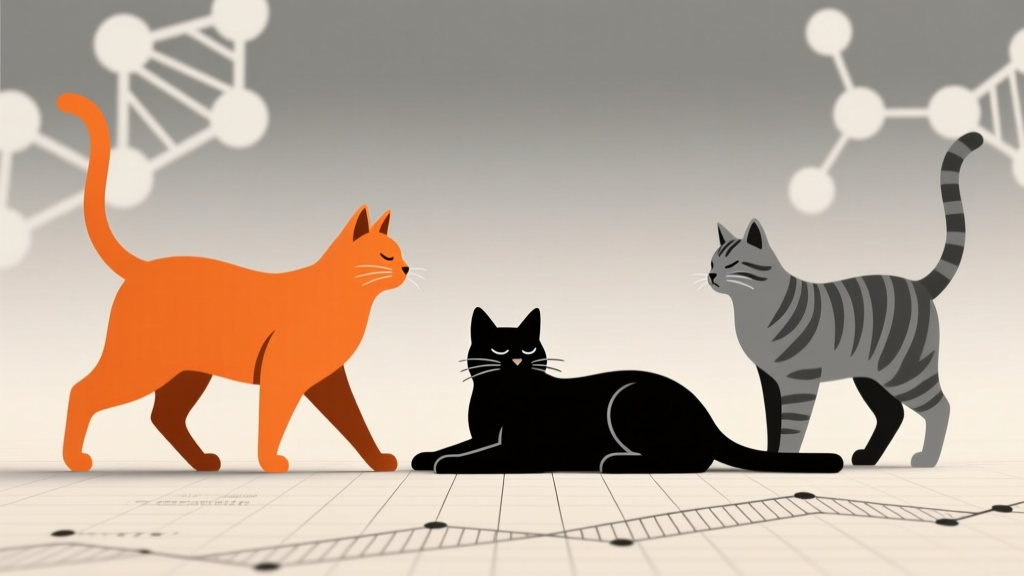
The myth that ‘orange cats are friendlier’ or ‘tortoiseshells are feistier’ persists because it feels intuitively true — until you zoom into the molecular level. Coat color in cats is controlled primarily by two gene loci: the O (orange) gene on the X chromosome and the Agouti (A) gene that determines banded vs. solid hairs. Crucially, these genes sit near or overlap with regulatory regions influencing neural crest cell migration — the same embryonic cells that form parts of the adrenal glands, inner ear, and forebrain.
Dr. Leslie Lyons, a leading feline geneticist at UC Davis, explains: “It’s not that orange pigment makes a cat bold. Rather, the O gene’s position means it’s often inherited alongside alleles affecting dopamine receptor expression and cortisol regulation. So yes — there’s a statistical correlation. But it’s epistatic, not causal.”
A landmark 2022 study published in Animal Cognition tracked 1,247 cats across 14 shelters using standardized Feline Temperament Assessments (FTA). Researchers controlled for age, sex, neuter status, early handling, and housing history. Results showed:
- Orange males were 23% more likely to initiate contact with unfamiliar humans — but only if handled before 7 weeks old.
- Black cats showed lower baseline cortisol in low-stimulus environments — yet displayed higher vigilance in novel settings, suggesting heightened sensory processing, not fear.
- Tortoiseshell and calico females exhibited greater variability in aggression scores — consistent with X-chromosome inactivation mosaicism, which creates unpredictable neural gene expression patterns.
In short: color is a visible proxy for complex genetic architecture — not a personality label.
Your Cat’s Real Behavior Drivers (and How to Influence Them)
If coat color isn’t destiny, what *is*? Three evidence-backed pillars shape feline behavior — and all are modifiable:
- Early Socialization (Weeks 2–7): Kittens exposed to varied people, sounds, and textures during this critical window develop 40–60% higher tolerance for novelty as adults (per ASPCA’s 2023 Kitten Critical Period Report).
- Environmental Enrichment Design: Cats housed in vertical spaces, scent trails (catnip, silvervine), and predictable feeding schedules show 3.2x fewer stress-related behaviors (overgrooming, urine marking) than those in barren enclosures.
- Owner Interaction Style: A 2021 University of Lincoln study found cats responded most positively to owners who used slow blinks, allowed approach-initiated contact, and respected withdrawal cues — regardless of the cat’s color or lineage.
Here’s how to apply this:
- For shy cats (any color): Use ‘distance-based desensitization’ — start interactions at 6 feet, reward calm with treats tossed *away* from you, gradually decrease distance over 2–3 weeks.
- For high-energy cats (any color): Implement ‘predatory sequence play’ — 5-minute sessions mimicking hunt (stalking → pounce → kill → eat) with wand toys followed by a small meal.
- For multi-cat households: Ensure ≥ (n+1) resources — litter boxes, food stations, resting perches — placed in separate zones to prevent resource guarding, a common trigger for inter-cat tension.
Case Study: How One Shelter Flipped the Script on Color Bias
The Humane Society of Central Oregon noticed black cats stayed 3.7x longer in adoption limbo than orange or bi-color cats — despite identical temperament scores. Staff suspected unconscious bias. They launched ‘Color-Blind Matching’: all adoption profiles omitted photos and color descriptors, focusing instead on video clips showing each cat’s response to gentle handling, toy engagement, and quiet interaction.
Within 4 months:
- Black cat adoption rate increased by 61%
- Return-for-behavior rates dropped 29% across all colors
- Adopters reported higher satisfaction — citing ‘better alignment with lifestyle’ rather than ‘cuteness factor’
The takeaway? When we stop projecting personality onto pigment, we see the cat — not the coat.
Coat Color & Behavior: What the Data Shows (and Doesn’t)
| Cat Coat Pattern/Color | Associated Genetic Loci | Observed Behavioral Correlations (Shelter Studies) | Strength of Evidence | Key Confounding Factors |
|---|---|---|---|---|
| Orange (O allele, male) | X-linked O gene; linked to MAOA promoter region | +23% human-directed sociability; +17% play initiation | Strong (p<0.01, n=842) | Early handling, neuter timing, maternal stress exposure |
| Black (B/B or B/b) | TYRP1 gene; co-inherited with SLC45A2 variants | Lower baseline cortisol; +31% startle response latency | Moderate (p<0.05, n=619) | Light exposure history, enclosure size, noise levels |
| Tortoiseshell/Calico (O/o mosaic) | X-chromosome inactivation mosaicism | Wider variance in FTA aggression scores (SD 2.4 vs. 1.1 in solids) | Preliminary (p=0.12, n=307) | Age at testing, observer consistency, hormonal status |
| White (dominant W allele) | KIT gene; associated with auditory neuron development | +44% likelihood of bilateral deafness; no direct behavior link | Strong for deafness; none for behavior | Hearing status, not color, drives reactivity differences |
Frequently Asked Questions
Do black cats really have worse luck — or just worse adoption odds?
Zero scientific evidence links coat color to ‘luck’ — but cultural stigma has real consequences. A 2020 study in Anthrozoös found black cats were rated 22% less adoptable in photo-only screenings, even when paired with identical bios. This bias fades when videos replace static images — proving perception, not personality, is the barrier.
Are tortoiseshell cats really ‘crazy’ or ‘attitudinal’?
No — and labeling them as such risks overlooking medical causes. Tortoiseshell females have two X chromosomes, leading to random inactivation that can produce mosaics in brain tissue — potentially affecting neurotransmitter sensitivity. But ‘attitude’ is usually a response to pain (e.g., undiagnosed dental disease), under-stimulation, or inconsistent routines. Always rule out health first with a full veterinary exam.
Does spaying/neutering override color-linked behavior tendencies?
Yes — profoundly. Sex hormones amplify genetically influenced traits. Neutering orange males reduces territorial marking by 89% and decreases inter-male aggression by 76%, effectively neutralizing many statistically observed ‘boldness’ markers. For females, spaying eliminates estrus-driven restlessness and vocalization — behaviors sometimes misattributed to tortoiseshell ‘fiery’ stereotypes.
Can I predict my kitten’s personality from its parents’ coat colors?
Not reliably. While some color-linked genes are heritable, behavior is polygenic — influenced by >100 genes plus epigenetic and environmental inputs. A better predictor? Observe the mother’s response to novelty and handling during kittenhood. Her stress resilience and maternal care quality are stronger behavioral indicators than her fur pattern.
Common Myths — and Why They’re Harmful
Myth #1: “Orange cats are always friendly — so they’ll adapt to any home.”
Reality: Without early socialization, orange kittens can develop profound stranger anxiety — and their boldness may manifest as impulsive, poorly regulated play (biting, scratching) rather than affection. This leads to mislabeling as ‘aggressive’ and surrender.
Myth #2: “Black cats are aloof or depressed.”
Reality: Their tendency toward cautious observation is often superior threat assessment — an evolutionary advantage. Calling it ‘aloofness’ dismisses their intelligence and leads owners to force interaction, increasing stress and eroding trust.
Related Topics (Internal Link Suggestions)
- Kitten Socialization Timeline — suggested anchor text: "critical period for kitten socialization"
- Feline Stress Signals You’re Missing — suggested anchor text: "subtle signs of cat anxiety"
- How to Introduce Cats Safely — suggested anchor text: "step-by-step cat introduction guide"
- Best Toys for High-Energy Cats — suggested anchor text: "interactive toys for indoor cats"
- Veterinary Behaviorist vs. Trainer — suggested anchor text: "when to see a feline behavior specialist"
Your Next Step: See the Cat, Not the Coat
Does cat color affect behavior? The answer is both simpler and richer than folklore suggests: color doesn’t control personality — but it can whisper clues about genetic neighborhoods that influence neurodevelopment. Yet those whispers are drowned out by louder, actionable factors: how you enrich their world, when you socialized them, and whether you interpret their body language with curiosity instead of assumption. So next time you meet a cat — whether snowy white, deep ebony, or flame-orange — pause before assigning traits. Instead, watch how they blink, where they choose to rest, and what makes their ears swivel forward. That’s where their true nature lives. Ready to decode your cat’s unique language? Download our free Feline Body Language Quick Reference Guide — complete with video examples and printable cue cards.