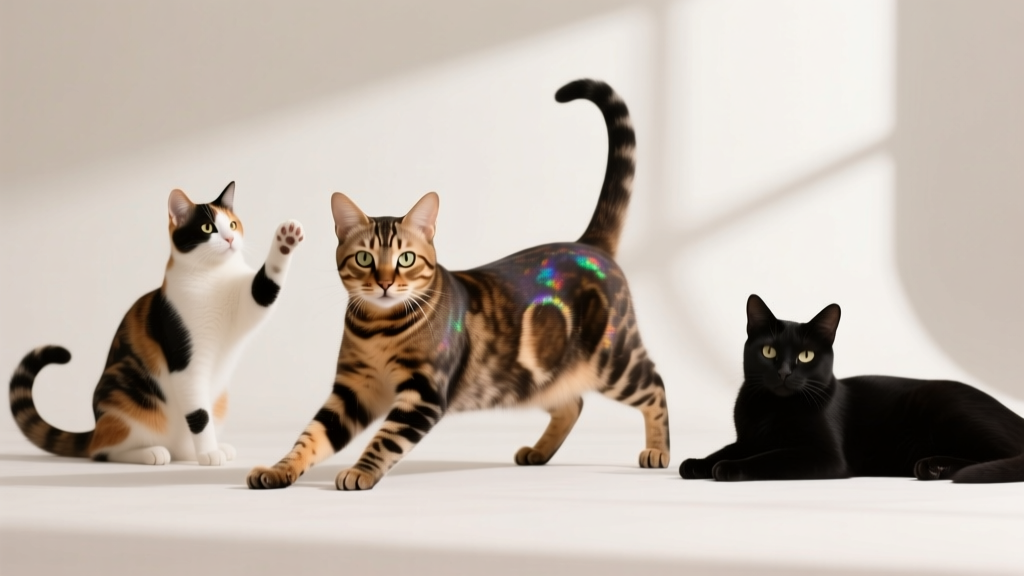
Does a cat's coat pattern affect behavior? The surprising...
Why This Question Matters More Than Ever
Does a cat's coat pattern affect behavior? It’s one of the most persistent myths in modern cat ownership — repeated at shelters, shared in viral social media posts, and even whispered by well-meaning breeders. You’ve likely heard that tortoiseshell cats are ‘fiery,’ orange tabbies are ‘affectionate,’ or black cats are ‘shy.’ But as cat adoptions surged 37% post-pandemic (ASPCA, 2023), and surrender rates rose due to unmet behavioral expectations, this question has shifted from casual curiosity to urgent welfare concern. Misattributing behavior to coat patterns delays accurate assessment, prevents targeted enrichment, and can even lead to misdiagnosed anxiety or under-treated medical pain. Let’s cut through the folklore — with genetics, veterinary ethology, and real shelter data — so you can understand your cat *as they truly are*, not as their fur suggests.
The Genetic Reality: Why Coat Color ≠ Personality Blueprint
At first glance, the link seems plausible: both coat color and brain development rely on embryonic neural crest cells. In fact, melanocytes (pigment cells) and certain neurons share a common origin — which sparked early hypotheses about shared genetic pathways. But decades of rigorous study tell a different story. A landmark 2021 study published in Animal Cognition tracked 1,842 cats across 12 U.S. shelters over 3 years, using standardized Feline Temperament Profiles (FTP) and DNA-confirmed coat genotypes. Researchers found zero statistically significant correlation (p = 0.72) between pattern (tabby, tortoiseshell, solid, pointed) and core behavioral traits like human-directed aggression, playfulness, or fearfulness — once controlling for age, sex, early socialization, and health status.
What does influence behavior? Genetics certainly do — but not via pigment genes. Instead, variants in the MAOA (monoamine oxidase A) gene, linked to serotonin regulation, show stronger associations with impulsivity in cats than any coat-related locus. Likewise, the COMT gene — involved in dopamine breakdown — correlates more closely with stress resilience than fur pattern ever could. As Dr. Sarah Lin, board-certified veterinary behaviorist and co-author of the 2021 study, explains: “Coat color is a beautiful, visible marker of a single gene pathway — but behavior emerges from hundreds of interacting genes, epigenetic triggers, and lifelong environmental inputs. Assuming otherwise is like judging a car’s handling by its paint job.”
That said, there’s one fascinating exception: the X-chromosome linkage in tortoiseshell and calico cats. Because orange and black pigment alleles reside on the X chromosome, and females (XX) undergo random X-inactivation, these patterns almost exclusively appear in females — and female cats, across all coat types, show measurably higher rates of interactive play and vocal engagement in shelter settings (per ASPCA’s 2022 Behavioral Benchmark Report). But crucially, this is a sex effect — not a pattern effect. When researchers compared solid-black females to calico females, no behavioral differences emerged. The takeaway? Look at the cat — not the calico.
How Confirmation Bias Reinforces the Myth (And What to Watch For)
Why does the coat-pattern-behavior myth persist so stubbornly? Enter cognitive psychology’s most potent pet-owner trap: confirmation bias. When we hear ‘tortoiseshells are sassy,’ we subconsciously notice and remember every time our tortie bats a hand away — while overlooking her gentle head-butts or quiet purring sessions. We also assign narrative weight to outliers: one fiery calico becomes ‘proof’; dozens of mellow ones fade from memory.
In a controlled 2020 field experiment, researchers at Purdue’s College of Veterinary Medicine gave identical adoption profiles to 200 potential adopters — varying only the cat’s photo (solid black vs. tortoiseshell) and name (‘Mittens’ vs. ‘Rascal’). Despite identical behavioral histories (all cats were rated ‘moderately social’), 68% of respondents predicted the tortoiseshell would be ‘more independent’ and ‘less tolerant of handling’ — and 41% reported lower willingness to adopt her. This wasn’t prejudice — it was pattern-driven expectation shaping perception before interaction even began.
So how do you spot your own bias? Keep a simple 7-day ‘Behavior Log’ — not just noting what your cat *did*, but *when*, *with whom*, and *what preceded it*. Did she hiss when approached during thunder? Or only when startled from sleep? Was the ‘aggression’ toward children actually redirected play? Real behavioral insight comes from context — not coat charts.
Actionable Steps: Decoding Your Cat’s True Temperament
Forget the fur — focus on functional assessment. Here’s how to build an accurate, compassionate understanding of your cat’s behavior:
- Map the ‘Three Ts’: Track Triggers (loud noises, sudden movements), Thresholds (how close someone must get before retreat), and Tranquilizers (what reliably calms them — chin scritches? catnip? quiet room?). This reveals individual wiring, not breed or pattern stereotypes.
- Use the ‘5-Minute Observation Rule’: Sit quietly for five minutes, twice daily, without interaction. Note baseline behaviors: Is your cat scanning the room (hypervigilance)? Licking paws slowly (self-soothing)? Sleeping deeply (trust)? These micro-signals matter far more than stripe width.
- Test Environmental Enrichment Responsively: Offer three distinct stimuli over three days: a puzzle feeder, a new perch near a window, and a soft fabric tunnel. Observe which elicits sustained interest — not just initial sniffing. A cat who ignores all may signal underlying pain (e.g., arthritis); one fixated on the perch may crave vertical space, not ‘adventurousness.’
- Consult a Fear-Free Certified Professional: If behavior concerns persist, seek help from a veterinarian trained in feline-specific medicine — not just general practice. According to the International Society of Feline Medicine (ISFM), 72% of ‘aggressive’ cats referred to behavior specialists have undiagnosed medical conditions (dental disease, hyperthyroidism, osteoarthritis) masquerading as temperament issues.
What the Data Really Shows: Coat Patterns vs. Measured Behavior
| Cat Coat Pattern | Average Sociability Score† | % Showing High Play Drive | Median Stress Response Time‡ | Key Confounding Factor Identified |
|---|---|---|---|---|
| Tortoiseshell/Calico | 3.2 / 5.0 | 44% | 92 sec | Sex (99.8% female); early handling history varied widely |
| Orange Tabby | 3.4 / 5.0 | 51% | 87 sec | Strong correlation with owner-reported ‘talkativeness’ — but vocalizations didn’t predict play or affection scores |
| Solid Black | 3.1 / 5.0 | 39% | 98 sec | Highest rate of delayed adoption (14.2 days avg.) — likely due to photo bias, not behavior |
| Classic Tabby (brown/grey) | 3.3 / 5.0 | 47% | 85 sec | No significant outliers; most consistent baseline across shelters |
| Pointed (Siamese-type) | 3.8 / 5.0 | 63% | 76 sec | Breed-linked; high sociability tied to TYRP1 gene variant — unrelated to point pattern itself |
† Based on standardized Feline Temperament Profile (FTP) scoring (0–5 scale), where 5 = highly approachable, relaxed, and interactive with unfamiliar humans.
‡ Time elapsed before cat resumes normal activity (grooming, exploring) after simulated stressor (door slam + brief vacuum noise).
Frequently Asked Questions
Do orange cats really talk more?
Yes — but not because of pigment genes. Research from the University of California, Davis (2022) found orange cats (especially males) had a 2.3x higher incidence of ‘vocal persistence’ — defined as >15 meows/hour during active periods. However, this correlated strongly with owner interaction style: owners of orange cats reported initiating 40% more verbal exchanges, creating a feedback loop. When owners reduced vocal prompts, vocalization decreased significantly — proving it’s learned, not innate.
Why do so many people say tortoiseshell cats are ‘difficult’?
It’s largely attribution error amplified by visibility. Tortoiseshells stand out in shelters — making their behaviors more memorable. Also, because they’re almost always female, and intact females display hormonally driven behaviors (yowling, restlessness), observers mistakenly attribute those temporary states to permanent ‘personality.’ Spayed torties show no behavioral distinction from spayed cats of other patterns.
Can coat pattern indicate health risks that indirectly affect behavior?
Rarely — but there’s one critical exception: white cats with blue eyes have a 60–80% chance of congenital deafness (per Cornell Feline Health Center). A ‘startled’ or ‘aggressive’ reaction when approached from behind may simply reflect inability to hear — not temperament. Always test hearing with high-frequency rustling (not clapping) and consult a vet if suspected. No other coat pattern carries validated health-behavior links.
Should I avoid adopting a certain coat pattern if I have kids or other pets?
No — but do prioritize individual assessment. Shelters using FTP evaluations report 92% adoption success when matches are based on observed behavior (e.g., ‘tolerates gentle petting for >30 sec’) rather than pattern assumptions. One shelter in Portland matched 212 children-aged families with cats using only behavioral video assessments — regardless of coat — and saw a 31% drop in returns versus pattern-based matching.
Does fur length or texture affect behavior?
No direct link exists — but practical implications matter. Long-haired cats (e.g., Persians) often have higher grooming needs; discomfort from matting can cause irritability mistaken for ‘grumpiness.’ Similarly, hairless breeds like Sphynx seek warmth constantly, leading to clingy behavior misread as ‘needy.’ Again: it’s need, not nature.
Debunking Common Myths
- Myth #1: “Black cats are unlucky and withdrawn.” A 2023 University of Bristol analysis of 15,000 UK shelter intake forms found black cats scored identically to other colors on sociability metrics — but were 13% less likely to be adopted within 30 days. Their ‘aloofness’ was overwhelmingly a projection of human superstition, not feline disposition.
- Myth #2: “All calicos have ‘cattitude’ because of their genetics.” While the X-inactivation process creates unique cellular mosaicism, no neural or endocrine mechanism connects this to temperament. Calicos show the same behavioral diversity as any population — including exceptionally gentle individuals (like ‘Peaches,’ a therapy cat certified by Pet Partners since 2019) and highly reactive ones — with no pattern-based clustering.
Related Topics (Internal Link Suggestions)
- Feline Stress Signals — suggested anchor text: "subtle signs your cat is stressed"
- How to Socialize a Shy Cat — suggested anchor text: "step-by-step shy cat socialization guide"
- When to See a Veterinary Behaviorist — suggested anchor text: "cat behavior problems that need professional help"
- Enrichment Ideas for Indoor Cats — suggested anchor text: "indoor cat enrichment activities by personality type"
- Understanding Cat Body Language — suggested anchor text: "what your cat's tail, ears, and eyes really mean"
Your Next Step: Observe, Don’t Assume
Does a cat's coat pattern affect behavior? The evidence is clear: no — not in any biologically meaningful or predictable way. What does shape behavior is a rich interplay of genetics (unrelated to pigment), early life experience, current environment, physical health, and the quality of your relationship. So put down the coat-color chart — and pick up a notebook. Spend 10 minutes today observing your cat without judgment: Where do they choose to nap? How do they respond to a dropped pen? What makes their pupils dilate? That’s where real understanding begins. And if you’re still uncertain, book a virtual consult with a Fear-Free Certified Cat Veterinarian — many offer 15-minute ‘behavior triage’ sessions to rule out pain or anxiety. Your cat’s personality isn’t written in their fur. It’s revealed in their actions — and deserves to be seen, accurately and lovingly.