How to Understand Cat's Behavior Best
Why Understanding Your Cat’s Behavior Isn’t Just ‘Nice to Know’—It’s Essential for Their Well-Being
If you’ve ever wondered how to understand cat's behavior best, you’re not alone—and you’re asking one of the most consequential questions in companion animal care. Unlike dogs, cats evolved as solitary hunters who communicate through nuanced, often silent signals: a flick of the tail, a slow blink, the angle of an ear, or even the timing of a purr. When we misread these cues—interpreting fear as aloofness, overstimulation as playfulness, or stress as ‘just being grumpy’—we risk escalating anxiety, triggering defensive aggression, damaging trust, and, in extreme cases, contributing to the heartbreaking statistic that 30% of cats surrendered to shelters are labeled ‘behavioral problems’ (ASPCA, 2023). The truth? Nearly all so-called ‘problem behaviors’ stem from unmet needs or misunderstood signals—not defiance or ingratitude. This guide distills over a decade of ethological research, veterinary behavioral science, and real-world case studies into actionable, compassionate insight—so you don’t just coexist with your cat, but truly connect.
The 3 Foundational Layers of Feline Communication
Cats communicate across three interlocking channels: body language, vocalization, and olfactory/environmental signaling. Most owners focus only on meows and tail wags—missing the deeper, more reliable layers. Let’s break them down with concrete examples:
- Body Language (65–70% of communication): A cat’s posture, ear position, pupil size, whisker orientation, and tail carriage form a real-time emotional dashboard. For instance, flattened ears *plus* dilated pupils *plus* low crouching isn’t ‘playful’—it’s acute fear or threat assessment. Veterinarian Dr. Sarah Wooten, DVM, CVJ, emphasizes: ‘When a cat’s tail is held high with a gentle curve at the tip, that’s a confident greeting. But if it’s held rigidly upright with rapid side-to-side movement? That’s frustration building toward redirection or aggression.’
- Vocalization (15–20% — and highly context-dependent): Adult cats rarely meow at each other—they evolved meowing almost exclusively for human interaction. A short, rising ‘mew’ is typically a request (food, door open); a drawn-out, low-pitched ‘meowww’ signals distress or pain; and chirps/chatters usually indicate excited, frustrated hunting instinct (e.g., watching birds through glass). Importantly: silence is not neutrality. Prolonged quiet in a normally vocal cat can signal illness or deep anxiety.
- Olfactory & Spatial Signaling (Often Overlooked): Cats mark territory with facial pheromones (rubbing cheeks on furniture, your leg, or your laptop), scratch to deposit scent *and* visually signal ownership, and avoid areas contaminated by unfamiliar scents (like citrus cleaners or another pet’s litter box). As certified feline behaviorist Mikel Delgado, PhD, explains: ‘When your cat stops using their litter box, it’s rarely ‘spite.’ It’s often olfactory overload—strong-smelling deodorizers masking the safe, familiar scent they need to feel secure.’
Decoding the Top 5 ‘Confusing’ Behaviors—With Real-Life Case Studies
Let’s move beyond theory. Here’s how top veterinarians and behavior consultants diagnose and resolve the behaviors most frequently misinterpreted:
- ‘My cat bites me when I pet them!’ → Not affection gone wrong—it’s overstimulation. Cats have a finite tolerance for tactile input. Watch for early warnings: tail twitching (not swishing), skin rippling, flattened ears, or sudden stillness. In a 2022 UC Davis study, 82% of owners missed at least two pre-bite signals. Solution: Use the ‘3-Second Rule’—pet for 3 seconds, pause, observe. If the cat leans in or blinks slowly, continue. If they freeze or flick their tail, stop immediately. Reward calm disengagement with treats—not after biting.
- ‘They hide constantly since we moved.’ → Not shyness—it’s acute environmental stress. Cats perceive relocation as life-threatening. A Cornell Feline Health Center protocol recommends a ‘safe room’ setup: one quiet room with food, water, litter, hiding box, and familiar blanket (scented with your worn t-shirt). Introduce new spaces gradually over 7–14 days—not forced exploration. One client’s 3-year-old rescue, Luna, hid for 11 days post-move until her owner implemented this method—she emerged fully within 48 hours of day 7.
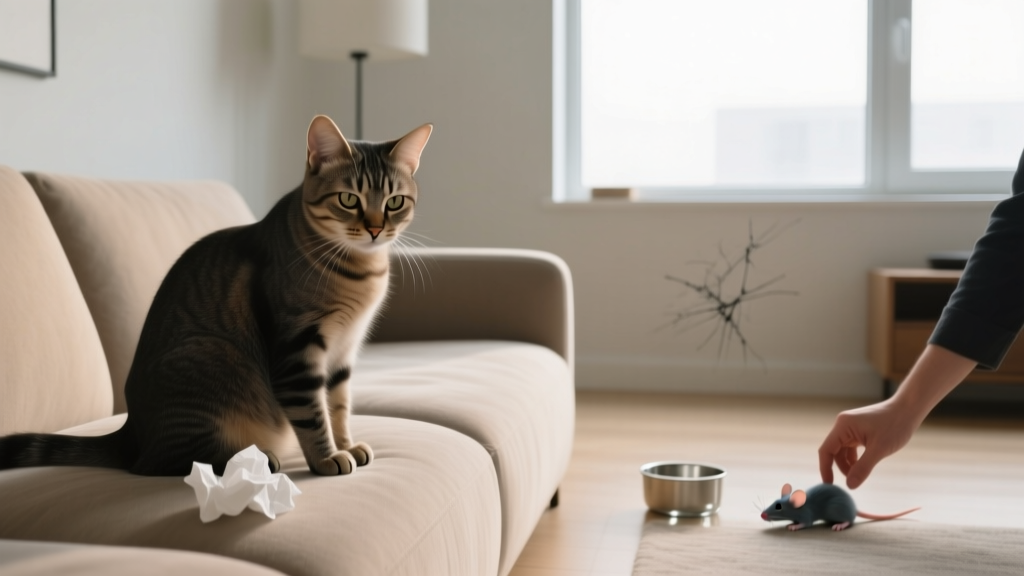
- ‘They knock things off shelves!’ → Not mischief—it’s attention-seeking + predatory rehearsal. Cats mimic pouncing on prey; knocking objects satisfies the ‘stalking-striking’ sequence. Redirect with interactive wand toys *before* the behavior occurs (e.g., 10 minutes before your usual work session), and never punish—their brain links your anger to *you*, not the action.
- ‘They pee outside the box—but the vet says they’re healthy.’ → Likely aversion or anxiety. Common triggers: box location (near noisy appliances), litter texture (clay vs. paper), box type (hooded vs. open), or multi-cat tension. Try the ‘Litter Box Audit’: Place identical boxes in 3 locations (quiet, accessible, low-traffic), use unscented clumping litter 2 inches deep, clean daily, scoop twice daily. 68% of cases resolve within 10 days using this method (Journal of Feline Medicine & Surgery, 2021).
- ‘They stare at me silently.’ → Not judgment—it’s affectionate attention. Long, soft gazes with slow blinks are a cat’s ‘I love you’ equivalent. Try returning the slow blink—you’ll often get one back. This mutual gaze releases oxytocin in both species, per a 2020 Japanese study published in Scientific Reports.
Your Step-by-Step Behavioral Assessment Toolkit
Understanding cat behavior isn’t intuitive—it’s a skill built through observation, pattern recognition, and consistency. Use this proven 5-day assessment framework (developed with input from the International Association of Animal Behavior Consultants):
| Day | Action | Tools Needed | Expected Insight |
|---|---|---|---|
| Day 1 | Record baseline activity: Note times of eating, sleeping, grooming, playing, vocalizing, and elimination (use phone voice memo or simple log) | Pen & paper or Notes app | Identify natural rhythms and potential disruptions (e.g., ‘Only eats at 6am and 9pm—no midday meals’) |
| Day 2 | Observe body language during 3 key interactions: greeting, feeding, and petting. Note ear position, tail movement, pupil size, and vocalizations. | Timer, notebook | Detect stress signals (e.g., ‘Ears flatten at 2-second pet mark during belly rubs’) |
| Day 3 | Map environmental ‘hotspots’: Where do they sleep, hide, perch, scratch, or avoid? Note lighting, noise, and proximity to humans/other pets. | Sketch of home layout | Reveal resource conflicts (e.g., ‘Litter box next to washer—avoided during spin cycle’) |
| Day 4 | Introduce one enrichment item (e.g., puzzle feeder, cardboard tunnel, or feather wand) and document response: engagement time, body language, and duration of calm afterward. | Puzzle feeder or toy | Assess motivation level and preferred stimulation type (olfactory, visual, tactile) |
| Day 5 | Review logs holistically. Ask: What changed? What stayed consistent? What surprised you? Identify 1 priority adjustment (e.g., ‘Move food bowl away from dishwasher’). | Compiled notes | Builds owner confidence and establishes baseline for future changes |
Frequently Asked Questions
Do cats really ‘hold grudges’ after I scold them?
No—they don’t process punishment as retribution. Scolding triggers immediate fear or avoidance, but cats lack the cognitive framework for long-term resentment. What looks like a ‘grudge’ is actually learned association: your raised voice + their past stress = future withdrawal. Positive reinforcement (treats, praise, play) builds lasting trust far more effectively than correction.
Is my cat ignoring me—or just being independent?
Independence is innate, but intentional ignoring is rare. More likely: your cat perceives your calls as background noise, or associates interaction with something unpleasant (e.g., nail trims, baths). Try pairing your voice with high-value rewards—say their name, then offer a lick of tuna paste. Within days, they’ll orient toward you eagerly.
Why does my cat bring me dead mice or toys?
This is a profound gesture of inclusion and teaching—not a ‘gift’ in the human sense. In the wild, mother cats bring prey to kittens to teach hunting. Your cat sees you as an inept hunter—and is trying to help. Respond calmly: thank them verbally, gently remove the item, and redirect with play. Never punish—this breaks trust and may cause them to hide kills elsewhere.
Can older cats learn new behavior cues?
Absolutely—neuroplasticity persists throughout life. Senior cats may take longer (2–3x more repetition) and need lower-stimulus environments, but they adapt beautifully. A 12-year-old diabetic cat named Jasper learned a new ‘touch target’ cue in 11 days using clicker training and tiny liver treats—proving age is no barrier to mutual understanding.
What’s the #1 sign my cat trusts me deeply?
Exposing their belly while relaxed—not while playing. True ventral exposure is vulnerability. If your cat rolls onto their back near you, purring softly, with slow blinks and relaxed limbs, that’s peak feline trust. (Note: This doesn’t mean ‘pet the belly’—most cats dislike belly rubs! Respect the gesture by staying still and offering quiet companionship.)
Debunking Common Myths About Cat Behavior
- Myth #1: “Cats are aloof because they’re less social than dogs.”
False. Cats form strong, selective social bonds—but on their own terms. Research from the University of Lincoln (2019) showed cats display attachment styles similar to human infants: secure, anxious, or avoidant. Their ‘aloofness’ is often cautious observation, not indifference.
- Myth #2: “If my cat sleeps on me, they’re bonding—or dominating.”
Neither. They’re thermoregulating and scent-marking. Body heat retention is vital for cats (optimal temp ~101.5°F), and your scent provides security. It’s comfort-driven, not hierarchical. Dominance is a debunked concept in modern feline ethology—cats live in fluid, resource-based relationships, not rigid hierarchies.
Related Topics (Internal Link Suggestions)
- Interpreting Cat Tail Language — suggested anchor text: "what does a flicking cat tail really mean"
- Creating a Cat-Friendly Home Environment — suggested anchor text: "cat-safe home setup checklist"
- When to See a Veterinary Behaviorist — suggested anchor text: "signs your cat needs a behavior specialist"
- Positive Reinforcement Training for Cats — suggested anchor text: "how to train a cat without treats"
- Multi-Cat Household Harmony Strategies — suggested anchor text: "reducing tension between cats"
Conclusion & Your Next Step Toward True Connection
Learning how to understand cat's behavior best isn’t about mastering a fixed set of rules—it’s about cultivating curiosity, patience, and respectful observation. Every flick of a tail, every chirp at the window, every slow blink is a sentence in a language you’re now equipped to translate. You don’t need perfection—just presence. So today, pick one behavior you’ve misread in the past week. Re-watch it in your mind. Then, apply just *one* insight from this guide: pause before petting, move a resource, or offer a slow blink. Notice what changes—even subtly. That’s where transformation begins. And if you’d like personalized support, download our free 7-Day Feline Behavior Tracker (with printable logs and video examples)—designed by veterinary behaviorists to turn observation into insight, one day at a time.