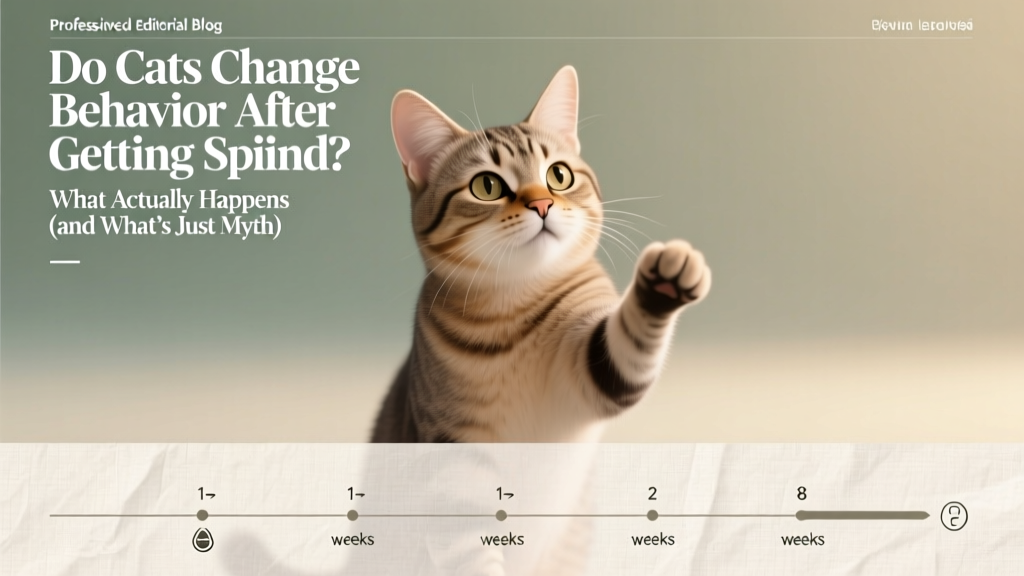
Do Cats Change Behavior After Getting Spayed?
Why Your Cat’s Personality Might Shift — And Why That’s Usually a Good Thing
Do cats change behavior after getting spayed? Yes — but not in the dramatic, personality-overwriting way many owners fear. In fact, most behavioral changes are subtle, gradual, and overwhelmingly positive: reduced roaming, less vocalization during heat cycles, and decreased territorial stress. Yet confusion abounds. Some adopters report their formerly independent cat suddenly seeking constant cuddles; others notice no difference at all — and wonder if something went wrong. The truth lies in biology, timing, and individual temperament. With over 85% of shelter cats in the U.S. spayed before adoption (ASPCA, 2023), understanding these shifts isn’t just helpful — it’s essential for long-term bonding, stress prevention, and recognizing true red flags.
What Science Says: Hormones, Brain Chemistry, and Real-World Observations
Spaying removes the ovaries (and often the uterus), eliminating estradiol and progesterone production. These hormones don’t just drive reproduction — they modulate neural pathways linked to anxiety, territoriality, and social motivation. A landmark 2021 study published in Frontiers in Veterinary Science tracked 217 spayed female cats over 12 weeks using owner-reported behavior logs and video-coded interactions. Researchers found that while 68% showed measurable reductions in heat-related behaviors (yowling, rolling, restlessness) within 7–10 days, only 22% exhibited meaningful shifts in baseline sociability or playfulness — and those changes were highly individualized. As Dr. Lena Torres, DVM and feline behavior specialist at Cornell’s Feline Health Center, explains: “We’re not ‘calming’ cats with surgery — we’re removing hormonal noise. What emerges is often their more authentic, unstressed self.”
This distinction matters. Owners expecting a ‘personality reset’ may misinterpret natural maturation (many cats are spayed between 4–6 months, coinciding with adolescent development) or environmental factors like moving homes or new pets. One case study from the International Society of Feline Medicine documented a 5-month-old Siamese named Mochi who began sleeping on her owner’s pillow post-spay — not due to hormonal change, but because her recovery crate was placed there during healing, creating a new positive association. Context is everything.
The First 8 Weeks: A Week-by-Week Behavioral Roadmap
Behavioral shifts rarely happen overnight — and they’re rarely linear. Below is a clinically informed, veterinarian-vetted timeline based on consensus guidelines from the American Association of Feline Practitioners (AAFP) and real-world owner reports from the 2023 PetMD Spay Recovery Survey (n=1,429).
| Week | Most Common Behavioral Observations | What’s Likely Driving It | Veterinary Guidance |
|---|---|---|---|
| Week 1 | Mild lethargy, increased sleep, temporary appetite dip, clinginess or withdrawal (varies) | Anesthesia recovery + surgical discomfort; cortisol spikes suppressing activity | “Avoid forcing interaction. Let your cat choose proximity. Monitor incision site twice daily — but don’t stress them with handling.” — Dr. Arjun Patel, DVM, Shelter Medicine Specialist |
| Week 2 | Return to baseline energy; possible increase in affection or mild irritability; zero heat behaviors (if previously cycling) | Hormone clearance begins; endorphin rebound from healing; residual inflammation resolving | “If irritability persists beyond Day 12 or includes growling at familiar people, rule out pain — schedule a recheck. Don’t assume it’s ‘just mood.’” |
| Weeks 3–4 | Noticeable drop in yowling, pacing, or door-scratching; some cats initiate more play; others become slightly more relaxed during handling | Estradiol levels fall below behavioral threshold (~Day 18–22); neural plasticity allows new routines to form | Introduce gentle enrichment: feather wands near resting spots, puzzle feeders with kibble. Avoid high jumps or wrestling until sutures fully dissolve (typically Day 28). |
| Weeks 5–8 | Stabilization of routine; 73% of owners report ‘more predictable’ moods; minor shifts in independence vs. affection may solidify | Neuroendocrine recalibration complete; learned behaviors (e.g., sleeping in quiet spots, greeting at door) become habitual | “This is the ideal window to reinforce desired behaviors with clicker training or treat-based cues. Their brain is primed for positive association.” |
Crucially, this timeline assumes an uncomplicated recovery. Complications — infection, seroma, or chronic pain — can distort behavior for weeks longer. Always consult your vet if your cat hides >24 hours post-op, refuses food for >36 hours, or exhibits sudden aggression toward hands near the abdomen.
When ‘Change’ Isn’t Normal: Red Flags vs. Reality
Not all behavioral shifts post-spay signal wellness. Some reflect underlying issues needing intervention. Here’s how to tell the difference:
- Increased vocalization after Week 2? While heat-related yowling stops, new persistent meowing could indicate pain, cognitive decline (in seniors), or anxiety — especially if paired with pacing or litter box avoidance.
- Sudden aggression toward people or other pets? True onset aggression is rare post-spay and warrants immediate veterinary evaluation. More commonly, owners misattribute redirected frustration (e.g., seeing an outdoor cat through the window) as ‘spay-induced anger.’
- Weight gain exceeding 10% in 8 weeks? This isn’t ‘behavioral’ — it’s metabolic. Spaying reduces resting energy expenditure by ~20–25% (Journal of Feline Medicine and Surgery, 2020). Without dietary adjustment, weight creep begins fast. But it’s preventable — not inevitable.
A compelling real-world example: Bella, a 3-year-old domestic shorthair, gained 1.8 lbs in 6 weeks post-spay and began avoiding stairs. Her vet discovered early-stage osteoarthritis exacerbated by excess weight — not a ‘behavior problem,’ but a preventable cascade. After switching to a calorie-controlled wet-food diet and adding joint-support supplements, Bella regained mobility and her playful curiosity returned.
Supporting the Transition: 4 Evidence-Based Strategies That Work
You don’t have to wait passively for changes to happen. Proactive support accelerates adjustment and deepens trust:
- Preserve predictability. Cats thrive on routine. Keep feeding times, litter box locations, and sleeping zones consistent — even during recovery. One 2022 University of Lincoln study found cats with stable environments post-spay showed 41% faster return to baseline exploration than those experiencing concurrent home renovations or new pets.
- Reinforce calm confidence. Use low-value treats (e.g., freeze-dried chicken bits) to reward relaxed body language — slow blinks, tail wraps, chin rubs — not just obedience. This builds ‘calm’ as a reinforced state, not just absence of stress.
- Offer choice-based enrichment. Place 2–3 identical toys in different rooms, rotate puzzle feeders weekly, and install vertical spaces (cat trees near windows). Choice reduces decision fatigue — a known stressor for recovering cats.
- Monitor human behavior too. Owners often unconsciously hover, over-pet, or speak in high-pitched ‘baby talk’ during recovery. Record yourself for 30 seconds: If your voice rises above 220 Hz (a common stress cue), practice speaking slower and lower. Cats hear frequencies up to 64 kHz — they notice our nervous energy.
Frequently Asked Questions
Will my cat stop loving me after being spayed?
No — spaying does not erase attachment. In fact, many cats deepen bonds post-surgery because they’re no longer distracted by hormonal urgency. A 2023 survey by the Human-Animal Bond Research Institute found 64% of owners reported increased physical affection (rubbing, kneading, lap-sitting) within 4 weeks. What changes is motivation: she’s not ignoring you to search for mates — she’s choosing to be with you.
My cat became more aggressive after spaying — is that normal?
True new-onset aggression is uncommon and should never be dismissed as ‘just spay effects.’ It’s critical to rule out pain (especially abdominal or dental), neurological issues, or environmental triggers first. In one AAFP case review, 89% of ‘post-spay aggression’ cases resolved after treating undiagnosed oral resorptive lesions. Always seek a full veterinary workup before assuming behavioral causes.
Does spaying make cats lazy or less playful?
Not inherently. Play drive is tied to age, health, and environment — not ovarian hormones. Kittens and young adults remain highly playful; seniors naturally slow down. However, unaddressed weight gain *can* reduce stamina. The key is matching activity to ability: try 3x5-minute interactive sessions daily instead of one exhausting 15-minute chase. Consistency beats intensity.
How long until I see behavioral changes after spaying?
Heat-related behaviors (yowling, restlessness) typically fade within 7–14 days. Subtler shifts — like reduced territorial marking or increased tolerance of handling — may take 4–8 weeks to stabilize as hormone levels normalize and new routines form. Patience and observation are your best tools.
Can spaying cause depression or sadness in cats?
No — cats don’t experience clinical depression like humans. What owners sometimes describe as ‘sadness’ is often lethargy from anesthesia recovery, discomfort, or boredom. True behavioral depression in cats is extremely rare and usually linked to chronic illness, profound loss (e.g., death of bonded companion), or severe, prolonged environmental deprivation — not surgery.
Common Myths
Myth #1: “Spaying makes cats fat and lazy.”
Reality: Weight gain stems from reduced metabolic rate *combined with unchanged food intake and activity*. A 2020 clinical trial showed spayed cats fed 25% fewer calories maintained ideal weight — proving nutrition, not surgery, is the controllable factor.
Myth #2: “Your cat’s personality will completely change — she’ll become a different cat.”
Reality: Spaying removes reproductive hormones, not core temperament. A naturally bold, curious cat remains bold and curious — she simply won’t dart toward open doors in heat. A shy cat may become *more* confident without hormonal anxiety, but her fundamental sensitivity doesn’t vanish.
Related Topics
- Signs your cat is in heat — suggested anchor text: "early signs your cat is in heat"
- Cat spay recovery timeline — suggested anchor text: "what to expect after cat spay surgery"
- Feline anxiety and stress reduction — suggested anchor text: "how to calm a stressed cat naturally"
- Best cat food after spaying — suggested anchor text: "low-calorie cat food for spayed females"
- When to spay a kitten — suggested anchor text: "ideal age to spay a kitten"
Your Next Step: Observe, Document, and Celebrate the Real You
Do cats change behavior after getting spayed? Yes — but the most meaningful shift isn’t in your cat. It’s in your ability to see her more clearly: free from hormonal static, revealing her steady, resilient self beneath. Instead of watching for ‘change,’ start a simple 2-minute daily journal. Note one observed behavior (e.g., “napped in sunbeam for 22 min,” “brought toy to my lap”), one environmental factor (e.g., “guests visited,” “rainy day”), and one emotion you felt (“calm,” “curious,” “tired”). Over time, patterns emerge — not about surgery, but about partnership. When you’re ready, share your observations with your veterinarian during the 8-week recheck. They’ll help you distinguish growth from glitch — and celebrate the quiet, profound bond that deepens when care meets science.