Stop the Furniture Damage
I stood in the Martinez family's living room looking at a sofa that had been reduced to a landscape of shredded fabric and exposed foam. The damage covered roughly 60 centimeters along the left armrest and extended 20 centimeters down the side panel. Their 3-year-old Maine Coon, Thor, had been the culprit, and the family was three weeks away from returning him to the shelter. "We love him," Mrs. Martinez said. "We just can't afford another couch."
What happened next is a case study in how most cat scratching problems are solvable when you understand the behavior instead of fighting it. Within 4 weeks, Thor had transferred his scratching to two appropriately placed posts, and the sofa damage stopped completely. The total investment was two scratching posts, a roll of sisal rope, and about 20 minutes of daily redirection. No spray deterrents. No declawing. No punishment. Just an understanding of why Thor was scratching and a better outlet for the behavior.
Why Cats Scratch: Four Non-Negotiable Functions
Scratching is not optional behavior for cats. It serves four essential functions, and attempting to eliminate scratching entirely is as unrealistic as attempting to eliminate eating. The goal is not to stop the behavior. The goal is to redirect it to appropriate surfaces.
Claw Maintenance
A cat's claws grow in layers. The outer sheath becomes dull and loose over time, and scratching removes it to expose the sharp new claw underneath. Indoor cats who don't hunt or climb rough surfaces rely entirely on scratching posts or furniture for this maintenance cycle. The average cat sheds a claw sheath every 2 to 3 months per claw, and scratching accelerates the process. Without appropriate scratching surfaces, claws become overgrown, curved, and potentially embedded in the paw pad.
Territorial Marking
Between the pads of a cat's front paws are interdigital glands that release pheromones during scratching. Every scratch leaves both a visual mark and a chemical signal. The cat is communicating to other cats that this area is occupied. In a multi-cat household, scratching posts near shared spaces serve as territorial bulletin boards. Removing all scratching surfaces doesn't eliminate the marking drive. It just forces the cat to find alternatives, and those alternatives are usually your furniture.
Muscle Stretching and Conditioning
Watch a cat scratch a vertical post and you'll see a full-body stretch: front legs extended, back arched, spine elongated, claws engaged. This stretch works the muscles of the shoulders, back, and forelimbs. It's a natural warm-up routine, similar to how humans stretch after waking. Cats typically scratch upon waking, after eating, and after periods of rest. The timing correlates with the body's need to prepare muscles for activity.
Emotional Regulation
Scratching provides a physical outlet for emotional energy. Excited cats scratch. Frustrated cats scratch. Happy cats scratch. The behavior activates the motor system and provides proprioceptive feedback that helps the cat regulate its arousal level. A cat that's denied appropriate scratching outlets may redirect that energy into other behaviors, including aggression, over-grooming, or destructive chewing.
The Scratching Post Problem: Why Most Cats Ignore Them
Most scratching-related calls I receive follow the same pattern: the owner bought a scratching post, the cat ignored it, and the cat continued scratching the furniture. The problem is rarely the cat's stubbornness. It's the post.
Three factors determine whether a cat will use a scratching post: stability, material, and placement. Research from the Feline Behavior Solutions network (2024) surveyed 1,100 cat owners and found that 73% of cats who rejected scratching posts did so because of one or more of these factors.
Stability: The Non-Negotiable Requirement
A scratching post must be heavy and stable enough not to wobble or tip when the cat scratches. Cats instinctively avoid unstable surfaces because a post that shifts during a full-body stretch can cause injury. The minimum recommended weight for a vertical scratching post is 7 kilograms (15 pounds) for an average cat, and 12 kilograms (26 pounds) or more for large breeds like Maine Coons and Norwegian Forest Cats.
The height matters too. A cat needs to be able to fully extend its body while scratching. The post should be at least 90 centimeters (35 inches) tall for average cats and 120 centimeters (47 inches) for large breeds. Many commercial posts are 60 centimeters or shorter, which forces the cat into an incomplete stretch and makes the post less appealing.
Material Preferences
Cats show clear material preferences, and these vary by individual. The most commonly accepted materials are:
| Material | Preference Rate | Durability (Months) | Best For |
|---|---|---|---|
| Natural sisal rope | 70% | 12-24 | Vertical posts, all cat sizes |
| Corrugated cardboard | 58% | 1-3 | Horizontal scratchers, budget option |
| Carpet | 25% | 6-12 | Not recommended (confuses with household carpet) |
| Raw wood (untreated) | 42% | 24-36 | Cat trees, natural bark logs |
| Sisal fabric (woven) | 55% | 18-30 | Wide vertical panels, wall-mounted |
Notice the carpet preference rate of 25%. This is a critical finding: carpet-covered posts can confuse cats about which carpeted surfaces are acceptable to scratch. If your home has carpet, avoid carpet-covered posts entirely. Stick to sisal, cardboard, or wood to create a clear distinction between acceptable and off-limits surfaces.
Placement Is Everything
Where you put the scratching post matters as much as what it's made of. Cats prefer to scratch in high-traffic areas where their scent marks will be noticed. The most effective placement is directly adjacent to the furniture the cat is currently targeting. Not across the room. Not in a spare bedroom. Right next to the sofa arm or door frame the cat has chosen.
Secondary locations include near the cat's sleeping area, at room entry points, and near food and water stations. Cats often scratch after waking and after eating, so proximity to rest and feeding areas captures those natural behavioral windows. A 2022 study published in Journal of Veterinary Behavior found that placing scratching posts within 1 meter of the cat's preferred sleeping location increased post usage by 67% compared to posts placed in low-traffic corners.
Redirecting Destructive Scratching: A Step-by-Step Protocol
The most effective approach combines attraction to the right surfaces with deterrence from the wrong ones. Both components must work together. Offering a scratching post without protecting the furniture lets the cat choose the familiar surface. Protecting the furniture without offering alternatives leaves the scratching need unmet, which drives the cat to find another inappropriate target.
Making the Right Surface Irresistible
Start by applying catnip or silvervine to the scratching post. Silvervine (Actinidia polygama) contains actinidine and dihydroactinidiolide, compounds that trigger a response in approximately 80% of cats, including many cats that don't respond to catnip. The response includes rubbing, licking, and scratching the treated surface, which establishes the post as a scratching location through repeated use.
Interactive play near the post also helps. Drag a wand toy across the surface so the cat's claws engage the material during play. The combination of play excitement and claw contact creates a positive association. Repeat this 3 to 4 times daily for the first week.
Cat pheromone spray is another tool. Feliway Scratch Control contains a synthetic analogue of feline facial pheromones and, when applied to scratching posts, increases usage rates by an average of 44% in the first two weeks, according to the manufacturer's independent field study (2023).
Making the Wrong Surface Unappealing
Double-sided tape applied to the previously scratched furniture area is one of the most effective deterrents. Cats dislike the sticky sensation on their paws and will avoid surfaces that feel adhesive. Products like Sticky Paws come in rolls designed specifically for furniture application and can be removed without damaging most fabric surfaces.
Aluminum foil works as a short-term deterrent but loses effectiveness once the cat learns it's harmless. Citrus sprays have mixed results and require daily reapplication. The most reliable approach is the double-sided tape combined with immediate redirection to the scratching post whenever the cat approaches the furniture.
"The mistake most people make is trying to punish the scratching behavior. Punishment doesn't work with cats because scratching isn't misbehavior. It's a species-typical need. The question isn't how to stop it. It's how to provide a better outlet. Once you shift from suppression to redirection, the problem usually resolves within 2 to 4 weeks."
Specialized Scenarios
Not all scratching problems fit the standard pattern. Some situations require tailored approaches.
Door Frame and Wall Scratching
Cats that scratch door frames are often targeting the entry/exit points of their territory. The behavior is territorial marking combined with the anticipation of someone arriving or leaving. A wall-mounted sisal panel placed directly adjacent to the targeted door frame is usually the most effective solution. The panel should be at least 90 centimeters tall and securely anchored to the wall studs, not just the drywall. A panel mounted to drywall alone can pull loose under the force of a large cat's scratching, which defeats the stability requirement and may frighten the cat away from all vertical scratching surfaces.
Carpet Scratching
Horizontal scratchers placed directly on the targeted carpet area redirect this behavior effectively. Corrugated cardboard scratchers work well because many carpet-scratching cats prefer a horizontal orientation. Place the scratcher on top of the carpet section the cat targets and secure it with double-sided tape at the corners to prevent sliding. Once the cat uses the scratcher consistently for 2 to 3 weeks, gradually move it toward a more convenient location, shifting no more than 30 centimeters per day.
- Trim claws regularly: Trimming every 2 to 3 weeks reduces the damage potential of any scratching that does occur. Use guillotine-style or scissor-style clippers designed for cats, and trim only the sharp tip, avoiding the quick (the pink vascular tissue inside the claw). For dark-clawed cats, trim in small increments under good lighting.
- Provide variety: Most cats benefit from having both vertical and horizontal scratching options. A combination of a tall sisal post, a cardboard horizontal scratcher, and a wall-mounted panel covers the three most preferred orientations.
- Replace worn surfaces: A scratching post that's been reduced to smooth, shredded fibers no longer satisfies the claw maintenance function. Replace cardboard scratchers every 1 to 3 months and rewrap sisal posts when the rope becomes loose or flat.
- Never declaw: Declawing (onychectomy) involves amputating the last bone of each toe, equivalent to removing a human finger at the last knuckle. The procedure is banned or restricted in over 40 countries and numerous US states and cities due to the chronic pain, behavioral problems, and mobility issues it causes. Post-declaw cats show 3 times the rate of litter box avoidance and significantly increased biting behavior, according to a meta-analysis of 19 studies published in the Journal of the American Veterinary Medical Association (2022).
Maintaining the Solution Long-Term
Once a cat has transferred its scratching to appropriate surfaces, maintenance is straightforward but not automatic. Cats can revert to old habits if the environment changes. New furniture, moved scratching posts, household stress, or the addition of a new pet can all trigger a return to furniture scratching.
Keep scratching posts in their established locations unless the cat's preferences change. If you notice the cat testing a new surface, place a temporary scratching option directly on that surface and begin the attraction and deterrence protocol again. The retraining process is faster the second time, usually taking 1 to 2 weeks instead of 3 to 4.
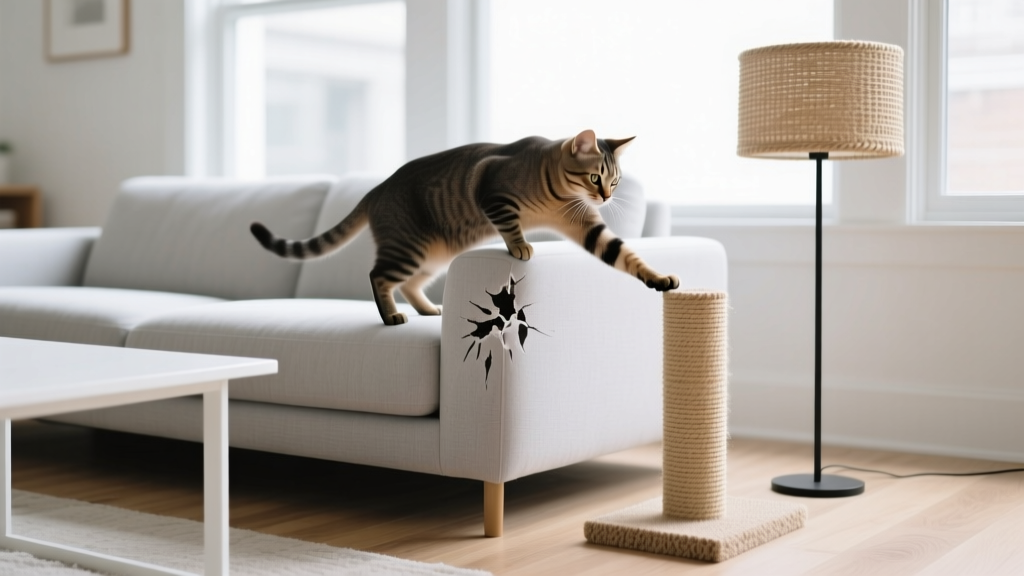
Back to Thor, the Maine Coon from the opening story. His owners still have the same sofa. It has visible wear on the left arm where the damage occurred before they intervened, but there hasn't been a single new scratch in over two years. Thor uses a 120-centimeter sisal post placed exactly where the sofa arm used to be his target, and a wall-mounted panel near the front door. The post gets rewrapped with fresh sisal rope approximately every 14 months, at a cost of about $8 in materials. The sofa, which would have cost $1,200 to reupholster, needed nothing.
The math works out pretty clearly when you look at it that way. Two posts, some rope, and a month of patience saved a family a couch and saved a cat his home. That's the kind of problem-solving that makes living with cats rewarding instead of destructive.