Cat Paw Swatting at the Window Blind Cord
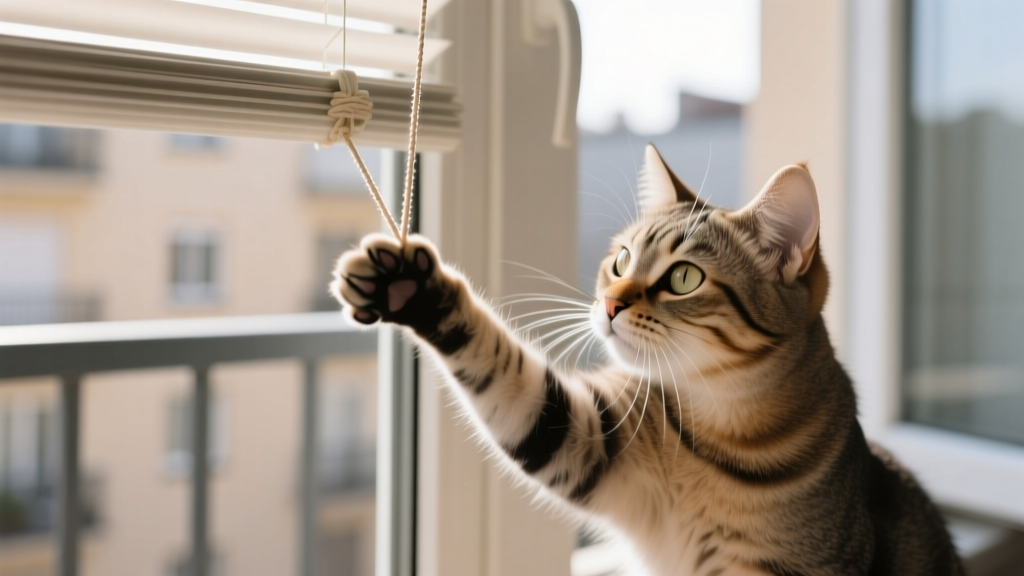
You’re in the kitchen making coffee, and from the living room you hear it: tap-tap… tap… tap-tap-tap. You already know what you’ll find. Your cat is perched on the windowsill like a tiny, fuzzy security guard, eyes locked on the dangling blind cord. One paw lifts with slow, dramatic precision… then whack! The cord swings. Your cat’s pupils bloom into full moons. Another swat. Another. Soon it looks less like “curiosity” and more like your cat is training for a championship match against a very specific piece of household string.
If you’ve ever wondered why your cat is so obsessed with that cord—and what it says about their mood, instincts, and needs—you’re in good company. This behavior is common, deeply feline, and (with a few important safety notes) pretty fascinating.
Why Cats Do This: The Evolutionary Backstory
To a human, a window blind cord is a boring household object. To a cat, it’s basically a deluxe prey simulator.
Cats are hardwired as solo hunters. Even well-fed house cats still carry a powerful “predatory sequence” in their brains: notice movement → stalk → pounce → grab → bite → “kill”. In the wild, that movement might be a lizard’s tail flicking, a bird hopping, or a mouse darting through grass.
A blind cord checks an incredible number of “prey boxes”:
- It moves unpredictably (especially after a swat).
- It dangles like a tail or a hanging insect.
- It’s narrow and string-like, which triggers chasing and grabbing instincts.
- It’s vertical, mimicking something that might climb or fly away.
- It’s near a window, where cats are already alert and stimulated by outdoor sights and sounds.
In short: your cat isn’t being “weird.” They’re being a cat—responding exactly the way nature designed them to respond to twitchy, prey-ish motion.
A Closer Look: Different Contexts (and What’s Really Going On)
“Swatting the blind cord” can mean slightly different things depending on when it happens, how intense it is, and what your cat’s body language looks like.
1) The “I’m Bored, Entertain Me” Swat
This is the casual bat-bat-bat while your cat lounges nearby. It often happens when the house is quiet, you’re working, or playtime has been light lately.
Typical vibe: relaxed posture, slow swats, maybe a little roll onto the side. Think of it as your cat using the cord like a fidget toy—something to do with their paws and brain.
2) The “Hunting Practice” Swat
This one looks more intense: crouching, focused stare, tail twitching, pupils big, rapid swats, maybe even a pounce with both paws.
Typical vibe: high arousal (not necessarily stress—often excitement). Your cat is running a full predatory mini-game: “If I swat it, it moves. If it moves, I chase. If I catch, I win.”
3) The “Window Patrol + Cord Bonus” Swat
Many cats become extra stimulated while watching the outdoors. Birds, squirrels, leaves blowing, neighborhood cats—windows are basically Cat TV. The cord just happens to be right there.
Typical vibe: your cat alternates between staring outside and swatting the cord, as if the energy from outdoor movement spills over into indoor play.
4) The “Attention Strategy” Swat
Some cats learn that swatting cords gets a reaction—especially if the cord makes noise or you jump up to stop them.
Typical vibe: your cat looks at the cord, swats, then glances at you like, “Did you see that?” If you’ve ever accidentally reinforced it by rushing over and talking excitedly, your cat may have filed it under “excellent human-summoning technique.”
5) The “I’m Stressed and Need an Outlet” Swat
In some homes, repetitive cord play can show up during change: a move, new baby, new pet, schedule shifts, construction noise outside. Swatting becomes a quick way to discharge energy.
Typical vibe: more frantic, harder to interrupt, possibly paired with other stress signs (hiding more, jumpiness, overgrooming). It’s not the most common reason, but it’s worth considering if the behavior suddenly ramps up.
What It Says About Your Cat’s Mood
Body language is your best translator. Here’s what common “cord swatting” styles tend to mean emotionally:
- Loose body, slow blinks, gentle swats: content, mildly playful, self-entertaining.
- Crouched body, fixed stare, pupils dilated, tail tip twitching: excited hunting mode; high engagement.
- Ears forward, whiskers slightly forward: curious and confident.
- Ears flattened, tense shoulders, frantic movements: overstimulation or stress; the cord may be an outlet.
- Swat + immediate look toward you: attention-seeking or learned habit.
One of the sweetest interpretations? Cord swatting often means your cat feels safe enough to play. A cat who is truly scared or shut down usually won’t spend time inventing games with household objects.
Related Behaviors You Might Also Notice
If your cat is a blind-cord enthusiast, you may see other “prey play” behaviors, too:
- Chasing shadows or light reflections (especially on walls and floors).
- Attacking shoelaces, hoodie strings, or phone charger cords.
- Window chattering (that rapid “ek-ek-ek” sound) at birds or squirrels outside.
- Ambush play from behind furniture or around corners.
- Nighttime zoomies that seem to come from nowhere.
All of these fit under the umbrella of: “My cat needs movement, hunting practice, and mental stimulation.”
When It’s Normal (and When It Might Be a Concern)
Swatting at a blind cord is usually normal enrichment behavior—with one big caveat: cords can be dangerous.
Normal, healthy cord interest tends to look like:
- Short bursts of play that your cat can stop on their own.
- Your cat is otherwise eating, sleeping, and using the litter box normally.
- No signs of panic or compulsive repetition.
It may be a concern if:
- Your cat chews or eats cords. This can cause choking, intestinal blockage, or electrical injury (if it’s a power cord). String ingestion is a veterinary emergency risk.
- Your cat gets overly fixated and struggles to disengage, even when offered other play.
- The behavior escalates suddenly alongside other changes (aggression, hiding, reduced appetite, overgrooming).
- There’s a strangulation hazard. Dangling blind cords are a known risk for pets (and children), especially if cords form loops.
If your cat is chewing cords, seems compulsive, or you’re seeing other stress signals, it’s smart to check in with your veterinarian and consider a behavior consult. Sometimes the “cord obsession” is a symptom of unmet needs, anxiety, or (less commonly) underlying medical issues that change activity levels and restlessness.
How to Respond: Safer, Smarter Ways to Channel the Instinct
You don’t have to ban fun. The goal is to make it safe and satisfying—for your cat and your household.
1) Make the cords safe (seriously)
- Shorten and secure blind cords with cord cleats, tension devices, or wind-ups so nothing dangles.
- Avoid loops where a cat could get caught.
- Consider cordless blinds if possible—many cat households swear by them.
2) Offer a “yes” alternative that scratches the same itch
- Wand toys (supervised) mimic dangling prey perfectly.
- Spring toys and crinkle toys satisfy the bat-and-chase urge.
- Kick toys help with the grab-and-bunny-kick phase of the hunting sequence.
Tip: If your cat loves the vertical dangly aspect, try clipping a toy to a cat tree (securely, with no long string) or using a suction-cup window toy designed for cats.
3) Build a tiny hunting routine
Many cord-swats happen because your cat’s day lacks a “complete hunt.” Try this pattern once or twice daily:
- 2–5 minutes of wand play (stalk, chase, pounce).
- Let your cat catch the toy at the end (very important for satisfaction).
- Follow with a small snack or meal. Hunt → eat → groom → sleep is peak cat contentment.
4) Don’t accidentally reward the cord
If swatting the cord reliably makes you rush over (even to say “no”), your cat may interpret that as a successful attention button.
Instead:
- Quietly redirect with a toy.
- Praise or engage when your cat chooses the toy.
- Make the cord boring by removing access, not by turning it into a dramatic event.
5) Enrich the window zone
If the window is your cat’s favorite stage, upgrade it:
- Add a sturdy perch or cat tree near the window.
- Try a bird feeder outside (placed safely so birds aren’t threatened).
- Rotate a couple of toys nearby so the area stays interesting.
Fun Facts and Research Nuggets
- Cats are built for movement detection. Their vision is especially tuned to notice small, quick motion—exactly what a swinging cord provides.
- Play is practice. In young cats, play behavior helps develop coordination and hunting skills. Adult cats keep playing because it remains mentally and physically rewarding.
- Predatory play and social play can blend. When your cat plays with you using a wand toy, they’re using hunting instincts in a safe social context—one reason interactive play can strengthen your bond.
- The “catch” matters. Studies and clinical behavior experience agree: cats can become frustrated if they never get to “win” during play. A cord that keeps escaping may keep them revved up without satisfying the sequence.
FAQ: Cat Paw Swatting at the Window Blind Cord
1) Is my cat trying to tell me something?
Often, yes—just not in a human-language way. Swatting usually says, “I’m stimulated,” “I want to play,” or “I need something to do.” If it consistently happens at certain times (like your work calls), it may also be an attention strategy.
2) Should I stop my cat from doing it?
You should prevent access to dangling blind cords for safety reasons, especially if your cat is intense, climbs the blinds, or chews. Then replace the cord game with safer options like wand toys, puzzle feeders, and window perches.
3) Why does my cat do it more at night?
Cats are naturally crepuscular—most active at dawn and dusk. Evening can bring a surge of energy, especially if your cat slept all day. A short interactive play session before bedtime can dramatically reduce nighttime cord shenanigans.
4) My cat chews the cord—what do I do?
Take it seriously. Secure or remove access immediately and offer appropriate chew alternatives (ask your vet for safe options if your cat is a dedicated chewer). If your cat eats string-like items, contact your veterinarian—string ingestion can become dangerous quickly.
5) Does cord swatting mean my cat is anxious?
Not usually. Most of the time it’s normal play/hunting behavior. It may be stress-related if it’s new, intense, hard to interrupt, or paired with other stress signals (overgrooming, hiding, appetite changes). Context and body language tell the story.
6) Can I train my cat not to swat the cord?
Yes—by managing access and reinforcing alternatives. Make the cord unavailable (or boring), then reward your cat for choosing appropriate toys. Training works best when it feels like a fun upgrade, not a punishment.
One Last Thought
Your cat isn’t picking a fight with your blinds out of spite. They’re responding to a moving “prey cue” with a brain that’s beautifully designed for stalking, swatting, and pouncing. With a few safety adjustments and some targeted play, you can keep the charm of the behavior (that focused little hunter face!) while steering it away from risky cords.
Does your cat have a favorite “unbelievable toy” that isn’t a toy—blind cords, shower curtains, hoodie strings, the mysterious dust bunny under the fridge? Share your funniest and most puzzling stories with the Cat Lovers Base community at catloversbase.com.