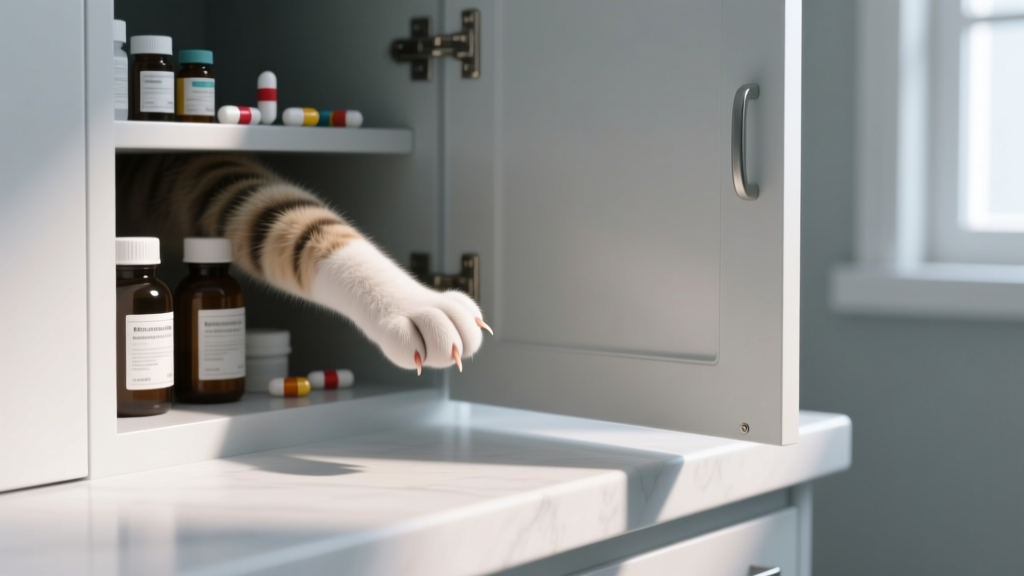
Cat Paw Reaching Into the Medicine Cabinet: Exploration
You’re brushing your teeth, half-awake, when you hear it: a soft tap… tap… tap from the bathroom. You turn around and there’s your cat—balanced on tiptoes like a tiny burglar—sliding one paw into the slightly open medicine cabinet. Maybe they hook a cotton ball with a single claw. Maybe they rattle a pill bottle like it’s a maraca. Maybe they just stand there, intensely focused, paw fishing through the shadows as if the cabinet contains the secrets of the universe.
If you’ve ever caught your cat reaching into the medicine cabinet (or any cabinet, drawer, box, or forbidden nook), you’re not alone. This is classic cat behavior: curious, clever, a little mischievous, and surprisingly logical once you understand what’s going on in that busy feline brain.
Why Cats Reach Into Cabinets: The Evolutionary Logic
Cats are built to investigate tight spaces. In the wild, small openings and hidden compartments are where the interesting things happen: prey hides there, scents collect there, and safety can be found there. A medicine cabinet is basically a modern indoor version of a rock crevice—dark, enclosed, full of layered smells, and occasionally home to “mysterious moving objects” (anything that rolls, crinkles, or shifts when pawed).
From a scientific standpoint, your cat’s paw-reaching behavior is a mix of:
- Predatory sequence practice: Cats use their paws to probe, pin, and pull. Even well-fed house cats retain the instinct to “hunt” with their feet and claws, especially when vision is limited.
- Tactile exploration: Cats don’t have hands, but they do have sensitive paws and whiskers. When something is partially hidden, a paw becomes the perfect tool to test it safely.
- Curiosity and novelty-seeking: Cats are drawn to changes. A cabinet door left ajar is a new “event” in their environment—worthy of investigation.
- Scent information gathering: Medicine cabinets carry strong and varied smells: mint toothpaste, soaps, lotions, essential oils, bandages, even human stress scents. Cats “read” these like a bulletin board.
In short: the cabinet is a puzzle box, and your cat is a professional puzzle-solver with built-in hunting software.
A Closer Look: Different Contexts of Cabinet-Pawing
Not all medicine-cabinet paw reaching is the same. The context matters, and it can tell you a lot about what your cat is trying to achieve.
1) “I Heard Something!” Pawing
This one starts with a head tilt, ears swiveling like radar dishes. Your cat may freeze, then slowly extend a paw into the cabinet as if defusing a bomb. Often, it’s prompted by a tiny sound—bottles clicking, a box shifting, or even the faint echo of plumbing.
What’s happening: Your cat is doing cautious investigation. Think: “Is that prey? Is that danger? Is that… fun?”
2) “Fishing Expedition” Pawing
Your cat deliberately reaches in, hooks something, and tries to pull it out. Cotton swabs, hair ties, floss containers, gauze, and blister packs are especially “rewarding” because they move easily.
What’s happening: This is active play blended with predatory behavior. If it slides, rolls, or crinkles, it’s basically begging to be hunted.
3) “Open Sesame” Pawing
Some cats aren’t reaching into an open cabinet—they’re trying to open it. They paw at the edge, push the door, or test the hinge with repeat swats.
What’s happening: Problem-solving and persistence. Cats learn through trial and error, and cabinets are a favorite “mechanical challenge.”
4) “Human, I Summon You” Pawing
Occasionally, cabinet pawing happens when you’re busy: on the phone, getting ready, or ignoring a pointed stare. Your cat may paw dramatically, then glance at you, then paw again.
What’s happening: Attention-seeking. The cabinet makes noise. Noise makes you look. Your cat files this under “effective communication.”
5) “I Like the Smell” Pawing
Some cats are drawn to certain scents—especially minty, herbal, or medicinal smells. They may sniff, rub their cheeks on the cabinet edge, then reach in like they’re trying to grab the scent itself.
What’s happening: Scent enrichment. Your cat is exploring a smell landscape, leaving their own facial pheromones in the process.
What This Behavior Says About Your Cat’s Mood
Cabinet-reaching can be playful, curious, or occasionally a sign of stress. Look at the whole body “sentence,” not just the paw “word.”
- Curious and confident: Tail up or gently waving, relaxed ears, smooth movements, soft eyes. Your cat is comfortable and mentally engaged.
- Playful and energized: Quick paw jabs, wiggle-butt stance, dilated pupils, maybe a little “chirp.” This is hunting practice, indoor edition.
- Wary or cautious: Low body posture, slow-motion paw extension, ears pivoting, weight shifted backward ready to retreat. Something about the cabinet feels uncertain.
- Restless or under-stimulated: Repetitive cabinet-checking, roaming, meowing, escalating mischief. Sometimes the cabinet is simply the best entertainment available.
- Stressed: If cabinet pawing is new and paired with hiding, over-grooming, or jumpiness, it may be displacement behavior—your cat trying to cope by focusing on a controllable “task.”
Related Behaviors You Might Notice
If your cat is a medicine cabinet explorer, you’ll probably see a few of these greatest hits too:
- Drawer peeking: Reaching under drawers or tugging at slightly open ones.
- Under-the-door pawing: Fishing for “something” on the other side—often your feet.
- Bathtub or sink investigation: Pawing at drains, droplets, or the “mysterious hole.”
- Countertop object sweeping: The classic “gravity experiment.”
- Bag and box obsession: Climbing in, sniffing, pawing corners, then ambushing imaginary prey.
- Toilet curiosity: Not every cat does it, but the water, echoes, and movement can be mesmerizing (and hazardous).
Normal vs. Concerning: When to Pay Attention
In most homes, cabinet-pawing is normal feline exploration. But there are a few situations where you’ll want to take it more seriously.
Generally Normal
- Occasional pawing when the cabinet is open or something new is inside
- Playful “fishing” that stops when redirected
- Curiosity during routines (you open the cabinet daily, so it’s part of the action)
Potential Concerns
- Obsessive repetition: Your cat returns to the cabinet constantly, seems unable to disengage, or escalates to frantic behavior.
- Sudden behavior change: A previously uninterested cat becomes fixated—especially if paired with vocalizing, clinginess, or hiding.
- Ingestion risks: If your cat steals items (cotton swabs, floss, pills, ointment tubes), the biggest concern is swallowing something dangerous.
- Attraction to potentially harmful scents: Some products (essential oils, certain topical medications, strong cleaners) can be toxic or irritating to cats.
- Signs of nausea or pica: If your cat is licking plastic, chewing wrappers, or trying to eat non-food items from the cabinet, discuss it with your veterinarian.
If you notice drooling, vomiting, difficulty breathing, lethargy, or sudden uncoordinated movement after a cabinet raid, treat it as urgent and contact a veterinarian or pet poison hotline immediately.
How to Respond (Without Turning It Into a Game)
The tricky part: cats are excellent at learning what gets a reaction. If you rush in dramatically every time the cabinet rattles, your cat may decide cabinet pawing is the fastest way to summon you.
1) Make the Medicine Cabinet Boring and Safe
- Use childproof latches or magnetic cabinet locks. They work beautifully for cats, too.
- Store high-risk items elsewhere. Pills, essential oils, topical medications, floss, and small swallowable items should be secured.
- Keep doors fully closed. A cracked door is a cat invitation written in neon.
2) Offer a “Yes Space” for Curiosity
If your cat loves probing hidden areas, give them approved puzzle opportunities:
- A treat puzzle that requires paw work
- A box with tissue paper or crinkle paper (nothing stringy)
- A snuffle mat designed for cats
- A “foraging tray” with safe objects and a few kibble pieces hidden underneath
3) Build a Mini Hunting Routine
Many cabinet explorers are simply under-employed hunters. Try:
- Two short wand-toy play sessions daily (5–10 minutes)
- End with a small snack to complete the “hunt-catch-eat” loop
- Rotate toys to keep novelty high
4) Redirect Calmly
If you catch them mid-reach, avoid yelling or chasing. Instead:
- Gently interrupt with a soft sound or their name
- Toss a toy away from the cabinet
- Reward them for engaging with the toy or stepping away
The goal is to teach: “Cabinet is dull. Approved activities are rewarding.”
Fun Facts and Research-Style Insights
- Cats solve problems with their paws. In cognition studies and puzzle-feeder observations, many cats prefer manipulating objects with a paw rather than using their mouth—especially when something is partly hidden.
- Whiskers and paws work as a team. Cats use whiskers to gauge openings and detect subtle airflow changes; paws then confirm what the eyes can’t see in a dark space.
- Novelty is enriching. Environmental enrichment research shows that small changes—like a new object, scent, or access point—can increase exploratory behavior and reduce boredom-related mischief.
- Your routine becomes their routine. If you open the medicine cabinet every morning, your cat may treat it like a scheduled event worth supervising.
FAQ: Cat Pawing in the Medicine Cabinet
Why is my cat obsessed with the medicine cabinet specifically?
It’s a high-interest zone: strong smells, daily human activity, and lots of small objects that make satisfying sounds. The cabinet is also elevated, which can make it feel like a valuable “territory” to monitor.
Does my cat think there’s prey in there?
Not always, but the behavior is borrowed from prey-seeking instincts. In a dark cabinet, your cat can’t fully see what’s inside, so paw-probing is a natural way to “hunt” for movement or interesting textures.
My cat steals cotton swabs and runs—why?
Because it’s the perfect cat “prey item”: light, portable, and fun to carry. The running part can be play excitement or a learned strategy to avoid you taking it back. Cotton swabs are a swallowing hazard, so it’s best to keep them secured.
Should I punish my cat for doing this?
Punishment usually backfires: it can create anxiety and make your cat sneakier without reducing the motivation to explore. A safer plan is prevention (locks, closed doors) plus enrichment (puzzles, play) and calm redirection.
Could this mean my cat is anxious or bored?
It can. If the cabinet behavior is frequent, intense, or paired with other signs (restlessness, nighttime zoomies, attention-demanding meows, destructive scratching), your cat may need more play, climbing space, and predictable routines. If it’s sudden and extreme, consider a vet check to rule out medical stressors.
Is it safe for my cat to smell medications and lotions?
Sniffing isn’t the same as ingesting, but some products can irritate cats or be toxic if licked (including many essential oils and certain topical medications). The safest approach is secure storage and keeping residue off surfaces your cat can lick.
Your cat reaching a paw into the medicine cabinet isn’t random nonsense—it’s curiosity, hunting instinct, and clever problem-solving wrapped into one small, determined limb. With a little prevention and a lot of appropriate outlets for exploration, you can keep your cat safe while still honoring that wonderfully inquisitive feline nature.
Has your cat ever “fished” something truly bizarre out of a cabinet—or mastered a door you swore was cat-proof? Share your story with the Cat Lovers Base community at catloversbase.com. We live for these tiny household mysteries.