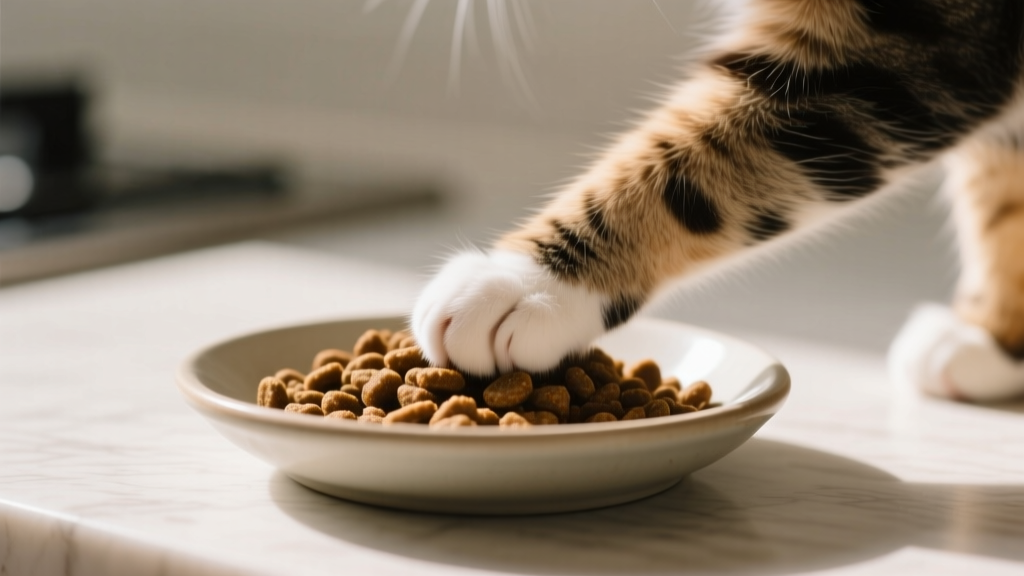
Cat Paw Covering Food: Caching Instinct Behavior
You put down dinner. Your cat takes a few bites, pauses, looks around like a tiny security guard, then starts “burying” the bowl—scratching the floor beside it, pawing at the air, nudging an invisible pile of dirt over the food. Sometimes they even drag a sock, a napkin, or yesterday’s mail toward the dish like it belongs in a pantry you didn’t approve.
If you’ve ever watched this and thought, Are you… hiding your dinner from me? you’re in excellent company. This quirky little routine is one of the most common “wait, what?” cat behaviors—and it actually makes a lot of sense once you see it through a cat’s eyes.
The evolutionary “why”: Your cat’s inner wild roommate
That paw-covering motion is often a form of caching—a survival behavior rooted in an animal’s relationship with food, predators, and competition. In the wild, leaving food out in the open can be risky for a few reasons:
- It attracts attention. Smell travels. A leftover carcass or scraps can draw predators or rival animals.
- It invites theft. Other hunters might snatch a meal you worked for.
- It can create conflict. Food is valuable; visible food can spark confrontations.
Some wild felines and other predators will cover or move food to reduce odor and visibility, or to save it for later. Domestic cats aren’t exactly hauling down wildebeest in the living room, but their brains still come with the same ancient “food management” programs. Your cat may not have learned this by watching other cats; many instincts show up even when a cat is raised alone.
One more piece of the puzzle: cats are both predators and (in the wild) potential prey. A cautious animal doesn’t broadcast anything that says, “Hello! I’m here!” That includes the scent of food.
What paw-covering food looks like (and what’s actually happening)
Most people call this “burying,” but cats usually aren’t covering the food directly. They’re making a scraping motion near the bowl—the same movement they use to cover waste in the litter box. Think of it as your cat’s all-purpose “I’d like this concealed” gesture.
Here are common versions you might see:
- The air-scoop: Your cat sits or stands near the bowl and repeatedly “rakes” the air, as if tossing imaginary sand forward.
- The floor-scratch: They scratch the floor just outside the mat, often making that squeaky “nails on tile” sound that makes humans wince.
- The bowl-nudge: They push the bowl slightly, sometimes rotating it like a lazy Susan.
- The object-drag: They pull a towel, paper, toy, or clothing toward the food—accidentally inventing meal prep storage solutions.
None of these necessarily mean your cat dislikes the food. Context matters, and cats are masters of making one behavior mean several different things depending on the situation.
Different contexts: Why your cat might “cache” food at home
1) “I’m saving this for later.”
This is the classic caching interpretation. Many cats prefer to eat multiple small meals rather than one big feast. If the food is plentiful, your cat might take what they want and attempt to “put away” the rest.
Typical scenario: You free-feed dry kibble or offer a larger portion of wet food than your cat finishes in one sitting. They eat, then scratch around the bowl as if closing a cupboard door.
2) “This smells… strong.”
Smell is a huge part of feline decision-making. Some foods—especially fishy wet foods—are aromatic even to us. Your cat may be reacting to odor intensity, trying to reduce scent in their environment.
Typical scenario: You open a new flavor, and your cat does a sniff, a few bites, then attempts to cover the rest like it’s a secret.
3) “I don’t feel safe eating all of this right now.”
In multi-pet homes, food can become social currency. A cat may cache food if they’re worried another pet will approach, or if they feel exposed while eating.
Typical scenario: A dog hovers, a second cat walks by, or the bowl is placed in a busy hallway. Your cat eats quickly, then tries to “hide” the leftovers.
4) “This isn’t fresh enough (in my opinion).”
Cats can be very particular about freshness. If food has been out for a while, warmed up, dried at the edges, or picked up a household odor, your cat might cover it as a way of saying, “Not dealing with this now.”
Typical scenario: Wet food has sat out and formed that little crust. Your cat makes the burying motion and walks away.
5) “I’m done, and I’d like my space back.”
Sometimes this is simply a closing ritual. Cats are creatures of sequences: sniff → eat → groom → “clean up.” The pawing can be part of tidying the area, even if it doesn’t actually tidy anything.
What it can mean about your cat’s mood and feelings
The paw-covering behavior is often emotionally neutral—just instinct. But you can read a lot from the rest of your cat’s body language:
- Calm caching: Relaxed tail, normal ears, slow movements, then they stroll away. This usually means “saving it” or “finished.”
- Anxious caching: Quick, jerky scratches; frequent looking around; ears swiveling; tense posture. This can mean they feel watched or unsafe.
- Displeased caching: Sniff, minimal eating (or none), then vigorous scratching and immediate departure. This is often “no thanks,” whether due to flavor, texture, or freshness.
- Overstimulated/over-aroused: If your cat escalates into swatting, growling, or guarding, the issue may be resource stress—especially in multi-cat homes.
In short: the pawing isn’t the whole message. It’s a headline. The “article” is the posture, pace, appetite, and environment.
Related behaviors you might also notice
Caching doesn’t always travel alone. If your cat covers food, you may also see:
- Litter-box-style scratching around the bowl (same motor pattern, different location).
- “Killing” the bowl or mat—biting the edge, grabbing it, or bunny-kicking a placemat after eating (a playful predatory echo).
- Dragging toys to the food area (some cats create a “stash zone” that includes food, toys, and comfy hiding spots).
- Food guarding or scarf-and-barf in competitive households (more about insecurity than instinctual saving).
- Covering water by pawing at the floor near the water dish—less common, but still tied to “arranging” resources.
When paw-covering food is normal—and when it’s worth attention
Usually normal:
- Your cat eats a reasonable amount, maintains weight, and seems relaxed.
- The behavior happens occasionally or after larger meals.
- No other signs of stress (hiding, aggression, litter box changes).
Worth a closer look (and possibly a vet call):
- Sudden change in appetite along with burying—sniffs, paws, refuses food repeatedly.
- Weight loss, vomiting, diarrhea, drooling, or bad breath (dental pain and nausea can make cats “reject” food in odd ways).
- Obsessive or frantic pawing that seems like agitation rather than a brief ritual.
- Conflict around food in multi-cat homes: stalking, blocking access, growling, or one cat consistently not eating enough.
Cats are famous for being subtle about discomfort. If food behavior changes and stays changed for more than a day or two—especially with reduced eating—get professional input promptly.
How to respond (and how to encourage a happier mealtime routine)
You don’t need to “train it out” of them. Most of the time, paw-covering is harmless. Instead, use it as information.
Make the feeding area feel safe
- Choose a quiet location away from foot traffic, loud appliances, and ambush corners.
- In multi-pet homes, separate feeding stations so each cat can eat without being monitored.
- Provide escape routes: avoid placing bowls in tight nooks where a cat could feel trapped.
Adjust portions and freshness
- Offer smaller, more frequent meals if your cat routinely tries to “save” leftovers.
- Pick up wet food after 20–30 minutes (or follow your vet/food safety guidance), then offer a fresh portion later.
- Consider puzzle feeders for kibble to mimic natural foraging and reduce the “leftover problem.”
Protect your floors without scolding your cat
- Use a washable mat with a textured surface. Some cats redirect scratching to the mat instead of your tile.
- Place a small scratch pad nearby (horizontal cardboard scratchers work well). Your cat may choose that for their post-meal “covering” routine.
- Avoid punishment. Scolding adds stress to eating, which can create new issues around food.
If you suspect social stress, add resources
A good rule in multi-cat homes: more bowls, more water stations, more litter boxes, more resting spots. When resources are abundant, cats relax—and relaxed cats don’t feel the need to manage food like it’s a high-stakes negotiation.
Fun facts and research-flavored nuggets
- Cats are natural “small meal” eaters. Free-ranging cats often consume multiple small prey items across the day. The instinct to eat-and-save fits that pattern.
- The “burying” motor pattern is versatile. The same basic paw movement can show up in litter box covering, food caching gestures, and even attempts to “hide” a toy or object that feels important.
- Smell drives behavior more than we realize. A cat’s sense of smell is far more sensitive than ours, and strong odors—pleasant or unpleasant—can trigger concealment instincts.
FAQ: Cat paw covering food
Why does my cat scratch the floor next to the food bowl after eating?
This is typically a caching/covering gesture—an instinctive “hide it” motion. It often means your cat is saving leftovers, masking scent, or simply finishing their eating ritual.
Does paw-covering mean my cat hates the food?
Not necessarily. If your cat eats a normal amount and seems calm, it may be “saving it.” If your cat refuses the meal, paws vigorously, and walks away, it can be a sign the food smells off to them, feels stale, or they’re feeling unwell.
My cat tries to cover food with random objects. Is that normal?
Yes—some cats take the concept literally and recruit nearby items like socks or paper. It’s usually harmless (if slightly inconvenient). Just make sure they aren’t ingesting stringy materials or plastic.
Why does my cat cover food but not bury poop (or vice versa)?
Cats vary in how strongly they show covering behaviors. Stress level, early experiences, household dynamics, and even personal preference play roles. One cat may be meticulous in the litter box but “messy” with food, and another may do the opposite.
Should I remove the bowl when my cat does this?
If it’s wet food, it’s reasonable to pick it up after a short period and offer a fresh portion later. For dry food, you can leave it if your cat’s diet plan allows. The key is noticing patterns: if your cat consistently leaves large amounts, try smaller portions or scheduled meals.
Can this behavior be a sign of anxiety?
It can be, especially if paired with tense body language, quick frantic scratching, or conflict with other pets around mealtimes. If you suspect stress, adjust the feeding setup and consider talking with your veterinarian or a qualified cat behavior professional.
That little pawing routine is one of those reminders that your cat isn’t being “weird”—they’re being a cat, running ancient software in a modern kitchen. Watch the context, respect the message, and you’ll learn a lot about how safe, satisfied, and secure your feline friend feels.
Has your cat ever tried to “bury” dinner with something truly ridiculous—like your sweater, a receipt, or a toy mouse? Share your story (and your cat’s funniest food-covering habits) with the Cat Lovers Base community at catloversbase.com.