Cat Nose-to-Nose Greeting: How Cats Say Hello
You’re standing in the kitchen when your cat appears like a tiny, whiskered ghost. No meow. No dramatic entrance. Just a slow, confident stroll straight toward your face. Before you can even say, “Hi, buddy,” your cat leans in and gently taps your nose with theirs—boop—and then strolls away as if they’ve just checked something off a clipboard.
If you’ve ever wondered whether that nose-to-nose moment is a kiss, a sniff inspection, or your cat politely collecting rent, you’re not alone. Nose-to-nose greetings are one of the sweetest, most meaningful social behaviors cats offer. It’s also more nuanced than it looks. In cat language, that tiny touch can say: “I know you,” “I trust you,” “You’re safe,” or even “Hold still, you smell different today.”
Why Cats Do Nose-to-Nose Greetings (The Science and Evolution)
Cats experience the world through scent the way we experience it through sight and language. Their noses are information hubs, constantly gathering data about identity, emotional state, health, and “where you’ve been.”
In the wild and in free-roaming cat colonies, cats rely on scent to maintain social order. Friendly cats exchange scents through rubbing, head bunting, and close sniffs. A nose-to-nose greeting is a concentrated version of that: a direct, intimate, high-trust interaction at very close range.
Here’s what makes it work:
- Scent glands and personal “ID”: Cats have scent glands around the mouth, chin, cheeks, and forehead. While the nose itself isn’t a major scent-gland area, going nose-to-nose puts cats close enough to smell the face region where those scent signatures live.
- The vomeronasal organ (Jacobson’s organ): This specialized scent-processing system helps cats decode pheromones and social signals. You might notice the “flehmen response” (open mouth, curled lip) after a good sniff—your cat is essentially running the smell through an extra analysis program.
- Risk and trust: Face-to-face contact is vulnerable. A cat that feels threatened won’t willingly offer their nose. So when your cat initiates a nose greeting, it’s often a quiet vote of confidence.
Think of it like a friendly handshake—except it’s also a name tag, mood check, and relationship reaffirmation all in one.
A Detailed Breakdown: Different Nose-to-Nose Contexts
Nose greetings don’t always mean the same thing. Context matters: who initiated it, the body language around it, and what happens afterward.
1) The “Hello, You’re Home” Nose Boop
You walk in the door, and your cat approaches with tail held upright (often with a little hook at the tip). They lift their head and touch noses.
What’s happening: Your cat is doing a social check-in and possibly refreshing your shared scent “badge.” You’ve been out collecting foreign smells—other people, other animals, outdoors—and your cat wants the update.
2) The Morning Inspection
Your cat hops onto the bed, stands over you like a supervisor, and leans in for a nose touch—followed by a long sniff at your breath, hair, or pillow.
What’s happening: You’re a scent storybook. Overnight, your smell changes. Your cat is catching up and also reinforcing familiarity in a peaceful moment.
3) The “You Smell Weird Today” Sniff
After you apply lotion, return from the vet, or cuddle another animal, your cat comes in close for a nose-to-nose, then pauses, stiffens slightly, or sniffs intensely.
What’s happening: Your scent is “incorrect,” and your cat is verifying identity and safety. Some cats will follow up with cheek rubbing to overwrite the unfamiliar smell with the household scent profile.
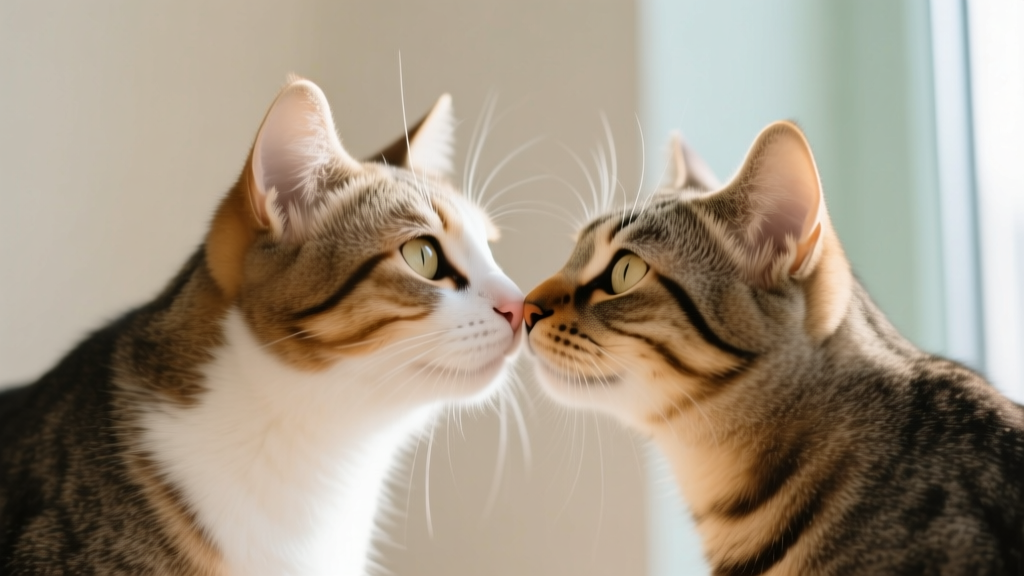
4) Cat-to-Cat Nose Greetings
Two cats approach, slow and cautious. They touch noses briefly. Then they either walk away calmly… or one cat swats, hisses, or turns sideways.
What’s happening: This is a social negotiation. A calm nose touch can be friendly confirmation. But it can also be a tense assessment—like two strangers deciding whether to be polite or start an argument in the parking lot.
5) The Nose Greeting That Turns Into Play
Your cat touches noses, then immediately bounces sideways, sprints away, or tries to grab your hand gently with their paws.
What’s happening: The greeting is real, but your cat is also inviting interaction. Some cats use a nose boop as the opening line to a play session.
What Nose-to-Nose Means About Your Cat’s Mood
Nose-to-nose contact is usually a good sign, but it’s best read as part of a “full sentence” that includes the rest of your cat’s body language.
- Relaxed and friendly: Soft eyes or slow blinks, tail up, loose posture, whiskers neutral or slightly forward.
- Curious and investigating: Focused sniffing, whiskers forward, ears neutral-to-forward, still body.
- Slightly unsure: Brief touch then retreat, ears rotate sideways, body a bit stiff, tail low or twitchy. This can happen if you smell unfamiliar.
- Overstimulated or conflicted: Nose touch followed by a sudden nip, swat, or zoom-away. Some cats get “too excited” by close contact and need space.
In general, a cat who initiates a nose greeting is choosing closeness. That choice matters. Cats aren’t big on doing things they don’t mean.
Related Behaviors You Might Also Notice
Nose-to-nose greetings often come bundled with other friendly cat rituals:
- Tail-up greeting: The classic “friendly flag.” If the tail is upright and relaxed, your cat is socially open.
- Head bunting (bunting): When your cat bumps their forehead or cheek into you. This deposits facial pheromones and marks you as “safe/familiar.”
- Cheek rubbing along your legs: A scent “refresh” and social bonding behavior.
- Slow blinking: Often called a cat “smile.” It’s a calm signal that can accompany close greetings.
- Sniffing your hair, breath, or hands: Especially after you’ve been outside, handled food, or touched another animal.
If your cat does a nose boop and then head-butts your chin, congratulations—you’ve been enthusiastically accepted into the inner circle.
When Nose-to-Nose Is Normal vs. When It Might Be a Concern
Most nose-to-nose greetings are perfectly healthy and social. But a few patterns are worth a closer look.
Normal variations
- Your cat only does it sometimes (cats have moods too).
- Your cat prefers nose-to-hand rather than nose-to-nose (many cats find faces intense).
- Your cat sniffs more when you come home or after you change routines.
Possible concerns
- Sudden avoidance of close contact: If your cat used to greet you nose-to-nose and suddenly stops, consider stress, pain, or a negative association (for example, being picked up right after greeting).
- Excessive nasal discharge, noisy breathing, or frequent sneezing: This isn’t a “behavior problem,” but it can affect a cat’s willingness to greet. A vet check is wise.
- Face-touching triggers aggression between cats: If nose greetings between cats routinely end in hissing or swatting, you may be seeing social tension. Resource competition, overcrowding, or poor introduction pacing could be involved.
- Compulsive sniffing or agitation: Rare, but if your cat seems frantic about sniffing and cannot settle, it can signal anxiety or medical issues affecting scent perception.
If something changes abruptly or seems paired with other symptoms (hiding, appetite shifts, irritability), it’s worth investigating with both behavior and health in mind.
How to Respond (And How to Encourage It Without Making It Weird)
If your cat offers a nose greeting, your job is simple: be a calm, predictable social partner.
- Hold still for one second: Sudden movement can startle a cat at close range. Let them initiate and finish.
- Offer a finger instead of your face: If you’re not comfortable with nose-to-nose, extend one finger at your cat’s nose level. Many cats will sniff or gently touch it.
- Reward with calm affection: If your cat enjoys it, follow with cheek rubs, gentle head scratches, or a slow blink. Avoid immediately scooping them up—some cats learn “nose boop = I get grabbed” and stop offering it.
- Respect the opt-out: If your cat leans in and then changes their mind, don’t pursue. Consent is huge in cat relationships.
- Use it as a trust-building ritual: Greet your cat softly when you come home, crouch to their level, and offer a finger. Over time, shy cats may build confidence and initiate closer greetings.
For multi-cat homes, you can support friendly greetings by reducing tension: multiple food stations, multiple litter boxes, and enough vertical space so cats don’t feel forced into close encounters.
Fun Facts and Research-Adjacent Nuggets
- Nose-to-nose is a high-trust move: Cats are both predator and prey, so face-to-face contact carries risk. Friendly cats choose it; tense cats avoid it.
- Cats use scent as “social glue”: Many feline friendly behaviors revolve around creating a shared group scent—sometimes called “colony scent.” When your cat rubs on you after sniffing, they may be restoring that shared identity.
- Your cat may be reading your emotional state: While cats don’t interpret feelings exactly like humans do, they do notice patterns—your voice, movement, and routine—and they can associate your “state” with safety or unpredictability. Calm greetings tend to invite closer contact over time.
- Some cats prefer parallel greetings: Not every cat loves face-to-face. Many friendly cats show affection by walking beside you, rubbing your leg, or sitting nearby. Social comfort can look quiet.
FAQ: Cat Nose-to-Nose Greetings
Is a cat nose-to-nose greeting the same as a kiss?
It’s affectionate, but it’s more like a friendly scent-based “hello” than a human-style kiss. Your cat is gathering information and confirming social familiarity, often in a trusting way.
Why does my cat nose boop me and then bite?
Usually it’s overstimulation, excitement, or a play invitation. Some cats get wound up by close contact. Try responding with a brief pause, then redirect to a toy rather than hands or faces.
Should I initiate a nose-to-nose greeting with my cat?
Only if your cat already enjoys close face contact. A safer option is offering a finger for them to sniff. Let your cat decide how close they want to get.
My cat only does nose greetings with one person. Why?
Cats have preferences. That person may move more slowly, speak more softly, respect boundaries more consistently, or simply smell more familiar/comforting. It’s not a judgment—just a feline friendship style.
Do cats do nose-to-nose greetings with cats they don’t like?
Sometimes they’ll approach and sniff as an assessment, but truly tense cats usually avoid close face contact or show stiff body language. If it frequently leads to hissing or swatting, the relationship may be uneasy.
What if my cat never does nose-to-nose greetings?
That can be completely normal. Some cats are “close, but not face-close” types. Look for other friendly signals: tail-up greetings, slow blinks, cheek rubs, or choosing to sit near you.
Nose-to-nose greetings are one of those small cat moments that feel almost magical once you understand the language behind them. Next time your cat leans in for that tiny boop, you’ll know it’s not random—it’s a social check-in, a trust gesture, and a scent-based “you’re part of my world.”
Does your cat do nose boops, finger sniffs, or dramatic “you smell different” inspections after you’ve been out? Share your stories (and your funniest greeting rituals) with the Cat Lovers Base community at catloversbase.com.