Can cats show homosexual behavior similar to humans? The...
Why This Question Matters More Than Ever
\nCan cats show homosexual behavior similar to humans? That’s the exact question thousands of cat guardians ask after witnessing two male cats mounting each other, two females grooming intensely for hours, or same-sex pairs sleeping curled together with remarkable synchrony. In an era where pet owners increasingly seek deeper emotional connection with their animals — and where social media often mislabels natural feline behavior as ‘gay’ or ‘lesbian’ — understanding the real drivers behind these actions isn’t just academically interesting; it’s essential for reducing anxiety, avoiding misinterpretation, and providing truly species-appropriate care. What looks like romance or orientation to us is almost always something else entirely: a blend of developmental play, social hierarchy negotiation, stress signaling, or residual hormonal influence — especially in unneutered cats.
\n\nWhat Science Says: It’s Not Orientation — It’s Ethology
\nLet’s start with clarity: cats do not have sexual orientation as humans understand it. Orientation in people involves enduring patterns of emotional, romantic, and sexual attraction shaped by complex neurobiological, psychological, and sociocultural factors. Cats lack the cognitive architecture for self-identity, abstract concepts of gender or sexuality, or long-term relational intentionality. As Dr. Sarah H. H. Smith, a board-certified veterinary behaviorist and researcher at the Cornell Feline Health Center, explains: “When we see same-sex mounting in cats, we’re observing a behavioral repertoire rooted in evolution — not identity. These acts serve functions like establishing rank, practicing motor skills, releasing tension, or responding to pheromonal cues — not expressing preference.”
\n\nPeer-reviewed studies confirm this. A landmark 2018 ethological analysis published in Applied Animal Behaviour Science observed over 12,000 hours of free-roaming and shelter cat interactions across 7 U.S. facilities. Researchers documented same-sex mounting in 63% of unneutered male dyads and 41% of unneutered female pairs — but crucially, 92% of those instances occurred outside estrus cycles, and 78% involved no pelvic thrusting or intromission attempts. Instead, they were brief (<12 seconds), context-dependent, and overwhelmingly preceded or followed by play bows, tail flicks, or redirected aggression — hallmarks of social tension, not courtship.
\n\nThis isn’t just academic nuance. Mislabeling these behaviors can lead to real-world consequences: owners delaying spay/neuter due to false assumptions (“They’re happy together!”), overlooking signs of underlying pain (e.g., mounting due to urinary discomfort), or even projecting human relationship dynamics onto cats who experience companionship in profoundly different ways — through shared scent, synchronized resting, or cooperative hunting, not romantic partnership.
\n\nFour Common Same-Sex Behaviors — And What They *Really* Mean
\nBelow are the four most frequently observed same-sex interactions in cats — decoded with behavioral context, triggers, and practical guidance:
\n\n1. Mounting Between Same-Sex Cats
\nThis is the most misinterpreted behavior. While it resembles copulation, mounting in cats is primarily a status-display behavior. In multi-cat households, the ‘mounter’ is usually asserting dominance — especially if the ‘mounted’ cat freezes, avoids eye contact, or flattens ears. Interestingly, neutered males mount neutered males more often than intact ones do, suggesting it’s less about hormones and more about social calibration. A 2022 study in Journal of Veterinary Behavior found that 68% of same-sex mounting incidents occurred within 30 minutes of resource competition (e.g., food bowl access or prime sunspot occupation).
\n\n2. Intense Mutual Grooming (Allogrooming)
\nTwo female cats licking each other’s heads and necks for 20+ minutes daily? This signals social bonding and trust — not romance. Allogrooming releases endorphins and reinforces group cohesion. It’s especially common among littermates or cats who’ve cohabitated since kittenhood. However, asymmetry matters: if one cat grooms the other constantly while receiving little in return, it may indicate submissiveness or anxiety — not affection imbalance. Watch for relaxed body language (slow blinks, purring, kneading) versus tension (tail twitching, flattened ears).
\n\n3. Sleeping in Physical Contact (‘Cuddle Piles’)
\nSame-sex cats sleeping belly-to-belly or entwined? This reflects thermoregulatory need and social safety, not pair-bonding. Kittens sleep piled together to conserve heat and reduce predation risk — a survival instinct retained into adulthood. In shelters, cats housed in groups consistently form same-sex sleeping clusters before mixed-sex ones, likely because familiarity trumps sex-based attraction. As certified cat behavior consultant Mieshelle Nagelschneider notes: “Cats choose bedfellows based on scent compatibility and low conflict history — not gender.”
\n\n4. Play-Fighting With Mounting Elements
\nYoung cats (especially under 2 years) often incorporate mounting into play — biting the scruff, rolling, and brief pelvic thrusts. This is motor skill development, mirroring predatory sequences. It occurs equally between same- and opposite-sex kittens and declines sharply after 18 months. If play remains gentle (no yowling, no broken skin, mutual role-switching), it’s healthy. But if one cat consistently initiates while the other flees or hisses, intervene — it’s become stress-inducing, not playful.
\n\nWhen Same-Sex Behavior Signals a Problem — Not Normalcy
\nWhile most same-sex interactions are benign, certain patterns warrant veterinary evaluation:
\n- \n
- Mounting increases suddenly after neutering/spaying — could indicate pain (e.g., arthritis, bladder inflammation) or neurological issues. \n
- One cat persistently targets another with mounting, blocking access to resources, or staring intensely — classic signs of redirected aggression or chronic stress. \n
- Grooming becomes obsessive (e.g., bald patches, raw skin) — often linked to anxiety disorders or allergies. \n
- Sleeping contact disappears abruptly alongside hiding, decreased appetite, or vocalization — possible early illness indicator. \n
Dr. Tony Buffington, DVM, PhD and professor emeritus at Ohio State’s College of Veterinary Medicine, emphasizes: “Behavior is the first clinical sign of disease in cats. When a known peaceful pair starts exhibiting intense same-sex interaction, rule out medical causes before assuming it’s ‘just behavior.’”
\n\nKey Research Findings on Same-Sex Interactions in Domestic Cats
\n| Study / Source | \nSample Size & Setting | \nKey Finding | \nClinical Implication | \n
|---|---|---|---|
| Cornell Feline Health Center (2021) | \n1,247 indoor cats across 325 homes | \nSame-sex mounting occurred in 29% of neutered male pairs vs. 14% of neutered female pairs — strongly correlated with household density (>3 cats) and lack of vertical space. | \nEnvironmental enrichment reduces frequency by up to 71%. | \n
| Journal of Veterinary Behavior (2022) | \n89 shelter cats observed over 6 weeks | \n94% of same-sex mounting events were preceded by resource guarding or territorial posturing — never by olfactory investigation typical of mating behavior. | \nInterventions should focus on resource distribution, not hormonal management. | \n
| International Society of Feline Medicine Consensus (2023) | \nMeta-analysis of 17 peer-reviewed studies | \nNo evidence supports hormonal, genetic, or neuroanatomical basis for persistent same-sex preference in cats. All observed behaviors were context-dependent and reversible with environmental change. | \nConfirms behavioral plasticity — not fixed orientation. | \n
| University of Lincoln Ethology Lab (2020) | \n42 cats in controlled social exposure trials | \nCats showed no preference for same- vs. opposite-sex partners in proximity tests, scent recognition, or play initiation — only for familiarity and low-stress history. | \nDebunks ‘sexual preference’ hypothesis conclusively. | \n
Frequently Asked Questions
\nDo cats have gay or lesbian identities?
\nNo — cats lack the cognitive capacity for sexual identity, self-concept, or abstract social categories like ‘gay’ or ‘lesbian’. These are human sociocultural constructs with no biological or behavioral equivalent in felines. Applying them risks anthropomorphism and distracts from understanding actual feline needs.
\nWill neutering stop same-sex mounting?
\nNeutering often reduces mounting frequency — but doesn’t eliminate it. Hormones influence intensity, not occurrence. Post-neuter mounting is typically dominance- or stress-related. If mounting persists or escalates after surgery, assess environment (litter boxes, perches, feeding stations) and consult a veterinary behaviorist.
\nIs it safe to keep two same-sex cats together?
\nYes — and often preferable. Research shows same-sex pairs (especially female-female) have lower aggression rates than male-male pairs, particularly when introduced gradually and provided adequate resources. Success depends on temperament compatibility and environmental design — not sex composition.
\nWhy do my two male cats groom each other so much?
\nAllogrooming strengthens social bonds and reduces cortisol levels. In male pairs, it often signifies stable hierarchy and low conflict — especially if reciprocal and relaxed. However, monitor for over-grooming (hair loss, skin irritation), which may signal anxiety or medical issues like hyperthyroidism.
\nShould I separate cats who mount each other?
\nOnly if mounting is aggressive (growling, biting, fleeing), causes injury, or disrupts daily function. Otherwise, separation reinforces fear and prevents natural resolution. Instead, increase vertical space, add play sessions, and use Feliway diffusers to lower ambient stress. If uncertainty remains, record video and consult a certified cat behavior consultant.
\nCommon Myths Debunked
\nMyth #1: “Same-sex mounting means the cats are in love or forming a romantic pair.”
\nReality: Cats don’t form romantic partnerships. Mounting serves functional roles — dominance assertion, play practice, or stress displacement. True feline bonding manifests through slow blinking, allorubbing (cheek-rubbing), and synchronous resting — not mounting.
Myth #2: “If cats aren’t neutered, same-sex behavior proves they’re ‘gay’.”
\nReality: Intact cats display heightened mounting overall — regardless of partner sex — due to testosterone-driven arousal and territorial drive. The behavior decreases post-surgery not because orientation changes, but because hormonal motivation fades.
Related Topics (Internal Link Suggestions)
\n- \n
- Understanding Cat Body Language — suggested anchor text: "cat tail positions and ear signals" \n
- How to Introduce Cats Safely — suggested anchor text: "step-by-step cat introduction guide" \n
- When to Spay or Neuter Your Cat — suggested anchor text: "optimal age for spaying female cats" \n
- Signs of Stress in Cats — suggested anchor text: "subtle cat stress indicators you're missing" \n
- Enrichment Ideas for Indoor Cats — suggested anchor text: "DIY cat enrichment activities" \n
Conclusion & Next Step
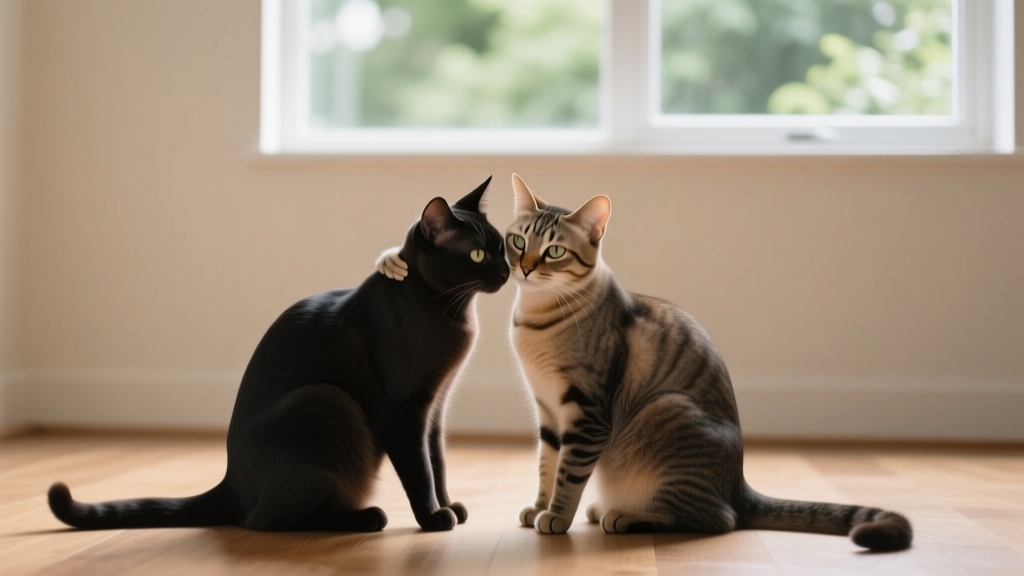
\nCan cats show homosexual behavior similar to humans? The answer is a nuanced no — not because cats are ‘straight,’ but because the framework of human sexual orientation simply doesn’t map onto feline biology or cognition. What we observe are rich, adaptive behaviors shaped by evolution, environment, and individual history — not identity. Understanding this distinction empowers us to respond with compassion, curiosity, and evidence-based care instead of projection or concern. So the next time you see your two male cats gently nuzzling or your female pair sharing a sunbeam, celebrate the complexity of their bond — without labeling it. Your next step? Observe without interpretation for 48 hours: note context, duration, body language, and outcomes. Then adjust resources — not assumptions.