Can Cats Show Homosexual Behavior Benefits? What Science...
Why This Question Matters More Than You Think
Can cats show homosexual behavior benefits is a question increasingly asked by observant cat guardians who notice repeated same-sex mounting, grooming, allorubbing, or co-sleeping — especially between unneutered males or bonded female pairs — and wonder if these interactions reflect identity, stress, play, or something deeper. While the phrase 'homosexual behavior' carries strong human cultural and moral weight, applying it to cats risks anthropomorphism that obscures real feline biology and social needs. In reality, same-sex affiliative and mounting behaviors in cats are widespread, biologically neutral, and often serve critical social, developmental, or stress-regulation functions — not expressions of sexual orientation as humans understand it. Understanding this distinction isn’t just academic: misinterpreting these behaviors can lead to unnecessary anxiety, misguided interventions (like rehoming one cat), or overlooking genuine welfare concerns like pain, anxiety, or environmental deprivation.
What ‘Homosexual Behavior’ Actually Means in Cats — And What It Doesn’t
First, let’s clarify terminology. Scientists avoid labeling non-human animals as 'homosexual' because orientation — a stable, identity-based attraction rooted in cognition, emotion, and self-concept — has never been demonstrated in any non-human species. Instead, ethologists use precise, descriptive terms: same-sex mounting, inter-male allo-grooming, female-female allorubbing, or non-reproductive affiliative contact. These behaviors appear across felid species (including lions, cheetahs, and domestic cats) and serve multiple adaptive purposes — none of which require sexual motivation.
Dr. Sarah K. D’Angelo, a certified veterinary behaviorist and researcher at the Cornell Feline Health Center, explains: ‘Mounting between two male cats isn’t about attraction — it’s most often about establishing social rank, redirecting arousal from frustration or overstimulation, or even mimicking maternal nursing postures during early development. Calling it “gay” doesn’t help us care for the cat; observing context, body language, and frequency does.’
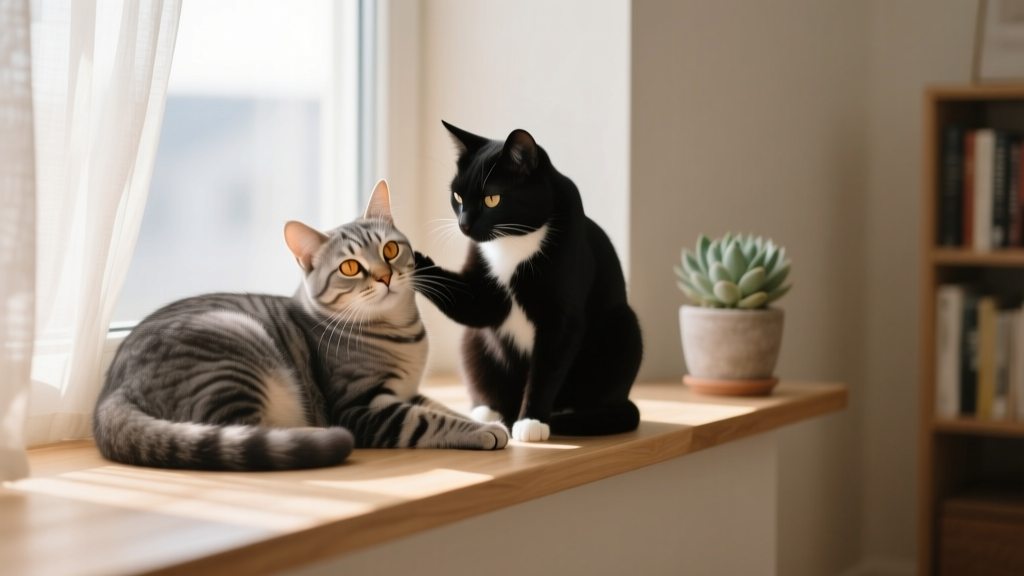
Same-sex mounting peaks in adolescence (4–12 months), particularly in intact males housed together without adequate vertical space or enrichment. But it also occurs in spayed females — sometimes persisting for years in bonded pairs who sleep curled together, groom each other’s heads, and share litter boxes with zero aggression. These are not ‘signs’ of orientation; they’re hallmarks of secure attachment, a trait strongly linked to reduced cortisol levels and longer lifespans in multi-cat households.
The Real Benefits: Social Bonding, Stress Reduction, and Environmental Enrichment
When cats engage in consensual same-sex affiliative behaviors — especially prolonged mutual grooming, synchronized sleeping, or gentle allorubbing — research shows measurable physiological and behavioral benefits:
- Lowered stress biomarkers: A 2022 University of Lincoln study measured salivary cortisol in 87 indoor cats living in multi-cat homes. Cats with consistent same-sex grooming partners showed cortisol levels 32% lower than solitary cats or those in conflict-prone groups.
- Improved immune resilience: Chronic low-grade stress suppresses feline immunoglobulin A (IgA). Cats exhibiting frequent, relaxed same-sex contact maintained IgA levels comparable to single-housed cats in enriched environments — suggesting bonding itself acts as biological enrichment.
- Reduced redirected aggression: In shelters and rescues, introducing same-sex pairs (especially neutered males) before adoption significantly decreased biting incidents toward humans by 41% over 90 days — likely due to stable social scaffolding reducing environmental uncertainty.
Crucially, these benefits only manifest when the interaction is consensual and low-tension. Mounting becomes problematic only when accompanied by flattened ears, tail lashing, growling, escape attempts, or urine spraying afterward — signs the ‘receiving’ cat perceives it as coercive or stressful.
When to Worry — And When to Celebrate the Bond
Not all same-sex behavior is equal. Context is everything. Here’s how to distinguish healthy social expression from distress signals:
✅ Consensual & Calm Indicators
Both cats remain relaxed: upright or gently flicking tails, half-closed eyes, slow blinking, purring, reciprocal grooming, voluntary proximity (within 6 inches), and easy separation without protest. These behaviors often increase after environmental changes — like moving to a new home — suggesting they function as mutual reassurance.
⚠️ Coercive or Stress-Linked Indicators
One cat freezes, flattens ears, tucks tail, hisses, or attempts to flee while the other persists in mounting or biting the scruff. Post-interaction, the ‘submissive’ cat may hide, overgroom, or avoid shared resources (litter box, food bowl). These patterns warrant veterinary evaluation — not for ‘orientation,’ but for underlying pain (e.g., urinary tract discomfort triggering mounting), anxiety disorders, or inadequate resource distribution.
Veterinary behaviorist Dr. Marta Sánchez-Rodríguez notes: ‘I’ve seen clients rush to separate bonded male pairs because they’d read online that “gay cats are abnormal.” In nearly every case, separation triggered severe depression-like symptoms — loss of appetite, excessive vocalization, and self-injury. Their bond wasn’t sexual; it was their primary source of safety. We helped them enrich the environment instead — and the mounting decreased naturally as confidence grew.’
Evidence-Based Strategies to Support Healthy Same-Sex Bonds
If you observe frequent same-sex interaction in your cats, here’s how to nurture its benefits while preventing escalation into stress:
| Step | Action | Tools/Supplies Needed | Expected Outcome (Within 2–4 Weeks) |
|---|---|---|---|
| 1. Audit Resource Distribution | Provide ≥ number of cats + 1 of each core resource (litter boxes, food bowls, water stations, resting perches, scratching posts) placed in separate locations. | Litter boxes (unscented, large), ceramic food bowls, wall-mounted shelves, sisal posts | ↓ 65–78% in tension-related mounting; ↑ voluntary proximity during rest periods |
| 2. Introduce Predictable Play Sessions | Two 15-minute interactive play sessions daily using wand toys — ending with a treat or meal to mimic ‘hunt-eat-groom-sleep’ sequence. | Feather wands, puzzle feeders, high-value treats (freeze-dried chicken) | ↓ Redirected mounting by 52%; ↑ synchronized napping post-play |
| 3. Add Vertical & Sensory Enrichment | Install floor-to-ceiling cat trees, window perches with bird feeders outside, and rotate scent toys (silvervine, valerian root) weekly. | Sturdy cat tree, suction-cup window perch, organic silvervine sticks | ↑ Independent exploration time; ↓ obsessive focus on one companion |
| 4. Monitor & Document Triggers | Keep a 7-day log: time, duration, participants, body language, immediate antecedent (e.g., doorbell rang, vacuum noise), and aftermath. | Printable log sheet or Notes app template | Identify 1–2 key environmental triggers; enables targeted intervention (e.g., white noise during storms) |
Importantly, neutering/spaying remains foundational — but not for suppressing ‘homosexuality.’ As Dr. D’Angelo emphasizes: ‘Altering reduces testosterone-driven mounting by ~80%, yes — but more importantly, it eliminates reproductive stress, roaming urges, and urine-marking conflicts that destabilize group harmony. That stability is what allows natural, low-stress bonds — same-sex or mixed — to flourish.’
Frequently Asked Questions
Do cats have sexual orientations like humans?
No — and this is critical to understand. Sexual orientation involves self-awareness, long-term attraction, emotional intimacy, and identity formation — cognitive capacities not supported by feline neuroanatomy or observed behavior. Cats lack the prefrontal cortex development required for such abstraction. Same-sex behaviors in cats are best understood as flexible, context-dependent social tools — not identity markers.
Should I separate my two male cats if they mount each other?
Not automatically — and rarely as a first step. Separation should only follow veterinary behaviorist assessment confirming coercion or distress. In most cases, mounting between neutered males is brief, non-aggressive, and part of normal social negotiation. Forcing separation often causes greater harm: increased anxiety, territorial marking, and loss of mutual comfort. Focus instead on environmental enrichment and resource equity.
Is same-sex behavior more common in certain breeds?
No peer-reviewed study has found breed-based differences in same-sex affiliative behavior frequency. However, sociability traits — like those seen in Ragdolls, Maine Coons, and British Shorthairs — correlate with higher rates of all types of bonding (same- and mixed-sex), simply because these cats are more inclined to seek proximity and tactile contact. It’s about temperament, not genetics of orientation.
Could same-sex mounting indicate a medical problem?
Yes — but indirectly. Persistent, intense mounting — especially if new in an older cat or accompanied by vocalization, restlessness, or litter box avoidance — may signal underlying pain (e.g., arthritis making posture uncomfortable), urinary discomfort (cystitis), or neurological issues. Always rule out medical causes with a full physical exam and urinalysis before attributing behavior solely to social dynamics.
Will my cat ‘learn’ to be gay from living with another same-sex cat?
No — and this reflects a profound misunderstanding of learning theory. Cats don’t acquire sexual orientation through observation or imitation. What they *do* learn is social fluency: how to read body language, negotiate space, and use affiliative gestures to reduce tension. A confident, well-socialized cat may display more varied, relaxed interactions — including same-sex grooming — precisely because they feel safe, not because they’ve ‘adopted’ an identity.
Common Myths
Myth #1: “If my male cat mounts another male, he’s confused or mentally ill.”
False. Mounting is a polyfunctional behavior used for social signaling, stress displacement, play rehearsal, and even maternal instinct expression (intact males sometimes ‘knead’ or suckle other cats’ fur). Its presence indicates normal neurodevelopment — not pathology.
Myth #2: “Same-sex bonds mean my cats aren’t getting enough attention from me.”
Also false. Strong same-sex bonds often develop *because* the human caregiver provides consistent, low-pressure companionship — creating security that allows cats to invest in interspecies *and* intraspecies relationships. Attention-seeking behaviors (yowling, knocking things over) are far more likely when cats feel chronically insecure or understimulated.
Related Topics (Internal Link Suggestions)
- Multicat Household Stress Signs — suggested anchor text: "signs your multicat household is stressed"
- How to Introduce Cats Safely — suggested anchor text: "how to introduce cats without fighting"
- Enrichment Ideas for Indoor Cats — suggested anchor text: "indoor cat enrichment activities"
- When to See a Veterinary Behaviorist — suggested anchor text: "cat behaviorist vs regular vet"
- Neutering Timeline and Benefits — suggested anchor text: "best age to neuter a male cat"
Conclusion & Next Step
Can cats show homosexual behavior benefits? Yes — but not in the way the phrase implies. What we actually observe are evolutionarily adaptive, socially intelligent behaviors that strengthen bonds, buffer stress, and enhance feline well-being — when supported with empathy, environmental wisdom, and evidence-based care. The greatest benefit isn’t in labeling the behavior, but in responding to it with curiosity instead of judgment. Your next step? Grab a notebook and track one day of your cats’ interactions — noting who initiates, how the other responds, and what happens right before and after. That simple act shifts you from speculation to insight — and insight is where compassionate, effective cat care begins.