Can Cat Behavior Be Linked to Ancient Times? What...
Why Your Cat’s ‘Weird’ Behavior Isn’t Weird at All—It’s 9,000 Years in the Making
Can cat behavior be linked to ancient times? Absolutely—and that connection isn’t poetic speculation. It’s confirmed by excavated burial sites in Cyprus, mitochondrial DNA sequencing from Neolithic Anatolia, and millennia-old Egyptian tomb reliefs depicting cats perched beside grain stores and pharaohs alike. When your cat stares into the corner at 3 a.m., bats at your hand mid-sentence, or abandons your lap the second you reach for your phone, you’re not dealing with moodiness—you’re witnessing living behavioral fossils. Understanding this lineage doesn’t just satisfy curiosity; it transforms frustration into empathy, miscommunication into mutual respect, and reactive discipline into thoughtful stewardship.
The First Domestication Wasn’t Taming—It Was Mutual Opportunism
Contrary to popular belief, cats weren’t ‘domesticated’ like dogs—bred for obedience, labor, or loyalty. Instead, archaeologists now agree: cats domesticated themselves. Around 9,500 BCE, as humans in the Fertile Crescent began storing surplus grain, wild Felis lybica (African wildcats) were drawn to rodent-rich settlements. These early interactions weren’t orchestrated by humans—they were negotiated in silence, over generations, through proximity, tolerance, and shared interest.
A landmark 2004 discovery in Shillourokambos, Cyprus—a 9,500-year-old grave containing a human buried alongside an 8-month-old cat—proved cats accompanied humans across open water long before Egypt’s dynastic era. Since Cyprus had no native felines, this cat was deliberately transported. As Dr. Jean-Denis Vigne, lead archaeozoologist on the excavation, stated: “This wasn’t accidental. It reflects symbolic association, possibly ritual or emotional significance—far earlier than we ever imagined.”
This sets the foundation for why modern cats retain so much autonomy: they entered the human sphere *on their own terms*. Unlike dogs—who underwent intense selective breeding for submission and task performance—cats experienced only *mild* artificial selection. Most traits we see today (e.g., coat color variation, reduced flight distance) emerged largely *after* the Bronze Age, and even then, selectively favored only in elite contexts (like temple cats in Egypt). Their core behavioral architecture—self-reliance, cryptic communication, territorial vigilance—remains functionally identical to their wild ancestors.
Five Ancient Behaviors You See Daily (and What They Really Mean)
Your cat’s habits aren’t random—they’re adaptive relics. Here’s how five common behaviors map directly to ancient survival strategies:
- Kneading (“making biscuits”): A neonatal reflex tied to milk stimulation—but also a tactile way to assess surface safety and scent-mark territory using paw glands. In wildcat dens, mothers kneaded soil to prepare nesting sites. Today, your lap is both nest and claim-stake.
- Purring at low frequencies (25–150 Hz): Far beyond contentment, this vibration promotes bone density and tissue repair—a trait critical for solitary hunters who couldn’t afford injury downtime. Studies (published in Journal of the Acoustical Society of America, 2021) confirm these frequencies stimulate osteogenesis—likely evolved when injured wildcats needed self-healing mechanisms during forced rest.
- Bringing you ‘gifts’ (dead mice, lizards, socks): Not a ‘thank-you’—but teaching behavior. Mother cats bring prey to kittens to instruct hunting. When your cat drops a toy mouse at your feet, she’s treating you as an underperforming apprentice—not a superior being. This is especially pronounced in cats raised without littermates or early exposure to live prey.
- Midnight activity surges (“zoomies”): Aligned with crepuscular (dawn/dusk) peaks in wild felid hunting—when prey is most active and light levels offer camouflage. Indoor cats shift this rhythm slightly due to artificial lighting, but their circadian biology remains anchored in ancestral twilight windows. A 2023 University of Lincoln study found indoor cats exhibit 73% more locomotor activity between 2–4 a.m. and 4–6 a.m.—a direct echo of pre-dawn rodent foraging windows.
- Slow blinking and gaze aversion: In wildcat social encounters, direct eye contact signals threat. The slow blink evolved as a non-confrontational signal of trust—used between familiar individuals or mother-kitten pairs. When your cat blinks slowly at you, she’s offering the highest form of interspecies diplomacy: “I am not threatening you—and I trust you not to threaten me.”
How Ancient Context Explains Modern ‘Problems’—and Fixes Them
So many so-called ‘behavioral issues’ vanish once reframed historically. Take litter box avoidance: rather than assuming defiance or medical trouble (though those must be ruled out first), consider the ancient roots. Wildcats bury waste to hide scent from predators *and* avoid drawing attention to den locations. A covered box in a high-traffic hallway violates two primal imperatives: concealment *and* escape routes. Likewise, scratching isn’t destruction—it’s scent-marking (via interdigital glands), claw maintenance, and visual territory signaling—all vital for solitary, scent-driven communicators.
Dr. Mikel Delgado, certified applied animal behaviorist and researcher at UC Davis, emphasizes: “Cats don’t have ‘bad behavior’—they have unmet species-specific needs. When we misinterpret kneading as ‘annoying,’ or nocturnal activity as ‘disruptive,’ we pathologize evolution. The fix isn’t training them out of instinct—it’s designing environments that honor it.”
Here’s how to align your home with ancient behavioral logic:
- Create vertical territory: Install shelves, wall-mounted perches, and window hammocks. In Neolithic granaries, cats used rafters and beams to survey rodent traffic—height = safety + surveillance.
- Rotate enrichment daily: Use puzzle feeders mimicking ‘prey capture’ (e.g., treat balls requiring batting, not just rolling). Ancient cats expended 3–5 hours daily hunting; modern cats average <15 minutes of active play. Chronic under-stimulation manifests as redirected aggression or overgrooming.
- Respect olfactory sovereignty: Avoid strong-smelling cleaners (citrus, pine, eucalyptus) near resting/sleeping zones. Cats have 200 million scent receptors (vs. humans’ 5 million); harsh scents overwhelm their limbic system, triggering chronic stress—a known precursor to urinary tract disease.
- Use slow-blink reciprocity: Gently blink back when your cat does. This builds trust faster than treats alone, per a 2019 study in Scientific Reports showing cats were 4x more likely to approach strangers who used slow-blink sequences vs. those who maintained steady eye contact.
What the Data Tells Us: Timeline of Key Behavioral Shifts
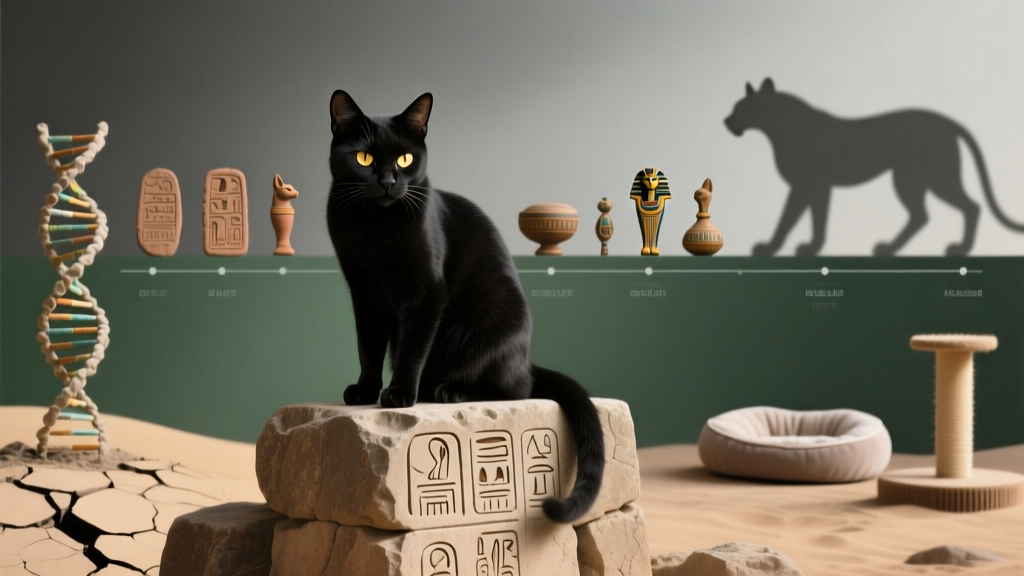
The table below synthesizes findings from archaeology, paleogenomics, and ethnohistorical records to show how—and when—human-cat behavioral dynamics evolved. Note: No major cognitive or motivational shifts occurred after ~1,000 BCE. What changed was context—not capacity.
| Time Period | Key Evidence | Behavioral Implication for Modern Cats | Source Type |
|---|---|---|---|
| 9,500 BCE | Cyprus burial site: human + juvenile cat, intentional transport | Early symbolic relationship—cats already held social value beyond pest control | Archaeological |
| 7,500 BCE | Neolithic Çatalhöyük (Turkey): cat bones in household refuse, not ritual contexts | Commensal coexistence—cats lived *with*, not *for*, humans | Zooarchaeological |
| 3,000 BCE | Egyptian tomb paintings: cats hunting birds, guarding grain, seated under chairs | Functional integration + status elevation—yet still depicted as autonomous, never leashed or commanded | Art Historical / Epigraphic |
| 1,000 BCE | Mitochondrial DNA analysis: single domestication event in Near East, followed by maritime dispersal | All domestic cats share one ancestral population—behavioral consistency is genetically encoded, not culturally learned | Genetic |
| 500 CE onward | Medieval European texts: cats associated with witchcraft, hunted en masse during plagues | Population bottlenecks reinforced genetic traits favoring wariness—explaining modern cats’ resilience *and* suspicion of sudden change | Historical / Demographic |
Frequently Asked Questions
Did ancient Egyptians worship cats—or just value them?
They did both—but not as deities *in themselves*. Bastet, originally a lioness warrior goddess, evolved into a protective feline deity associated with fertility, home, and joy—but her iconography emphasized *qualities* cats embodied (alertness, maternal ferocity, liminality), not worship of individual animals. Real cats were revered as living vessels of divine energy—not gods, but sacred conduits. Killing a cat, even accidentally, carried the death penalty in New Kingdom Egypt (c. 1550–1070 BCE), per Herodotus’ accounts—underscoring profound cultural weight rooted in practical and spiritual symbiosis.
Are street cats today behaving more ‘ancient’ than house cats?
Not inherently—just more visibly reliant on ancient instincts. Free-roaming cats face constant environmental pressures (predators, resource scarcity, social competition) that activate survival behaviors more frequently. But neurologically and motivationally, your indoor cat possesses identical drives: the same hunting sequence (stare-stalk-pounce-bite-kick), same scent-marking thresholds, same need for safe elevated vantage points. Environment modulates expression—not existence—of behavior.
Can understanding ancient behavior help with aggression or anxiety?
Yes—profoundly. A 2022 clinical trial published in Frontiers in Veterinary Science found that owners who received ‘evolutionary behavior coaching’ (focusing on territorial security, predictable routines, and scent-safe spaces) saw a 68% reduction in urine marking and inter-cat aggression within 6 weeks—compared to 32% in standard behavior-modification groups. Why? Because anxiety in cats rarely stems from ‘disobedience’—it stems from perceived threats to ancient priorities: safety, predictability, and control over resources.
Do different breeds have stronger ancient links?
No—breed differences are superficial and recent (<200 years). All domestic cats share >99.8% identical nuclear DNA. Coat patterns, ear shapes, or size variations (e.g., Maine Coon vs. Singapura) reflect Victorian-era aesthetic preferences—not functional divergence. Even ‘primitive’ breeds like the Egyptian Mau or Abyssinian show no greater behavioral fidelity to wildcats—their ‘wild look’ is purely phenotypic. Behaviorally, a shelter tabby and a pedigreed Persian operate from the same 9,000-year-old playbook.
Is my cat ignoring me—or practicing ancient social strategy?
She’s likely doing both. Solitary felids lack pack-based reinforcement systems—so ‘attention-seeking’ isn’t wired like in dogs. Cats use proximity strategically: sitting near you while you work signals comfort and co-regulation, not demand. Ignoring you when called? Not rudeness—it’s conserving energy for high-value interactions (like greeting you at the door, which mirrors wildcat reunion behaviors after solo forays). As feline behaviorist Pam Johnson-Bennett notes: “Cats don’t ignore us. They curate engagement—with intention.”
Common Myths Debunked
Myth #1: “Cats are aloof because they’re less intelligent or emotionally complex than dogs.”
False. Neuroimaging shows cats possess comparable neural density in areas governing emotion, memory, and decision-making. Their independence reflects ecological niche—not cognitive deficit. Dogs evolved to read human cues; cats evolved to *influence* human behavior subtly (e.g., purring at frequencies matching infant cries to trigger caregiving responses).
Myth #2: “Ancient cats were fully domesticated—so modern ones should ‘obey’ like pets.”
Incorrect. Domestication is a spectrum. Cats sit at the ‘commensal’ end—like pigeons or raccoons—where association benefits both parties *without* dependency. They retained full reproductive autonomy, predatory competence, and sensory acuity. Expecting ‘obedience’ misunderstands the entire contract.
Related Topics (Internal Link Suggestions)
- Understanding Cat Body Language — suggested anchor text: "what your cat's tail flick really means"
- Best Enrichment Toys for Indoor Cats — suggested anchor text: "indoor cat enrichment that satisfies ancient hunting instincts"
- Litter Box Placement Guide — suggested anchor text: "litter box location rules based on feline territorial science"
- When to Worry About Cat Aggression — suggested anchor text: "cat aggression triggers rooted in ancient stress responses"
- Slow Blink Training for Trust Building — suggested anchor text: "how to communicate with your cat using ancient feline diplomacy"
Conclusion & Next Step
Can cat behavior be linked to ancient times? Unequivocally yes—and recognizing that link doesn’t romanticize cats. It empowers you. Every time you adjust a litter box location, rotate a toy, or return a slow blink, you’re not indulging a pet—you’re honoring a 9,500-year-old partnership built on mutual benefit, quiet observation, and deep biological continuity. Stop asking, “Why won’t my cat listen?” Start asking, “What ancient need is this behavior trying to meet?” Then meet it—on their terms. Your next step? Spend 5 minutes today observing your cat without interpretation: note where they choose to rest, how they approach food, what surfaces they scratch. Jot down one behavior—and consult the timeline table above. You’ll spot the past in real time. And that changes everything.