Understanding Cat Food Dry Matter Basis Calculation
1) Why this topic matters for cat health
Cat food labels can look straightforward—protein, fat, fiber, moisture. The problem is that most labels list nutrients “as fed,” meaning the numbers include water. Since wet foods can be 70–85% moisture and dry foods are often 6–12% moisture, comparing them side-by-side without adjusting for water can lead to misleading conclusions. A canned food might appear “low protein” compared to kibble simply because it contains more water, not because it provides less protein relative to its actual nutrients.
Dry Matter Basis (DMB) calculation removes water from the equation. It lets you compare foods more fairly, evaluate whether a diet aligns with feline nutritional needs, and spot red flags like unexpectedly high carbohydrates or low protein. If you’re feeding a cat with obesity, diabetes risk, urinary issues, or chronic kidney disease (CKD), this tool becomes even more valuable for informed decision-making.
Use DMB as a comparison tool—not a replacement for veterinary advice. Cats with medical conditions should have their diet chosen with guidance from a veterinarian, ideally with a board-certified veterinary nutritionist when available.
2) Scientific background: feline nutritional needs and obligate carnivore biology
Cats are obligate carnivores. Their metabolism and nutrient requirements evolved around prey-based diets: high in animal protein, moderate fat, and very low carbohydrate, with substantial water intake from food.
- High protein requirement: Cats have higher protein needs than dogs and humans. They continuously use amino acids for energy and have limited ability to downshift protein metabolism when dietary protein is low.
- Essential nutrients from animal sources: Cats require taurine, preformed vitamin A (retinol), and arachidonic acid—nutrients naturally abundant in animal tissues.
- Carbohydrate handling: Cats can digest carbs, but they do not have a nutritional requirement for carbohydrates. Diets high in starch can be problematic for some cats, especially those prone to weight gain or glucose intolerance.
- Hydration physiology: Cats have a relatively low thirst drive. They’re designed to get much of their water from prey. Lower water intake can contribute to concentrated urine, which may be relevant for urinary tract health in some cats.
Commercial diets that meet standards from organizations like AAFCO (U.S.) or FEDIAF (Europe) can be nutritionally complete, but their macronutrient distribution varies widely. DMB helps you see those differences more clearly.
3) Detailed analysis: what “Dry Matter Basis” means and how to calculate it
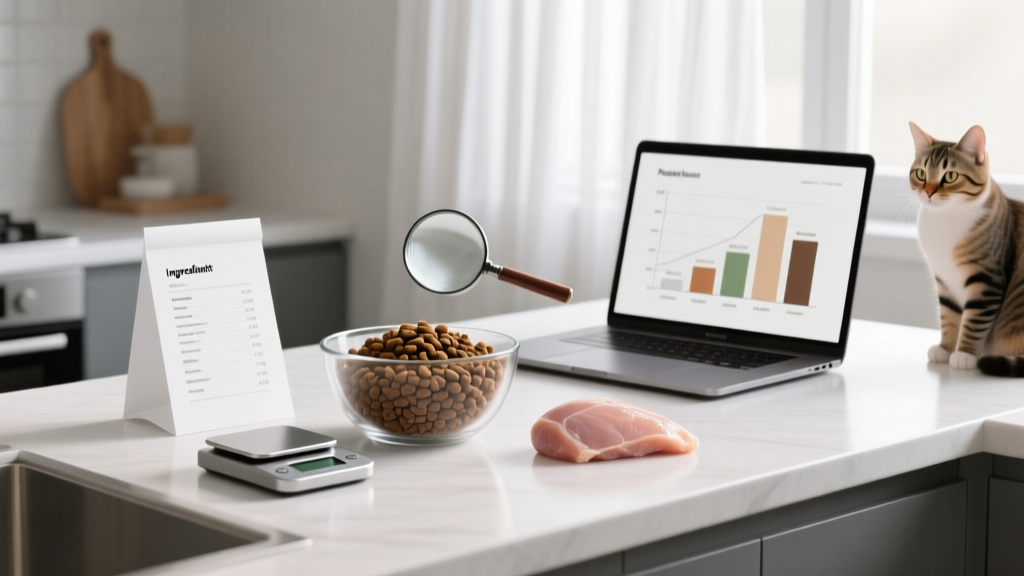
Dry matter is what’s left when you remove moisture: protein, fat, minerals (ash), fiber, and carbohydrates. DMB expresses nutrients as a percentage of that dry portion rather than the whole food.
Key terms on pet food labels
- As-fed: Nutrient percentage including moisture (what the label typically shows).
- Moisture: Water content of the food.
- Dry matter: 100% minus moisture percentage.
- Ash: Total mineral content (not “burnt food”; it’s a lab measurement).
The DMB formula
Dry Matter % = 100 − Moisture %
Nutrient (DMB) % = (Nutrient as-fed % ÷ Dry Matter %) × 100
Worked example: comparing wet vs dry protein fairly
| Food | Moisture (as-fed) | Protein (as-fed) | Dry Matter % | Protein (DMB) |
|---|---|---|---|---|
| Canned | 78% | 10% | 22% | (10 ÷ 22) × 100 = 45.5% |
| Kibble | 10% | 34% | 90% | (34 ÷ 90) × 100 = 37.8% |
On the label, kibble looks higher protein (34% vs 10%). On a dry matter basis, the canned food is actually higher protein relative to its nutrients (45.5% vs 37.8%). This is why DMB matters.
Estimating carbohydrates on a dry matter basis
Many labels don’t list carbohydrates. You can estimate “nitrogen-free extract” (NFE), a common proxy for carbs, by subtraction:
Carbs (as-fed) % ≈ 100 − Protein − Fat − Fiber − Moisture − Ash
If ash isn’t listed, you can request a full nutrient profile from the manufacturer. Using a guessed ash value can introduce error, especially when comparing foods closely.
Carbohydrate calculation example (with ash listed)
| Label item | As-fed % |
|---|---|
| Protein | 10 |
| Fat | 6 |
| Fiber | 1.5 |
| Moisture | 78 |
| Ash | 2.5 |
| Estimated carbs (as-fed) | 100 − (10+6+1.5+78+2.5) = 2% |
Convert to DMB:
- Dry matter = 100 − 78 = 22%
- Carbs DMB = (2 ÷ 22) × 100 = 9.1%
This approach is useful, but remember: “crude fiber” underestimates total dietary fiber, and rounding rules on labels can skew results. Use DMB to compare trends and shortlist foods, then confirm details with your veterinarian—especially for cats with medical needs.
4) Practical recommendations for cat owners
- Use DMB to compare within a goal: If you’re prioritizing higher protein and lower carbs, compare candidates on DMB rather than as-fed.
- Ask manufacturers for an “as fed” and “dry matter” nutrient profile: Many companies will provide a typical analysis including ash and sometimes phosphorus, sodium, and magnesium—critical for certain health conditions.
- Prioritize complete and balanced diets: Choose foods labeled complete and balanced for your cat’s life stage (kitten, adult maintenance, growth/reproduction, senior as directed by your vet).
- Let health goals guide the choice: Weight management, urinary support, diabetes risk, and GI sensitivity benefit from different nutrient profiles. DMB helps you see how formulas differ beyond marketing terms.
5) Comparison of approaches: what DMB can and can’t tell you
| Approach | Best for | Pros | Limitations |
|---|---|---|---|
| DMB comparison | Comparing wet vs dry; spotting macro trends | Removes moisture bias; simple math | Doesn’t show calorie density or ingredient quality; label rounding affects accuracy |
| Calories (kcal) and kcal/cup or kcal/can | Weight control; portion accuracy | Directly tied to weight gain/loss | Not a full nutrition picture; macros still matter |
| Nutrients per 100 kcal | Clinical nutrition; comparing nutrient density | Excellent for medical cases and balanced feeding | Requires manufacturer data; more complex |
| Veterinary therapeutic diets | Diagnosed conditions (CKD, urinary stones, diabetes) | Formulated for specific clinical targets; tested | Not one-size-fits-all; should be vet-directed |
When DMB is most helpful: comparing protein, fat, and estimated carbs across foods with different moisture levels.
When DMB is not enough: conditions where minerals matter (phosphorus for CKD, magnesium for some urinary issues) or when calorie density and portion control are the main issue.
6) Common mistakes and misconceptions to avoid
- Mistake: “Wet food is always lower protein.”
Reality: Wet foods often look lower protein as-fed due to high moisture. DMB frequently shows comparable or higher protein than kibble. - Mistake: “Higher protein DMB automatically means better.”
Reality: Cats generally benefit from adequate animal protein, but “best” depends on the cat. Some medical conditions require specific targets (for example, CKD often focuses on phosphorus control and tailored protein strategies under veterinary supervision). - Mistake: “Carbs calculated by subtraction are exact.”
Reality: It’s an estimate influenced by rounding, unlisted ash, and how fiber is measured. Use it to compare foods, not to treat it as a lab-grade value. - Mistake: “Ash is bad and should be as low as possible.”
Reality: Ash represents minerals—some are essential. What matters is the specific minerals and amounts (like phosphorus and sodium), especially for cats with health conditions. - Myth: “Grain-free means low-carb.”
Fact: Grain-free foods can still be high in starch (peas, lentils, potatoes, tapioca). DMB carb estimates can help reveal this. - Myth: “Kibble cleans teeth, so it’s necessary.”
Fact: Most kibble shatters and does not provide meaningful dental cleaning. Dental health is best supported by vet-recommended dental diets, dental treats approved by the Veterinary Oral Health Council (VOHC), tooth brushing, and regular exams.
7) How to implement diet changes safely (transition tips)
Even when the numbers look ideal on paper, cats need gradual transitions to avoid GI upset and food refusal. Sudden changes can trigger vomiting, diarrhea, or a hunger strike—especially risky for overweight cats due to hepatic lipidosis (fatty liver disease).
- Transition over 7–10 days (or longer for sensitive cats):
- Days 1–3: 75% old, 25% new
- Days 4–6: 50% old, 50% new
- Days 7–9: 25% old, 75% new
- Day 10+: 100% new
- Warm wet food slightly to enhance aroma (avoid hot temperatures).
- Maintain meal routine and offer measured portions to prevent overfeeding.
- Monitor stool quality, appetite, water intake, and body weight weekly.
- If your cat stops eating for 24 hours (or eats dramatically less), call your vet, especially for kittens, seniors, and cats with chronic disease.
8) Special considerations: age, health conditions, and activity level
Kittens and growing cats
- Need higher energy density and specific nutrient ratios for growth.
- Choose diets labeled for growth or all life stages.
- DMB can help compare macros, but growth nutrition is not just protein—calcium/phosphorus balance and DHA matter too. Ask your vet before making major changes.
Adult indoor cats
- Often lower activity and prone to weight gain.
- Focus on calories, portion control, adequate protein, and satiety strategies (higher moisture, thoughtful fiber levels).
- DMB helps you avoid choosing a “high-protein” diet that is only high as-fed due to low moisture differences.
Seniors
- Needs vary widely: some seniors maintain well; others lose muscle mass.
- Higher-quality, digestible protein can support lean body mass in many older cats, but comorbidities (kidney disease, dental pain, GI disease) may change targets.
- Have your vet monitor body condition score, muscle condition score, hydration, and lab work.
Overweight cats
- DMB is helpful, but calories drive weight loss.
- Use measured portions and aim for slow, vet-supervised weight reduction.
- Higher moisture diets can improve satiety for some cats.
Diabetes and prediabetes risk
- Many diabetic cats do better with diets lower in carbohydrates and higher in protein, but management should be individualized with your veterinarian.
- DMB carb estimates can help shortlist appropriate foods, then confirm details (and safety) with your vet, especially if insulin is used.
Urinary tract concerns
- Moisture intake, urine concentration, mineral balance, and urine pH can matter.
- DMB comparisons won’t tell you urine pH effects. Veterinary urinary diets are formulated for specific stone/crystal risks and should be used under veterinary direction.
Chronic kidney disease (CKD)
- Phosphorus control is often a central goal; protein strategy should be guided by your veterinarian.
- DMB protein alone is not enough—ask for phosphorus (ideally as mg/100 kcal) and follow your vet’s recommendations.
Helpful quick-reference table: DMB calculations
| What you want | Formula | What you need from label/manufacturer |
|---|---|---|
| Dry matter % | 100 − moisture% | Moisture |
| Nutrient DMB % | (as-fed% ÷ dry matter%) × 100 | Nutrient as-fed %, Moisture |
| Estimated carbs as-fed % | 100 − protein − fat − fiber − moisture − ash | Protein, Fat, Fiber, Moisture, Ash |
| Estimated carbs DMB % | (carbs as-fed% ÷ dry matter%) × 100 | All above |
9) FAQ
How do I calculate dry matter basis from a cat food label?
Find moisture on the label. Subtract it from 100 to get dry matter %. Then divide the as-fed nutrient by the dry matter %, and multiply by 100. Example: moisture 78% means dry matter is 22%. If protein is 10% as-fed: (10 ÷ 22) × 100 = 45.5% protein DMB.
Is DMB enough to choose the best cat food?
DMB is a strong comparison tool for protein, fat, and estimated carbs across wet and dry foods. It does not evaluate calorie density, amino acid balance, digestibility, or key minerals (like phosphorus and sodium). For kittens and cats with medical conditions, work with your veterinarian for diet selection.
Why doesn’t the carbohydrate percentage appear on most labels?
In many regions, pet food labels aren’t required to list carbohydrates. Carbs are typically estimated by subtraction using the guaranteed analysis and ash (if available). For a more accurate picture, ask the manufacturer for a full typical nutrient analysis.
What’s a “good” protein percentage on a dry matter basis for cats?
Many cat owners aim for relatively high protein on a DMB compared with omnivores, reflecting cats’ obligate carnivore biology. However, “good” depends on the individual cat’s life stage, calorie needs, and health status. Your veterinarian can help you select targets, especially for seniors and cats with kidney disease or other chronic conditions.
Does wet food automatically mean a healthier diet?
Not automatically. Wet food often increases water intake and can support satiety, which is helpful for many cats. But the best choice depends on the complete nutrient profile, calorie control, your cat’s preferences, and any medical needs. Plenty of cats thrive on kibble, wet, or mixed feeding when the diet is complete, balanced, and appropriately portioned.
If my cat is picky, should I keep rotating foods?
Some rotation can be fine, but frequent abrupt changes can worsen pickiness and GI upset. If you want variety, rotate within a small set of nutritionally appropriate foods and transition gradually. If pickiness is new or worsening, consult your veterinarian to rule out dental disease, nausea, pain, or other medical issues.
Bottom line: Dry Matter Basis calculation helps you compare cat foods fairly by removing moisture from the equation. Pair DMB with calorie awareness, life-stage appropriateness, and veterinary guidance—especially if your cat has any health condition or needs a therapeutic diet.
If you found this guide helpful, explore more practical cat nutrition articles and feeding tips on catloversbase.com to build a diet plan that supports long-term health.