Feeding Cats With Urethral Blockage History: Prevention Diet
1. Why This Nutrition Topic Matters for Cat Health
A urethral blockage is one of the most frightening emergencies a cat owner can face. When a cat can’t pass urine, toxins build quickly, the bladder becomes dangerously distended, and electrolyte abnormalities can become life-threatening within hours. Even after successful treatment, recurrence is common—especially in male cats—because many of the underlying risk factors remain unless they’re addressed long-term.
Diet is one of the strongest tools you and your veterinarian have to reduce the chance of another blockage. The right feeding plan can:
- Increase urine volume (diluting minerals and irritants)
- Support a urinary pH range that reduces certain crystal types
- Lower urinary mineral load that contributes to stone formation
- Help maintain lean body condition, reducing FLUTD risk factors
Because urinary issues can stem from different causes (crystals, stones, inflammation, stress-related cystitis), prevention diets should be tailored. Always work with your veterinarian—especially if your cat has had a confirmed obstruction.
2. Scientific Background: Feline Nutritional Needs and Why Urinary Health Is Unique
Cats are obligate carnivores. Their physiology evolved to thrive on prey-based diets that are:
- High in animal protein (amino acids like taurine are essential)
- Moderate-to-high in fat for energy
- Very low in carbohydrates compared with omnivores
- Moisture-rich (prey is typically ~70–75% water)
Two points matter most for cats with a blockage history:
- Low thirst drive: Many cats do not voluntarily drink enough to compensate for dry diets. Lower water intake often means smaller urine volume and more concentrated urine.
- Urine chemistry responds to diet: Minerals (magnesium, phosphorus, calcium, sodium), protein level, and diet acidifying/alkalinizing properties influence urinary pH and saturation—the factors that determine whether crystals or stones are likely to form.
Most obstructed male cats have urethral plugs, inflammatory debris, and/or crystals (commonly struvite), but calcium oxalate stones and idiopathic cystitis can also be involved. The “best” diet depends on which pattern your veterinarian has identified.
3. Evidence-Based Nutrition Analysis: What a Prevention Diet Needs to Do
3.1 Increase Water Intake: The Most Powerful Lever
Higher total water intake increases urine volume and lowers urine concentration. This reduces the chance that minerals will reach a saturation point where crystals precipitate. For many cats, the easiest way to do this is to feed primarily wet food and/or add water strategically.
Veterinary urinary diets are typically designed to promote:
- Higher urine volume
- Lower relative supersaturation for stone-forming minerals
- Controlled mineral content
3.2 Manage Urinary pH (Without Chasing Numbers at Home)
Urine pH affects crystal formation:
- Struvite (magnesium ammonium phosphate) is more likely in more alkaline urine.
- Calcium oxalate is more likely when urine is more acidic and concentrated, and when urinary calcium/oxalate saturation is high.
Because the “ideal” pH target depends on your cat’s diagnosis, home pH manipulation using supplements is risky. Many over-the-counter urinary “acidifiers” can overshoot and may increase risk of calcium oxalate stones or cause gastrointestinal upset. A veterinary-prescribed urinary diet is the safest way to influence pH.
3.3 Control Key Minerals (Ash, Magnesium, Phosphorus, Calcium, Sodium)
Owners often focus on “low ash,” but ash is a broad label and not a precise stone-prevention tool. What matters is the balance and bioavailability of specific minerals and how they affect urinary saturation.
| Nutrient/Mineral | Why it matters for urinary cats | How prevention diets typically handle it |
|---|---|---|
| Magnesium | Component of struvite crystals | Controlled to reduce struvite building blocks |
| Phosphorus | Also part of struvite; important for overall health | Balanced; may be moderated depending on formulation |
| Calcium | Key component of calcium oxalate stones | Balanced; not simply “low,” but controlled to reduce saturation risk |
| Sodium | Can increase water intake/urine volume in some formulations | Often moderately increased under veterinary guidance |
| Total mineral load (“ash”) | Crude marker; not diagnostic | Not the main focus; specific mineral targets matter more |
3.4 Support Healthy Body Condition and Reduce Inflammation Triggers
Overweight cats have a higher risk of feline lower urinary tract disease (FLUTD). Stress and environmental factors also play a role, especially for feline idiopathic cystitis (FIC), where inflammation occurs without infection or stones. Diet can support weight goals and hydration, while routine and enrichment support stress reduction.
3.5 When Infection Is (and Isn’t) the Cause
Most urinary blockages in young-to-middle-aged male cats are not caused by bacterial infection. Feeding “anti-UTI” supplements or assuming antibiotics solve the issue can delay proper prevention. Your vet may recommend urinalysis, culture, imaging, and stone analysis when appropriate to guide diet selection.
4. Practical Recommendations for Cat Owners
Use these steps as a starting framework, then customize with your veterinarian.
Daily Feeding Priorities
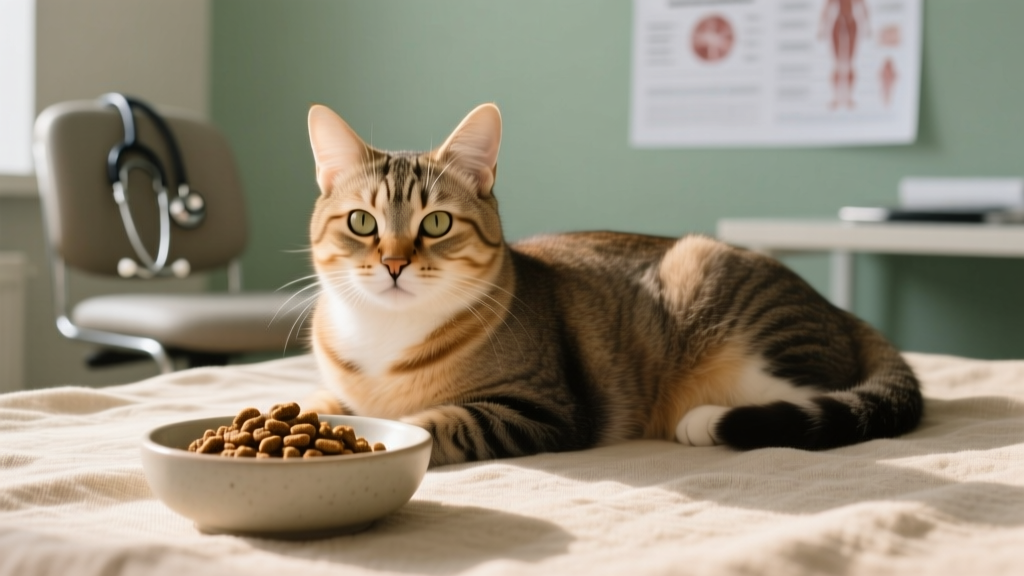
- Prioritize moisture: Feed primarily wet food when possible. If using dry food, consider a measured portion alongside wet food rather than free-feeding.
- Use a veterinary urinary diet if prescribed: These diets are formulated to manage urinary pH and mineral saturation more reliably than general “urinary health” retail foods.
- Measure portions: Maintain a lean body condition. Ask your vet for a target weight and daily calorie plan.
- Keep treats minimal and appropriate: Treats can disrupt the mineral/pH design of a urinary diet.
Hydration Boosters That Help Many Cats
- Add 1–3 tablespoons of water to wet food (increase gradually)
- Offer multiple water stations, wide bowls, and fresh water daily
- Use a cat water fountain if your cat prefers moving water
- Ask your vet about safe broths (low sodium, onion/garlic-free) as occasional toppers
5. Comparing Options and Approaches
| Option | Pros | Cons / Cautions | Best fit |
|---|---|---|---|
| Veterinary prescription urinary wet diet | Highest moisture; controlled minerals; designed for urinary pH and reduced stone risk | Cost; some cats need time to accept; must limit non-diet treats | Cats with confirmed blockage/crystals/stones; high recurrence risk |
| Veterinary prescription urinary dry diet | Convenient; still formulated for urinary targets | Lower moisture than wet; may require extra hydration strategies | Cats that refuse wet; multi-cat households with careful management |
| Over-the-counter “urinary health” foods | Easier to buy; may modestly support urinary health | Not equivalent to therapeutic diets; may not address specific stone type; variable formulations | Mild urinary history only, or as vet-approved maintenance after stabilization |
| Homemade diets | Can be high moisture; ingredient control | High risk of mineral imbalance without a boarded veterinary nutritionist; urinary targets hard to hit consistently | Only with professional formulation and monitoring |
| Supplements (cranberry, acidifiers, etc.) | Some owners perceive benefits | Evidence is limited for obstruction prevention; can shift pH in the wrong direction; may interact with conditions | Only if vet recommends for a specific case |
6. Common Mistakes and Misconceptions to Avoid (Myths Debunked)
- Myth: “Low ash food prevents all urinary problems.”
Fact: “Ash” is not a precise urinary-health metric. Crystal/stone risk is driven by urine concentration, pH, and specific minerals—not a single ash number. - Myth: “Dry food causes blockages, so switching to any wet food fixes it.”
Fact: Higher moisture usually helps, but the mineral balance and urinary targets still matter. Some cats need therapeutic urinary formulas, not just any canned food. - Myth: “If my cat strains, it’s a UTI—cranberry will help.”
Fact: In male cats, straining can be obstruction or inflammation. Cranberry is not a substitute for veterinary diagnosis, and delays can be dangerous. - Myth: “I can manage urine pH with supplements at home.”
Fact: Pushing urine too acidic may increase calcium oxalate risk. Proper diets use controlled formulation rather than guesswork. - Myth: “Once treated, the problem is gone.”
Fact: Recurrence is common. Long-term feeding strategy and monitoring are part of prevention.
7. How to Implement Diet Changes Safely (Transition Tips)
Cats with urinary history benefit from consistency, but transitions must be gradual to avoid food refusal (which can be risky in cats) and gastrointestinal upset.
- Transition over 7–14 days (or longer for picky cats).
- Start with 10–25% new food mixed with the current food, increasing every 2–3 days.
- Warm wet food slightly (test temperature) to boost aroma.
- Keep meal routines predictable; avoid frequent brand hopping.
- Do not fast a cat into acceptance. If your cat refuses food for 24 hours (or eats dramatically less), contact your vet promptly.
If your veterinarian prescribes a urinary diet after a blockage, follow it strictly. Mixing it with other diets can reduce its effectiveness because therapeutic diets rely on specific nutrient ratios.
8. Special Considerations: Age, Health Conditions, Activity Level
Kittens
Urethral obstruction is less common in kittens, and they have higher energy needs. Don’t place a growing kitten on an adult urinary diet unless your veterinarian explicitly recommends a formulation appropriate for growth.
Adult Neutered Male Cats
This group is at higher risk for obstruction due to anatomy and common lifestyle factors (indoor living, stress, reduced activity). Strategies that often help include:
- Wet-focused feeding
- Lean body condition maintenance
- Environmental enrichment and litter box optimization
Seniors
Older cats may have concurrent kidney disease, arthritis, or dental issues. If chronic kidney disease is present, diet selection becomes more complex because kidney diets and urinary diets differ in phosphorus and protein strategies. Your veterinarian may prioritize one condition or choose a compromise plan with monitoring.
Multi-Cat Homes
Diet control is harder when cats share food. Consider:
- Microchip feeders or feeding in separate rooms
- Scheduled meals rather than free-choice kibble
- Monitoring litter box output to spot changes early
Low Activity or Overweight Cats
Weight management matters. Ask your vet for a calorie target and weigh-ins. Rapid weight loss is unsafe for cats, so aim for gradual loss with a structured plan.
Cats With Recurrent Idiopathic Cystitis (FIC)
For FIC-prone cats, diet helps mainly by improving hydration, but prevention also requires stress reduction: predictable routine, play, hiding spaces, and sufficient litter boxes (commonly one per cat plus one extra).
9. FAQ: Feeding Cats With a Urethral Blockage History
1) Should my cat be on a prescription urinary diet forever?
Many cats with a confirmed obstruction benefit from long-term use, especially if stones/crystals were documented or recurrence risk is high. Some cats transition to a non-prescription maintenance plan later, but only after veterinary rechecks (urinalysis, imaging when indicated) and a clear risk assessment.
2) Is wet food always better than dry food for urinary prevention?
Wet food generally improves hydration and urine dilution, which is strongly beneficial. Some cats do well on prescription urinary dry food with aggressive water-intake support, but for many blockage-history cats, a wet-focused plan is preferred. Your vet can help decide based on your cat’s urine concentration, history, and acceptance.
3) Can I add water to dry food instead of feeding canned?
Some cats will eat moistened kibble, which can help hydration. Food safety matters: discard moistened food after a short period rather than leaving it out all day. Wet therapeutic diets are still more consistent for urinary targets, but adding water can be a useful tool if your cat refuses canned food.
4) Are urinary supplements (cranberry, D-mannose, methionine) helpful?
They are not reliable obstruction-prevention tools on their own. Some may have niche uses in specific scenarios, but they can also be counterproductive (for example, acidifiers increasing calcium oxalate risk). Use supplements only with veterinary guidance.
5) How do I know if my cat is getting enough water?
Urine that is consistently very concentrated can be a clue, but you can’t accurately judge hydration from bowl drinking alone. Your veterinarian can check urine specific gravity and discuss targets. At home, watch for larger clumps in the litter box, normal appetite, and good energy—while remembering these signs don’t replace testing.
6) What are the red-flag signs of another blockage?
Straining with little or no urine, repeated trips to the litter box, crying, lethargy, vomiting, hiding, or a painful abdomen are emergencies—especially in male cats. Seek veterinary care immediately. Do not wait to “see if it passes.”
Building a Prevention Plan That Works
For cats with a urethral blockage history, the best prevention diet is one that reliably increases urine volume, supports appropriate urine chemistry for your cat’s diagnosis, and fits your household so you can feed it consistently. Your veterinarian is your partner in choosing between therapeutic urinary diets, wet-focused strategies, and monitoring plans based on urinalysis and imaging.
If you want more practical, science-based feeding guidance, explore more feline nutrition articles on catloversbase.com.