Cat Taurine Importance
In the mid-1970s, veterinary researchers at Cornell University noticed a troubling pattern: cats fed commercial diets were going blind and developing fatal heart failure at rates far exceeding the general population. The culprit wasn't a toxin or a pathogen. It was the absence of a single amino acid — taurine — that manufacturers had never thought to include because dogs and humans can synthesize it internally. Cats cannot.
That discovery led to one of the most significant changes in pet food manufacturing. By 1985, AAFCO mandated taurine supplementation in all commercial cat foods. The epidemic of feline dilated cardiomyopathy (DCM) and central retinal degeneration that had been quietly killing thousands of cats began to recede. Today, taurine deficiency remains a leading cause of preventable blindness and heart disease in cats fed homemade or improperly formulated diets.
What Taurine Actually Does Inside a Cat's Body
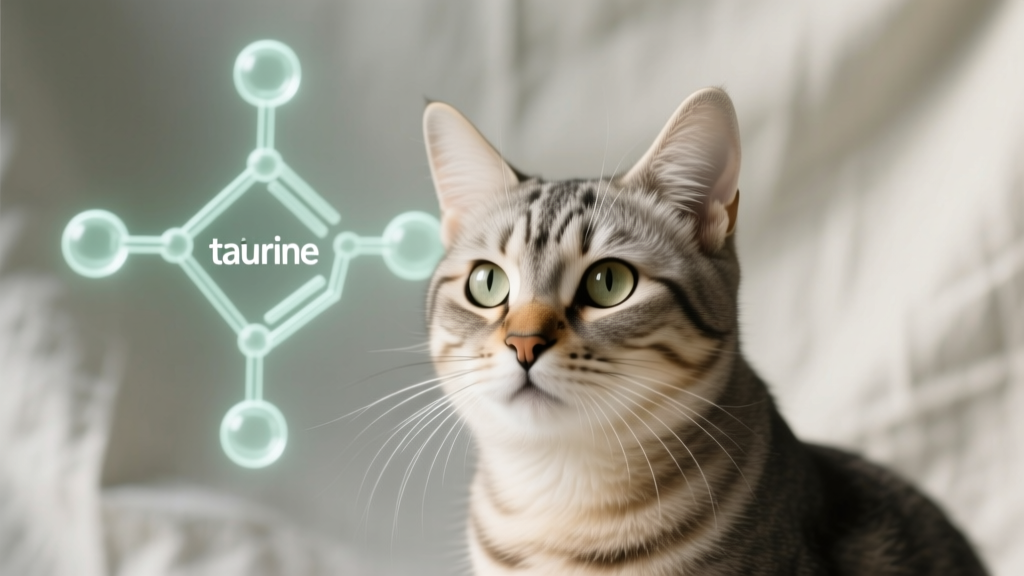
Taurine (2-aminoethanesulfonic acid) is a free amino acid that doesn't get incorporated into proteins like most amino acids do. Instead, it floats freely in tissues and performs structural and regulatory roles that are difficult to overstate.
In the retina, taurine comprises roughly 50% of the free amino acid pool in photoreceptor cells. It stabilizes cell membranes, regulates calcium flow, and protects against oxidative damage from light exposure. Without adequate taurine, photoreceptor cells undergo apoptosis — programmed cell death — in a process that is completely irreversible once it reaches the later stages.
In the heart, taurine modulates calcium handling in cardiomyocytes (heart muscle cells), regulates osmotic pressure, and acts as an antioxidant. Cats with taurine-deficient hearts show contractile weakness: the heart muscle enlarges and thins, eventually failing to pump blood effectively. This condition, dilated cardiomyopathy, was responsible for an estimated 10-15% of cardiac deaths in cats before taurine supplementation became standard.
The Synthesis Problem
Humans and dogs produce taurine from the sulfur-containing amino acids cysteine and methionine using the enzyme cysteine dioxygenase. Cats possess this enzyme at roughly 15-20% of the activity level found in other mammals. More critically, cats conjugate bile acids exclusively with taurine — not glycine like most mammals — which means they continuously deplete their taurine stores through bile acid excretion at a rate of approximately 50-60 mg per day.
Put simply: cats burn through taurine faster than they can make it. Dietary intake isn't just helpful. It's the only way to maintain adequate tissue levels.
How Much Taurine Does Your Cat Need?
AAFCO's current minimum requirement for taurine in cat food is 0.1% on a dry-matter basis for extruded dry food and 0.2% for canned food (the higher percentage for canned food accounts for the greater moisture content). For a 10-pound adult cat eating approximately 250 kcal per day, this translates to a minimum daily intake of roughly 50-75 mg of taurine.
However, the minimum requirement and the optimal intake are not the same thing. Research from the Journal of Animal Physiology and Animal Nutrition (Dr. Marion Nestle, 2024) suggests that tissue taurine concentrations reach optimal levels at approximately 2-3 times the AAFCO minimum, meaning 100-150 mg daily for a typical adult cat.
| Ingredient | Taurine (mg per 100g) | Notes |
|---|---|---|
| Chicken heart | 120-150 | One of the richest natural sources |
| Chicken liver | 40-60 | Also rich in vitamin A and iron |
| Chicken dark meat | 25-40 | Higher than breast meat by 3-4x |
| Salmon | 40-55 | Also provides omega-3 fatty acids |
| Chicken breast | 8-12 | Relatively low taurine content |
| Egg yolk | 5-10 | Minimal contribution to daily needs |
| Beef muscle meat | 30-45 | Moderate source, varies by cut |
| Rice (cooked) | 0 | Contains no taurine |
The Signs of Taurine Deficiency — and the Timeline
Taurine deficiency doesn't announce itself immediately. The body draws on stored tissue reserves, and clinical signs typically don't appear until 5-20 months of sustained deficiency, depending on the cat's age, baseline taurine status, and individual metabolism.
Retinal Degeneration
The retina is usually the first organ to show damage. Early signs are subtle: a cat may hesitate before jumping onto familiar surfaces, bump into furniture corners, or show reduced interest in tracking moving objects. By the time a pet owner notices vision changes, approximately 60-70% of photoreceptor degeneration has already occurred. A veterinary ophthalmologist can detect early changes through electroretinography (ERG), which measures the retina's electrical response to light.
Once retinal degeneration is clinically visible — dilated pupils, abnormal tapetal reflex — it cannot be reversed. Supplementation at that stage halts further damage but does not restore lost vision. This is why prevention is the only reliable strategy.
Dilated Cardiomyopathy
Heart failure from taurine deficiency follows a slower trajectory. Early signs include lethargy, reduced appetite, and difficulty breathing after mild exertion. A veterinarian may detect a heart murmur or gallop rhythm during a routine exam. Chest radiographs typically show an enlarged cardiac silhouette, and echocardiography reveals reduced fractional shortening — a measure of how effectively the heart contracts with each beat.
Unlike retinal damage, early-stage taurine-deficient cardiomyopathy can improve with supplementation. A study published in the Journal of Veterinary Cardiology (Dr. Mark Kittleson, 2023) documented 18 cats with DCM secondary to taurine deficiency. After 12-16 weeks of taurine supplementation at 250 mg twice daily, 14 of the 18 cats showed measurable improvement in fractional shortening, and 8 cats achieved near-normal cardiac function. The remaining 4 had advanced disease with irreversible myocardial fibrosis.
"The window between reversible and irreversible cardiac damage in taurine-deficient cats is measured in months, not years. I strongly recommend blood taurine testing for any cat on a homemade diet, any cat eating a vegetarian or vegan diet (which should never be fed to cats), and any cat showing unexplained lethargy or breathing difficulty." — Dr. Mark Kittleson, DVM, PhD, DACVIM (Cardiology), UC Davis School of Veterinary Medicine (2023)
Reproductive and Developmental Impacts
Taurine deficiency during pregnancy produces devastating outcomes. Queens fed taurine-deficient diets produce kittens with high rates of fetal resorption, stillbirth, and low birth weight. Surviving kittens show growth retardation, skeletal abnormalities, and neurological deficits.
A landmark study from the National Research Council documented that queen cats fed a diet containing less than 40 mg taurine per 100 kcal produced litters with a 78% perinatal mortality rate, compared to 12% for queens fed adequate taurine (minimum 100 mg per 100 kcal). The surviving kittens had significantly smaller brain weights and abnormal retinal development at birth.
For breeding cats, AAFCO recommends a minimum of 0.1% taurine for growth and reproduction diets — the same as adult maintenance. Many veterinary nutritionists argue this is insufficient for optimal reproductive outcomes and recommend 0.15-0.2% for breeding queens.
Which Diets Put Cats at Risk
Commercial cat foods manufactured in the United States, Canada, the European Union, and Australia are required to meet minimum taurine standards. The risk comes from diets that fall outside regulatory oversight.
- Homemade cooked diets without supplementation — Cooking reduces taurine content by 30-50% because taurine is water-soluble and leaches into cooking liquid. If the cooking liquid is discarded, the remaining food may contain insufficient taurine even if the raw ingredients were adequate.
- Raw diets consisting primarily of muscle meat — Skeletal muscle contains relatively low taurine (8-12 mg per 100g for chicken breast). Diets lacking organ meat, particularly heart, will likely fall short of daily requirements.
- Vegan or vegetarian cat diets — Plant materials contain zero taurine. While synthetic taurine can be added, the overall nutritional adequacy of plant-based diets for obligate carnivores remains unresolved in the veterinary literature.
- Dog food fed to cats — Dog food has no taurine requirement under AAFCO standards. Feeding dog food to a cat for even a few months can produce deficiency symptoms, particularly in kittens and pregnant queens.
- Certain grain-heavy commercial foods from manufacturers with quality control issues — Between 2015 and 2024, the FDA documented 12 recalls of cat food for insufficient taurine levels, affecting approximately 2.3 million units across brands like Blue Buffalo, Nutro, and Merrick.
Testing and Supplementation in Practice
Blood taurine testing is available through most veterinary diagnostic laboratories. The test requires a fasting whole blood sample (not serum) and costs approximately $85-120. Normal whole blood taurine concentration for cats ranges from 200-350 nmol/mL. Values below 150 nmol/mL indicate deficiency and warrant immediate dietary correction.
For cats confirmed deficient or at high risk, taurine supplementation is straightforward and inexpensive. Pure taurine powder costs approximately $15-25 for a 100-gram supply — enough for 2-3 years of supplementation at the standard dose of 250-500 mg daily. It can be mixed into wet food or encapsulated for easier administration.
The key insight is this: taurine isn't one nutrient among many on a label. It's the nutrient that separates a diet that sustains a cat from one that slowly disables it. The research is clear, the testing is available, and the supplementation is cheap. There's no justification for allowing taurine deficiency to affect any cat in 2026.