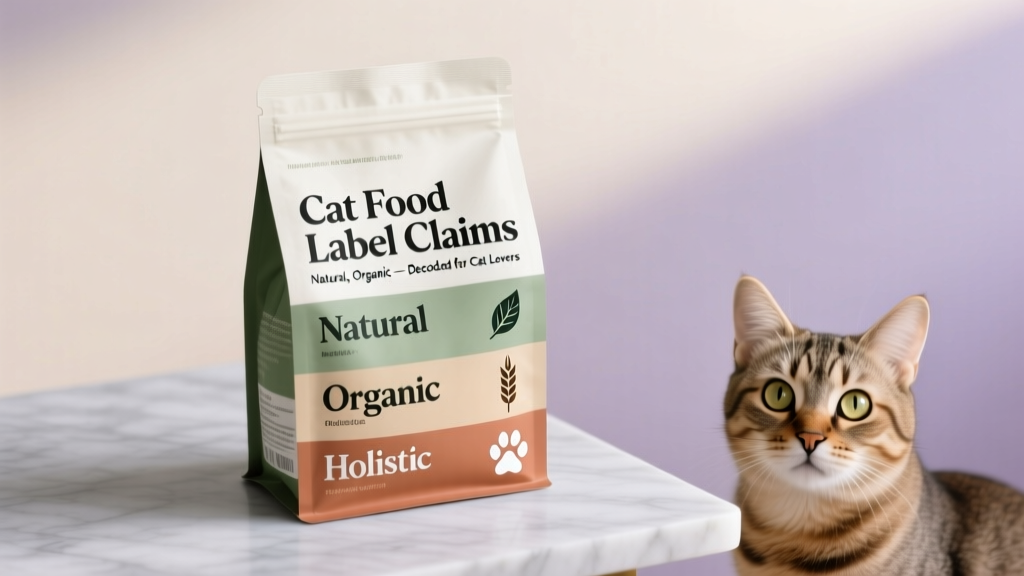
Cat Food Label Claims: Natural, Organic, Holistic Defined
1) Why these label claims matter for cat health
Walking down the cat food aisle can feel like reading a wellness brochure: “natural,” “organic,” “holistic,” “human-grade,” “premium,” “grain-free,” “ancestral.” These words are powerful because they suggest safety, quality, and better health. The problem: many of these claims are loosely defined, inconsistently regulated, or used mainly for marketing.
For your cat, label interpretation isn’t just a shopping skill—it’s a health skill. Cats can’t “eat around” a diet that’s unbalanced. Because they’re obligate carnivores with specific nutrient requirements, a food that sounds wholesome can still be too low in key amino acids (like taurine), too high in carbohydrates, deficient in minerals, or inappropriate for a medical condition.
This guide breaks down what “natural,” “organic,” and “holistic” actually mean, what they do not guarantee, and how to choose foods based on evidence-based nutrition rather than buzzwords. For individual diet changes, especially for kittens, seniors, or cats with health problems, work with your veterinarian (or a board-certified veterinary nutritionist).
2) Scientific background: what cats biologically need
Cats are obligate carnivores. That’s not a lifestyle label—it’s biology. Over evolutionary time, cats adapted to derive most of their calories from animal tissues. This influences how they process protein, fat, and carbohydrates and what nutrients they must get from food.
- High protein need: Cats use amino acids as an ongoing energy source and require higher dietary protein than many other species.
- Essential nutrients found in animal tissues: Taurine, preformed vitamin A (retinol), arachidonic acid (an omega-6 fatty acid), and certain B vitamins are critical.
- Limited ability to “make up” for deficits: Cats have specific metabolic pathways that make some nutrients conditionally or absolutely essential in the diet.
- Water matters: Many cats have a naturally low thirst drive. Moisture intake influences urinary health and can support overall hydration.
To protect cat health, focus on whether a food is complete and balanced for your cat’s life stage and whether it fits your cat’s medical needs, not whether the label uses fashionable terms.
| Nutrient/Factor | Why it matters | What to look for on the label |
|---|---|---|
| Complete & balanced formulation | Prevents nutrient deficiencies/excesses over time | AAFCO nutritional adequacy statement (or equivalent), life-stage match |
| Animal protein & amino acids (e.g., taurine) | Heart, vision, reproduction, overall health | Named animal ingredients; taurine listed (common in cat foods) |
| Mineral balance (Ca:P, Mg, etc.) | Bone health, urinary tract health | Guaranteed analysis is limited; seek brands that provide full nutrient profiles on request |
| Moisture | Supports hydration; may help urinary health for some cats | “Moisture” percentage; wet foods typically 70–80% water |
3) Detailed analysis: “Natural,” “Organic,” “Holistic” defined (and what they really mean)
“Natural” cat food: what it usually means
In pet food, “natural” typically refers to ingredients being derived from plant, animal, or mined sources and not produced through certain synthetic processes. Depending on your region, definitions may be guided by regulatory bodies or industry standards, but the key point is this:
- “Natural” does not automatically mean nutritionally superior.
- “Natural” does not mean “no processing.” Pet foods are processed for safety and shelf stability.
- “Natural” does not mean “no additives.” Many “natural” foods still contain added vitamins and minerals because those are necessary to make the diet complete and balanced.
Watch for a common nuance: foods marketed as “natural” may still use synthetic vitamin/mineral supplements. That isn’t inherently bad; in fact, supplementation is often essential to meet feline requirements reliably.
“Organic” cat food: what it usually means
“Organic” is generally more regulated than “natural,” but the meaning depends on certification standards in your country (for example, USDA Organic standards in the United States). Organic standards typically address how ingredients are grown and processed (e.g., restrictions on certain pesticides, fertilizers, and genetically engineered ingredients), and animal welfare rules may apply for animal-derived ingredients.
What “organic” can offer:
- Reduced exposure to certain agricultural chemicals (depending on the ingredient and regulations)
- Traceability and third-party certification (when properly certified)
What “organic” does not guarantee:
- Better amino acid balance, mineral balance, or overall nutrient profile for cats
- Appropriate calories for weight management
- That the food is ideal for urinary, kidney, gastrointestinal, or allergy issues
Practical tip: If a label implies organic, look for the specific organic certification seal and wording (not just “made with organic ingredients”). If only a portion of ingredients are organic, the claim may be limited.
“Holistic” cat food: what it actually means
“Holistic” is largely a marketing term in pet foods. There is no universally accepted regulatory definition that ensures specific nutritional standards beyond what any complete and balanced food should already meet. A “holistic” food can be excellent—or it can be average.
Common “holistic” themes you may see:
- Herbs, botanicals, and “superfoods” (pumpkin, blueberries, turmeric)
- Claims about supporting immunity, digestion, or skin/coat
- “No fillers” rhetoric (often poorly defined)
Evidence-based reality: Some added fibers can help stool quality, and certain fatty acid profiles can help skin/coat. Many other add-ins are present in tiny amounts that are unlikely to have meaningful clinical impact. Cats benefit most from meeting core nutrient requirements consistently.
How these claims can distract from what matters most
For feline health, the strongest “quality signals” tend to be:
- Life-stage appropriateness (growth/kitten, adult maintenance, senior, reproduction)
- AAFCO (or equivalent) nutritional adequacy statement indicating “complete and balanced”
- Manufacturer transparency: feeding trials performed, nutrient analysis available, qualified formulation team
- Diet appropriateness for health conditions when needed (therapeutic diets should be vet-guided)
| Claim | What it tends to regulate/indicate | What it does NOT guarantee | Best use for cat owners |
|---|---|---|---|
| Natural | Ingredient sourcing/processing definitions (varies by region) | Nutritional superiority, lower carbs, better digestibility, safety | Preference-based choice after confirming complete & balanced |
| Organic | How ingredients are produced (certified standards) | Correct mineral balance, ideal calories, disease-specific suitability | For owners prioritizing certified agriculture standards |
| Holistic | Marketing positioning; no consistent regulatory definition | Clinically proven benefits, better formulation quality | Treat as advertising; judge by nutrition and company practices |
4) Practical recommendations: how to choose a food that truly supports health
- Start with the AAFCO statement (or your region’s equivalent). Look for “complete and balanced” and the correct life stage. If it says “for intermittent or supplemental feeding,” it’s not meant to be the sole diet.
- Match calories to your cat, not the marketing. Indoor cats often gain weight easily. Ask your vet for a target calorie range, especially after spay/neuter or with a sedentary lifestyle.
- Consider moisture intake. Many cats do well with some or all wet food. For cats prone to urinary issues, your vet may recommend higher moisture diets or prescription urinary diets.
- Evaluate the company, not just the ingredient list. Reputable manufacturers can provide full nutrient profiles, digestibility data, quality control practices, and have qualified nutrition professionals involved.
- Be cautious with boutique and exotic-protein formulas. They may be appropriate in some cases, but “rare” ingredients are not automatically better and sometimes complicate allergy workups.
5) Comparing options and approaches
| Option | Pros | Cons | Best fit |
|---|---|---|---|
| Conventional complete & balanced (wet or dry) | Often well-tested; predictable nutrition; wide availability | Quality varies by brand; dry foods are lower moisture | Most healthy cats when chosen thoughtfully |
| “Natural” branded diets | May align with owner preferences; sometimes simpler ingredient panels | Claim doesn’t equal better formulation; still must be complete & balanced | Owners wanting certain ingredient sourcing while maintaining nutrition standards |
| Certified organic diets | Third-party verified sourcing standards | Can be more expensive; doesn’t guarantee better clinical outcomes | Owners prioritizing organic certification and willing to pay more |
| “Holistic” diets | Sometimes includes useful fiber or omega-3 sources | Term is vague; benefits often overstated | Only after verifying adequacy, calories, and company transparency |
| Prescription/therapeutic diets | Formulated for specific diseases; stronger evidence base for targeted outcomes | Must be vet-directed; may be less “trendy” on the label | UTI/FLUTD, kidney disease, food trials, GI disease, diabetes (vet guided) |
6) Common mistakes and misconceptions to avoid
- Myth: “Natural means safer.” Reality: safety depends on sourcing, manufacturing quality control, and formulation testing. “Natural” doesn’t prevent contamination or nutrient imbalance.
- Myth: “Organic means nutritionally superior.” Reality: organic refers to how ingredients are produced, not whether the final nutrient profile fits feline needs.
- Myth: “Holistic foods have medicinal benefits.” Reality: some ingredients may support normal physiology, but most “immune support” claims are not backed by robust clinical trials in cats.
- Mistake: Choosing based on the first 3 ingredients alone. Ingredient lists are ordered by pre-cooked weight; water content can change positions. Nutrient profile and adequacy matter more than list aesthetics.
- Mistake: Feeding a diet labeled “supplemental” as the main food. This can lead to deficiencies (taurine, vitamins, minerals) over time.
- Mistake: Frequent switching chasing labels. Constant changes can trigger GI upset and makes it harder to identify what truly works for your cat.
7) How to implement changes safely (transition tips)
Diet transitions should protect your cat’s GI tract and reduce stress. Sudden switches can cause vomiting, diarrhea, food refusal, or worsened constipation.
- Use a 7–10 day transition for most cats (longer for sensitive cats):
| Day | Old Food | New Food |
|---|---|---|
| 1–2 | 75% | 25% |
| 3–4 | 50% | 50% |
| 5–6 | 25% | 75% |
| 7–10 | 0% | 100% |
- Monitor stool, appetite, and energy. Mild stool changes can occur; persistent diarrhea, vomiting, or refusal to eat needs a vet call.
- Avoid fasting cats. Cats that stop eating are at risk for hepatic lipidosis (fatty liver), especially overweight cats. If your cat won’t eat for 24 hours (or less for kittens), contact your veterinarian promptly.
- Use measured portions. When switching foods, calorie density can differ a lot. Measuring prevents unintentional weight gain.
8) Special considerations: age, health conditions, activity level
- Kittens (growth): Need higher calories, protein, and specific mineral balance for bone development. Choose a food labeled complete and balanced for growth (or “all life stages” from reputable brands). Avoid boutique foods with vague formulation practices.
- Adult cats: Focus on maintaining ideal body condition. Many adults benefit from mixed feeding (some wet) for hydration support. Discuss calorie targets with your vet.
- Seniors: Aging cats can have changes in digestion, dental health, and body composition. Some seniors need higher digestible protein; others need medical diets. Regular vet checks and bloodwork help guide diet choices.
- Overweight/obesity: “Natural” or “holistic” does not mean weight-loss friendly. Use a vet-approved weight plan; consider higher-protein, calorie-controlled diets and measured meals.
- Urinary tract issues (FLUTD, crystals): Moisture intake and mineral balance matter. Many cats do best with vet-recommended urinary diets rather than over-the-counter “urinary support” claims.
- Kidney disease: Requires careful management of phosphorus, protein quality, calories, and hydration. Work with your veterinarian; therapeutic renal diets have the strongest evidence.
- Food allergies/adverse food reactions: Don’t rely on “natural” or “grain-free” claims. True diagnosis usually requires a structured elimination diet trial using a vet-guided hydrolyzed or novel protein diet.
- Highly active cats: May need more calories and nutrient-dense food. Monitor body condition rather than assuming a label claim equals performance nutrition.
FAQ: Cat food label claims
1) Is “natural” cat food better for my cat?
Not automatically. A “natural” label doesn’t guarantee better nutrient balance, digestibility, or safety. Choose foods that are complete and balanced for your cat’s life stage, made by companies with strong quality control. Ask your vet for guidance if your cat has health conditions.
2) Does organic cat food reduce health risks?
Organic certification may reduce exposure to certain agricultural chemicals, depending on ingredients and standards. It doesn’t guarantee the final diet is ideal for weight control, urinary health, kidney health, or allergies. Nutrition adequacy and appropriate formulation matter most.
3) What does “holistic” mean on cat food labels?
“Holistic” is typically a marketing term without a consistent regulatory definition. Some holistic diets are well-formulated; others rely on wellness-sounding add-ons. Use objective criteria: life-stage adequacy statement, nutrient transparency, and veterinary guidance for medical needs.
4) Are added vitamins and minerals a bad sign?
No. Added vitamins and minerals are often necessary to ensure the food is complete and balanced. A diet made only from “whole ingredients” can still miss key nutrients (like taurine or specific trace minerals) unless formulated carefully.
5) Should I pick foods with the most meat ingredients listed first?
Not as your main decision tool. Ingredient lists are ordered by weight before cooking, so water-heavy ingredients can appear higher. AAFCO adequacy, calorie content, and the manufacturer’s formulation/testing practices are more reliable indicators of suitability.
6) My cat has a medical condition. Do label claims help me choose?
Usually not enough. For conditions like urinary disease, kidney disease, diabetes, or significant GI disease, the best results often come from vet-recommended therapeutic diets designed for those problems. Speak with your veterinarian before changing foods.
Practical checklist for your next purchase
- Find the nutritional adequacy statement (complete & balanced; correct life stage).
- Check calories per cup/can and portion realistically for your cat.
- Decide on wet, dry, or mixed feeding based on hydration needs and your cat’s preferences.
- Prefer brands that can answer: Who formulates the diet? What quality control is used? Can they provide a full nutrient analysis?
- Use “natural/organic/holistic” as secondary preferences, not primary health proof.
When you’re ready to adjust your cat’s diet, loop in your veterinarian—especially for kittens, seniors, overweight cats, and any cat with urinary, kidney, GI, or endocrine disease. For more practical, science-based feeding help, explore the nutrition guides and label-reading resources on catloversbase.com.