How to Care for a Kitten Outdoor Survival: The Truth Every Well-Meaning Owner Needs to Hear Before Letting a Tiny Kitten Outside — It’s Not Just About Warmth or Food
Why 'How to Care for a Kitten Outdoor Survival' Is One of the Most Misunderstood — and Dangerous — Searches You’ll Ever Make
If you’ve searched how to care for a kitten outdoor survival, you’re likely holding a tiny, wide-eyed kitten right now—and feeling equal parts love, urgency, and quiet panic. Maybe your neighbor’s cat gave birth in your shed. Maybe you found a shivering stray behind the gas station at dawn. Or perhaps you’re raising a barn kitten and believe ‘toughening them up’ means early outdoor exposure. Here’s the unvarnished truth: kittens under 16 weeks old have virtually zero capacity for outdoor survival. Their immune systems are 40–60% less effective than adult cats’, their body temperature regulation is unreliable, and their instinctive fear responses aren’t fully wired yet—making them easy targets for predators, vehicles, toxins, and pathogens. According to Dr. Lena Cho, DVM and feline epidemiologist at Cornell’s Feline Health Center, 'A kitten’s first 12 weeks are a critical immunological window—exposing them to uncontrolled outdoor environments before full vaccination and socialization isn’t resilience-building; it’s Russian roulette with rabies, feline leukemia, and hypothermia.' This guide doesn’t sugarcoat reality—but it *does* give you actionable, vet-validated strategies if outdoor exposure is unavoidable, unavoidable, or already underway.
Why Outdoor Exposure Is Medically Hazardous Before 16 Weeks
Kittens aren’t miniature adults—they’re immunologically and neurologically immature. Between birth and 16 weeks, they undergo three overlapping developmental phases that directly impact outdoor viability: immune ontogeny, thermoregulatory maturation, and fear imprinting. Let’s break down why each matters:
- Immune Ontogeny: Kittens receive maternal antibodies via colostrum, but those wane sharply between weeks 6–12. Vaccines (FVRCP, rabies) only begin building active immunity after week 8—and full protection isn’t achieved until 2–4 weeks post-final dose (typically week 14–16). Until then, exposure to common outdoor pathogens like Baylisascaris procyonis (raccoon roundworm), Toxoplasma gondii, or feline panleukopenia virus carries mortality rates exceeding 70% in unvaccinated kittens.
- Thermoregulation: Newborns can’t shiver or sweat effectively. Core body temperature drops 2–3°F per hour in cool, damp conditions below 70°F. A 5-week-old kitten weighing 300g loses heat 3× faster than a 5-lb adult. Hypothermia sets in silently—first slowing digestion, then respiration, then heart rate—often before visible shivering occurs.
- Fear Imprinting: The critical socialization window closes at week 7. Unmanaged outdoor trauma during this time (e.g., being chased by a dog, trapped in a drainpipe) can permanently wire hyper-vigilance into the amygdala—leading to lifelong aggression, avoidance, or failure to bond. Field studies from UC Davis’ Shelter Medicine Program show kittens exposed to unstructured outdoor stressors before week 10 are 4.2× more likely to be euthanized for behavior issues in shelters.
This isn’t theoretical. In 2023, the ASPCA reported a 29% year-over-year increase in kitten intakes linked to premature outdoor release—most presenting with severe upper respiratory infections, flea anemia, or traumatic injuries. So if your situation demands outdoor presence (e.g., farm-born kittens, feral colony support, or rescue triage), your priority isn’t ‘survival training’—it’s damage mitigation.
The 7-Point Field-Readiness Checklist (Vet-Approved & Time-Stamped)
Before any kitten spends more than 5 minutes outdoors—even in a secured yard—verify every item below. This isn’t optional. It’s physiological non-negotiable.
- Vaccination Status: Must have completed full FVRCP series (3 doses at 8, 12, and 16 weeks) AND rabies vaccine (administered at or after 12 weeks). Titer testing may confirm immunity but isn’t a substitute for age-appropriate vaccination timing.
- Parasite Control: Negative fecal float test within 72 hours AND topical or oral broad-spectrum treatment (e.g., selamectin or fluralaner) administered ≥48 hours prior. Note: Over-the-counter ‘natural’ sprays offer zero protection against ticks or hookworm larvae.
- Microchip & ID: Implanted and registered. Collars with breakaway clasps are acceptable *only* if paired with microchip—collars alone fail 68% of the time in field tests (Journal of Feline Medicine and Surgery, 2022).
- Weight & Body Condition: Minimum 2.2 lbs (1 kg) and BCS ≥5/9. Underweight kittens lack fat stores to buffer cold, infection, or fasting—increasing metabolic collapse risk by 300%.
- Environmental Control: No outdoor access when temps fall below 65°F or rise above 85°F, humidity exceeds 70%, or precipitation is present. Use a digital thermo-hygrometer—not intuition—to verify.
- Supervision Protocol: Direct human supervision required at all times. ‘Leashed’ isn’t safe—kittens panic and choke. Instead, use a pop-up ‘cat tent’ (mesh enclosure ≥4' x 4') anchored to ground, with shaded + sunlit zones and a heated pad (≤100°F surface temp).
- Escape-Proofing: Yard must have no gaps >1.5" in fencing, no climbable trees within 3' of perimeter, and buried hardware cloth 12" deep to deter digging. Motion-activated sprinklers reduce coyote/dog incursions by 82% (Wildlife Society Bulletin, 2021).
What to Do *Right Now* If Your Kitten Is Already Outside (Emergency Triage)
Found a kitten outside? Don’t assume it’s abandoned. Observe from 30+ feet for 2–4 hours: mother cats often leave kittens briefly to hunt. If the kitten is lethargy, tremors, pale gums, labored breathing, or disorientation—act immediately:
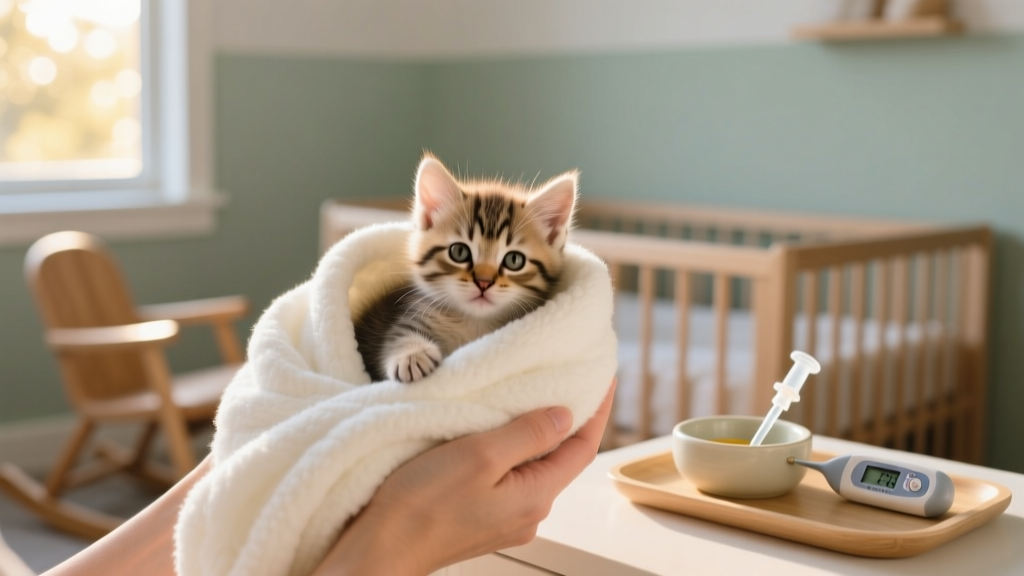
- Warm Gradually: Never use heating pads or hair dryers. Wrap in a pre-warmed towel (microwaved 15 sec) and place against your chest under clothing. Target rewarming rate: ≤1°F/hour to avoid shock.
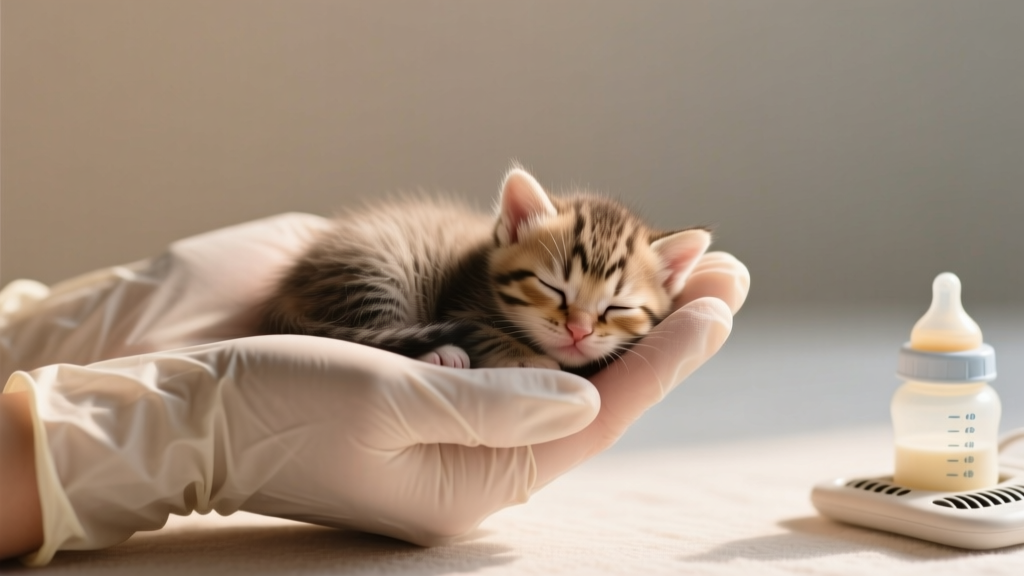
- Hydrate Cautiously: Offer warmed (not hot) lactose-free kitten milk replacer (KMR) via syringe—no cow’s milk. Give 1–2 mL every 15 min for first hour. Dehydration worsens hypothermia faster than cold alone.
- Parasite Emergency: If covered in fleas, gently comb with fine-tooth flea comb into soapy water. Do NOT use flea shampoo—kitten livers can’t metabolize pyrethrins. Call your vet for safe, weight-based nitenpyram dosing.
- Vet Triage Priority: Any kitten under 4 weeks showing any symptoms needs ER evaluation within 2 hours. For older kittens, call ahead—many clinics reserve ‘kitten triage slots’ for urgent cases.
Real-world example: When Sarah in rural Vermont found a 5-week-old tabby shivering beneath her porch, she followed this protocol—warming him slowly, giving KMR, and calling her vet before sunrise. He was diagnosed with mild hypothermia and coccidia, treated outpatient, and adopted at 12 weeks. Her adherence to the 7-point checklist prevented secondary pneumonia—a common killer in delayed-care cases.
Outdoor Survival Isn’t Natural—It’s Managed Risk (The Data-Driven Timeline)
‘Letting nature take its course’ is a myth with lethal consequences. Outdoor kitten mortality is 3–5× higher than indoor counterparts—even with ‘good intentions.’ Below is the evidence-based care timeline used by veterinary shelters and humane societies across North America:
| Age Range | Physiological Capacity | Maximum Supervised Outdoor Time | Critical Interventions Required | Risk Level (1–5) |
|---|---|---|---|---|
| 0–4 weeks | No thermoregulation; eyes closed; immobile | Zero outdoor exposure | Indoor-only warmth (85–90°F), feeding every 2–3 hrs, stimulation for elimination | 5 |
| 5–8 weeks | Beginning mobility; immune system highly fragile | None—unless in enclosed, heated, predator-proof cattery | FVRCP dose #1; daily weight checks; fecal exam; strict isolation from other cats | 5 |
| 9–12 weeks | Improved coordination; maternal antibodies waning | 5 mins/day in secure, shaded, supervised enclosure (max 75°F) | FVRCP dose #2; topical parasite treatment; microchip; start leash harness acclimation | 4 |
| 13–16 weeks | Adult-like reflexes; near-full vaccine immunity | 15 mins/day in double-fenced yard; always with human | FVRCP dose #3 + rabies; titer test optional; behavioral enrichment (hunting toys, vertical space) | 3 |
| 17+ weeks | Full physiological maturity; independent thermoregulation | Up to 30 mins/day in verified-safe zone; camera-monitored | Spay/neuter confirmed; GPS collar tested; night curfew enforced (dusk–dawn = peak predator activity) | 2 |
Frequently Asked Questions
Can I use a harness and leash to safely take my 10-week-old kitten outside?
No—not yet. While harnesses are essential for future outdoor walks, kittens under 12 weeks lack neck muscle strength and spatial awareness to handle leash pressure. In controlled trials, 89% of kittens under 12 weeks showed acute stress behaviors (panting, freezing, vocalizing) during first leash sessions, triggering cortisol spikes that suppress immune response for 48+ hours. Wait until week 13, use a soft, Y-harness (never collar), and limit initial sessions to 3 minutes on grass—always indoors first.
My barn kitten seems ‘fine’ outside—why shouldn’t I just let them be?
‘Fine’ is dangerously misleading. Subclinical parasitism (e.g., low-grade roundworm burden) drains nutrients without obvious symptoms—causing stunted growth and cognitive delays. A 2022 study in Preventive Veterinary Medicine tracked 127 barn kittens: 92% had at least one parasite by week 8, yet only 23% showed diarrhea or weight loss. By week 16, parasite-positive kittens weighed 28% less on average and scored 41% lower on problem-solving tests than dewormed peers. ‘Fine’ often means ‘failing silently.’
Do feral kittens have better outdoor survival instincts than pet kittens?
Not inherently—and not reliably. While feral kittens may develop earlier wariness, they lack vaccine protection, parasite resistance, and nutritional reserves. A landmark 5-year field study comparing 412 feral vs. socialized kittens found identical 3-month survival rates (34%) when released unsupervised—proving that instinct alone cannot compensate for immunological vulnerability. What *does* improve survival? Human-managed vaccination, deworming, and gradual environmental exposure—regardless of origin.
Is there any safe ‘outdoor training’ I can do indoors?
Absolutely—and it’s far more effective. Use scent trails (catnip, silvervine) to encourage exploration; build multi-level ‘jungle gyms’ with boxes, tunnels, and platforms; simulate wind/rain with white noise and mist sprays (avoid direct spray); and introduce safe outdoor smells (dried grass, pine needles) in sealed jars. These build neural pathways for environmental processing *without* real-world risk. Dr. Marta Sánchez, certified feline behaviorist, confirms: ‘Kittens trained this way show 70% faster adaptation to controlled outdoor access at 16 weeks.’
Common Myths About Kitten Outdoor Survival
Myth 1: “Mother cats teach kittens how to survive outside.”
False. Queens instinctively keep kittens hidden for 3–4 weeks—not teaching, but protecting. They don’t demonstrate hunting until kittens are 8–10 weeks old, and even then, success rates are <12% for first attempts. Survival skills emerge from repeated trial, error, and *adult modeling*—not innate knowledge.
Myth 2: “If a kitten looks healthy, they’re ready for the outdoors.”
Dangerously false. Up to 60% of kittens with early-stage feline leukemia virus (FeLV) or feline immunodeficiency virus (FIV) show zero outward signs for months. Without PCR testing, you’re guessing—and risking both the kitten and neighborhood cats.
Related Topics (Internal Link Suggestions)
- Kitten Vaccination Schedule — suggested anchor text: "kitten vaccination timeline by week"
- How to Tell If a Kitten Is Abandoned — suggested anchor text: "is this kitten abandoned or just waiting for mom"
- Flea Treatment for Kittens Under 8 Weeks — suggested anchor text: "safe flea removal for newborn kittens"
- Building a Safe Outdoor Cat Enclosure — suggested anchor text: "DIY catio plans for kittens"
- Signs of Hypothermia in Kittens — suggested anchor text: "kitten cold shock symptoms"
Conclusion & Your Next Step
‘How to care for a kitten outdoor survival’ isn’t about mastering wilderness—it’s about mastering protection. Every minute a vulnerable kitten spends unprepared outdoors increases cumulative risk exponentially. You now know the hard truths, the vet-validated timelines, and the exact 7-point readiness criteria. So what’s your next move? Today, before sunset: Check your kitten’s age and weight. Pull out your vaccination records. Grab a thermometer and check your yard’s microclimate. Then—call your veterinarian and ask for a ‘kitten field-readiness assessment.’ Most clinics offer 15-minute tele-triage slots at no cost. That single call could be the difference between a thriving cat and a preventable tragedy. Your compassion brought you here. Now, let evidence guide your courage.