Cat Persistent Right Aortic Arch: Congenital Vascular Ring
1. Introduction: Why this topic matters for cat owners
Most cats eat quickly, occasionally cough up a hairball, and carry on like nothing happened. So when a kitten repeatedly brings up food right after meals, struggles to gain weight, or seems uncomfortable swallowing, it can be confusing and worrying. One uncommon but very real cause is a congenital (born-with) problem called persistent right aortic arch (PRAA), a type of vascular ring anomaly.
This condition matters because it can interfere with how food moves from the mouth to the stomach. With the right diagnosis and timely treatment—often surgery—many cats can go on to live comfortable, happy lives. Understanding what PRAA looks like at home helps you get your cat the help they need sooner.
2. Overview: What persistent right aortic arch is (plain-language explanation)
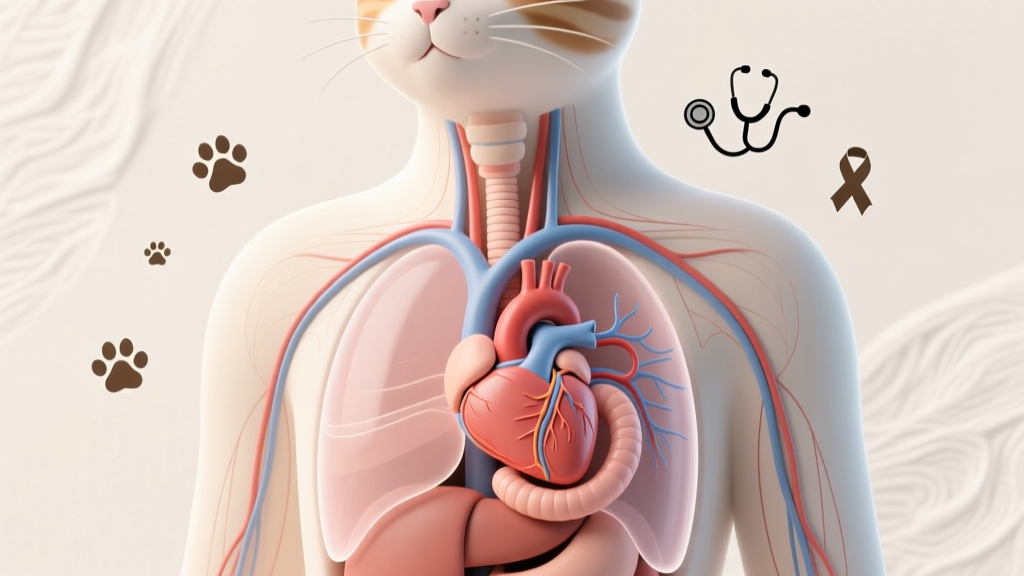
To understand PRAA, it helps to picture the anatomy in the chest:
- The esophagus is the tube that carries food and water from the mouth to the stomach.
- The trachea (windpipe) carries air to the lungs and sits near the esophagus.
- The aorta is the main blood vessel leaving the heart, curving through the chest to deliver blood to the body.
During fetal development, several temporary blood vessels form and then rearrange. Normally, the aorta ends up arching to the left side in a way that leaves the esophagus uncompressed. In persistent right aortic arch, the aorta (or associated vessels/ligaments) develops in a configuration that creates a ring-like structure around the esophagus. This “vascular ring” can pinch or constrict the esophagus, most often near the base of the heart.
When the esophagus is squeezed, food can get stuck or move very slowly. Over time, the portion of the esophagus in front of the narrowing can become stretched and enlarged, a condition called megaesophagus. This can lead to:
- Regurgitation (food coming back up without the abdominal heaving seen with vomiting)
- Poor growth and weight loss
- Aspiration pneumonia if food or liquid is inhaled into the lungs
PRAA is less common in cats than in dogs, but it can occur, and it’s treatable—especially when caught early.
3. Symptoms and warning signs to watch for
Many cats with PRAA show signs soon after weaning, when they begin eating solid food. Some cats have milder symptoms and aren’t diagnosed until later.
Common signs at home include:
- Regurgitation shortly after eating (often minutes to an hour), especially with solid food
- Undigested food coming up in a tube-like shape or puddle, sometimes with saliva or foam
- Eating eagerly but not thriving (poor weight gain, stunted growth in kittens)
- Increased appetite but continued thin body condition
- Coughing, gagging, or throat-clearing after meals
- Noisy breathing, fast breathing, or reduced energy (can suggest aspiration pneumonia)
- Difficulty swallowing or repeated attempts to swallow
- Dehydration if water is also regurgitated
Regurgitation vs. vomiting (quick owner tip):
- Regurgitation: passive, “falls out,” little to no retching; food is often undigested.
- Vomiting: active abdominal heaving/retching; food is usually partially digested and may contain bile.
If you’re unsure which your cat is doing, take a short video for your veterinarian—this can be surprisingly helpful.
4. Causes and risk factors
PRAA is a congenital developmental abnormality. Your cat did not “catch” it, and it is not caused by something you did at home. In most cases, it’s considered a random developmental event, although congenital conditions can have genetic components.
Risk factors and patterns:
- Age: signs often appear in kittens after weaning, but some cats present later.
- Congenital anatomy: PRAA may occur alone or alongside other vascular variations.
- Secondary complications: repeated regurgitation increases the risk of aspiration pneumonia and esophagitis (inflammation of the esophagus).
Because PRAA is uncommon in cats, there isn’t strong breed-specific data the way there is in some dog breeds. Any cat can be affected.
5. Diagnosis: Methods and what to expect at the vet
If your vet suspects a vascular ring anomaly, they’ll focus on confirming that the esophagus is being compressed at a typical location and assessing for complications like pneumonia.
What your veterinarian may do:
- History and physical exam
- Questions about timing of regurgitation, type of food (wet vs dry), growth, and breathing signs
- Listening to the lungs for crackles/wheezes that can suggest aspiration
- Checking hydration, body condition, and overall development
- Chest X-rays (radiographs)
- Can show an enlarged esophagus in front of the heart (megaesophagus)
- May reveal aspiration pneumonia (lung changes), especially in the right middle lung lobe
- Contrast esophagram (barium swallow)
- Your cat swallows a contrast material so the esophagus shows clearly on X-rays
- Helps identify the narrowing and the dilated portion of the esophagus
- Not always appropriate if aspiration risk is very high—your vet will decide what’s safest
- Advanced imaging (often used for surgical planning)
- CT angiography can map blood vessels and confirm the type of vascular ring
- Echocardiogram (heart ultrasound) may be recommended to check for other congenital heart issues and evaluate anatomy
- Bloodwork
- Assesses general health, hydration, inflammation, and anesthesia readiness
Practical prep tip: Bring notes on meal times, what food was offered, and when regurgitation happens. If possible, bring a video of an episode.
6. Treatment options: Medical, surgical, and home care
Treatment usually has two goals: relieve the constriction (often surgically) and reduce complications while supporting nutrition and safe swallowing.
Surgical treatment (often the main treatment)
For most true vascular ring anomalies, surgery is the definitive treatment. The surgeon identifies and cuts the structure causing the ring (commonly the ligamentum arteriosum or related tissue), which relieves pressure on the esophagus.
What surgery can and can’t do:
- Can: release the “band” around the esophagus so food can pass more normally.
- Can’t instantly reverse: esophageal stretching/weakness that has already developed. Improvement often takes time, and some cats still need feeding modifications long-term.
Your veterinarian may refer you to a specialty surgeon, especially if advanced imaging suggests a more complex vascular arrangement.
Medical management (supportive care)
Medical care is commonly used:
- Before surgery to stabilize your cat
- After surgery to support healing and reduce regurgitation
- When surgery isn’t possible due to other health issues or owner constraints
Supportive treatments may include:
- Antibiotics if aspiration pneumonia is suspected or confirmed
- Anti-nausea/antiemetic medications (even though regurgitation isn’t vomiting, these may still help some cats depending on the case)
- Acid reducers and esophageal protectants if reflux or esophagitis is present
- Pain control around the time of surgery
- Fluids for dehydration
Home care and feeding strategies (actionable steps)
Feeding management is one of the most helpful things you can do right away, but it should be guided by your veterinarian to reduce aspiration risk.
Common at-home strategies vets recommend:
- Feed smaller, more frequent meals (for example, 4–6 small meals/day instead of 1–2 large meals).
- Adjust food texture:
- Some cats do better on a smooth slurry (canned food blended with warm water).
- Others do better with meatball-sized portions of canned food. Your vet may suggest trying one approach at a time.
- Upright feeding position:
- Encourage a vertical posture during meals and for 10–15 minutes after eating if tolerated.
- For cats, this may mean feeding on an elevated surface and gently encouraging a “sphinx to sit-up” posture, rather than forcing a stressful position.
- Control water intake if needed:
- Some cats regurgitate water more easily than food. Your vet may advise offering small amounts more often or using thickened water techniques in select cases.
- Never restrict water without veterinary guidance.
- Keep meal time calm to reduce gulping and air swallowing.
- Track weight weekly with a baby scale for kittens or a home pet scale for adults.
Do not start new medications or supplements for regurgitation without your veterinarian—some products can irritate the esophagus or mask worsening disease.
7. Prevention strategies and early detection tips
You can’t prevent PRAA from forming because it happens during development before birth. What you can do is prevent many complications through early recognition and prompt care.
Early detection tips:
- Pay attention after weaning: repeated regurgitation of solid food in a kitten is not normal.
- Monitor growth: kittens should steadily gain weight. A kitten that eats but stays thin needs a vet check.
- Don’t assume it’s “just picky eating” or hairballs when food comes back up undigested repeatedly.
- Seek veterinary advice quickly if regurgitation is frequent, paired with coughing, or associated with lethargy.
If you adopt a kitten with chronic regurgitation: ask your vet about congenital causes early. Earlier treatment often means less long-term esophageal damage.
8. Prognosis and quality of life considerations
The outlook for cats with PRAA depends on:
- How early it’s diagnosed
- How severe the esophageal dilation is (megaesophagus can be partially reversible, but sometimes persists)
- Whether aspiration pneumonia has occurred, and how well it responds to treatment
- How consistent feeding management is at home
After successful surgery, many cats experience fewer regurgitation episodes and better weight gain over time. Some cats still need lifelong feeding adjustments, especially if the esophagus remains enlarged or has reduced motility.
Quality of life can be very good when:
- Nutrition is maintained (steady weight, good hydration)
- Regurgitation is minimized
- Respiratory complications are avoided
- Stress-free routines are established around feeding
It’s normal to feel overwhelmed at first. Your veterinary team can help you dial in a routine that is realistic for your household and comfortable for your cat.
9. When to seek emergency veterinary care
PRAA itself is not a reason to panic, but complications can become urgent. Contact an emergency vet or your regular clinic right away if your cat has:
- Difficulty breathing, open-mouth breathing, or rapid breathing
- Blue/gray gums or collapse
- Marked lethargy or weakness after regurgitation
- Fever, severe coughing, or suspected aspiration (food/water “went down the wrong way”)
- Repeated regurgitation with inability to keep down water
- Signs of dehydration (sunken eyes, tacky gums, very low energy)
- Any sudden worsening in a cat already diagnosed with PRAA/megaesophagus
Aspiration pneumonia can progress quickly and is much safer to treat early.
10. FAQ: Common questions from cat owners
Is persistent right aortic arch the same as megaesophagus?
Not exactly. PRAA is a vascular ring that can compress the esophagus. Megaesophagus means the esophagus is enlarged and not moving food properly. PRAA can cause megaesophagus (especially in the portion in front of the compression), but megaesophagus can also occur for other reasons. Your vet’s imaging helps sort this out.
My cat regurgitates sometimes—could it still be PRAA?
Occasional regurgitation can happen for many reasons (eating too fast, esophagitis, hair/foreign material, other motility disorders). PRAA is more suspicious when regurgitation is frequent, begins in kittenhood, and happens soon after meals—especially solid meals. A veterinary exam is the best next step.
Will my cat be cured after surgery?
Surgery typically removes the constriction, which is a major step forward. Whether symptoms fully resolve depends on how much permanent change occurred in the esophagus before surgery. Some cats do extremely well and return to near-normal eating. Others improve but still need smaller meals, specific textures, or upright feeding.
What should I feed a cat with suspected PRAA while waiting for the vet?
Contact your veterinarian for individualized guidance, especially if your cat is a kitten or has coughing/breathing signs. In general, safer interim steps often include small, frequent meals and a moist texture that your cat handles best, while avoiding dry kibble if it reliably triggers regurgitation. If your cat is struggling to keep down water or seems unwell, treat it as urgent.
Can PRAA cause coughing or pneumonia?
Yes. Regurgitated food or liquid can be inhaled into the lungs, leading to aspiration pneumonia. Coughing after meals, fast breathing, fever, lethargy, or reduced appetite are reasons to call your veterinarian promptly.
Is PRAA hereditary in cats?
It’s congenital, meaning present from birth, but the exact hereditary contribution in cats is not well defined. If you have a cat diagnosed with PRAA, discuss it with your veterinarian, and consider informing the breeder or rescue organization so they can track potential patterns responsibly.
If your cat is regurgitating regularly or not gaining weight as expected, schedule a veterinary visit. With timely diagnosis, the right treatment plan, and supportive home feeding strategies, many cats with persistent right aortic arch can enjoy a comfortable life.
For more caring, vet-guided cat health education and practical tips, visit catloversbase.com.