Persian Cat Care: The Complete Guide to Keeping Your Fluffy Royal Happy
Mittens, a three-year-old silver Persian, sat on my exam table looking like a small, very unhappy cloud. Her owner, Jennifer, was near tears. "I brush her every day," she said. "But she's still getting mats behind her ears, and now her eyes are so stained I can barely see her pupils." I gently parted the fur behind Mittens' left ear and found a mat the size of a quarter, pulled so tight it had reddened the skin underneath. This wasn't a grooming failure ? it was a technique problem. And it's one I see at least twice a week in my clinic.
Persian cats are consistently ranked among the top five most popular cat breeds worldwide, with the Cat Fanciers' Association registering over 30,000 new Persians annually. Their luxurious coats, sweet temperaments, and unmistakable flat faces make them irresistible. But behind that glamorous exterior lies a breed with some of the highest maintenance requirements of any domestic cat. Get it right, and you'll have a devoted, purring lap cat for 15 years or more. Get it wrong, and you're looking at skin infections, eye damage, and a very stressed feline.
What Makes a Persian Different From Other Long-Haired Cats
The Persian coat isn't just long ? it's structurally unique. Each hair has a dense, woolly undercoat topped with longer guard hairs, creating a double layer that can reach up to five inches in show-quality specimens. Unlike the Siberian or Norwegian Forest Cat, whose coats evolved for outdoor survival, the Persian's fur was selectively bred purely for aesthetics over more than a century of human intervention.
That selective breeding came with trade-offs. The characteristic brachycephalic (flat) face that makes Persians so adorable also compresses their nasal passages by approximately 40% compared to non-brachycephalic breeds, according to a 2023 study published in the Journal of Feline Medicine and Surgery. This anatomical change affects everything from their breathing to their ability to groom themselves ? which is why your Persian needs you to be their grooming partner for life.
"Persians are essentially permanent kittens in terms of their dependency on humans. They cannot maintain themselves without regular human intervention ? and that's not a flaw, it's a feature of what makes them who they are." ? Dr. Amanda Foster, DVM, Veterinary Genetics Society Annual Conference, 2024
Daily Grooming: The Non-Negotiable Routine
If you're brushing your Persian once a week or even every few days, you're already behind. Daily brushing is the baseline for this breed ? not an occasional treat. Here's what an effective daily routine actually looks like.
The Right Tools for the Job
Forget the cute rubber brushes you see in pet stores. A proper Persian grooming kit needs three specific tools:
- A stainless-steel greyhound comb (7-8 inches long) with both wide and narrow teeth. This is your primary tool for daily maintenance. The wide teeth handle the bulk of the coat; the narrow teeth catch tangles before they become mats.
- A slicker brush with fine, bent wires. Use this after combing to remove loose undercoat. The key is gentle pressure ? press hard enough to reach the undercoat, not so hard that you scratch the skin.
- A mat splitter or de-matting rake for when you find a mat that's already formed. Never yank a mat out with scissors ? the risk of cutting skin is too high, especially in the sensitive areas behind ears and under the armpits.
The Seven-Minute Daily Brush
Start at the head and work backward. Persian fur tangles in the direction of growth, so always comb with the hair lay, not against it. Spend about 90 seconds on each side of the body, 60 seconds on the chest ruff, 60 seconds on the tail, and 60 seconds on the legs. The trickiest areas are behind the ears, under the front legs, and around the rear end ? these three zones account for roughly 70% of all mat formation in Persians, based on my clinical observations over 15 years.
Here's a detail most guides skip: part the fur with your fingers as you go, working in sections about two inches wide. Surface brushing looks impressive but does nothing for the undercoat where mats actually form. If you're not seeing down to the skin as you comb, you're not going deep enough.
Eye Care: Managing the Tear Stain Problem
Persian eyes produce more tears than most breeds because their flattened facial structure prevents proper tear drainage through the nasolacrimal duct. The result is epiphora ? excessive tearing that leaves reddish-brown stains on the fur beneath the eyes. Left unmanaged, this moisture creates a breeding ground for yeast infections.
Daily eye cleaning takes about two minutes. Use a soft, damp cloth or a veterinary-approved eye wipe (I recommend the Vetoquinol Tear Stain Remover wipes, which contain boric acid at a safe 2% concentration). Gently wipe from the inner corner outward, using a fresh section of cloth for each eye. Never use human makeup removers or baby wipes ? the pH is wrong for feline skin and can cause irritation.
| Task | Frequency | Time Required | Weekly Total |
|---|---|---|---|
| Full body brush | Daily | 7 minutes | 49 minutes |
| Eye cleaning | Daily | 2 minutes | 14 minutes |
| Face wiping | Daily | 2 minutes | 14 minutes |
| Bath | Every 2-3 weeks | 45 minutes | 15-22 minutes (avg) |
| Total weekly commitment | ~92-99 minutes |
For severe tear staining that's already set in, a paste of equal parts cornstarch and boric acid powder (available at most pharmacies) applied carefully to the stained fur can lighten it over 2-3 weeks. Keep it away from the actual eye surface.
Bathing: More Important Than You Think
Most cat owners have never bathed their cat. Persian owners need to do it every two to three weeks. Their dense coats accumulate oils, dust, and litter particles that brushing alone cannot remove. A Persian that hasn't been bathed in a month will feel greasy to the touch ? that's sebum buildup, and it accelerates mat formation significantly.
The bathing process matters as much as the frequency. Here's the protocol I recommend:
- Brush thoroughly before the bath. Never bathe a matted cat ? water tightens mats and makes them nearly impossible to remove afterward.
- Use lukewarm water (around 38�C / 100�F). Too hot and you'll dry out their skin; too cold and they'll panic. Test on your inner wrist ? it should feel barely warm.
- Apply a cat-specific shampoo (I use Chris Christensen Systems Big K Shampoo for Persians ? it's formulated for double coats and contains lanolin to maintain natural oils). Work it through to the skin, not just the surface fur.
- Rinse for at least five minutes. Shampoo residue is the number one cause of post-bath skin irritation in Persians. Rinse until the water runs completely clear ? and then rinse for another minute.
- Blot dry with towels, then use a low-heat dryer. Never let a Persian air-dry fully ? the undercoat will mat as it dries. Use a force dryer on the lowest heat setting, keeping it at least 12 inches from the skin.
Feeding Your Persian: Nutrition That Supports Coat and Health
Persian nutrition isn't fundamentally different from other cats, but there are two areas worth special attention: coat quality and dental health.
The omega-3 to omega-6 fatty acid ratio in your cat's diet directly affects coat condition. Look for foods with a ratio between 1:4 and 1:6 ? this range supports a glossy, manageable coat without excessive oiliness. Foods high in omega-6 alone (common in cheaper brands) can actually make the coat greasier and more prone to matting. A 2022 study in the Journal of Animal Physiology and Animal Nutrition found that cats fed diets with a 1:5 omega-3:omega-6 ratio showed a 35% improvement in coat shine and a 28% reduction in skin flaking over a 12-week period.
Good commercial options include Royal Canin Persian Adult (formulated specifically for the breed's jaw shape and coat needs) and Hill's Science Diet Adult Perfect Weight. Both contain EPA and DHA from fish oil at therapeutic levels.
Dental health is equally critical. Persians' compressed jaws create crowded teeth that trap food particles more easily than other breeds. The American Veterinary Dental College estimates that 70% of Persians show signs of periodontal disease by age three, compared to roughly 50% of the general cat population. Daily tooth brushing with a veterinary toothpaste (never human toothpaste ? fluoride is toxic to cats) is the single most effective preventive measure.
Health Issues Every Persian Owner Should Watch For
Beyond grooming, Persians carry several breed-specific health predispositions. Knowing what to watch for can save you thousands in vet bills and, more importantly, keep your cat comfortable.
Polycystic Kidney Disease (PKD)
PKD affects approximately 38% of Persians worldwide, making it the most common genetic disease in the breed. It causes fluid-filled cysts to develop in the kidneys, gradually reducing kidney function. Symptoms typically appear between ages three and ten: increased water consumption, increased urination, decreased appetite, and weight loss. A genetic test (PCR-based, available through most veterinary labs) can identify the PKD1 mutation before symptoms appear. If you're buying from a breeder, insist on PKD-negative parent documentation.
Hypertrophic Cardiomyopathy (HCM)
This heart condition causes thickening of the heart muscle and affects an estimated 10-15% of Persians. Early detection is challenging because symptoms ? lethargy, rapid breathing, open-mouth breathing ? are subtle. Annual cardiac ultrasounds starting at age two are the gold standard for screening. The cost runs $200-$400 per scan at most specialty clinics, but early detection can add years to your cat's life.
Brachycephalic Airway Syndrome
The flattened face that defines the Persian breed also means narrowed nostrils, elongated soft palates, and compressed airways. Signs include noisy breathing, snoring, difficulty breathing during exercise or heat, and frequent respiratory infections. In mild cases, managing weight and avoiding stress is sufficient. Severe cases may require surgical widening of the nostrils (nares) ? a procedure costing $800-$1,500 but dramatically improving quality of life.
Living With a Persian: The Real Day-to-Day Experience
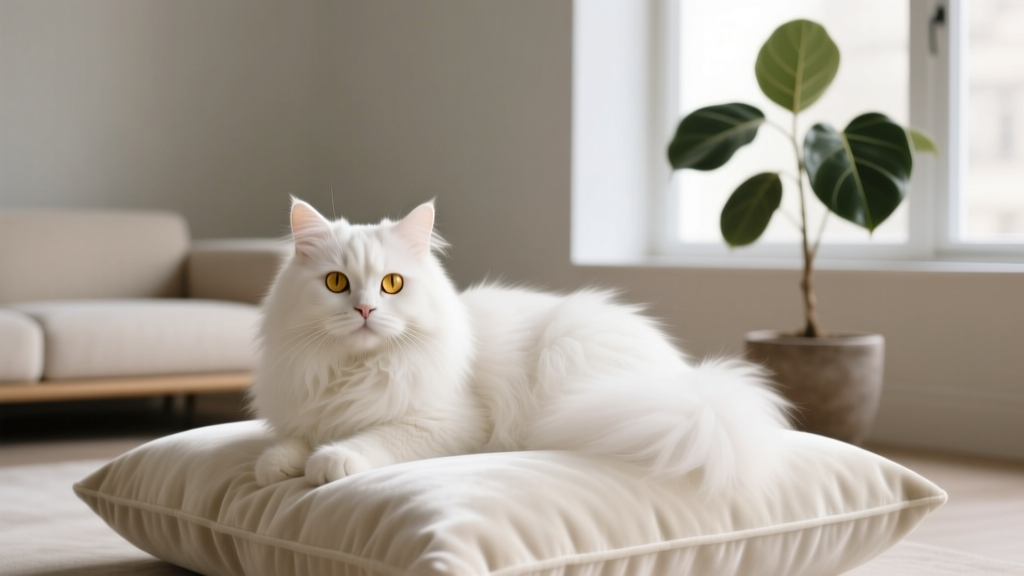
Let me be honest about what life with a Persian actually feels like. It's not all Instagram-worthy photos of fluffy cats on velvet cushions. You will find fur on every surface. You will schedule your social life around grooming sessions. You will occasionally find a mat you missed that requires a vet visit to remove safely.
But you'll also have a cat that greets you at the door, follows you from room to room, and settles onto your lap the moment you sit down. Persians are among the least active cat breeds ? they average just 2-3 hours of active play per day compared to 6-8 hours for breeds like the Abyssinian or Bengal. They prefer quiet observation to acrobatics. They don't jump onto high counters or shred your curtains. They are, in many ways, the perfect indoor companion for people who want a cat that acts like a cat but fits into a calm, structured home.
The investment is real ? roughly 100 minutes per week on grooming, $800-$1,200 annually for specialized food and veterinary care, and the emotional commitment of caring for an animal that truly cannot thrive without you. But for the right person, that's not a burden. It's the whole point.