Why Does My Cat Repeat Bad Behavior? (2026)
Why This Feels So Frustrating (And Why It’s Not Your Fault)
If you’ve ever asked why does my cat repeat bad behavior after the third time they knock your coffee off the counter, shred your favorite armchair, or urinate beside the litter box—not in it—you’re not alone. In fact, over 68% of cat owners report at least one persistent behavior issue within the first year of ownership (2023 International Cat Care Behavioral Survey). But here’s the crucial truth most never hear: cats don’t repeat bad behavior because they’re ‘mad at you,’ ‘testing boundaries,’ or ‘being stubborn.’ They repeat it because something in their environment, physiology, or learning history is actively reinforcing it—even when you think you’re discouraging it. This isn’t disobedience. It’s communication. And once you learn how to decode it, the shift isn’t just behavioral—it’s relational.
The Real Culprits: What’s Actually Reinforcing the Behavior
Behavior doesn’t persist in a vacuum. Every repeated action serves a function for your cat—whether you see it or not. Veterinary behaviorist Dr. Sarah Hargreaves, DACVB, explains: ‘Cats are operant learners. If a behavior results in relief, attention, food, or escape—even accidentally—it will resurface. Punishment rarely stops the behavior; it only teaches the cat to do it when you’re not watching.’
Let’s break down the five primary reinforcement drivers behind recurring issues:
- Sensory Relief: Scratching isn’t ‘destruction’—it’s nail maintenance, scent-marking, and muscle stretching. If your cat scratches the couch instead of the post, it’s likely because the texture, height, or location better meets those needs.
- Stress-Driven Coping: Over 40% of inappropriate urination cases in multi-cat households stem from chronic low-grade anxiety—not UTIs (per Cornell Feline Health Center). Cats may urinate near your bed or shoes to deposit calming facial pheromones—or conversely, mark territory due to perceived threats.
- Attention Accidentally Given: Even negative attention (yelling, chasing, picking up and scolding) can reinforce biting or pouncing. One study found that cats whose owners responded to nighttime yowling with verbal reprimands were 3.2× more likely to escalate vocalizations within two weeks.
- Unmet Environmental Needs: Indoor cats require vertical space, safe hiding zones, predictable routines, and daily predatory outlets (chase-hunt-eat-groom-sleep cycles). Without them, normal feline drives manifest as ‘bad behavior.’
- Pain or Discomfort Masked as Misbehavior: Arthritis, dental disease, or hyperthyroidism can cause irritability, aggression, or litter box avoidance—often misread as ‘acting out.’ A 2022 JAVMA study showed 29% of cats labeled ‘aggressive’ had undiagnosed medical conditions.
How to Diagnose the Function—Not Just the Symptom
Before changing anything, play detective for 72 hours using the ABC model (Antecedent-Behavior-Consequence), recommended by the American College of Veterinary Behaviorists:
- Antecedent: What happened *immediately before* the behavior? (e.g., You sat down to work → cat jumps on keyboard.)
- Behavior: Describe it objectively—no judgment words like ‘naughty’ or ‘demanding.’ (e.g., ‘Cat places both front paws on laptop, meows 5x, then bites edge of monitor frame.’)
- Consequence: What happened *right after*? Did you laugh? Push them off? Give treats to distract? Walk away? Pick them up?
This reveals patterns invisible in real time. For example, if your cat bites your hand when you stop petting, and you consistently withdraw—then the biting is reinforced by gaining control over interaction duration. The solution isn’t ‘stop letting them bite’—it’s teaching them how to ask for continued attention appropriately (e.g., with a nose bump).
Mini Case Study: Luna, a 3-year-old rescue, repeatedly knocked items off her owner’s desk. ABC logging revealed the antecedent was always the owner typing rapidly for >90 seconds. The consequence? Owner looked up, sighed, and spoke to her. The function: attention-seeking via low-effort, high-impact action. Intervention: Scheduled 2-minute ‘desk breaks’ with interactive wand play *before* she escalated—reducing incidents by 92% in 10 days.
The 4-Step Reset Protocol (No Punishment Required)
Based on protocols used successfully in shelter behavior programs and private consultations, this evidence-based framework replaces correction with clarity:
- Rule Out Medical Causes First: Schedule a vet visit with a focus on behavior. Request full bloodwork, urinalysis, and orthopedic exam—even for ‘young’ cats. Pain is silent but powerful.
- Remove Reinforcement Loops: Identify and interrupt the consequence maintaining the behavior. If your cat scratches the sofa, cover it with double-sided tape *and* provide a tall, sisal-wrapped post beside it—not across the room. Make the right choice easier than the wrong one.
- Teach the Replacement Behavior: Use positive reinforcement to reward the *opposite* of the problem. Want less biting during play? End sessions *before* biting starts—and reward gentle mouthing with treats. Consistency matters more than duration: 3x daily, 60-second sessions beat one 10-minute session weekly.
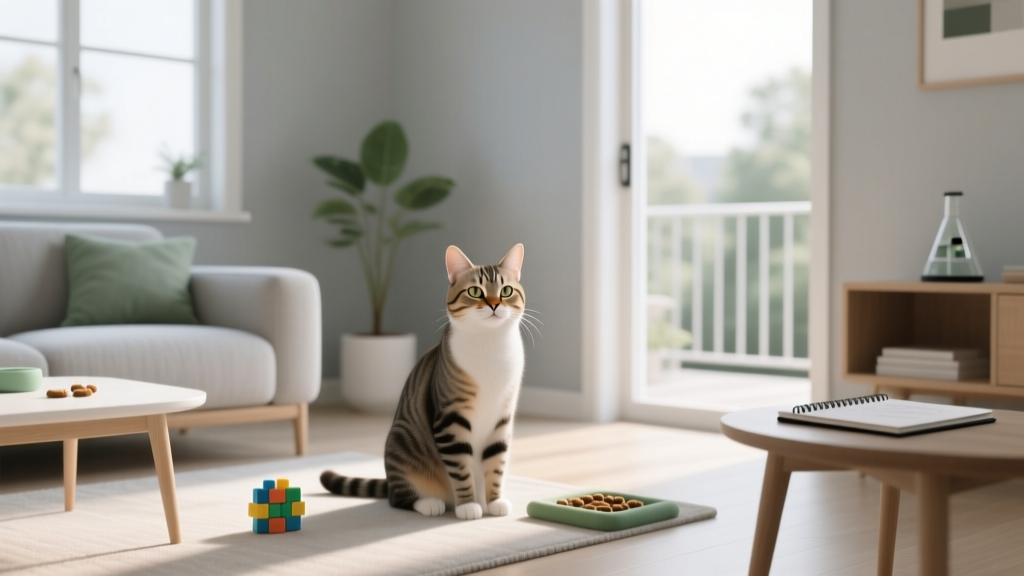
- Enrich the Environment Systemically: Not with one new toy—but with layered enrichment: vertical territory (wall shelves), foraging (food puzzles 2x/day), olfactory variety (catnip + silvervine rotation), and predictable human interaction (same 5-minute greeting ritual each morning).
Pro Tip: Track progress in a simple spreadsheet. Note date, behavior frequency, antecedents observed, and what you did differently. You’ll spot trends faster—and celebrate micro-wins that build momentum.
What Works vs. What Backfires: Evidence-Based Comparison
| Intervention | Effectiveness (Based on 2020–2023 Clinical Studies) | Risk of Escalation | Time to Noticeable Change |
|---|---|---|---|
| Clicker training + target stick for recall | 89% success rate for redirecting attention-seeking behaviors | Negligible | 4–12 days |
| Spray bottle / hissing / shouting | 12% reduction in short term; 73% relapse within 3 weeks | High (increased fear, redirected aggression) | None (temporary suppression only) |
| Litter box hygiene overhaul + location audit | 67% resolution of inappropriate elimination in non-medical cases | None | 3–10 days |
| Calming supplements (L-theanine, Zylkene) | Moderate support when paired with behavior modification (41% improvement vs. placebo) | Low (GI upset in <5% of cats) | 2–4 weeks |
| Ignoring all attention-seeking vocalizations | Effective only if 100% consistent; fails if owner caves even once | Moderate (may increase intensity before extinction burst) | 1–3 weeks (with strict consistency) |
Frequently Asked Questions
Why does my cat repeat bad behavior even after I punish them?
Punishment doesn’t teach your cat what to do instead—it only creates fear or confusion. Worse, if the punishment isn’t delivered *within 0.5 seconds* of the behavior (nearly impossible for humans), your cat associates it with whatever they’re doing *at that moment*—like looking at you or sitting nearby. That’s why many punished cats become anxious around their owners or develop redirected aggression. Positive reinforcement builds trust; punishment erodes it.
Could my cat be doing this on purpose to ‘get back’ at me?
No—cats lack the cognitive capacity for revenge or spite. These are human emotions requiring complex theory of mind and long-term intent planning, which feline neurology doesn’t support. What looks like ‘payback’ is almost always an unmet need (boredom, stress, pain) or accidental reinforcement. As Dr. Tony Buffington, DVM, MS, states: ‘If your cat seems “spiteful,” ask: What changed in their world? Not what did they “mean.”’
Will neutering/spaying stop repeated bad behavior?
It can reduce hormonally driven behaviors like spraying (by ~85% in males) or roaming, but it won’t resolve learned behaviors, anxiety-based issues, or environmental triggers. A spayed female who scratches the door because she wants outside isn’t expressing hormones—she’s communicating frustration. Sterilization is health care, not behavior therapy.
How long should I wait before seeking professional help?
If the behavior persists beyond 2–3 weeks despite consistent environmental adjustments and no medical cause found, consult a board-certified veterinary behaviorist (DACVB) or certified cat behavior consultant (IAABC or CCPDT). Early intervention prevents habits from hardening into neural pathways—and reduces household stress for everyone, including other pets.
Common Myths Debunked
Myth #1: “Cats are independent—they don’t need training.”
Truth: Independence ≠ inability to learn. Cats learn constantly through observation and consequence. In fact, they often outperform dogs in certain associative learning tasks—but require different motivators (e.g., food rewards work best with high-value treats like tuna flakes or chicken breast, not kibble).
Myth #2: “If I ignore the bad behavior, it’ll go away on its own.”
Truth: Ignoring only works for attention-seeking behaviors *if* you simultaneously reinforce alternative behaviors *and* ensure no accidental reinforcement occurs (e.g., your cat knocks things off your desk, you sigh and look at them—that’s attention). Passive ignoring without proactive replacement leads to escalation or new problem behaviors.
Related Topics (Internal Link Suggestions)
- How to Stop Cat Scratching Furniture — suggested anchor text: "how to stop cat scratching furniture"
- Cat Litter Box Training Mistakes — suggested anchor text: "common cat litter box mistakes"
- Best Cat Enrichment Toys for Indoor Cats — suggested anchor text: "indoor cat enrichment ideas"
- Signs Your Cat Is Stressed (Not Just ‘Grumpy’) — suggested anchor text: "subtle signs of cat stress"
- Veterinary Behaviorist vs. Trainer: What’s the Difference? — suggested anchor text: "when to see a cat behaviorist"
Your Next Step Starts Today—Not Tomorrow
Understanding why does my cat repeat bad behavior isn’t about fixing a ‘flawed’ pet—it’s about becoming a fluent interpreter of their world. Every repeated action is data, not defiance. Start small: pick *one* behavior this week. Log its ABC pattern for 48 hours. Then, implement *just one* change from the 4-Step Reset—like adding a second litter box or swapping your current scratching post for one that’s taller and sturdier. Don’t aim for perfection. Aim for presence. Because the most powerful tool you have isn’t spray bottles or clickers—it’s your consistent, curious, compassionate attention. Ready to translate your cat’s language? Download our free ABC Behavior Tracker & Enrichment Planner (PDF) — includes printable logs, species-appropriate toy recommendations, and a vet checklist tailored to behavior-related concerns.