Why Cats Sit on the Router or Modem
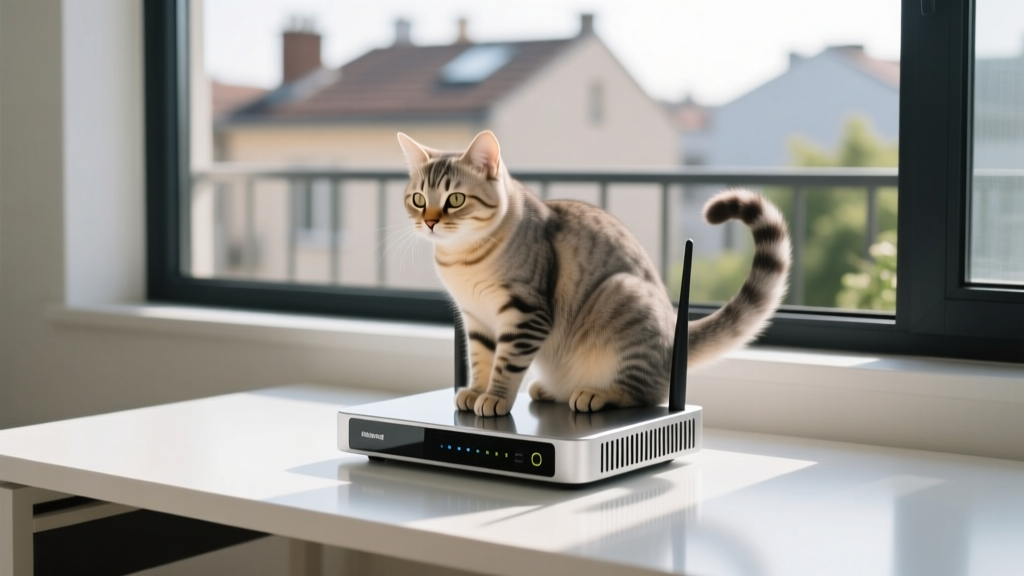
You sit down with your coffee, open your laptop, and—of course—your video call chooses that exact moment to lag. You glance over at the router and there’s your cat, loafed like a warm croissant on top of it, blinking slowly as if to say, “What? This is my seat.” Maybe you gently shoo them away, only for them to return the second your back is turned. Or you notice the modem has become their preferred throne whenever you’re busy, stressed, or trying to focus.
If you’ve ever wondered why your cat is drawn to the router like it’s the most luxurious bed in the house, you’re not alone. This quirky habit is surprisingly logical in cat terms—part comfort-seeking, part territory, part “I want to be where the action is,” and occasionally a dash of “I know this gets your attention.”
The scientific (and evolutionary) logic: warm, high, and important
Cats are masters at finding the best microclimates in your home. From an evolutionary standpoint, a small predator conserves energy whenever possible. Warmth helps them do exactly that. In the wild, cats seek sun-warmed rocks, protected nooks, and elevated perches that let them rest while staying aware of their surroundings. Your router or modem checks several “perfect cat spot” boxes:
- Heat source: Routers and modems give off a steady, gentle warmth—especially in cooler homes. It’s like a tiny heating pad that never turns off.
- Elevation and vantage point: Many routers sit on a shelf, desk, or cabinet. Cats feel safer when they can see the room and monitor movement.
- Central location: Wi‑Fi equipment is often placed where it can “reach” the house—open areas, hallways, living rooms. Cats also tend to choose central hubs because that’s where life happens.
- Scent and routine: That spot becomes part of their map. If they’ve sat there before and nothing bad happened (and maybe they got pets), it becomes a trusted resting place.
From a feline psychology perspective, your router is less “internet device” and more “warm, stable, socially important object in the heart of the territory.” Your cat isn’t trying to sabotage you (most of the time). They’re following instincts that prioritize comfort, security, and proximity to their people.
A detailed breakdown: what “router sitting” looks like in different contexts
1) The winter loaf: “This is my heated seat.”
In colder months, you might notice your cat glued to the router like it’s magnetized. They’ll curl tightly, paws tucked, tail wrapped—classic heat-conserving posture. If your cat also seeks out laundry piles, radiator shelves, sunny windows, and laptop keyboards, this is almost certainly about warmth.
2) The “you’re busy” perch: “I’d like access to you.”
Some cats pick the router specifically when you’re working, gaming, or on your phone. That’s often because the router sits near your desk or entertainment center. Cats are social learners; they watch where you spend time and choose nearby spots. If the router is close enough for them to receive occasional head scratches, it becomes a prime real estate.
3) The attention move: “Notice me, please.”
Not every cat does this for attention, but many do. If your response is predictable—laughing, talking to them, picking them up, or fussing—the behavior can be reinforced. Cats repeat what works. A cat who hops on the router and instantly gets interaction may think, “Excellent. I have discovered the magic button.”
4) The scent-marking lounge: “This belongs to my territory.”
Cats mark with cheeks, paws, and their body. Sitting on something is a subtle, full-body version of scent transfer. If your cat rubs their face on the router corners, kneads near it, or flops dramatically beside it, they may be “branding” a central object in the home.
5) The anxious anchor: “I need a predictable, safe spot.”
In some homes, cats develop a “safe station”—a spot they return to when the environment feels unpredictable. The router area may be quiet, elevated, and consistent. If you’ve had visitors, loud construction, a new pet, or schedule changes, your cat may retreat to that familiar perch to regulate themselves.
What it means about your cat’s mood and feelings
Like most cat behaviors, the meaning depends on body language. Here are common “router sitter” moods:
- Content and relaxed: Loose body, slow blinks, half-closed eyes, calm tail. This is the “I’m comfy and safe” cat.
- Seeking closeness: They choose the router when you’re nearby, orient their body toward you, or hop down to follow you. This often signals affection and social bonding—your cat likes being in your orbit.
- Possessive or territorial: Stiff posture, blocking the device, swatting if approached, tense tail flicks. This suggests they’re guarding a valued spot (or guarding you if the router is near your main hangout zone).
- Overstimulated or annoyed: Fast tail flicking, ears rotating back, sudden nips if touched. In this case, the router may not be “the problem,” but rather the cat is using it as a resting spot while not wanting interaction.
- Stressed: Wide pupils, crouched posture, hypervigilant scanning. If the router spot is being used as a “control tower,” your cat may be looking for security.
Most of the time, router sitting is simply a sign you have a cat who enjoys warmth and likes to be in the social center of the home. It can also be a quiet compliment: your cat trusts the environment enough to nap in a visible place.
Related behaviors you might also notice
Router sitting rarely happens in isolation. Cats who love the router often love:
- Sleeping on laptops or keyboards: Warmth + attention + your scent in one place.
- Perching on the TV stand or soundbar: High vantage point near household activity.
- Sitting on game consoles, cable boxes, or speakers: These often run warm and sit in “important” areas.
- Claiming the laundry basket: Soft, insulating, and smells like you.
- Hanging out in doorways or hallways: Cats love controlling “traffic zones.”
- Sleeping on your shoes or bag: High-scent objects that smell like “outside” and “you.”
If your cat rotates through these spots, you’re looking at a normal pattern of comfort-seeking, scent-soothing, and social proximity.
When it’s normal… and when it might be a concern
Normal router sitting
- Your cat naps calmly and can be redirected without drama.
- They show relaxed body language and normal appetite, play, and litter box habits.
- The behavior is occasional or seasonal (more in winter, less in summer).
Potential concerns
- Overheating risk: If your cat is panting, drooling, seeking cool surfaces, or seems lethargic—heat may be too much. (Most routers aren’t that hot, but small enclosed spaces can warm up.)
- Compulsive “can’t settle anywhere else” behavior: If your cat paces, seems anxious, and only calms on the router, consider stress as a driver.
- Aggression when moved: Guarding behavior can escalate if the router spot becomes highly valued.
- Safety/equipment issues: If your router is in a precarious spot, your cat could knock it down, chew cords, or block ventilation—risking both injury and fried hardware.
- Sudden change: If your cat never cared about the router and suddenly camps there constantly, look for changes in temperature, household routine, pain/discomfort, or stressors. When in doubt, a vet check is wise—cats often seek warmth when they’re not feeling their best.
How to respond (and how to encourage safer versions of the behavior)
You don’t have to turn your home into a router-free cat zone. The goal is to meet your cat’s needs—warmth, security, proximity—without risking overheating, cord chewing, or internet outages.
Create a “better router” spot
- Add a heated alternative: A pet-safe heated bed or self-warming mat near your workspace can be irresistible. Place it slightly higher than floor level if your cat prefers perches.
- Offer an elevated perch: A cat tree by the desk or a window hammock often wins over a router shelf.
- Make it smell right: Put a small fleece blanket you’ve used (clean, no harsh detergents) on the new spot. Familiar scent is powerful.
Keep the router safe if your cat insists
- Improve ventilation: Ensure vents aren’t blocked. Consider a wall mount or a shelf that leaves airflow around the device.
- Use cord protection: Cord covers and cable management boxes reduce chewing temptation.
- Stabilize the setup: If the router sits on a wobbly stand, secure it. A cat launching into a leap can send gear flying.
- Discourage gently, not dramatically: If you react big, the router becomes “the place that makes humans make noise.” Calmly redirect to the alternate bed and reward with a treat or a few pets when they choose it.
Boost “you and me” time
If your cat uses the router as an attention strategy, add predictable interaction so they don’t have to invent creative ways to summon you. A five-minute play session before your meeting, a treat puzzle during your work block, or a scheduled cuddle can reduce “I must sit on the internet” moments.
Fun facts and research-adjacent tidbits
- Cats are heat seekers by design: Domestic cats prefer warmer ambient temperatures than humans typically do. That’s one reason they gravitate toward sunny patches, warm electronics, and laps.
- Elevated resting is a security strategy: Many cats feel safer when they can observe without being approached from all sides. A router shelf can function like a mini lookout tower.
- Scent is social information: When your cat parks their body on a central object, they’re often mixing their scent into the home’s “family smell.” This can be calming for them and helps define the environment as familiar.
- Your habits shape their habits: Cats learn the “important zones” of the home by watching you. If the router is near the place you sit for hours, it becomes part of the social landscape—less about Wi‑Fi, more about you.
FAQ: Cats and routers
Do cats sit on routers because of radiation or Wi‑Fi signals?
There’s no good evidence that cats are attracted to Wi‑Fi signals themselves. The simplest explanations—warmth, height, location, and attention—fit the behavior extremely well. Your cat is almost certainly responding to comfort and routine, not the internet waves.
Is it dangerous for my cat to sit on the router or modem?
Usually it’s not dangerous for the cat, but it can become risky if the device gets too warm, ventilation is blocked, cords are chewed, or the equipment can fall. If your cat is a committed router sitter, focus on airflow, stability, and cord safety.
Why does my cat only do this when I’m working?
Because you’re predictable: you sit still, you’re focused, and you’re in one spot for a long time. Cats love reliable routines and “togetherness without pressure.” The router is often close enough to be near you without being in your lap—an ideal compromise for many cats.
How do I stop my cat from sitting on the router without upsetting them?
Give them a better option in the same area: a warm bed, a small perch, or a cat tree. Then calmly redirect and reward. Avoid yelling or spraying—those methods can create stress and make the router even more “interesting.”
My cat guards the router and swats when I move them. What does that mean?
That spot has high value to your cat (comfort, security, or territorial significance). Increase alternatives, reduce competition for prime resting spots, and avoid physically forcing them off whenever possible. If guarding escalates or spreads to other resources, a behavior consult can help.
Could this be a sign my cat is sick?
Warmth-seeking can be normal, but if the behavior is new, intense, or paired with hiding, reduced appetite, less grooming, or changes in litter box habits, schedule a vet check. Cats often change resting patterns when they’re uncomfortable.
At the end of the day, a cat sitting on the router is usually a classic case of feline logic: warm spot, good view, central territory, and a side benefit of being close to their favorite human. If you can meet those needs with a safer “approved” perch, you’ll protect your equipment and keep your cat happily loafing.
Does your cat have a favorite “weird warm place”—router, laptop, cable box, or something even more random? Share your story (and your best “caught in the act” moment) with the Cat Lovers Base community at catloversbase.com.