Why Cats Sit on the Balcony Plant Pot Rim
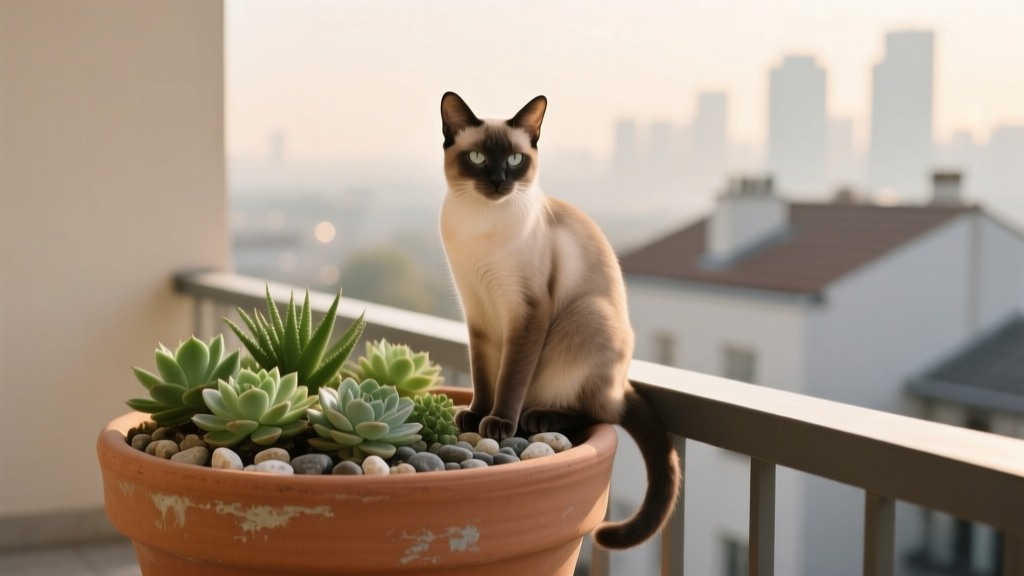
You step onto the balcony with your coffee and there’s your cat—perched like a tiny tightrope artist on the narrow rim of a plant pot. Not curled up in the cozy bed you bought. Not even on the chair with the sunbeam. No, they’ve chosen the least reasonable seat in the entire outdoor space: a dirt-filled container with a two-inch ledge, one ear swiveling toward the street and the other toward you, tail draped like a confident flourish.
If you’ve ever watched this and thought, “Why that spot?” you’re in excellent company. From a cat’s perspective, the plant pot rim is not an awkward place at all—it’s a strategic, sensory-rich, status-symbol kind of place. It’s basically a feline balcony throne… with bonus smells.
1) The evolutionary logic: cats love edges, vantage points, and controlled risk
Domestic cats may live in our apartments and houses, but their brains are still wired like those of small predators who also happen to be prey to larger animals. That combination creates a very specific lifestyle preference: they want to observe while staying safe, and they want to feel in control of their space.
Edges are information hubs. In the wild, borders—between shrubs and open ground, between rocks and grass—are where movement is easiest to track. Perching on an edge gives a cat a panoramic view and clearer detection of “who’s coming from where.” The rim of a balcony pot is literally an edge: a boundary line between the pot and open air, between the plant’s micro-world and the balcony’s bigger stage.
Height equals safety and advantage. Even a small elevation changes a cat’s options. From a pot rim, your cat can monitor the door, the railing, the street, and any fluttering bird activity without committing their whole body to the open area. That “up a bit” feeling matters to cats more than it does to us.
A little wobble can be rewarding. Balancing on a narrow rim isn’t just tolerable—it can be mildly stimulating in the same way a climbing structure is. Many cats enjoy controlled challenges. It activates their body awareness and gives them a sense of mastery. If your cat looks extra smug up there, that’s not your imagination.
2) What’s so special about plant pots? A behavior breakdown by context
Not all pot-rim sitting is the same. The “why” shifts depending on the situation, the cat, and what’s happening around them.
A) The lookout post: “I’m on neighborhood watch.”
If your cat sits on the rim facing outward—eyes tracking birds, ears flicking at traffic, whiskers forward—you’re watching classic observation behavior. Many cats prefer a defined perch over a wide open surface because it feels safer: there’s a clear “front” to scan and a clear “back” to protect.
Common scenario: Your cat jumps up, does two slow circles on the rim (carefully), then freezes to stare at a pigeon like they’re reading its diary.
B) The scent spa: “This place smells alive.”
Plant pots hold a rich mix of scents—soil, fertilizer, plant oils, water, insects. Cats process the world heavily through smell, and outdoor air currents can turn a balcony pot into a scent delivery system. Sitting on the rim puts their nose right in the stream of interesting information.
Common scenario: They sit, lean down to sniff the soil, then lift their head and do a half-open mouth expression (the “flehmen response”) like they’re tasting the air.
C) The comfort perch: “This fits me just right.”
It sounds odd, but many cats enjoy resting against firm boundaries. A pot rim can provide a gentle pressure point under the chest and forelegs, and the rounded edge may feel supportive—especially for cats who like to “loaf” with their paws tucked.
Common scenario: Your cat perches like a gargoyle, loafed neatly, eyes half-closed, clearly convinced this is peak furniture design.
D) The status seat: “This is my spot.”
Cats are quietly territorial. A repeated perch can become part of their “core area,” the zone they feel responsible for monitoring and scent-marking. Being on the pot rim may be their way of claiming the balcony as an extension of their home territory.
Common scenario: They hop onto the same rim every morning, especially after another cat has been seen outside or a neighbor has walked by.
E) The social choice: “I want to be near you, but not too near.”
If you’re on the balcony too, the plant pot rim might be your cat’s compromise between closeness and independence. Cats often prefer side-by-side proximity rather than direct face-to-face interaction.
Common scenario: You sit down. Your cat immediately chooses the nearest pot rim, positioning themselves in your orbit, pretending it’s purely coincidental.
3) What it says about your cat’s mood (body language clues)
The rim itself isn’t the whole story. Your cat’s posture and micro-signals tell you what they’re feeling up there.
- Relaxed and content: Soft eyes (slow blinking), loose tail drape, ears neutral or gently swiveling. This is a “pleasant observation” perch.
- Curious and engaged: Forward whiskers, ears pointed toward a sound, head movements in small precise tracking motions. Their brain is doing data collection.
- On alert: Stiff posture, tail held tight or twitching at the tip, pupils larger than expected for the light level. Something outside has their attention and they’re evaluating it.
- Uncertain or conflicted: Repeated shifting feet, crouching low, ears rotating back and forth quickly. They may be torn between staying and retreating.
- Overstimulated: Tail lashing, skin rippling, sudden jumpiness. If you try to pet them here, you might get the “please don’t touch me while I’m on duty” reaction.
One of the sweetest takeaways: many cats choose a rim perch when they feel safe enough to sit still but interested enough to stay vigilant. It’s a very “secure but curious” state.
4) Related behaviors you might also notice
Pot-rim sitting often comes bundled with other balcony and plant-adjacent quirks:
- Railing walks: Similar balancing satisfaction and vantage-point seeking.
- Loafing in doorways: Cats love thresholds—another type of “edge” with lots of information.
- Sniffing and pawing at soil: Investigating scent layers or testing texture (sometimes a prelude to digging).
- Chewing plant leaves: Sensory exploration, boredom, or gastrointestinal self-soothing (but can be risky depending on the plant).
- Rubbing cheeks on the pot: Facial pheromone marking—“This belongs in my safe map.”
- Chattering at birds: High arousal frustration/excitement response when prey is visible but unreachable.
5) When it’s normal… and when it might be a concern
Most of the time, sitting on a plant pot rim is completely normal cat behavior. Still, a few situations deserve a closer look.
Normal (and even healthy) if:
- Your cat can balance comfortably and dismount easily.
- They look relaxed or pleasantly alert.
- It’s part of a routine—morning bird-watching, evening breeze time.
- They’re not damaging plants or ingesting anything unsafe.
Potential concern if:
- Safety risk: The pot is on/near a ledge where a slip could lead to a fall. Even agile cats misjudge distances, especially if startled.
- Obsessive vigilance: They spend hours tense and fixated, especially if there’s an outdoor cat nearby. Chronic stress can show up as over-grooming, hiding, or litter box issues.
- Sudden change: A cat who never used to perch like this starts doing it constantly, paired with restlessness, vocalizing, or clinginess—could indicate anxiety, boredom, or discomfort.
- Mobility issues: Older cats sitting awkwardly, hesitating to jump down, or appearing stiff could be dealing with pain (arthritis is very common and often subtle).
- Plant toxicity risk: If they chew leaves or dig in soil that contains fertilizers/pesticides, it becomes more than a quirky perch.
If anything about the behavior looks tense, compulsive, or physically difficult, a vet check and a stress audit of the environment are worthwhile.
6) How to respond: encourage the good parts, prevent the hazards
You don’t need to “train it out” of them. You can guide it into a safer, cleaner, more cat-friendly version.
Make the perch safer
- Stabilize the pot: Heavy pots tip less. Consider a wider base or a pot stand that’s hard to knock over.
- Move pots away from the outer edge: Create a buffer zone so a startled jump doesn’t become a dangerous misstep.
- Add a better perch nearby: A sturdy balcony chair, a cat shelf, or a small outdoor-safe cat tree can satisfy the same need with less risk.
Redirect if your cat digs or chews
- Offer a legal digging box: A shallow tray with pet-safe soil or sand can satisfy the sensory urge.
- Use plant barriers: Decorative stones on top of the soil (large enough not to be swallowed) can deter digging while still looking nice.
- Grow cat-safe greens: Cat grass or catnip in a designated pot can reduce interest in your other plants.
Support their “watch duty” in a calming way
- Create predictable balcony time: Routine reduces stress. A consistent daily perch session can be comforting.
- Pair with enrichment: After balcony watching, offer a small food puzzle or a short wand-toy session to complete the “hunt sequence.”
- If outdoor cats trigger stress: Window film, balcony screens, or visual blockers can reduce direct staring contests.
7) Fun facts and research-flavored insights
- Cats map safety through scent. When your cat rubs their cheeks on objects (including pots), they’re depositing facial pheromones that help them label areas as familiar and safe.
- Perching is a confidence behavior. Many cats choose higher or narrower resting spots when they feel secure enough to relax while staying aware of their surroundings.
- “Edges” are naturally attractive. Thresholds, ledges, windowsills, and narrow surfaces concentrate airflow and scent cues—like a newsfeed for a cat’s nose.
- Bird-watching is enrichment. Visual access to nature can be mentally stimulating for indoor cats, reducing boredom—so long as it doesn’t become frustrating or stressful.
8) FAQ: Common questions about cats and plant pot rims
Why does my cat choose the pot rim over a comfy bed?
Beds are great for deep rest, but a pot rim offers something different: a vantage point, boundary support, and high-quality smells. Cats pick locations based on what they need in that moment—sleep, security, monitoring, or sensory input.
Is it dangerous for my cat to sit there?
It can be, depending on placement and stability. If the pot is near a drop, wobbly, or on a narrow ledge, it’s worth relocating it and offering a sturdier perch. Cats are agile, but they’re not immune to slips—especially when startled by a sudden noise.
Why does my cat stare outside for so long from the pot?
It’s normal “predatory attention” and environmental monitoring. If the body language stays relaxed, it’s healthy enrichment. If your cat looks tense or fixated for hours, consider whether an outdoor animal is stressing them and add visual barriers or alternative perches.
My cat keeps digging in the pot after sitting on the rim—why?
Digging can be play, scent investigation, or a natural motor pattern. Some cats also enjoy the texture of soil. Provide a designated digging tray and use large decorative stones or a mesh cover to protect the plant pots.
Why does my cat rub their face on the pot first?
That’s scent marking with facial glands. It’s a friendly “this is part of my safe home” label. It can also be a self-soothing ritual before settling in.
Should I stop my cat from going on the balcony altogether?
Not necessarily. Supervised balcony time can be excellent enrichment. The key is safety: secure screens/rails, stable furniture, non-toxic plants, and smart placement of anything your cat might climb or perch on.
If your cat has claimed a balcony plant pot rim as their personal observation deck, you’re seeing a very cat-like combination of curiosity, comfort, and environmental control. With a few safety tweaks, you can let them enjoy their quirky perch—while keeping your plants (and your nerves) intact.
Does your cat have a favorite “impossible” seat outdoors—pot rims, railings, the top of the watering can? Share your cat’s balcony habits and funniest perching choices with fellow cat people at catloversbase.com.