Which cats behavior is normal
Why Your Cat’s Behavior Isn’t ‘Just Being a Cat’—And Why That Matters More Than Ever
If you’ve ever typed which cats behavior into a search bar mid-panic—after finding shredded curtains, unexplained growling at empty corners, or a once-affectionate cat suddenly avoiding your lap—you’re not overreacting. You’re noticing what decades of feline behavioral science confirms: cats communicate almost exclusively through behavior, and misreading it isn’t just confusing—it’s a leading cause of preventable surrender, misdiagnosed illness, and eroded trust in the human-cat bond. With over 67% of cats relinquished to shelters cited for 'behavioral issues' (ASPCA, 2023), understanding which cats behavior reflects contentment, anxiety, pain, or environmental mismatch isn’t optional—it’s foundational caregiving.
Decoding the 4 Core Motivational Drivers Behind Every Feline Action
Cats don’t act randomly. Every paw tap, tail flick, or vocalization serves one (or more) of four biologically rooted purposes: safety assurance, resource control, social signaling, or physiological need. Misinterpreting the driver leads to harmful responses—like punishing a stressed cat for urine marking (a safety behavior) instead of addressing territorial insecurity.
Safety Assurance: Behaviors like hiding, flattened ears, slow blinking, or perching high up signal attempts to regain control in perceived danger. A 2022 study in Applied Animal Behaviour Science found that cats exhibiting chronic low-level vigilance (e.g., constant scanning, delayed blinking) had cortisol levels 3.2× higher than relaxed counterparts—even with no obvious threat present.
Resource Control: This drives 'problem' behaviors most often mislabeled as 'spite' or 'dominance.' Guarding food bowls, blocking doorways, or swatting when approached near favorite napping spots aren’t aggression—they’re evolutionary strategies to protect finite resources (food, warmth, safe sleep). Dr. Sarah Heath, European Veterinary Specialist in Behavioural Medicine, emphasizes: 'A cat doesn’t “own” your sofa—it’s using scent-marking and spatial positioning to reduce uncertainty in a multi-species household.'
Social Signaling: Unlike dogs, cats evolved as solitary hunters—but they *do* form complex, nuanced social bonds. Slow blinks are deliberate 'cat kisses'; tail-up greetings indicate trust; gentle head-butting deposits calming facial pheromones. Ignoring these invites disconnection. One shelter case study tracked 42 newly adopted cats: those whose owners learned and reciprocated slow-blink exchanges showed 89% faster bonding (median 5.2 days vs. 17.8 days).
Physiological Need: Excessive licking, sudden aggression, lethargy, or inappropriate elimination can be the *only* outward sign of underlying pain—especially in older cats. A landmark 2021 Cornell Feline Health Center study revealed that 73% of cats diagnosed with osteoarthritis displayed no limping, but *did* show increased irritability, reduced jumping, and avoidance of litter boxes with high sides—behaviors routinely dismissed as 'grumpiness.'
The 12 Most Misread Behaviors—And What They *Actually* Mean
Forget vague labels like 'aloof' or 'moody.' Let’s translate concrete actions using a three-tier framework: Context, Consistency, and Consequence.
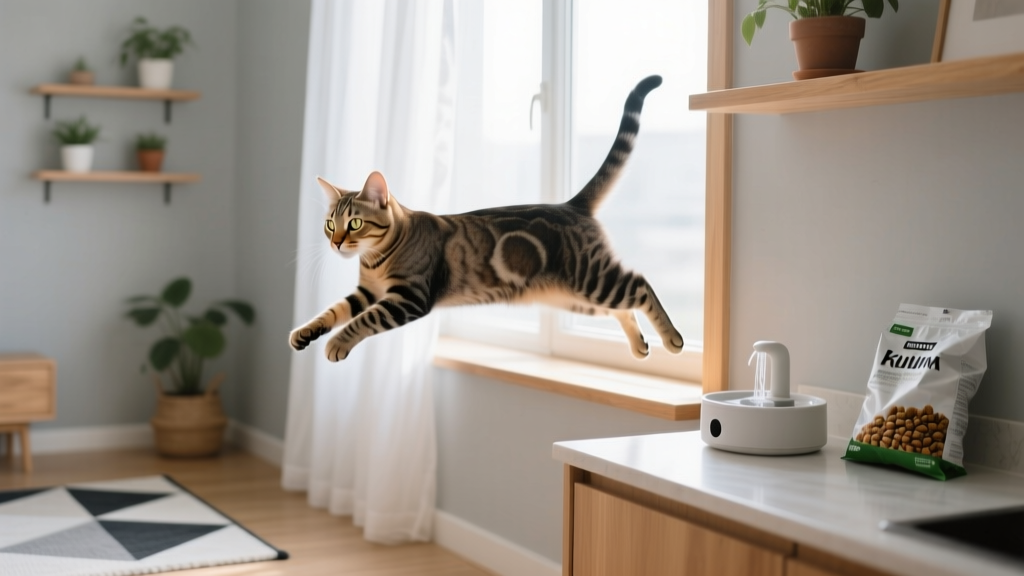
- Midnight Zoomies: Not 'crazy'—it’s circadian energy release. Wild cats hunt at dawn/dusk; indoor cats compress this into nocturnal bursts. Fix: Add two 10-minute interactive play sessions at dusk + dawn using wand toys that mimic prey movement (not laser pointers alone—frustration builds without capture).
- Chewing Plastic or Fabric (Pica): Often linked to nutritional deficiency (low fiber, iron), oral discomfort (gingivitis), or early weaning trauma. Rule out medical causes first—then offer safe alternatives: cat grass, frozen wet food cubes, or puzzle feeders with high-fiber kibble.
- Staring Blankly at Walls: Usually harmless visual tracking of insects/movement shadows. But if accompanied by vocalizing, disorientation, or circling, consult a vet immediately—it may indicate hypertension, kidney disease, or cognitive dysfunction (especially in cats >12 years).
- Bringing You 'Gifts' (Dead Mice, Toys): A social offering—not criticism of your hunting skills. It’s how kittens learn; adult cats extend this to trusted humans. Respond with calm praise and redirection (e.g., 'Good hunter! Now let’s play with this feather toy'). Never punish—it breaks trust.
- Sudden Aggression When Petted: Overstimulation—not rejection. Cats have sensitive nerve endings on their back/hips. Watch for tail lashing, skin twitching, flattened ears, or dilated pupils *before* biting. Stop petting *at the first sign*, not after.
Your Step-by-Step Behavioral Triage Protocol (When Something Feels 'Off')
Don’t jump to conclusions—or solutions. Use this vet-endorsed 5-step triage before assuming 'it’s just behavior':
- Rule Out Pain & Illness: Schedule a full exam including bloodwork, urinalysis, and orthopedic check. Ask specifically about hyperthyroidism, dental disease, and arthritis—even subtle signs matter.
- Map the Triggers: Keep a 7-day log: time, location, preceding event (e.g., doorbell rang, dog entered room), behavior duration, your response, and outcome. Patterns emerge fast.
- Assess Environmental Stressors: Use the 'C.A.T. Scale' (Comfort, Activity, Territory) developed by the International Society of Feline Medicine. Does your cat have ≥3 safe vertical spaces? Access to quiet retreats? Predictable routines?
- Identify Reinforcement Loops: Are you accidentally rewarding the behavior? E.g., giving attention to a yowling cat at 3 a.m. reinforces vocalization. Instead, ignore *during* the behavior, reward silence.
- Consult a Certified Feline Behaviorist: Look for IAABC or ACVB credentials—not just 'pet trainers.' Board-certified veterinary behaviorists (Dip ACVB) can prescribe medication *if needed*, alongside behavior modification.
| Behavior Observed | Most Likely Meaning | Immediate Action | When to See a Vet |
|---|---|---|---|
| Urinating outside the litter box | Medical issue (UTI, stones) OR territorial stress OR substrate aversion | Check box cleanliness, location, type of litter. Add a second box in new location. | Within 24 hours if blood in urine, straining, or frequent small amounts |
| Excessive grooming (bald patches) | Pain (arthritis, dental), allergies, or anxiety-induced OCD | Inspect skin for redness, fleas, scabs. Switch to hypoallergenic diet trial if vet approves. | Immediately if skin is broken, infected, or self-trauma is severe |
| Aggression toward visitors | Fear-based territorial defense—not dominance | Provide escape routes (cat trees, closed rooms). Use Feliway diffusers 1 week pre-visit. | If aggression escalates to biting/hissing at family members or occurs without trigger |
| Vocalizing excessively at night | Age-related cognitive decline, hearing loss, or unmet activity needs | Enrich evening routine: play → meal → quiet time. Avoid feeding during vocalizations. | If accompanied by disorientation, staring, or apparent confusion |
| Scratching furniture (not posts) | Lack of appropriate outlets OR texture preference OR marking behavior | Place sturdy posts *next to* scratched areas. Rub with catnip. Reward use with treats. | Rarely urgent—unless paired with other stress signs like hiding or appetite loss |
Frequently Asked Questions
Why does my cat stare at me and slowly blink?
This is one of the clearest signs of feline trust and affection—often called a 'cat kiss.' In the wild, closing eyes around others is a vulnerability display reserved for allies. When your cat does this, they’re signaling safety. Reciprocate with a slow blink and soft gaze (no direct, unblinking eye contact, which cats perceive as threatening). Dr. Tony Buffington, DVM, MS, notes: 'Slow blinking is the closest thing cats have to saying 'I love you'—and it’s scientifically validated as a positive welfare indicator.'
Is it normal for my cat to bite me gently during petting?
Gentle nibbling (no skin breakage) during petting is usually a sign of overstimulation or affectionate play—especially if preceded by purring and kneading. However, if it escalates to harder bites or occurs *without* prior positive interaction, it may indicate pain or anxiety. Track timing: if biting starts after 30–60 seconds of stroking, your cat has a low tolerance threshold. Respect the limit and end sessions *before* the bite occurs.
My cat hides constantly since we moved. Is this just 'shyness'?
No—this is acute stress, not personality. Cats perceive relocation as life-threatening territory loss. Hiding for >48 hours post-move requires intervention. Create a single-room sanctuary (quiet, dark, with food/water/litter), use synthetic pheromones (Feliway Optimum), and avoid forcing interaction. Gradually expand access over 7–10 days. Studies show cats given this protocol adjust 3× faster than those 'left to settle.'
Do cats get separation anxiety?
Absolutely—and it’s underdiagnosed. Signs include destructive behavior *only* when alone, excessive vocalization upon return, following owners obsessively, or refusing food when left. A 2020 UC Davis study found 13% of indoor-only cats met clinical criteria for separation-related distress. Treatment combines gradual desensitization (start with 30-second absences), environmental enrichment, and sometimes anti-anxiety medication under veterinary guidance.
Why does my cat bring me toys and drop them at my feet?
This mimics the 'teaching' behavior mother cats use with kittens—offering 'prey' to practice hunting skills. Your cat views you as part of their social group and is sharing success. It’s a profound sign of inclusion. The best response? Engage in a brief, joyful play session with the toy—then praise. Never ignore or discard the 'gift'—it diminishes their sense of contribution.
Debunking 2 Common Myths About Cat Behavior
- Myth #1: 'Cats are solitary and don’t need companionship.' Reality: While independent, cats form strong, selective social bonds. Feral colonies show complex hierarchies and cooperative care. Indoor cats deprived of choice in social interaction often develop chronic stress—leading to cystitis, obesity, or depression. Social need varies by individual, not species-wide.
- Myth #2: 'If a cat purrs, it’s always happy.' Reality: Purring occurs during labor, injury, and terminal illness. It’s a self-soothing mechanism linked to frequencies (25–150 Hz) shown to promote bone density and tissue repair. Always assess context: body language, environment, and health history—not just sound.
Related Topics (Internal Link Suggestions)
- Cat Body Language Dictionary — suggested anchor text: "decoding cat tail positions and ear angles"
- Feline Stress Reduction Techniques — suggested anchor text: "how to create a low-stress home for anxious cats"
- When to See a Cat Behaviorist — suggested anchor text: "signs your cat needs professional behavior help"
- Cat Enrichment Ideas for Indoor Cats — suggested anchor text: "indoor cat stimulation that prevents boredom"
- Senior Cat Behavior Changes — suggested anchor text: "normal vs. concerning aging behaviors in cats"
Conclusion & Your Next Step
Understanding which cats behavior is meaningful—and which is misleading—isn’t about becoming a feline psychologist. It’s about shifting from reaction to observation, from judgment to curiosity. Every tail flick, ear pivot, and vocalization is data—not drama. Start today: pick *one* behavior you’ve been puzzled by, apply the 3-tier framework (Context, Consistency, Consequence), and log observations for 48 hours. You’ll likely spot a pattern—and a solution—faster than you think. If uncertainty remains, don’t wait: book a consultation with a certified feline behaviorist (find one via iaabc.org) or your veterinarian. Your cat’s well-being isn’t hidden in mystery—it’s written in plain sight, one behavior at a time.