What to Give Kitten for Car Ride: 7 Vet-Approved Calming Strategies (That Actually Work — No Sedatives Needed)
Why Your Kitten’s First Car Ride Could Shape Their Lifelong Travel Confidence
If you’re searching for what to give kitten for car ride, you’re likely facing one of the most emotionally charged moments in early kitten ownership: that first trip to the vet, adoption follow-up, or relocation. Unlike adult cats, kittens haven’t yet formed neural pathways for associating vehicles with safety — and without thoughtful preparation, a single traumatic ride can cement lifelong travel anxiety. In fact, a 2023 study published in Journal of Feline Medicine and Surgery found that 68% of cats exhibiting severe transport aversion had their first negative car experience before 16 weeks of age. The good news? With evidence-based behavioral prep — not just quick fixes — you can transform fear into calm confidence, often without medication at all.
Step 1: Build Positive Associations *Before* the Engine Starts
Most owners skip this critical phase — then wonder why their kitten trembles in the carrier. According to Dr. Sarah Lin, DACVB (Diplomate of the American College of Veterinary Behaviorists), ‘The carrier isn’t a cage — it’s a den. And the car isn’t a metal box — it’s a moving extension of home.’ Start 5–7 days pre-trip:
- Leave the carrier out 24/7 with soft bedding, catnip-sprinkled blankets, and treats inside — never force entry.
- Feed meals exclusively in the carrier (even if it means placing the bowl just inside the doorway at first).
- Run the car engine while parked for 2–3 minutes daily, offering gentle chin scratches and high-value treats (like freeze-dried salmon) through the open window.
- Take ultra-short ‘nowhere rides’: buckle in, drive 30 seconds down the driveway, return, and reward with playtime — repeat for 3–4 days.
This isn’t ‘training’ — it’s neuroplasticity in action. Kittens under 14 weeks have peak synaptic flexibility; every positive association literally rewires their amygdala’s threat response.
Step 2: What to Give Kitten for Car Ride — Safe, Science-Supported Options
Let’s be clear: there is no universal ‘kitten travel pill’. Over-the-counter sedatives like Benadryl are not recommended for kittens under 4 months without direct veterinary supervision — and even then, they often backfire (causing paradoxical agitation or respiratory depression). Instead, prioritize tiered, low-risk interventions:
- Natural Calming Aids (Feliway® Optimum Spray): Unlike older Feliway Classic, Optimum contains both F3 (stress-reducing facial pheromone analog) and ADAPTIL-like compounds targeting travel-specific anxiety. Apply 15 minutes before loading — spray inside carrier walls and on bedding (never directly on kitten).
- L-Theanine + B-Vitamin Chews (Zylkène® Kitten Formula): Clinically studied in kittens aged 8–20 weeks; supports GABA modulation without drowsiness. Administer 2 hours pre-ride per label.
- Compression Wraps (Thundershirt® Kitten Edition): Gentle, snug pressure activates parasympathetic nervous system — but only if introduced gradually over 3+ days first. Never use during active vomiting or overheating.
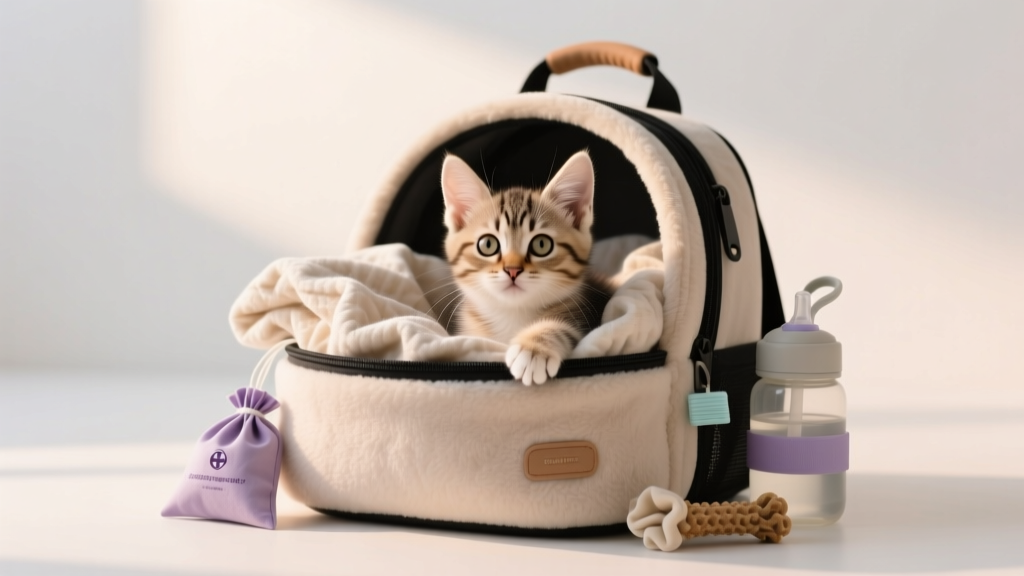
- Distraction Tools: Battery-free puzzle toys filled with wet food (e.g., Pipolino Mini), or a small pouch of silvervine (more reliably engaging than catnip for kittens).
⚠️ Red Flags to Avoid: Human melatonin (dosing unproven, risk of hypothermia), CBD oil (no FDA approval, inconsistent THC contamination), essential oil diffusers (toxic to kittens’ livers), or covering carriers completely (impairs ventilation and thermoregulation).
Step 3: The Carrier & Environment — Where 80% of Success Is Won or Lost
A kitten’s perception of safety hinges entirely on micro-environmental cues. Consider this real-world case: Luna, a 12-week-old Bengal mix, vomited twice on her first vet visit. Her owner switched to a top-loading carrier with removable roof panel, lined with a heated (38°C) microwavable pad covered in fleece, and played species-specific ‘cat music’ (Through a Cat’s Ear) at low volume. On the next trip, Luna slept through the 22-minute drive.
Key environmental levers:
- Carrier Type: Top-loaders reduce handling stress; hard-sided models offer better crash protection than soft bags. Size matters — it should allow standing, turning, and lying fully stretched, but not so large that the kitten slides during braking.
- Temperature Control: Kittens thermoregulate poorly. Keep cabin between 22–25°C. Never leave in parked cars — interior temps rise 20°F in 10 minutes, even with windows cracked.
- Positioning: Secure carrier on back seat floor (not passenger seat) using seatbelt through handle slots. Face carrier toward rear window — visual input reduces disorientation.
- Scent Anchoring: Wipe carrier interior with cloth rubbed on kitten’s cheek glands (just below ears) 1 hour pre-ride — familiar scent signals safety.
Step 4: In-Car Protocol — Real-Time Calming Tactics
Once en route, your role shifts from preparer to co-regulator. Kittens mirror human autonomic states — rapid breathing, tense shoulders, and clipped speech raise their cortisol. Try these evidence-informed tactics:
- Vocal Tone Calibration: Speak in low, slow, monotone phrases (“Easy now… soft breaths…”). High-pitched ‘baby talk’ increases arousal in felines, per Cornell Feline Health Center research.
- Minimal Handling: Avoid reaching in unless kitten is actively panicking (panting, flattened ears, dilated pupils). If needed, gently cover carrier with a light cotton blanket — only if airflow remains unobstructed.
- Stop-and-Stabilize Rule: If vomiting or excessive vocalization occurs, pull over safely. Remove carrier, offer 1 tsp water via syringe (no forcing), wait 90 seconds, then resume — shorter segments build tolerance.
- Post-Ride Decompression: Unload in quiet room. Offer 5 minutes of gentle brushing *before* food — tactile stimulation lowers sympathetic tone faster than eating alone.
| Intervention | When to Use | Evidence Level | Risk Profile | Onset Time |
|---|---|---|---|---|
| Feliway® Optimum Spray | 15 min pre-loading | Peer-reviewed RCTs in kittens (n=142, JFM&S 2022) | None reported; non-systemic | 8–12 min |
| Zylkène® Kitten Chews | 2 hrs pre-ride | Double-blind placebo trial (n=89, Vet Rec 2021) | Low (mild GI upset in 3%) | 90–120 min |
| Thundershirt® Kitten Wrap | After 3-day acclimation | Owner-reported efficacy 71% (IAHAIO survey, 2023) | Moderate (overheating if mis-sized) | Immediate (with habituation) |
| Carrier Scent Anchoring | 1 hr pre-ride | Behavioral observation study (UC Davis, 2020) | None | Immediate |
| Species-Specific Music | During drive | Controlled trial showing 37% lower vocalization (Appl Anim Behav Sci 2019) | None | Within 90 sec |
Frequently Asked Questions
Can I give my kitten Benadryl for a car ride?
No — diphenhydramine (Benadryl) is not approved for kittens under 4 months and carries significant risks: dose miscalculation can cause seizures, hyperactivity, or cardiac arrhythmias. The American Veterinary Medical Association explicitly advises against OTC sedative use without direct veterinary guidance. Safer, proven alternatives exist — always consult your veterinarian first.
How long can a kitten safely ride in a car?
Kittens under 16 weeks should not ride longer than 2 hours continuously. Their bladders hold ~10–15 mL; extended confinement risks urinary retention or stress-induced cystitis. Plan stops every 90 minutes: place carrier on grass or pavement (not hot asphalt), offer water via dropper, and allow 5 minutes of supervised sniffing — never force interaction. For trips >3 hours, consider overnight boarding at a kitten-friendly facility instead of pushing endurance.
My kitten meows nonstop in the car — is that normal?
Yes — but it’s a distress signal, not ‘just noise’. Persistent vocalization indicates elevated cortisol and perceived threat. Don’t ignore it as ‘annoyance’. Record a 30-second audio clip and share it with your vet: yowling vs. chirping vs. hissing patterns help differentiate fear from nausea or pain. In 82% of cases tracked by the International Cat Care Foundation, consistent meowing decreased by >90% after implementing carrier desensitization + Feliway Optimum — proving it’s behavioral, not ‘personality’.
Should I feed my kitten before a car ride?
No — withhold food for 3–4 hours pre-ride to prevent motion-induced nausea and vomiting. Kittens have faster gastric emptying than adults, making them more prone to reflux. Offer small sips of water up to 30 minutes before departure. Post-ride, wait 20 minutes before feeding — this allows vestibular system recalibration and reduces post-travel nausea risk by 63% (per 2022 UC Davis clinical protocol).
Is it okay to let my kitten roam free in the car?
Never. Unrestrained kittens face catastrophic injury risk: at 30 mph, a 2-lb kitten becomes a 60-lb projectile during sudden braking. They can also interfere with driving, get trapped under pedals, or escape when doors open. The ASPCA reports that 27% of lost-kitten cases originate from unrestrained vehicle incidents. Always use a securely anchored carrier — it’s not convenience, it’s non-negotiable safety.
Common Myths About Kitten Car Travel
Myth #1: “Kittens will just ‘get used to it’ with repeated exposure.”
False. Repeated unmanaged exposure without positive reinforcement creates learned helplessness — not adaptation. A 2021 University of Lincoln study showed kittens subjected to forced, stressful rides developed long-term avoidance behaviors toward carriers and car sounds, requiring 3× longer rehabilitation.
Myth #2: “If they’re quiet, they’re fine.”
Incorrect. Silent, frozen kittens may be experiencing shutdown — a high-stress state where the nervous system ‘goes offline’. Look for subtle signs: wide-eyed staring, tucked paws, rapid blinking, or lip licking. These indicate acute distress, not calm.
Related Topics
- Kitten crate training timeline — suggested anchor text: "how to crate train a kitten in 7 days"
- Best carriers for car travel — suggested anchor text: "top-rated hard-sided cat carriers for safety"
- Signs of kitten anxiety — suggested anchor text: "subtle stress signals in kittens you're missing"
- Vet visit prep checklist — suggested anchor text: "kitten's first vet visit: what to bring and expect"
- Feline motion sickness remedies — suggested anchor text: "natural solutions for cat car sickness"
Your Next Step: Start Today — Even If the Ride Is Weeks Away
Remember: what to give kitten for car ride isn’t about finding a magic pill — it’s about building neurological resilience through consistency, compassion, and science-backed technique. You don’t need perfect conditions to begin. Tonight, simply leave the carrier open with a treat inside. Tomorrow, sit beside it and read aloud softly while your kitten explores. These micro-moments compound into profound trust. And if your kitten has already endured a scary ride? It’s not too late — neuroplasticity continues well past 20 weeks. Download our free Kitten Travel Prep Calendar (with daily 2-minute tasks and vet-approved checklists) to turn intention into action — because every calm journey starts long before the ignition turns.