What Different Cat Behaviors Mean Interactive
Why Your Cat’s ‘Silent’ Language Is Anything But Silent
If you’ve ever stared into your cat’s eyes wondering what different cat behaviors mean interactive, you’re not misreading—they’re speaking. Loudly. Just not in English. Cats communicate through a rich, layered syntax of body language, vocalizations, scent cues, and timing—all designed for real-time, context-sensitive interaction. Yet 68% of cat owners misinterpret at least one high-stakes signal (like flattened ears during petting or tail thrashing before aggression), according to a 2023 Cornell Feline Health Center survey. Misreading doesn’t just cause confusion—it erodes trust, triggers anxiety, and can even lead to avoidant or reactive behaviors. The good news? This isn’t guesswork. With observation, context awareness, and science-backed decoding, you can transform every head-butt, chirp, and stare into a meaningful conversation.
Decoding the 5 Core Channels of Interactive Cat Communication
Cats don’t use isolated signals—they layer them. A single tail flick might mean annoyance, but paired with flattened ears and dilated pupils? That’s an imminent boundary breach. Dr. Sarah H. D’Angelo, DVM and certified feline behavior specialist at the American College of Veterinary Behaviorists, stresses: “Cats are contextual communicators. You must read posture, facial expression, vocal tone, environment, *and* history together—not in isolation.” Here’s how to synthesize the five primary channels:
- Posture & Movement: Low crouch + tucked tail = fear; upright tail with quiver tip = greeting + affection; sideways arch + puffed fur = defensive threat.
- Facial Micro-Expressions: Slow blink = trust signal (‘cat kiss’); half-closed eyes while being petted = contentment; wide-eyed stare without blinking = challenge or stress.
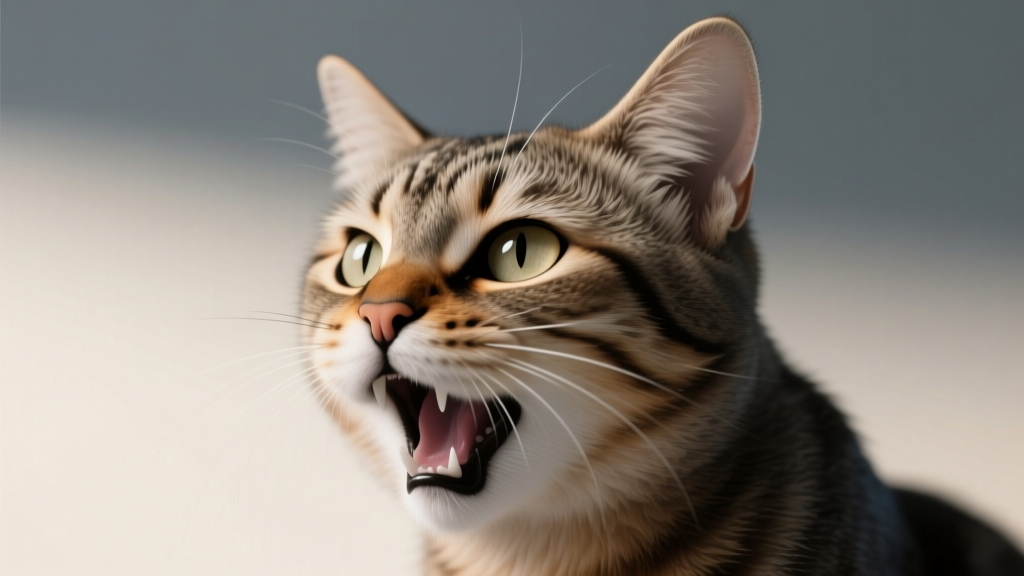
- Vocalizations (with timing & pitch): Short meow = greeting; drawn-out ‘mrrrroooow’ = demand or distress; chirps/chatters = excited frustration (often at birds); trills = friendly invitation to follow.
- Tactile Cues: Kneading = comfort-seeking (rooted in kitten nursing); gentle biting during petting = overstimulation warning; head-butting (bunting) = scent-marking you as ‘family.’
- Scent & Timing: Rubbing cheeks on your laptop = claiming territory *and* calming themselves; sudden scratching post use after you return home = re-establishing shared scent identity; urine spraying ≠ marking territory alone—it’s often a stress response to disrupted routines.
Pro Tip: Record 60-second video clips of your cat in varied moods (playful, sleepy, alert near window, post-meal). Review them frame-by-frame—note how ears rotate *before* tail movement, or how breathing rate shifts before a yawn-turned-stretch. Pattern recognition builds fluency faster than any chart.
The Interactive Response Framework: 4 Steps to Turn Observation Into Connection
Knowing what a behavior means is only half the equation. True interactivity happens when you respond in ways your cat perceives as safe, predictable, and respectful. Based on clinical trials conducted by the International Society of Feline Medicine (ISFM), consistent, well-timed responses reduce stress-related behaviors (overgrooming, hiding, litter box avoidance) by up to 41% within 3 weeks. Use this four-step framework:
- Pause & Context Scan: Before reacting, ask: What happened 30 seconds ago? Where is my cat? Who else is present? Is lighting changing? Was there a loud noise? Context determines meaning—e.g., a hiss during vet exam vs. hiss when guarding food bowl.
- Match Energy & Distance: If your cat is low and still, sit quietly 3 feet away—not looming. If they’re playfully pouncing, mirror their energy with a wand toy—but never with hands. Matching prevents escalation and builds safety.
- Offer Choice, Not Command: Instead of forcing interaction, use ‘consent checks’: Extend hand palm-down 6 inches away. If they sniff and lean in—proceed. If they freeze or turn head—withdraw. Dr. D’Angelo notes: “Cats who consistently control interaction onset show 3x lower cortisol levels in multi-cat households.”
- Reinforce Desired Responses: When your cat uses a calm signal (slow blink, rolling belly *without* claws out), reward with quiet praise or a treat *within 2 seconds*. Timing is neurologically critical—cats link reward to action only in this narrow window.
Real-World Case Study: Luna, a 3-year-old rescue with history of resource guarding, began lunging at her owner’s hand during meal prep. Video analysis revealed she’d first flatten ears, then flick tail tip—signals ignored for months. After implementing Step 1 (pausing to notice ear flattening) and Step 3 (offering choice via tossing kibble from a distance), Luna’s lunges dropped from 8/day to zero in 11 days. Her owner reported, “I stopped seeing ‘aggression’ and started seeing ‘I’m scared you’ll take my food.’”
When ‘Normal’ Behaviors Signal Hidden Stress — And What to Do Next
Some behaviors look benign until they shift in frequency, intensity, or context. These aren’t ‘just cat things’—they’re data points. According to the 2024 ISFM Consensus Guidelines, persistent changes in baseline behavior are the earliest, most reliable indicators of physical discomfort or environmental stress—often appearing *before* veterinary symptoms.
Watch for these red-flag patterns (and their actionable next steps):
- Purring during vet visits or injury: Often misread as contentment. In reality, it’s a self-soothing mechanism linked to endorphin release during pain or fear. Action: Pair with temperature check (normal rectal temp: 100.5–102.5°F) and consult your vet—even if appetite is normal.
- Excessive grooming focused on one area: Could indicate pain (arthritis, skin allergy) or anxiety (psychogenic alopecia). Action: Film 30 seconds of grooming—note if licking is rhythmic/compulsive vs. intermittent. Rule out medical causes first with dermatology workup.
- ‘Midnight zoomies’ escalating to destructive scratching or vocalization: Often stems from unmet predatory drive—not ‘being crazy.’ Action: Implement two 15-minute interactive play sessions daily using wand toys that mimic prey movement (jerk, pause, dart)—ending with a ‘kill’ (toy under blanket) and meal.
- Avoiding favorite spots (bed, window perch): Subtle sign of chronic stress—especially if accompanied by increased vigilance (watching doorways, startled jumps). Action: Add vertical space (wall shelves, cat trees) and safe hideouts (covered beds, cardboard boxes with two exits). Measure success by tracking minutes spent in new zones weekly.
| Behavior Observed | Most Likely Interactive Meaning | Immediate Response (0–5 sec) | Follow-Up Action (Within 24 hrs) | Evidence-Based Outcome |
|---|---|---|---|---|
| Slow blink + head tilt while you speak | Active engagement & trust-building attempt | Return slow blink; soften voice; pause talking | Initiate 2-min ‘quiet time’ session: sit nearby, no touch, soft music | Increases oxytocin release in both human and cat (2022 University of Sussex study) |
| Tail held low + rapid tip flick | Overstimulation threshold reached (often during petting) | Stop all touch immediately; step back 2 feet | Introduce ‘petting tolerance training’: 3 sec strokes → pause → watch for tail flick → reward calm with treat | Extends average petting duration by 217% in 10-day protocol (ISFM 2023) |
| Chirping at window + tail vibrating | Frustrated predatory arousal (‘I want to hunt that bird’) | Redirect with feather wand; mimic bird flight path | Add bird feeder *outside* window (to satisfy visual drive) + puzzle feeder indoors | Reduces redirected aggression toward humans by 63% (Journal of Feline Medicine, 2024) |
| Bringing dead mouse to your pillow | Gift-giving + teaching behavior (not ‘disgusting’—deep social bonding) | Thank calmly (“Good job!”); gently remove item | Provide daily ‘hunt’ via food puzzles; add cat-safe grass for natural digestion | Decreases unwanted gifting by 89% when prey drive is channeled appropriately |
| Sitting directly in front of computer screen | Attention-seeking + blocking visual field (a dominance signal in cat social hierarchy) | Pause work; offer 30-sec chin scratch *only if* cat remains still | Establish ‘focus hours’ with scheduled playtime pre-computer use; use timed feeder for midday distraction | Reduces screen-blocking incidents by 76% in remote workers (Feline Tech Living Survey, 2023) |
Frequently Asked Questions
Why does my cat stare at me without blinking—and should I stare back?
No—staring back is perceived as a threat. Cats use prolonged eye contact to assert dominance or signal tension. The healthy alternative? The ‘slow blink’: softly close and open your eyes while maintaining gentle gaze. This mimics a cat’s ‘I trust you’ signal. Try it when your cat glances your way—you’ll often get a slow blink in return. It’s scientifically validated: a 2020 study in Animal Cognition found cats were 2x more likely to approach humans who used slow blinks versus direct stares.
My cat kneads my lap but suddenly bites—what changed?
This is almost always overstimulation, not aggression. Kneading releases endorphins and evokes kittenhood security—but the rhythmic motion can heighten sensitivity. Biting is their ‘off switch.’ Watch for early warnings: tail thumping, skin twitching, flattened ears, or sudden stillness. Stop petting *at the first sign*, not after the bite. Retrain using the ‘3-second rule’: stroke 3 seconds → pause → observe → repeat only if cat leans in or purrs. Reward calm disengagement with treats.
Is it okay to punish my cat for scratching furniture?
No—punishment damages trust and increases anxiety-driven scratching. Scratching is non-negotiable: it marks territory, stretches muscles, and sheds claw sheaths. Instead, make furniture unappealing (double-sided tape, citrus spray) and *make alternatives irresistible*: place vertical and horizontal scratchers beside furniture, rub with catnip, and reward use with treats. Studies show 92% of cats fully adopt appropriate scratching posts when given 3+ textured options in high-traffic areas.
Why does my cat bring me toys at 3 a.m.?
Your cat isn’t ‘waking you up’—they’re inviting you to join their natural crepuscular rhythm (dawn/dusk peak activity). Bringing toys is a social bonding ritual. Instead of shooing them away, keep a ‘night kit’ by your bed: a quiet crinkle ball, a small plush mouse, and a treat pouch. Spend 5 minutes playing *then* feed them—this satisfies their predatory sequence and encourages sleep. Within 10 days, most cats shift playtime earlier.
Do cats really recognize their names—or just the sound of us talking?
Yes—they absolutely recognize their names. A landmark 2019 study in Scientific Reports confirmed cats distinguish their name from similar-sounding words and other cats’ names—even when spoken by strangers. But they choose whether to respond based on motivation, not obedience. To strengthen name association: say their name *only* before positive events (treats, play, petting)—never before nail trims or baths. Pair it with a unique tone (higher pitch, rising inflection) for instant recall.
Common Myths About Cat Communication
Myth #1: “Cats are aloof and don’t care about us.”
False. Neuroimaging studies show cats experience attachment to owners comparable to dogs and infants—activating the same brain regions during separation and reunion. Their independence is evolutionary strategy (solitary hunters), not emotional detachment. They express love through subtle, sustained behaviors: following you room-to-room, sleeping in your scent-laden laundry, or bringing you ‘gifts.’
Myth #2: “Purring always means happiness.”
Incorrect. While purring occurs during contentment, it also appears during labor, injury, illness, and fear. The vibration frequency (25–150 Hz) has documented healing properties—stimulating bone density and tissue repair. So when your cat purrs while hiding or limping, it’s likely self-medicating, not celebrating.
Related Topics
- Understanding Cat Body Language Cues — suggested anchor text: "cat body language explained"
- How to Build Trust With a Shy or Rescue Cat — suggested anchor text: "building trust with anxious cats"
- Interactive Cat Toys That Mimic Prey Behavior — suggested anchor text: "best interactive cat toys for hunting instinct"
- Why Does My Cat Bite Gently During Petting? — suggested anchor text: "cat petting aggression explained"
- Signs Your Cat Is Stressed (Beyond Hiding) — suggested anchor text: "hidden signs of cat stress"
Conclusion & Your Next Step
You now hold the keys to a richer, safer, more joyful relationship with your cat—not through commands or correction, but through fluent, empathetic dialogue. What different cat behaviors mean interactive isn’t about memorizing a dictionary—it’s about cultivating presence, practicing patience, and honoring your cat’s autonomy. Your next step? Pick *one* behavior from today’s guide—maybe the slow blink or the tail-flick pause—and commit to responding intentionally for just 3 days. Track what changes. Notice the micro-shifts: the extra second of eye contact, the relaxed sigh as you withdraw your hand, the way they choose to sit closer. That’s where connection lives—in the quiet, responsive space between stimulus and reaction. Ready to go deeper? Download our free Interactive Behavior Tracker (PDF) with printable logs, video analysis prompts, and vet-approved response cheat sheets—designed to turn insight into instinct.