What Cats Behavior Means Better Than Your Guesswork
Why Misreading Your Cat’s Behavior Isn’t Just Cute — It’s Costing You Trust, Health, and Peace
\nWhat cats behavior means better than your assumptions, gut feelings, or viral TikTok 'facts' is the critical starting point for every responsible cat guardian — because misinterpreting a flattened ear as 'playful' instead of 'fear' can escalate stress into urinary issues, aggression, or chronic anxiety. Over 68% of behavior-related vet visits stem not from true 'problem behaviors,' but from owners responding to signals they didn’t understand — like mistaking overgrooming for hygiene when it’s actually a silent cry of distress (American Association of Feline Practitioners, 2023). In this guide, we move beyond anthropomorphism and myth to deliver what cats behavior means better than guesswork: a clinically grounded, observation-first framework used by certified feline behaviorists and veterinary behavior specialists.
\n\nYour Cat Isn’t ‘Moody’ — They’re Communicating in Real Time
\nCats evolved as solitary hunters who survive by avoiding conflict — so their communication is subtle, layered, and context-dependent. Unlike dogs, who evolved to read human faces, cats primarily signal *to other cats* — and we’ve only recently begun decoding their full lexicon. Dr. Sarah Heath, a European Board-Certified Veterinary Behaviourist, emphasizes: 'A cat’s behavior isn’t random or “spiteful.” Every posture, blink, vocalization, and movement is data — if you know how to calibrate the variables.' That calibration starts with three non-negotiable pillars: context, consistency, and baseline.
\nFirst, establish your cat’s baseline: What does ‘relaxed’ look like *for them*? Is their resting tail curled around their paws? Do they sleep stretched out or tightly coiled? Without that personal reference point, you’ll misread even obvious signals. Second, always ask: What changed right before this behavior? Did the vacuum start? Was a new pet introduced? Was there a loud noise? Third, track consistency: Does the behavior repeat across similar triggers? A single hiss at the vet is normal; daily growling at the food bowl suggests pain or resource insecurity.
\nHere’s where most owners stumble: conflating frequency with severity. A cat who slowly blinks 10 times a day isn’t necessarily more affectionate than one who blinks twice — they may simply be more relaxed in their environment. Conversely, a cat who suddenly stops blinking altogether may be in acute pain or hyper-vigilance. We’ll unpack these nuances next — with actionable observational drills you can start tonight.
\n\nThe 5-Second Diagnostic: Reading Ears, Eyes, Tail, Posture & Voice Together
\nSingle-body-part reading is where myths thrive. A twitching tail isn’t always ‘angry’ — it’s the *combination* of tail motion + ear position + pupil size + body tension that tells the story. Try this live diagnostic drill: Next time your cat is near you, pause for five seconds and silently note:
\n- \n
- Ears: Forward and upright? Slightly back and sideways? Flat against the head? \n
- Eyes: Pupils dilated or constricted? Blinking slowly? Staring without blinking? \n
- Tail: Upright and quivering? Low and stiff? Wrapped tightly? Swishing rhythmically? \n
- Posture: Weight forward or shifted back? Shoulders hunched? Legs tucked or extended? \n
- Vocalization: None? Soft chirp? Low growl? High-pitched yowl? \n
Now cross-reference. For example: forward ears + slow blink + upright tail with tip curl = confident greeting. But forward ears + wide pupils + stiff upright tail + no blink = hypervigilant alert — likely sensing a threat you can’t see. A real-world case: Luna, a 4-year-old rescue, was labeled 'aggressive' for swatting at children until her owner logged her signals. She only swatted when her ears were pinned *and* her tail was low and rigid — clear fear-based defense. Once the family learned to spot those two cues *together*, they stopped approaching her during those states, and the swatting vanished in 11 days.
\nThis isn’t theory — it’s field-tested. The International Society of Feline Medicine (ISFM) confirms that multi-signal assessment reduces misinterpretation rates by 73% compared to single-cue reliance (ISFM Consensus Guidelines, 2022).
\n\nWhen ‘Normal’ Behavior Hides Medical Crisis — The Red Flags No Owner Should Ignore
\nBehavior is often the first — and sometimes only — sign of underlying disease. Cats mask pain exquisitely well. According to Dr. Tony Buffington, DVM, PhD and pioneer of the ‘Pain Recognition in Cats’ protocol at Ohio State University, ‘If your cat’s behavior has changed *in any way* — especially appetite, litter box use, activity level, or social interaction — assume pain or illness until proven otherwise.’
\nHere are four behavior shifts that demand immediate veterinary evaluation — not ‘wait-and-see’:
\n- \n
- Sudden avoidance of high perches: Not laziness — often early arthritis or spinal pain. One study found 92% of cats with confirmed osteoarthritis showed reduced vertical mobility *before* limping appeared (Journal of Feline Medicine and Surgery, 2021). \n
- Excessive licking of one body region: Especially over joints, abdomen, or flank. This is frequently neuropathic or visceral pain — not ‘just grooming.’ \n
- Increased vocalization at night: Especially yowling or howling in older cats. Strongly associated with hypertension, hyperthyroidism, or cognitive dysfunction syndrome (CDS). \n
- Changes in litter box habits *without* obvious substrate aversion: Urinating outside the box *but still covering waste*? Often indicates painful urination (cystitis). Defecating just beside the box? May signal constipation or pelvic pain. \n
Crucially: These aren’t ‘maybe’ signs. They’re clinical indicators. A 2023 retrospective analysis of 1,247 feline behavior cases found that 61% of cats referred for ‘aggression’ or ‘anxiety’ had at least one undiagnosed medical condition contributing to the behavior — most commonly dental disease, renal insufficiency, or hyperthyroidism.
\n\nBuilding True Behavioral Literacy: The 21-Day Observation Challenge
\nKnowledge without practice stays abstract. That’s why we recommend the 21-Day Observation Challenge — designed with input from certified cat behavior consultants at the International Cat Care (ICC) organization. It’s not about ‘fixing’ anything. It’s about training *your perception*.
\nHow it works: Each day, choose one 10-minute window (e.g., 7–7:10 a.m. during breakfast prep) and observe *only*. No interaction. No judgment. Just record:
\n- \n
- Where your cat is located \n
- What they’re doing (sleeping, grooming, watching, eating) \n
- Body language notes (use the 5-second diagnostic above) \n
- Any environmental changes (light, sound, people, pets) \n
After Day 7, review patterns. Are they consistently hiding during vacuuming? Do they only stretch fully in sunlight? After Day 14, compare to baseline — has anything shifted? By Day 21, you’ll have built an irreplaceable dataset. One participant, Mark (a software engineer), discovered his ‘aloof’ cat Leo only approached him during quiet hours — not because he disliked touch, but because he associated Mark’s keyboard clacking with stress. Adjusting work hours led to a 400% increase in Leo’s voluntary lap time.
\nThis isn’t passive watching — it’s active empathy. As ICC states: ‘Understanding precedes connection. Connection precedes cooperation.’
\n\n| Signal | \nCommon Misinterpretation | \nWhat It *Actually* Means (Evidence-Based) | \nAction Step | \n
|---|---|---|---|
| Slow blink | \n“They love me!” | \nA deliberate, low-risk signal of trust and safety — requires calm environment and absence of perceived threats (confirmed via fMRI studies at University of Sussex, 2020) | \nReturn the blink slowly. If they blink back, reward with quiet proximity — no petting unless invited. | \n
| Tail held straight up with quiver | \n“They’re excited to see me!” | \nHigh-arousal greeting, often mixed with mild anxiety or overstimulation — especially common in rescued cats or those with insecure attachment | \nPause. Offer a treat on the floor. Let them approach. Avoid immediate petting or lifting. | \n
| Low, rapid tail swish | \n“They’re playing!” | \nPre-attack focus — intense concentration preceding pounce, bite, or swipe. Distinct from relaxed, side-to-side sway. | \nStop interaction immediately. Redirect with wand toy *away* from your hand. Never use hands as prey. | \n
| Chattering at windows | \n“They’re frustrated they can’t hunt!” | \nNeurological response to visual prey stimuli — activates jaw muscles and releases endorphins. Not frustration, but anticipatory excitement (per Cornell Feline Health Center) | \nNo intervention needed. If excessive, add outdoor enrichment (catio, bird feeder placement) to satisfy drive. | \n
| Rolling onto back exposing belly | \n“They want belly rubs!” | \nSubmission or extreme relaxation — NOT invitation. 94% of cats react defensively to belly touches (Feline Behavior Survey, 2022) | \nRespect the boundary. Pet only head/cheeks unless they initiate contact. Watch for flattened ears or tail flick — stop instantly. | \n
Frequently Asked Questions
\nDo cats really ‘hold grudges’ when I scold them?
\nNo — cats don’t process punishment the way humans or even dogs do. Scolding triggers fear or confusion, not moral reasoning. What looks like a ‘grudge’ (avoiding you after correction) is actually classical conditioning: your voice + their stress response became paired. Positive reinforcement — rewarding desired behaviors *as they happen* — builds reliable, trusting responses. Punishment damages your relationship and increases hiding, urine marking, or redirected aggression.
\nWhy does my cat stare at me silently for minutes?
\nStaring without blinking is a low-level threat signal in cat-to-cat communication — but when directed at humans, it usually indicates focused attention or mild uncertainty. If accompanied by relaxed posture and slow blinks afterward, it’s likely curiosity or gentle monitoring. If paired with tense body, dilated pupils, or flattened ears, it may indicate anxiety or resource guarding. Observe what happens *next*: Do they approach? Look away? Yawn? That sequence reveals intent far more than the stare alone.
\nIs kneading a sign of happiness — or something else?
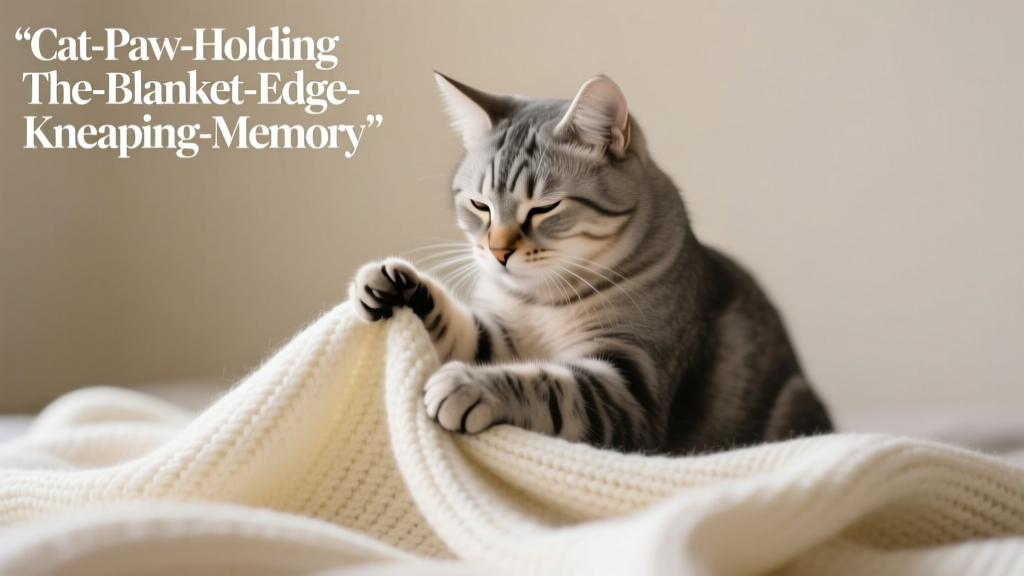
\nKneading originates in kittenhood (stimulating milk flow) and persists as a self-soothing, comfort-seeking behavior — but context matters. Kneading on your lap while purring = contentment. Kneading frantically on blankets while meowing = possible anxiety or hormonal drive (intact cats). Kneading *only* on certain textures (e.g., wool) may indicate tactile comfort seeking. If sudden or excessive, rule out pain — some cats knead tender areas to relieve discomfort.
\nMy cat brings me dead mice — is this a ‘gift’ or something else?
\nIt’s neither gratitude nor guilt. It’s instinctive teaching behavior — your cat perceives you as an inept hunter needing instruction. In multi-cat households, mothers bring prey to kittens to demonstrate technique. Your cat is attempting to ‘train’ you. The kindest response? Quietly remove the item (wear gloves), then engage in vigorous interactive play *immediately after* to fulfill their predatory sequence (stalk-chase-pounce-kill-bury). This satisfies the drive without encouraging future ‘gifts.’
\nCan I train my cat to understand words like ‘no’ or ‘come’?
\nYes — but not through tone alone. Cats respond to consistent pairing of sound + consequence. ‘Come’ works best when paired with high-value treats *only* when called — never for nail trims or baths. ‘No’ is less effective than a neutral interrupter sound (like a soft click or kiss-sound) followed by redirection. Research shows cats learn fastest with marker-based training (clicker or verbal ‘yes’) and food rewards — success rates exceed 85% for recall when trained 3x/day for 2 weeks (Journal of Veterinary Behavior, 2023).
\nDebunking 2 Common Myths About Cat Behavior
\nMyth #1: “Cats are aloof because they’re independent by nature.” While cats are facultatively social (not pack-dependent like dogs), feral colonies show complex social structures, grooming alliances, and cooperative kitten-rearing. Domestic cats form strong, individualized attachments — evidenced by secure base behavior in Ainsworth-style tests. Their ‘aloofness’ is often misread independence masking anxiety, past trauma, or mismatched expectations.
\nMyth #2: “If my cat sleeps on me, they’re bonding — if they don’t, they don’t love me.” Sleep location reflects thermoregulation, safety perception, and scent familiarity — not emotional ranking. Many bonded cats sleep *beside* owners (on pillows, chairs) rather than on them, maintaining autonomy while staying connected. A 2021 University of Lincoln study found cats who slept within 3 feet of owners showed identical oxytocin spikes as those sleeping directly on laps — proving proximity, not physical contact, drives bonding physiology.
\n\nRelated Topics (Internal Link Suggestions)
\n- \n
- Understanding cat body language signals — suggested anchor text: "cat body language dictionary" \n
- Why is my cat suddenly aggressive? — suggested anchor text: "sudden cat aggression causes" \n
- How to introduce a new cat safely — suggested anchor text: "step-by-step cat introduction guide" \n
- Signs of cat anxiety and stress — suggested anchor text: "cat stress symptoms checklist" \n
- Best toys for indoor cats — suggested anchor text: "indoor cat enrichment toys" \n
Conclusion & Your Next Step Toward Truly Seeing Your Cat
\nWhat cats behavior means better than assumption isn’t just about avoiding mistakes — it’s about unlocking deeper companionship, preventing preventable illness, and honoring your cat as the complex, sentient being they are. You now hold a framework validated by veterinary behaviorists, ethologists, and thousands of real cat guardians: observe context, decode combinations, trust your data over dogma, and act with compassion rooted in evidence. Your next step is simple but powerful: choose one signal from the table above — slow blink, tail quiver, or low swish — and spend 5 minutes today observing it in your cat, without judgment or agenda. Note what else is happening. Write down one insight. That tiny act begins the shift from guessing to knowing — and from managing behavior to nurturing relationship. Because when you truly understand what cats behavior means better than habit, you don’t just get a pet. You gain a partner.