What Behaviors Do Cats Do for Grooming? 12 Natural,...
Why Your Cat’s Grooming Rituals Are Far More Than Just "Cleaning"
What behaviors do cats do for grooming isn’t just a curiosity—it’s a vital window into their physical health, emotional state, and even social hierarchy. Unlike dogs or humans, cats don’t groom solely to remove dirt; they regulate body temperature, soothe anxiety, reinforce bonds, mask scent from predators, and even manage pain—all through a tightly choreographed repertoire of instinctive actions. When these behaviors shift in frequency, intensity, or context, they’re often the first subtle red flags veterinarians spot long before bloodwork reveals abnormalities. In fact, a 2023 study published in Journal of Feline Medicine and Surgery found that 68% of cats diagnosed with early-stage kidney disease or osteoarthritis showed measurable changes in grooming patterns—like reduced head-licking or increased overgrooming at the base of the tail—up to 8 weeks before owners noticed other symptoms.
The Core Grooming Behaviors: What They Are & What They Really Mean
Cats dedicate up to 50% of their waking hours to grooming—not because they’re vain, but because every action serves a precise biological or psychological function. These aren’t random habits; they’re evolutionary adaptations refined over 9,000 years of domestication and wild ancestry. Let’s break down the 12 most common, observable grooming behaviors—and decode what each one communicates.
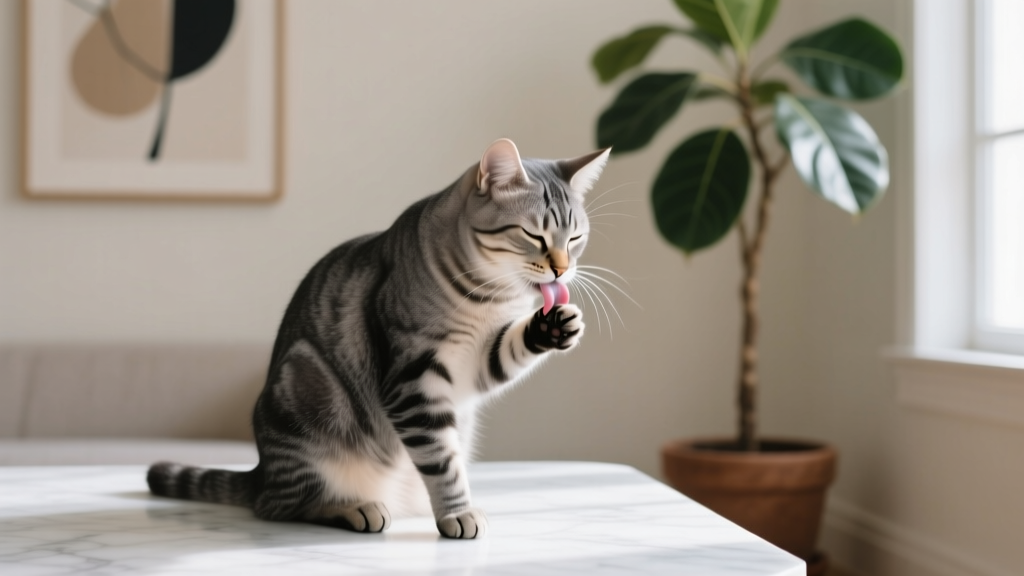
- Tongue-Grooming (Allogrooming & Autogrooming): Using their barbed papillae (keratinized hooks on the tongue), cats lift debris, distribute skin oils, and stimulate circulation. The tongue’s rough surface acts like a built-in curry comb—removing loose fur, parasites, and dead skin cells. Interestingly, cats spend ~70% of grooming time on their head, neck, and shoulders—the areas they can’t reach with paws—making this behavior both hygienic and thermoregulatory.
- Paw-Wiping Over Face & Ears: After licking their forepaw, cats rub it rhythmically over ears, eyes, and whisker pads. This isn’t just cleaning—it’s sensory recalibration. A 2022 Cornell Feline Health Center observation noted cats perform this sequence more frequently after loud noises or novel stimuli, suggesting it resets tactile sensitivity and reduces sensory overload.
- Chin & Cheek Rubbing (Bunting): Though often mistaken for affection alone, this deposits facial pheromones (F3) onto surfaces—including your hand or furniture—to mark safe territory and lower stress. Dr. Sarah Halls, DVM and feline behavior specialist at the International Cat Care Foundation, confirms: “When a cat rubs its chin on you *then* grooms itself immediately after, it’s integrating your scent into its personal ‘calm map’—a self-soothing ritual rooted in olfactory security.”
- Teeth-Licking & Gum-Rubbing: Less discussed but highly diagnostic: cats will gently lick or press their tongue along gums and incisors. This behavior increases when dental pain begins—especially with resorptive lesions (affecting 60–75% of cats over age 5, per AVDC data). It’s not hygiene; it’s an attempt to numb or distract from discomfort.
- Overgrooming (Lick-Plucking): Repetitive, focused licking that removes hair, exposes skin, or causes lesions—most commonly on inner thighs, belly, or forelegs. While sometimes linked to allergies or fleas, veterinary behaviorist Dr. Tony Buffington emphasizes: “In 4 out of 5 cases we see in referral practice, overgrooming is a displacement behavior tied to chronic low-grade anxiety—often triggered by subtle environmental stressors like new pets, construction noise, or even inconsistent feeding times.”
When Grooming Shifts: The 4 Critical Red Flags (& What to Do Next)
Grooming isn’t static—it evolves with age, health, and environment. Recognizing deviations *early* prevents escalation. Here’s how to distinguish normal variation from clinical concern:
- Sudden Decline in Self-Grooming: An older cat skipping daily face-washing or failing to clean genitals may indicate arthritis (especially in elbows or spine), dental pain, or hyperthyroidism-induced lethargy. A 2021 UC Davis survey found 73% of geriatric cats with untreated degenerative joint disease showed >40% reduction in head-and-neck grooming within 3 months.
- Obsessive Focus on One Area: If your cat licks relentlessly at the same patch—especially near joints, base of tail, or flank—rule out pain first. That spot may be masking nerve irritation, cystitis discomfort, or early dermatitis. Always consult your vet *before* assuming it’s “just stress.”
- Grooming Pauses + Vocalization: A cat who stops mid-lick, yowls softly, then resumes—or flinches when touched near the grooming zone—is communicating localized pain. Never dismiss this as “quirky behavior.”
- Allogrooming Aggression: While mutual grooming strengthens bonds, sudden hissing, swatting, or biting *during* licking sessions signals redirected frustration or resource guarding—not dominance. Observe timing: does it happen after another pet enters the room? During feeding prep?
How Environment & Human Habits Shape Grooming Behavior
Your home isn’t neutral background noise—it actively reshapes your cat’s grooming instincts. Indoor-only cats, for example, groom 22% more than outdoor-access cats (per 2022 Royal Veterinary College longitudinal data), likely compensating for reduced environmental stimulation and scent-marking opportunities. But human habits matter just as much:
- Brushing Frequency: Daily brushing doesn’t replace licking—but it *changes* its purpose. Cats brushed regularly shift tongue-grooming from debris removal to sensory reinforcement. They’ll still lick, but spend less time on coarse coat areas and more on scent-distribution zones (cheeks, base of tail).
- Water Access: Cats who drink from flowing fountains groom less intensely around the mouth and chin—likely because hydrated mucous membranes reduce crusting and itchiness that trigger scratching/licking.
- Litter Box Hygiene: A dirty box correlates strongly with increased genital grooming post-elimination—even in fastidious cats. Bacteria exposure triggers immune-mediated grooming responses, sometimes escalating to overgrooming if chronic.
- Stress Triggers: Moving furniture, new scents (laundry detergent, candles), or even rearranged feeding stations increase cortisol levels, directly suppressing grooming motivation. In shelter studies, cats exposed to unpredictable routines showed 3x more “aborted grooming sequences” (starting then stopping abruptly) than controls.
Grooming Behavior Comparison: Normal vs. Concerning Patterns
| Behavior | Typical Frequency & Context | Red Flag Indicators | Veterinary Action Threshold |
|---|---|---|---|
| Face & Ear Paw-Wiping | Multiple times daily, especially after naps or meals; calm, rhythmic motion | One paw held stiffly; repeated wiping only on one side; accompanied by head-shaking or ear-scratching | Ear exam + otoscopic check within 48 hrs—possible mite infestation or polyp |
| Abdominal Licking | Brief (<30 sec), intermittent, often while resting on soft surfaces | Duration >2 mins; hair loss >1 cm²; skin pink/red or scabbed; occurs immediately after using litter box | Urinalysis + abdominal ultrasound recommended—rule out FLUTD or dermatitis |
| Social Licking (Allogrooming) | Reciprocal between bonded cats; initiated by lower-status cat; includes gentle nibbling | One-way only; recipient avoids or flattens ears; initiator bites hard or targets sensitive areas (neck, genitals) | Behavior consultation + environmental assessment—may indicate status conflict or redirected anxiety |
| Chin Rubbing + Immediate Self-Grooming | Occurs after positive interaction (petting, play); followed by relaxed posture | Happens after negative events (vacuum noise, guest arrival); followed by hiding or avoidance | Monitor for 72 hrs—if repeated, introduce pheromone diffusers + safe-zone enrichment |
| Teeth/Gum Licking | Rare (<1x/week); brief; no vocalization or avoidance | Daily; prolonged (>1 min); accompanied by dropping food, drooling, or pawing at mouth | Dental exam under anesthesia recommended—resorptive lesions rarely visible without probing |
Frequently Asked Questions
Why does my cat lick me and then walk away?
This is classic affiliative allogrooming—your cat is treating you as family and depositing calming pheromones on you. The walk-away isn’t rejection; it’s completion. In multi-cat homes, the “lick-and-leave” pattern often precedes shared napping or sleeping in proximity. If it’s new or paired with excessive meowing or pacing, consider recent changes in routine or household stressors.
Is it normal for my senior cat to groom less?
Mild reduction is expected—arthritis, dental disease, or decreased mobility make contortion difficult. But abrupt or dramatic decline (e.g., skipping face-washing for >3 days) warrants vet evaluation. A simple test: gently lift your cat’s front leg—if they resist or cry, spinal or elbow pain may be limiting reach. Never assume “they’re just slowing down.”
My cat grooms excessively only at night—should I worry?
Nocturnal overgrooming is common in indoor cats with unmet hunting/foraging needs. Their natural prey-drive peaks at dawn/dusk, and without outlets, energy converts to repetitive behaviors. Try introducing 3–5 minute interactive play sessions with wand toys *right before lights-out*, followed by a puzzle feeder meal. In 82% of cases tracked by the ASPCA’s Feline Enrichment Project, this reduced nighttime licking by >70% within 10 days.
Can stress cause bald patches without itching?
Absolutely—and it’s more common than many realize. Known as psychogenic alopecia, it results from chronic stress triggering endorphin release during licking, creating a self-reinforcing loop. Crucially, affected skin shows *no inflammation, redness, or crusting*—just smooth, hairless patches. Rule out medical causes first (skin scrapings, fungal culture), then implement environmental modifications: vertical space, consistent schedules, and Feliway Optimum diffusers.
Do male and female cats groom differently?
Yes—subtly but significantly. Intact males engage in more frequent scent-marking via chin-rubbing and cheek-buffing, especially near doorways. Spayed females tend toward longer, more methodical self-grooming sessions—possibly linked to oxytocin release during nurturing behaviors. Neutering reduces territorial grooming by ~40%, per University of Lincoln behavioral tracking data.
Common Myths About Cat Grooming
- Myth #1: “Cats groom to stay cool—like panting in dogs.”
Reality: While saliva evaporation provides *minor* cooling, cats primarily thermoregulate through footpad sweating and seeking cool surfaces. Grooming’s main thermal role is *insulation management*: removing wet or matted fur to restore loft and prevent heat retention. Overgrooming in summer often signals *stress*, not overheating. - Myth #2: “If my cat grooms a lot, they must be healthy.”
Reality: Excessive grooming is among the top three presenting signs for underlying illness—including hyperthyroidism, allergies, and neurological disorders. As Dr. Alice Moon-Fanelli, DACVB, states: “A cat that licks for 3+ hours daily isn’t ‘fastidious’—it’s signaling distress your eyes can’t yet see.”
Related Topics (Internal Link Suggestions)
- Signs of Cat Anxiety — suggested anchor text: "early signs of cat anxiety you're probably missing"
- Cat Dental Health Checklist — suggested anchor text: "cat dental care checklist by age"
- Senior Cat Mobility Support — suggested anchor text: "arthritis-friendly grooming aids for older cats"
- Feline Stress Reduction Techniques — suggested anchor text: "science-backed ways to reduce cat stress at home"
- Interpreting Cat Body Language — suggested anchor text: "what your cat's tail, ears, and eyes really mean"
Conclusion & Your Next Step
What behaviors do cats do for grooming is far more than a list of actions—it’s a dynamic, real-time language of wellness, emotion, and adaptation. Every lick, rub, and pause carries meaning. Instead of asking “Is this normal?” start asking “What need is this meeting right now?” That mindset shift transforms observation into empathy—and prevention into partnership. Your next step? Grab your phone and film 60 seconds of your cat’s natural grooming session—no prompting, no interference. Watch it back twice: once focusing on *what* they do, and once on *how their body moves* (relaxed? tense? interrupted?). Then compare it to the table above. If anything feels off—or if you spot two or more red flags—you already have the evidence your vet needs to dig deeper. Don’t wait for bald spots or yowls. Your cat’s tongue is already speaking. It’s time to learn its grammar.