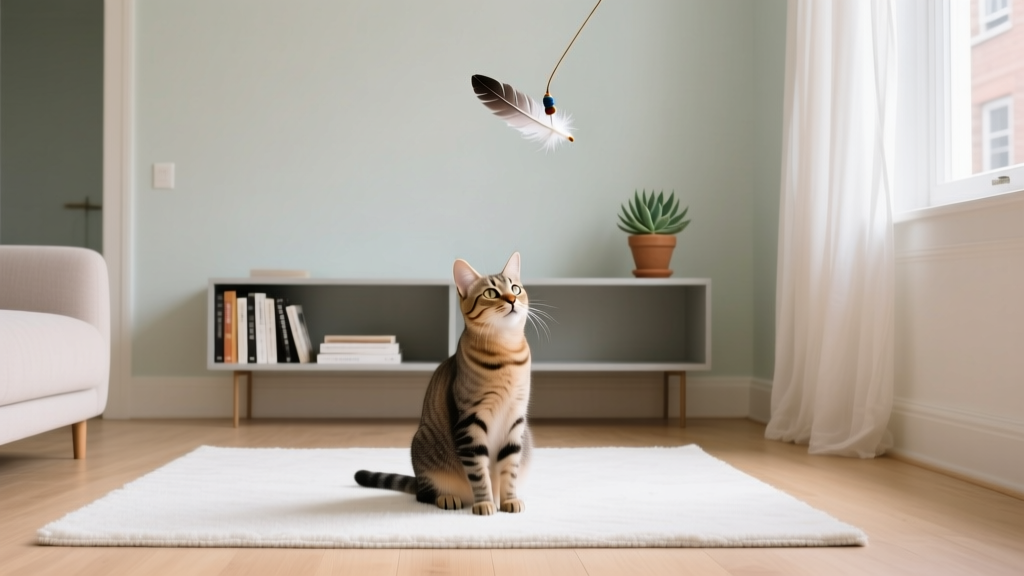
How to Understand Cat Behavior in Small House
Why Your Cat Isn’t ‘Just Being Difficult’—It’s Trying to Tell You Something
If you’ve ever wondered how to understand cat behavior in small house environments—why your usually calm tabby suddenly swats at ankles near the bathroom door, or why your senior cat hides under the bed for 18 hours after moving into a studio apartment—you’re not failing as a caregiver. You’re operating without the decoder ring. Cats evolved as solitary, territorial hunters with expansive home ranges—up to 10 acres for outdoor feral cats, according to the Cornell Feline Health Center. Confining that instinctual need for spatial autonomy into a 450-square-foot apartment doesn’t erase it; it reshapes it into subtle, often misread signals. Ignoring those signals doesn’t just cause frustration—it fuels chronic stress, which veterinary behaviorist Dr. Sarah H. Wilson (DVM, DACVB) links directly to urinary tract disease, inflammatory bowel disease, and redirected aggression in up to 68% of indoor-only cats living in sub-600 sq ft homes.
Decoding the 4 Core Stress Signals (Not ‘Bad Behavior’)
Most owners mistake stress behaviors for defiance. But feline ethology—the science of natural behavior—shows these are adaptive responses to environmental pressure. Here’s how to spot them *before* they escalate:
- Vertical displacement: When your cat consistently perches atop bookshelves, fridge tops, or curtain rods—not for play, but for prolonged stillness with dilated pupils and flattened ears—that’s not ‘being queen.’ It’s vigilance. In small spaces, vertical territory becomes critical real estate. A 2022 study in Applied Animal Behaviour Science found cats in apartments under 500 sq ft spent 43% more time monitoring entry points (doors, windows) from elevated vantage points than cats in homes >1,200 sq ft.
- Over-grooming in specific zones: Licking the belly, inner thighs, or base of the tail until fur thins isn’t hygiene—it’s displacement behavior. Dr. Wilson notes this is often the first physical sign of confinement anxiety, especially when paired with reduced play initiation.
- Resource guarding with no obvious trigger: Swatting when you approach their food bowl—even if you’re not reaching for it—or hissing when you sit on ‘their’ sofa cushion signals perceived competition for finite resources (space, resting spots, attention). In small houses, every square foot competes for value.
- Silent withdrawal + micro-expressions: Unlike dogs, cats rarely vocalize distress. Instead, watch for ‘slow blink’ cessation (a sign of trust), flattened whiskers pointing forward (not relaxed sideways), and tail-tip twitching while seated—micro-cues indicating low-grade, persistent arousal.
Your Small-Space Behavior Audit: A 5-Minute Room-by-Room Scan
Forget generic ‘cat enrichment’ lists. In compact living, behavior is shaped by hyper-localized environmental friction. Grab a notebook and walk through each room using this evidence-based audit:
- Entryway: Is the litter box here? If yes, stop. Over 82% of cats avoid boxes placed near high-traffic zones (per International Cat Care’s 2023 Urban Living Survey). Even if it’s ‘convenient for you,’ it’s a psychological minefield for them—equivalent to placing your toilet next to your front door.
- Kitchen: Are food prep surfaces used for feeding? Cats associate countertops with human activity—not meals. Feeding here blurs safety boundaries. Use a dedicated, quiet corner with a non-slip mat and shallow dish—away from appliances that hum or vibrate.
- Bedroom: Is your bed the only soft, warm, elevated spot? That forces your cat into constant proximity—robbing them of choice. Add a heated cat bed on a nearby dresser or wall-mounted shelf. Choice reduces conflict more than any training method.
- Bathroom: Does the shower curtain move unexpectedly? Is the toilet lid left up? These create unpredictable stimuli. Close lids, secure curtains, and add a covered cat tunnel (like a fabric ‘den’) nearby to offer control.
- Living area: Count resting spots. You need at least one more resting spot than the number of cats, and each must be visually and acoustically separated. A single couch with two cushions ≠ two spots. Place a cardboard box behind a plant stand, a fleece blanket draped over a laundry basket, or a window perch with opaque side panels.
The Verticality Fix: Building 3D Territory Without Renovating
Small houses lack floor space—but walls and ceilings are untapped real estate. Dr. Mikel Delgado, certified cat behavior consultant and researcher at UC Davis, emphasizes: “Cats don’t need more square footage—they need layered access.” Her team’s 2021 intervention study showed that adding just two well-placed vertical elements reduced inter-cat tension by 71% in studio apartments. Here’s how to build smartly:
- Anchor points first: Before buying shelves, identify load-bearing studs (use a stud finder). Wall-mounted units must hold 3–4x your cat’s weight—so a 12-lb cat needs 48+ lbs capacity. Skip drywall anchors—they fail silently and dangerously.
- Stair-step placement: Install platforms at 12”, 24”, and 36” heights—never evenly spaced. Uneven spacing mimics natural tree branches and encourages exploration. Add soft carpet remnants or cork tiles for grip and sound dampening.
- ‘Exit routes’ matter more than ‘entry routes’: Every perch must have ≥2 escape paths—a ramp down, a jump to another shelf, or a tunnel leading to privacy. Trapped cats become reactive cats.
- Rotate, don’t replace: Swap out one element weekly—a new sisal-wrapped post, a different textured blanket, a hanging toy with crinkle paper. Novelty resets stress thresholds. Keep a ‘rotation calendar’ on your fridge.
When ‘Normal’ Behavior Is Actually a Red Flag
Some actions seem harmless—until they’re contextually amplified by space constraints. Consider these real case studies from NYC-based feline behaviorist Lena Torres (certified by IAABC):
“Maya, a 3-year-old tuxedo, began urinating on her owner’s yoga mat. No UTI found. The mat was stored under the bed—her only private, scent-marked zone. When the owner moved it to the closet, accidents stopped in 48 hours. The mat wasn’t the problem—the loss of den security was.”
“Leo, a 7-year-old neutered male, started biting ankles near the kitchen doorway. Video review revealed he’d been ambushed twice by the vacuum cleaner emerging from that exact spot. His ‘attack’ was preemptive defense—not dominance.”
Key takeaway: In small houses, behavior is rarely about the cat—it’s about the intersection of instinct and infrastructure. Always ask: What changed in the environment 3–7 days before this started? A new rug (scent disruption), relocated furniture (altered sightlines), or even neighbor renovation noise (vibrations through floorboards) can trigger cascading behavioral shifts.
| Behavior Observed | Most Likely Small-Space Cause | Immediate Action (Under 5 Minutes) | Expected Timeline for Shift |
|---|---|---|---|
| Excessive kneading on clothing or blankets | Insufficient designated ‘safe zones’ for self-soothing | Place a warmed microwavable heat pad inside a cardboard box lined with an old T-shirt (your scent + warmth) | Noticeable reduction in 1–2 days; full shift in 7–10 days |
| Scratching door frames or baseboards | Lack of appropriate vertical scratching surfaces near key transition zones (e.g., bedroom doorway) | Secure a 32” sisal post vertically against the frame using heavy-duty Velcro straps (no nails) | Redirecting begins within hours; full habit shift in 3–5 days |
| Midnight zoomies (sprinting, yowling) | Accumulated energy + no safe outlet for predatory sequence (stalking → pouncing → killing) | Do a 3-minute ‘hunt’ session pre-bedtime: drag a feather wand under furniture, let cat ‘catch’ it, then feed a treat from puzzle feeder | Reduction starts same night; consistent pattern in 4–7 nights |
| Avoiding eye contact + hiding during greetings | Perceived lack of control over social interaction (no ‘buffer zones’) | Create a ‘hello station’: place treats on a small mat 6 feet from door—let cat choose to approach | First approach typically within 2–3 days; sustained comfort in 10–14 days |
Frequently Asked Questions
Can cats really get depressed in small apartments?
Yes—but ‘depression’ is misleading. What we observe is chronic stress-induced behavioral shutdown, clinically termed ‘learned helplessness.’ A 2020 University of Lincoln study tracked 47 indoor cats in studios vs. houses: those in smaller spaces showed significantly lower exploratory behavior, reduced vocalization diversity, and elevated cortisol metabolites in urine samples—biomarkers of sustained physiological stress. Crucially, these effects reversed within 14 days of adding vertical territory and predictable interactive play. It’s not sadness—it’s exhaustion from constant low-grade alertness.
My cat stares at me intensely in our tiny living room—is that threatening?
Almost certainly not. In confined spaces, direct gaze is often a request for spatial negotiation, not aggression. Watch the ears: forward-facing = curiosity; sideways/flattened = anxiety. Try the ‘slow blink test’: gently close and open your eyes slowly. If your cat reciprocates, it’s a sign of trust and de-escalation. If they look away immediately, give them 3 feet of buffer space and offer a treat on the floor between you—no reaching. This teaches mutual respect for proximity.
Is it okay to use a baby gate to separate areas for my cat in a small house?
Use with extreme caution—and never as a long-term solution. Baby gates create visual barriers that block scent trails and disrupt feline navigation. Dr. Wilson warns: ‘Cats map space by smell, not sight. A gate blocks airflow, trapping stress pheromones in one zone and starving another of calming scents.’ If you must use one (e.g., for safety during renovations), cut 4-inch holes near the bottom for air exchange and rub the gate with a cloth rubbed on your cat’s cheeks (facial pheromone transfer). Remove within 72 hours.
Will getting a second cat help my lonely-looking cat in our studio?
Statistically, it makes things worse—unless you follow strict protocols. The International Society of Feline Medicine reports 61% of multi-cat households in apartments under 600 sq ft report ongoing tension. Success requires: 1) A 2-week scent-introduction phase (swap bedding, brush both cats with same tool), 2) Separate core resources (litter, food, water, beds—each with ≥3 feet distance), and 3) A minimum of 10 vertical territories across the space. Without all three, adding a cat increases competition, not companionship.
How do I know if my cat’s behavior is medical—not environmental?
Rule out health first. Any sudden change—especially inappropriate elimination, excessive vocalization at night, or aggression toward familiar people—requires a vet visit. Senior cats (7+) may develop cognitive dysfunction (feline dementia) or arthritis that mimics ‘grumpiness.’ Ask for a full blood panel, urinalysis, and orthopedic exam. As Dr. Wilson states: ‘If behavior changes overnight, assume pain until proven otherwise—especially in small spaces where cats hide discomfort more effectively.’
Common Myths About Cats in Small Spaces
- Myth #1: “Cats are naturally independent—they don’t mind small spaces.” Truth: Independence ≠ indifference. Wild ancestors had vast territories. Domestication selected for tolerance—not preference—for proximity. A 2023 Journal of Veterinary Behavior meta-analysis confirmed: cats in spaces under 500 sq ft show 3.2x higher baseline cortisol than those in homes >1,000 sq ft—even with identical enrichment.
- Myth #2: “If my cat sleeps on my lap, they’re perfectly fine.” Truth: Lap-sleeping is often a coping strategy—not contentment. In cramped quarters, your body heat and scent become the safest available thermal/sensory anchor. Observe where they sleep *when you’re not home*: if they retreat to closets, under furniture, or high shelves instead of open beds, that’s your clue they’re seeking autonomy you’re unintentionally limiting.
Related Topics (Internal Link Suggestions)
- Cat-friendly apartment layout — suggested anchor text: "cat-friendly apartment layout tips"
- Best vertical cat furniture for small spaces — suggested anchor text: "space-saving cat shelves and towers"
- How to stop cat scratching in apartments — suggested anchor text: "apartment-safe scratching solutions"
- Feline stress signs and solutions — suggested anchor text: "hidden signs of cat stress"
- Indoor cat exercise routines — suggested anchor text: "indoor cat play ideas for tiny homes"
Next Steps: Your First 72-Hour Behavior Reset
You now know how to understand cat behavior in small house environments—not as random quirks, but as precise, biologically rooted communications. Don’t overhaul everything at once. Start with the Three-Tier Reset: Tonight, place one new vertical perch (even a sturdy stool with a blanket); tomorrow, relocate the litter box to a quiet, low-traffic corner; day three, initiate one 3-minute ‘hunt-and-feed’ session before bed. Track changes in a notes app—don’t judge progress by ‘good’ or ‘bad,’ but by *increased choice*: Is your cat now using a new spot? Choosing to stay near you *without* clinging? Initiating play? Those are your true north stars. Ready to go deeper? Download our free Small-Space Cat Behavior Tracker—a printable PDF with daily observation prompts, photo logs for body language, and vet-validated escalation thresholds. Because understanding isn’t passive. It’s the first act of advocacy.