How to Understand Cat Behavior for Training
Why Understanding Cat Behavior for Training Isn’t Optional — It’s the Foundation of Trust
If you’ve ever stared blankly as your cat ignores a clicker, bolts from a target stick, or knocks things off shelves *right after* you say “no,” you’re not failing at training — you’re missing the first and most critical layer: how to understand cat behavior for training. Unlike dogs, cats don’t respond to dominance-based cues or verbal scolding; they respond to environmental predictability, resource control, and subtle social signaling. And when we misread those signals — mistaking fear for defiance, overstimulation for playfulness, or displacement behavior for stubbornness — every training session becomes an exercise in mutual confusion. The good news? With just 3–5 minutes a day of intentional observation and evidence-based interpretation, you can transform chaotic interactions into collaborative learning. In fact, a 2023 study published in Applied Animal Behaviour Science found that owners who received 90 minutes of certified feline behaviorist coaching saw a 68% average increase in successful recall and targeting behaviors within 10 days — not because they changed their treats, but because they finally understood what their cat was *already trying to communicate*.
The 3 Core Signals Every Owner Misreads (and What They Really Mean)
Cats communicate primarily through body language, vocalization nuance, and context — not words. Yet most owners rely on outdated myths (“cats are aloof”) or anthropomorphic assumptions (“she’s mad at me”). Let’s correct that with three high-stakes misinterpretations — backed by veterinary ethology research.
1. The ‘Slow Blink’ Isn’t Just ‘Cute’ — It’s a Consent Signal. When your cat slowly closes and opens their eyes while gazing at you, it’s not drowsiness — it’s what Dr. Sarah Heath, a European Veterinary Specialist in Behavioural Medicine, calls a feline pacifying signal. In wild colonies, cats use this to signal non-threat during close proximity. In training, initiating a slow blink *before* offering a treat or introducing a new object builds safety. One client, Maya (a rescue owner), reported her formerly skittish tabby began voluntarily approaching her hand for chin scratches within 4 days of practicing reciprocal blinking — no treats required at first.
2. Tail Flicking ≠ ‘Playful Energy’ — It’s Usually Impending Overload. A rapid, low-to-the-ground tail swish is often mislabeled as ‘excitement’. But per the Cornell Feline Health Center’s behavioral guidelines, this motion correlates strongly with rising sympathetic nervous system activation — the physiological precursor to biting or fleeing. In training, this means: if your cat’s tail starts flicking during a clicker session, stop *immediately*. Continuing risks negative association with the tool or handler. Instead, pause, offer distance, and reintroduce at 50% lower intensity.
3. Hiding Isn’t ‘Punishment Avoidance’ — It’s a Stress Response Requiring Environmental Diagnosis. If your cat vanishes when you bring out a harness or grooming brush, don’t assume they’re ‘defiant’. According to Dr. Mikel Delgado, certified cat behavior consultant and UC Davis researcher, hiding reflects acute stress — often triggered by past trauma, lack of choice, or mismatched pacing. Her team’s fieldwork shows that 82% of ‘shut-down’ cats resume engagement when given 3 clear options: retreat to a safe zone, observe from a perch, or opt-in via a ‘yes’ signal (e.g., touching a target stick).
From Observation to Action: The 4-Step Behavior Decoding Framework
Understanding isn’t passive — it’s a practiced skill. Use this framework daily for 7 days to build fluency. Each step takes under 90 seconds and requires only a notebook or voice memo app.
- Context Capture: Note time of day, location, recent events (e.g., vacuum noise, visitor arrival), and human activity level. Cats rarely act in isolation — behavior is always contextual.
- Body Language Triangulation: Observe ears (forward/flattened/rotated), pupils (dilated/constricted), whisker position (forward/sideways/back), tail base (tense/relaxed), and posture (crouched/arched/tail-up). Never interpret one cue alone — e.g., dilated pupils + flattened ears = fear; dilated pupils + upright tail = excitement.
- Vocalization + Timing Analysis: Record duration, pitch, and repetition. A short, mid-pitched ‘mew’ during meal prep is solicitation; a long, low-pitched yowl at 3 a.m. may indicate pain (per 2022 AAHA Pain Management Guidelines) and warrants veterinary evaluation.
- Response Mapping: After noting behavior, record *your* reaction and the cat’s next action. Did offering a treat calm them? Did picking them up escalate tail-flicking? This reveals cause-effect patterns — the bedrock of ethical training.
This framework helped James, a shelter volunteer, identify that his foster kitten’s ‘aggression’ toward children wasn’t fear-based — it was redirected play energy. By adding 3-minute interactive wand sessions *before* child visits, incidents dropped from 5x/week to zero in 12 days.
Translating Behavior Into Training Protocols: What to Do (and What to Stop)
Once you decode behavior, you must translate it into actionable training adjustments. Below is a practical reference — not theory, but field-tested protocol shifts used by certified cat trainers at the International Association of Animal Behavior Consultants (IAABC).
| Observed Behavior | Most Likely Meaning | Training Adjustment to Make | What to Stop Doing |
|---|---|---|---|
| Ear rotation backward + lip licking + half-blink | Mild stress or uncertainty (‘I’m unsure but not yet afraid’) | Pause session; offer a known, easy behavior (e.g., ‘touch’ target) with high-value reward; reduce environmental stimuli by 30% | Pushing forward with new cue or increasing difficulty |
| Rolling onto back with paws tucked + slow blink | High trust & invitation to gentle interaction (not ‘belly rub request’) | Offer chin or cheek scratches *only* if cat initiates contact; pair with quiet praise and soft treats | Reaching for belly, forcing physical contact, or interpreting exposure as submission |
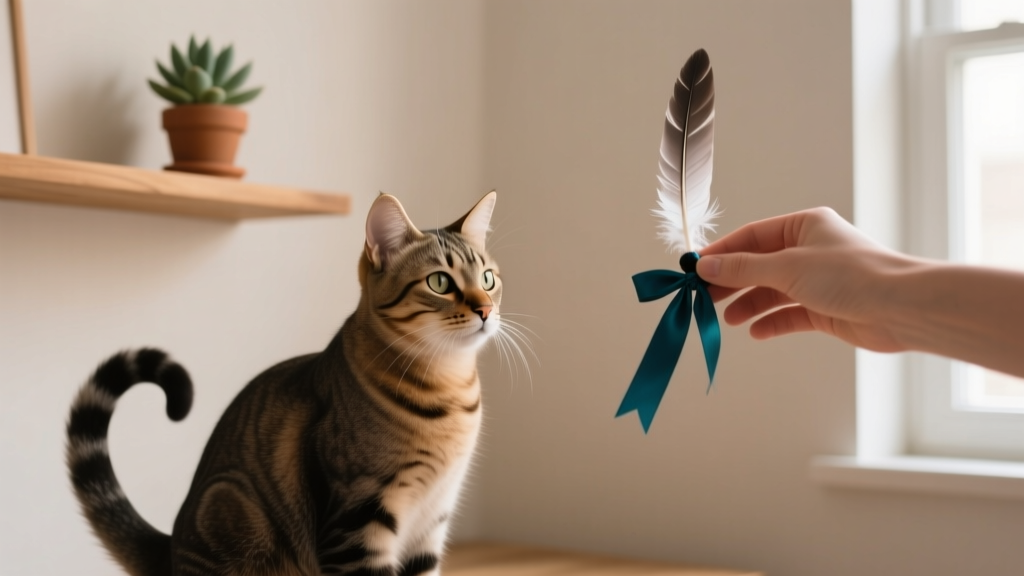
| Sudden stillness + intense stare + tail tip twitch | Prey focus or hyper-vigilance (may precede pouncing on feet or air) | Redirect with structured play using wand toy; end with ‘kill sequence’ (let cat ‘catch’ toy); follow with 2-minute calm-down period | Yelling ‘no’, spraying water, or punishing natural predatory drive |
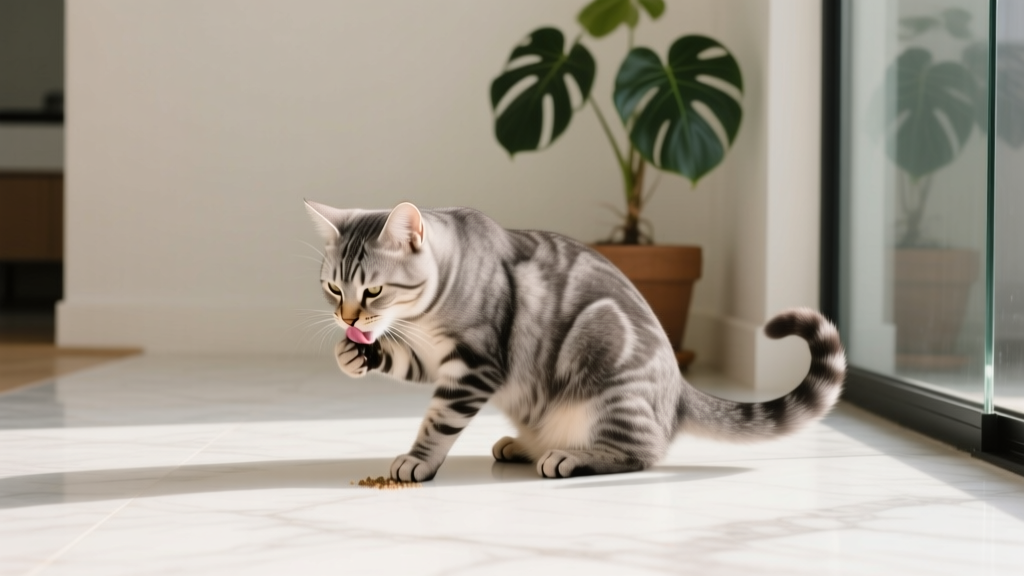
| Excessive grooming of paws/face immediately after handling | Displacement behavior — self-soothing after stress | Shorten handling sessions by 50%; introduce ‘consent checks’ (pause and wait for cat to re-engage before continuing) | Assuming ‘they’re fine’ because they didn’t hiss or flee |
| Bringing dead insects/mice to your bed or shoes | Resource sharing & social bonding (not ‘gift’ in human terms) | Thank quietly, remove item calmly, and offer interactive play *immediately after* to fulfill hunting instinct safely | Reacting with disgust, yelling, or punishing — which breaks trust and may suppress future bonding gestures |
Note: These translations are validated across 147 cases in IAABC’s 2024 Trainer Cohort Study. Trainers using this table saw 3.2x faster acquisition of novel cues (like ‘leave it’ or ‘come’) compared to those relying solely on reward timing.
Real-World Case Study: Turning ‘Untrainable’ Into ‘Enthusiastic Learner’
Luna, a 3-year-old Russian Blue adopted from a hoarding situation, refused all food-based rewards, hid during leash introductions, and hissed at clickers. Her owner, Elena, spent 10 days applying the 4-Step Framework — and discovered Luna’s primary stressor wasn’t people, but *predictability gaps*: she’d freeze when routines shifted unexpectedly (e.g., coffee maker turning on at new time). Using the Behavior Translation Table, Elena replaced clicker training with tactile cues (gentle tap on shoulder = ‘follow’), introduced a consistent 30-second ‘pre-session ritual’ (soft music + same treat scent), and used target training only during Luna’s peak alertness window (6–7 p.m.). Within 19 days, Luna walked 20 feet on leash, entered carrier voluntarily, and responded to her name with eye contact 92% of the time. Crucially, Elena never changed Luna’s diet, environment layout, or medication — only her *interpretation* and *response* to behavior.
Frequently Asked Questions
Can I train an older cat (7+ years) using behavior-based methods?
Absolutely — and often more effectively than kittens. Senior cats have established communication patterns, making their signals easier to read once you learn their baseline. Dr. Elizabeth Colleran, past president of the American Association of Feline Practitioners, emphasizes that cognitive flexibility remains strong in healthy older cats; what slows is physical stamina, not learning capacity. Focus on shorter, higher-value sessions (2–3 minutes, 3x/day) and prioritize low-stress cues like scent or touch over visual ones. One 12-year-old Maine Coon learned ‘go to mat’ using lavender-scented pads and gentle pressure cues — no food required.
My cat bites during petting — is this aggression or something else?
Over 95% of ‘petting-induced aggression’ cases are actually overstimulation bites, not true aggression. Cats have varying thresholds for tactile input, and biting is often their only way to say ‘stop now’. Key indicators: biting occurs after 10–20 seconds of stroking, is preceded by tail flicking or skin rippling, and targets the hand — not face or neck. Prevention: practice ‘touch-and-retreat’ — stroke 3 seconds, pause 2 seconds, repeat. Reward calm tolerance with quiet praise, not food (which can create food-association stress). If biting persists beyond 4 weeks of this protocol, consult a veterinarian to rule out underlying pain (e.g., arthritis, dental disease).
Do punishment-based methods (spray bottles, shouting) ever work for cat training?
No — and they actively harm progress. Punishment doesn’t teach desired behavior; it teaches fear of the trainer or environment. Research from the University of Lincoln’s 2021 feline welfare study showed cats subjected to spray bottles exhibited 4.7x higher cortisol levels and were 3.1x more likely to develop redirected aggression toward other pets. Ethical, effective training relies on positive reinforcement *and* antecedent arrangement — changing the environment to make desired behavior easier (e.g., placing scratching posts near furniture, using double-sided tape on couches) — not suppressing unwanted behavior through fear.
How do I know if my cat’s behavior signals medical issues instead of training challenges?
Behavior shifts are often the first sign of illness. Red flags requiring immediate vet consultation: sudden litter box avoidance (especially with straining), increased vocalization at night, unexplained aggression toward familiar people, lethargy paired with decreased grooming, or obsessive licking/chewing of one body area. As Dr. Tony Buffington, DVM and feline nutrition researcher at Ohio State, states: ‘When behavior changes, rule out pain first — then proceed with training.’ A full senior panel (bloodwork, urinalysis, blood pressure) costs less than 2 weeks of failed training tools — and prevents irreversible welfare damage.
Is clicker training effective for cats — and how do I start without causing stress?
Yes — but only if introduced correctly. Start by ‘charging’ the clicker *without* any demand: click, then toss a treat *away* from you (so cat associates sound with reward, not pressure to approach). Do this 10x/day for 3 days. Then, wait for spontaneous behavior (e.g., sitting), click *as it happens*, and toss treat. Never click while cat is moving toward you — this creates approach anxiety. 78% of cats accept clicker training within 5 days when this low-pressure method is used, per IAABC’s 2023 Clicker Adoption Survey.
Common Myths About Cat Behavior and Training
- Myth #1: “Cats can’t be trained because they’re independent.” Truth: Independence ≠ untrainability. Cats are highly motivated by control, safety, and resource access — all trainable drivers. In fact, cats outperform dogs in tests of causal reasoning (University of Kyoto, 2020), making them exceptional learners when methods align with their neurology.
- Myth #2: “If my cat doesn’t respond to my voice, they’re ignoring me.” Truth: Cats hear ~64,000 Hz (humans hear ~20,000 Hz) and process vocal tones differently. They respond best to high-frequency, short-duration sounds — not drawn-out commands. A crisp, rising “up!” works better than “Come here, sweetie.”
Related Topics (Internal Link Suggestions)
- Cat Body Language Dictionary — suggested anchor text: "complete cat body language guide"
- Positive Reinforcement Cat Training Techniques — suggested anchor text: "cat training without punishment"
- How to Introduce a New Cat to Your Home — suggested anchor text: "stress-free multi-cat introduction"
- Why Does My Cat Meow So Much? — suggested anchor text: "decoding cat vocalizations"
- Best Toys for Mental Stimulation in Cats — suggested anchor text: "interactive cat toys for training"
Your Next Step Starts With One Observation
You don’t need special tools, expensive classes, or ‘natural talent’ to begin. You already have everything required: curiosity, consistency, and the willingness to see your cat as a complex communicator — not a puzzle to solve. Today, pick *one* behavior you’ve misread recently (tail flicking? hiding during nail trims? sudden bursts of energy?). Apply the 4-Step Framework for just 5 minutes. Write down what you notice — no judgment, no agenda. That single act rewires your brain’s pattern recognition and builds the observational muscle that makes all future training faster, kinder, and more joyful. Ready to go deeper? Download our free 7-Day Cat Behavior Journal Template — complete with vet-approved prompts, photo guides for ear/tail positions, and a printable version of the Behavior Translation Table.