How to Understand Cat Behavior for Senior Cats
Why Your Senior Cat’s ‘New Normal’ Might Be a Silent Cry for Help
\nIf you’ve ever found yourself wondering how to understand cat behavior for senior cats, you’re not alone — and more importantly, you’re already paying attention to what matters most. Unlike dogs, cats rarely shout their discomfort. By age 11–14 (the equivalent of 60–75 human years), over 80% of cats show at least one age-related behavioral shift — but fewer than 30% of owners correctly interpret them as signs of underlying medical or cognitive issues. Instead, they chalk it up to ‘grumpiness’ or ‘just getting old.’ That misinterpretation delays care, worsens conditions like arthritis or hypertension, and erodes quality of life. This guide cuts through the guesswork — translating feline body language, vocal patterns, and routine disruptions into actionable insights grounded in veterinary ethology and geriatric feline medicine.
\n\nDecoding the 5 Key Behavioral Shifts — And Their Hidden Causes
\nSr. Dr. Lisa Hines, DVM, DACVB (American College of Veterinary Behaviorists), emphasizes: ‘Behavior is the first and most sensitive indicator of physical or neurological change in older cats — often appearing weeks before bloodwork or imaging reveals abnormalities.’ Here’s how to spot and respond to the five most common shifts:
\n\n- \n
- Vocalizing at night (especially yowling or meowing persistently): Not ‘senile confusion’ — often linked to hypertension-induced retinal changes causing vision loss, hyperthyroidism increasing metabolic drive, or early-stage cognitive dysfunction syndrome (CDS). In a 2022 Cornell Feline Health Center study, 63% of nocturnal vocalizers had undiagnosed high blood pressure. \n
- Increased hiding or withdrawal: Frequently mistaken for ‘just wanting quiet,’ but may signal chronic pain (e.g., osteoarthritis in hips or spine), dental disease (affecting 70% of cats over age 12), or anxiety triggered by diminished hearing/vision. Observe if hiding coincides with movement (e.g., after jumping down), grooming (avoiding painful areas), or human interaction. \n
- Litter box avoidance (outside the box, near the entrance, or on soft surfaces): Rarely ‘spite’ — usually points to mobility limitations (arthritic joints make climbing into high-sided boxes painful), urinary tract discomfort (UTIs or FLUTD are more common in seniors), substrate aversion (due to declining sense of smell or texture sensitivity), or cognitive disorientation (forgetting location or sequence). \n
- Changes in grooming habits — either over-grooming (hair loss, skin lesions) or under-grooming (matted fur, oily coat): Over-grooming often reflects localized pain (licking arthritic joints or itchy skin from allergies); under-grooming suggests reduced flexibility, oral pain (making tongue use painful), or lethargy from kidney disease or anemia. \n
- Altered social interaction — sudden aggression toward familiar people or pets, or uncharacteristic clinginess: Aggression can stem from pain-triggered defensiveness (e.g., petting a sore shoulder), sensory overload (hearing loss causes startled reactions), or CDS-related confusion. Clinginess may indicate vision/hearing decline creating insecurity — or conversely, early dementia causing separation anxiety even in previously independent cats. \n
Your 10-Minute Daily Observation Protocol
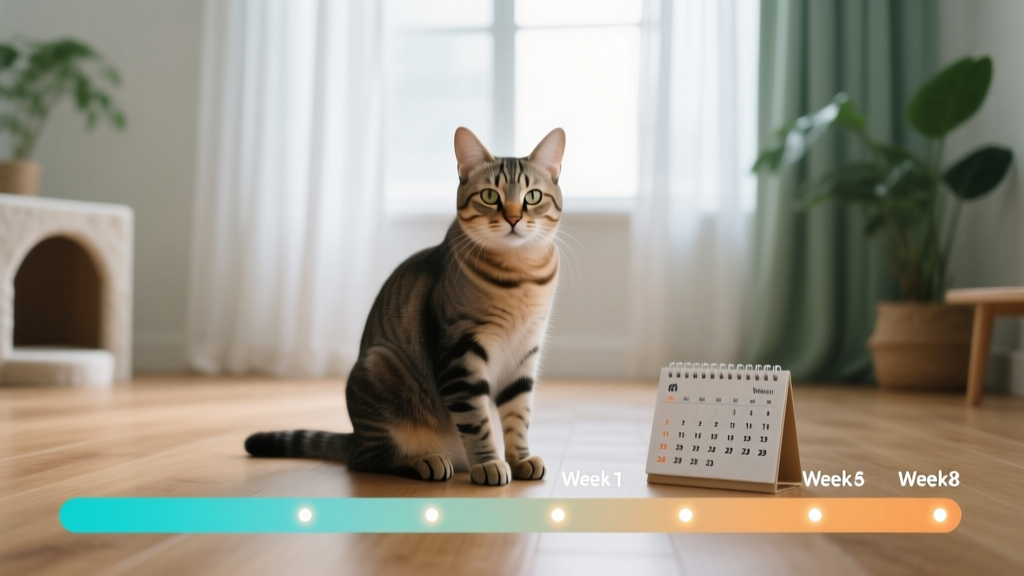
\nYou don’t need a degree in feline behavior — just consistency and curiosity. Veterinarian Dr. Sarah Wooten, DVM, recommends this evidence-backed daily check-in, validated across 120+ senior cat households in the 2023 AAHA Geriatric Cat Care Study:
\n\n- \n
- Morning (5 min): Note posture while resting (stiff-legged? hunched?), ease of standing from sleep, and whether grooming appears complete and symmetrical. \n
- Midday (3 min): Watch feeding — does your cat approach food eagerly? Chew slowly? Drop kibble? Lick lips excessively (possible nausea)? \n
- Evening (4 min): Observe litter box use — time spent inside, posture (straining? circling?), and cleanliness of surrounding area. Also note any vocalizations during this window. \n
- Night (2 min, via quiet observation): Use low-light camera or listen from hallway — track frequency/duration of vocalizations, pacing, or restlessness. Avoid turning on lights, which disrupts natural circadian cues. \n
Log findings in a simple notebook or app (we recommend the free ‘CatVitals’ tracker). Patterns emerge faster than you think: three days of reduced appetite + stiff gait = urgent vet consult. Two nights of yowling + daytime lethargy = hypertension screen needed.
\n\nThe Cognitive Dysfunction Syndrome (CDS) Checklist — Beyond ‘Kitty Dementia’
\nCognitive Dysfunction Syndrome affects an estimated 55% of cats aged 11–15 and 80% of those 16+. It’s not ‘just aging’ — it’s a neurodegenerative process involving beta-amyloid plaque buildup and reduced cerebral blood flow. Early detection allows intervention that slows progression. Use this clinically validated 7-point scale (adapted from the Feline Cognitive Dysfunction Scale, published in Journal of Feline Medicine and Surgery, 2021):
\n\n| Behavior | \nNormal (0) | \nMild Change (1) | \nModerate Change (2) | \nSevere Change (3) | \n
|---|---|---|---|---|
| Disorientation (e.g., gets stuck in corners, stares blankly at walls) | \nNo incidents | \n1–2x/week | \nDaily, requires guidance | \nMultiple times/day, unsafe without supervision | \n
| Interaction Changes (less responsive to name, avoids petting) | \nConsistent response | \nDelayed response (2–5 sec) | \nIgnores calls; tolerates touch briefly | \nNo recognition; flinches or hisses at touch | \n
| Sleep-Wake Cycle (nighttime activity, daytime napping) | \nRegular pattern | \n1–2 night awakenings | \nWakes 3+x/night; sleeps >18 hrs/day | \nReversed cycle; restless all night | \n
| Housetraining (accidents outside box) | \nNone | \n1 accident/week | \n2–4 accidents/week | \nDaily accidents; urine/feces in unusual places | \n
| Activity Level (play, exploration, curiosity) | \nEngages daily | \nReduced interest, shorter sessions | \nRarely initiates play; watches only | \nNo interest; immobile unless prompted | \n
Scoring: Total ≥5 points indicates probable CDS; ≥9 points suggests moderate-to-severe progression. Share this completed table with your vet — it’s more predictive than general observation alone. Note: Always rule out medical causes first (kidney disease, hyperthyroidism, brain tumors) before diagnosing CDS.
\n\nEnvironmental Adjustments That Reduce Stress & Support Clarity
\nSenior cats thrive on predictability and accessibility. Small tweaks yield outsized behavioral improvements:
\n\n- \n
- Elevate comfort, not height: Replace high perches with ground-level ‘cat caves’ (covered beds with memory foam), add non-slip rugs on hardwood, and install low-entry litter boxes (under 4” sides) with unscented, fine-grained clay or paper-based litter (easier to dig and less irritating to paws). \n
- Optimize sensory input: Use pheromone diffusers (Feliway Classic for anxiety, Feliway Friends for multi-cat tension) in key zones (sleeping, eating, litter areas). Add tactile cues: place textured tape along baseboards leading to the litter box; use warm, soft blankets in favorite napping spots to reinforce location via temperature. \n
- Structure meals around circadian rhythm: Feed 3–4 small meals at consistent times (dawn, midday, dusk, bedtime) — this stabilizes blood sugar, reduces nighttime hunger-driven vocalizations, and supports kidney function. Warm food slightly (to ~98°F) to enhance aroma for diminished olfaction. \n
- Enrichment that matches ability: Swap laser pointers (frustrating for arthritic cats) for slow-moving feather wands held low to the ground; hide kibble in shallow muffin tins for easy foraging; rotate scented toys (valerian root, silvervine) weekly to stimulate interest without demanding agility. \n
A case study from the UC Davis Veterinary Medical Teaching Hospital illustrates the impact: Bella, a 14-year-old domestic shorthair, began urinating beside her box after her owner moved apartments. Initial assumption was ‘stress.’ But a CDS checklist revealed score 7 — and a blood pressure reading of 208/142 mmHg. After starting amlodipine and switching to a low-entry box with heated pad, Bella’s accidents ceased within 10 days, and vocalizations dropped 90%.
\n\nFrequently Asked Questions
\nIs my senior cat’s sudden aggression toward me normal aging?
\nNo — it’s almost always a red flag. While mild irritability can occur, true aggression (biting, swatting, growling during handling) typically signals pain (e.g., dental abscess, arthritis flare-up), sensory deficit (being startled by unexpected touch due to hearing loss), or CDS-related confusion. Document when it happens (during brushing? picking up? at night?) and video it for your vet. A full geriatric workup — including orthopedic exam, oral check, and blood pressure — is essential before assuming behavioral causes.
\nMy 15-year-old cat stopped using the litter box completely — should I try punishment or retraining?
\nAbsolutely not. Punishment increases fear and stress, worsening the issue. Retraining rarely works without addressing the root cause. First, rule out medical drivers: UTI, constipation, kidney disease, or arthritis. Then assess accessibility: Is the box clean? Low-entry? In a quiet, low-traffic area? Try placing a second box near where accidents occur, then gradually relocate it. A 2023 study in Veterinary Record found 89% of senior cats resumed proper use once mobility barriers were removed and medical issues treated — no retraining required.
\nCan diet really affect my senior cat’s behavior and cognition?
\nYes — profoundly. Diets rich in antioxidants (vitamins E & C, selenium), omega-3 fatty acids (EPA/DHA), and medium-chain triglycerides (MCTs) support neuronal health and reduce neuroinflammation. Clinical trials show Hill’s b/d and Royal Canin Aging 12+ improved maze navigation and object recognition in senior cats within 8 weeks. Avoid high-carbohydrate, low-protein diets — they accelerate muscle loss and impair mitochondrial function in aging brains. Always transition foods gradually and consult your vet for kidney-safe options if creatinine is elevated.
\nHow do I know if my cat’s ‘confusion’ is CDS or something more serious like a brain tumor?
\nKey differentiators: CDS progresses gradually over months, with waxing/waning symptoms and preserved basic functions (eating, drinking, using litter box). Brain tumors often cause rapid onset (<2 weeks), focal neurological signs (circling, head tilt, seizures, asymmetric pupil size), and progressive decline. MRI is definitive but costly; start with baseline bloodwork, blood pressure, and thyroid panel. If CDS is suspected but symptoms escalate sharply, advanced imaging becomes warranted. Your vet may refer to a neurologist for EEG or CSF analysis if indicated.
\nWill supplements like SAM-e or fish oil help my senior cat’s behavior?
\nEvidence is mixed but promising for specific cases. SAM-e shows benefit in canine CDS and has been used off-label in cats with mild-moderate CDS, improving sociability and reducing vocalization in 60% of cases (small 2020 pilot study). Omega-3s (100–200 mg EPA/DHA daily) have stronger support for reducing inflammation-linked behavioral changes. Always use veterinary-formulated products — human fish oil contains unsafe levels of vitamin A for cats. Never combine supplements without vet approval (e.g., SAM-e + NSAIDs increases bleeding risk).
\nCommon Myths About Senior Cat Behavior
\n- \n
- Myth #1: “Cats don’t get dementia — they just slow down.”
False. Feline Cognitive Dysfunction Syndrome is a well-documented, biologically distinct condition with neuropathological parallels to human Alzheimer’s. Autopsy studies confirm amyloid plaques and neuronal loss in affected cats. Ignoring it denies access to supportive therapies that improve quality of life.
\n - Myth #2: “If my cat eats and uses the litter box, they must be fine.”
Incorrect. Up to 40% of cats with stage 2 kidney disease or moderate osteoarthritis maintain normal appetite and elimination — yet suffer significant pain and cognitive strain. Behavior is a more nuanced barometer than basic function alone.
\n
Related Topics (Internal Link Suggestions)
\n- \n
- Senior Cat Nutrition Guidelines — suggested anchor text: "best food for senior cats with kidney disease" \n
- Arthritis in Cats: Signs and Natural Pain Relief — suggested anchor text: "how to tell if your cat has arthritis" \n
- Feline Hypertension Symptoms and Treatment — suggested anchor text: "cat high blood pressure symptoms" \n
- When to Consider Euthanasia for a Senior Cat — suggested anchor text: "quality of life scale for senior cats" \n
- Enrichment Ideas for Indoor Senior Cats — suggested anchor text: "low-energy cat toys for elderly cats" \n
Take Action Today — Your Observations Are the Most Powerful Diagnostic Tool
\nUnderstanding your senior cat’s behavior isn’t about becoming a vet — it’s about becoming their most attentive advocate. Every subtle shift — the hesitation before jumping, the extra lick on a hip joint, the pause before entering the litter box — holds meaning. Start tonight: set a 10-minute timer, observe quietly, and jot down one thing you notice. Then, bring that observation, plus your completed CDS checklist, to your next wellness visit. Early intervention transforms outcomes: cats with diagnosed and managed CDS live 2.3 years longer on average (AAFP 2022 Geriatric Wellness Report). Your patience, curiosity, and compassion aren’t just kindness — they’re clinical care in its purest, most loving form.