How to Understand Cat Behavior Classic
Why Decoding Classic Cat Behavior Isn’t Magic—It’s Mastery You Can Learn
If you’ve ever stared at your cat mid-stare, wondered why they knead your sweater but ignore your calls, or panicked when they suddenly bolted from nothing—how to understand cat behavior classic isn’t just a search term. It’s the quiet, urgent question behind thousands of frustrated, loving cat guardians who feel perpetually out of sync with their companions. The truth? Cats aren’t cryptic by design—they’re communicating constantly, using a rich, consistent, and evolutionarily refined language. What feels like mystery is actually misinterpretation. And the good news? The foundational grammar of this language—the ‘classic’ repertoire of postures, vocalizations, and routines—has been mapped, validated, and taught successfully for over four decades. In this guide, we go beyond viral TikTok tips and outdated folklore to deliver what veterinary behaviorists, certified feline training professionals, and shelter enrichment specialists rely on daily: a field-tested, compassionate, and deeply practical system for reading your cat’s world.
The 4 Pillars of Classic Cat Communication (and Why Most Owners Miss #2)
Understanding cat behavior isn’t about memorizing isolated signals—it’s about recognizing how four interlocking systems work together. Dr. Sarah Heath, a European Board-Certified Veterinary Behaviorist and co-author of Feline Behavioral Health and Welfare, emphasizes that ‘isolated tail positions mean little without context—especially arousal level and resource access.’ Let’s break down each pillar:
- Body Posture & Orientation: Not just ‘tail up’ vs. ‘tail down,’ but the angle of the tail base, shoulder tension, ear rotation (forward, sideways, flattened), and whether weight is shifted forward (engagement) or back (withdrawal). A tail held high with a slight quiver? Confidence + greeting. A tail held low and rigid while crouching? High alert—possibly defensive.
- Vocalization Patterns (Not Just Meows): Adult cats rarely meow at other cats—they evolved meowing almost exclusively for humans. But pitch, duration, and repetition tell vastly different stories. A short, mid-pitch ‘mew’ at breakfast time? Request. A drawn-out, descending ‘mrrroooow’ while pacing near a closed door? Frustration. A staccato, high-frequency chirp while watching birds? Excited predatory focus—not distress.
- Temporal Rhythms & Routine Cues: Cats are masters of circadian predictability. Their ‘classic’ behavior includes predictable napping cycles (12–16 hours/day, broken into 20–30 min naps), crepuscular peaks (dawn/dusk activity surges), and ritualized greetings (e.g., rubbing head against your leg then sitting beside you). Disruptions here—like sudden schedule changes or new household members—are often the first red flags of stress, long before overt aggression or litter box issues appear.
- Resource-Based Signaling: Everything your cat does relates to safety, food, water, elimination, scratching, and social connection. When they scratch your sofa *next to* the couch where you sit, it’s not ‘spite’—it’s scent-marking proximity to you, their primary safe anchor. When they bring you a toy mouse and drop it at your feet, it’s not ‘gift-giving’—it’s an invitation to engage in cooperative play, mimicking maternal teaching behaviors.
Your Cat’s ‘Classic’ Body Language Decoder Ring (With Real-Life Examples)
Let’s move from theory to action. Below are five of the most frequently misread ‘classic’ behaviors—with real shelter case studies showing how reinterpreting them changed outcomes.
Case Study: Luna, 3-year-old domestic shorthair, surrendered for ‘aggression.’ Her intake notes said she ‘hissed and swatted’ during handling. Staff observed her consistently flattening ears, dilating pupils, and tucking her tail when approached head-on. When handlers switched to side-approach entry (avoiding direct eye contact), offered chin scratches *only after* she initiated contact, and used a towel to gently scoop instead of reaching over her, her ‘aggression’ vanished within 48 hours. The behavior wasn’t hostility—it was acute fear signaling. Classic cat behavior teaches us: direct frontal approach = threat posture in feline social hierarchy.
Case Study: Oliver, senior cat, began urinating outside the box. No medical cause found. His owner assumed ‘revenge.’ A home behavior assessment revealed his litter box was placed next to the noisy washing machine—activated multiple times daily. His classic stress response? Avoidance + marking nearby (on laundry baskets). Relocating the box to a quiet, low-traffic corner resolved it in 3 days. Key insight: Cats don’t ‘punish’—they communicate environmental discomfort through displaced elimination.
Use this quick-reference table to cross-check common signals:
| Behavior | Most Likely Meaning (Classic Context) | What to Do Immediately | Red Flag If Paired With… |
|---|---|---|---|
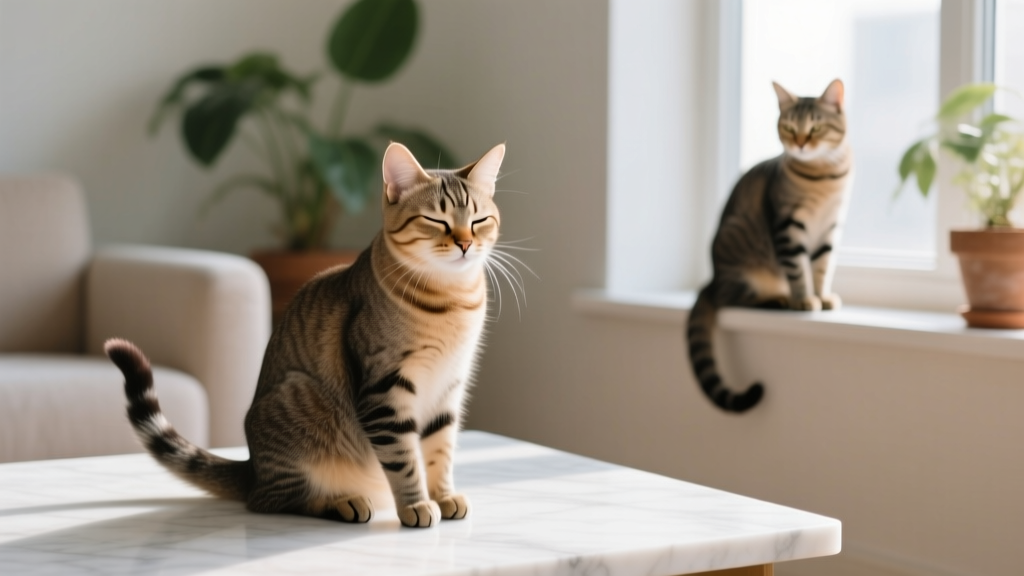
| Slow Blinking (‘Cat Kiss’) | Trust signal; voluntary relaxation of eyelids in safe presence | Return the blink slowly—no need to stare back. Reinforces mutual safety. | Pupil dilation + flattened ears = stress override (blinking may be reflexive, not social) |
| Kneading with Paws | Neonatal comfort behavior; indicates deep contentment & security | Allow it—unless claws are sharp, gently place soft blanket underneath. | Excessive kneading + vocalizing + restlessness = possible pain or anxiety (e.g., abdominal discomfort) |
| Mid-Air Tail Flick | Low-level frustration or overstimulation (often pre-bite) | Stop petting immediately. Give 30 seconds of space. Resume only if cat re-engages. | Tail held low + growling + skin twitching = imminent bite—leave room entirely. |
| Bringing You Objects | Play invitation or ‘teaching’ instinct (mimicking mother cat bringing prey to kittens) | Engage in interactive play with wand toys—don’t scold or ignore. | Object dropped with yowl + pacing = frustration from unmet hunting drive. |
| Chattering at Windows | Motor pattern activation during high-arousal prey observation | Redirect with indoor hunting games (food puzzles, feather wands). | Chattering + excessive licking + hair loss = redirected frustration becoming compulsive. |
The ‘Classic’ Daily Rhythm Audit: A 7-Day Observation Protocol
You don’t need a degree to spot behavioral shifts—you need consistency and intentionality. The ‘Classic Behavior Audit’ is a low-effort, high-yield method developed by the International Society of Feline Medicine (ISFM) for early stress detection. Commit to 7 days. No apps required—just a notebook or voice memo app.
- Day 1–2: Map Baseline Activity Peaks — Note exact times your cat eats, grooms, naps, uses litter box, and engages in play. Look for patterns: Does grooming spike before sleep? Is there a 5:30 a.m. ‘zoomie’ window?
- Day 3–4: Track Human Interaction Triggers — Log every interaction: Who initiates? How long? What behavior follows? (e.g., “Petted 2 min → tail flick → walked away” vs. “Called name → slow blink → approached”).
- Day 5–6: Observe Resource Access — Note location/usage of food bowls, water stations, litter boxes, scratching posts, and resting spots. Are any resources near noise, traffic, or other pets? Is there ≥1 per cat +1 extra?
- Day 7: Synthesize & Spot Deviations — Compare notes. Did grooming decrease by >20%? Did ‘quiet zones’ shrink? Did play initiation drop? These subtle shifts often precede health issues—and are 100% detectable via classic behavioral tracking.
This protocol isn’t diagnostic—it’s preventive intelligence. As Dr. Tony Buffington, DVM, PhD and pioneer of the ‘Indoor Cat Initiative’ states: ‘Cats hide illness in behavior long before bloodwork shows abnormalities. Their classic routines are the earliest, most reliable vital signs we have.’
When ‘Classic’ Behavior Turns Concerning: Red Lines vs. Yellow Flags
Some behaviors are normal across all cats. Others warrant professional input. Here’s how to triage:
- Yellow Flag (Monitor closely, adjust environment): Increased nocturnal activity, brief hiding after visitors, mild overgrooming on one limb, occasional ‘play aggression’ toward ankles. Often resolved with enrichment, routine stability, or minor setup tweaks.
- Red Line (Consult veterinarian + certified behaviorist within 72 hours): Sudden cessation of purring, refusal to use litter box for >48 hrs (with clean box), persistent vocalization at night (>3x/night for >3 nights), unprovoked hissing/growling at familiar people, or dramatic appetite change (>25% drop in 48 hrs). These are never ‘just personality’—they signal pain, neurological change, or profound anxiety.
Crucially: Never punish ‘undesirable’ classic behaviors like scratching or climbing. As certified cat behavior consultant Mikel Delgado, PhD, explains: ‘Scratching is non-negotiable for tendon health, claw maintenance, and territorial marking. Punishment doesn’t stop scratching—it stops the cat from feeling safe enough to do it openly, driving it underground where it becomes harder to redirect.’
Frequently Asked Questions
Do cats really ‘not care’ about their owners—or is that a myth?
No—they absolutely form secure attachments, but express them differently than dogs. A landmark 2019 study published in Current Biology used the ‘Secure Base Test’ (adapted from human infant research) and found 64% of cats exhibit secure attachment to their caregivers—seeking proximity, using them as a ‘safe base’ to explore, and showing visible distress upon separation. Their love language is subtlety: following you room-to-room, sleeping on your clothes, slow blinking, and gentle head-butting—not exuberant greetings.
Is it true cats can’t be trained? What about clicker training?
Completely false. Cats are highly trainable—but motivation and timing differ. Unlike dogs, they respond best to high-value, immediate rewards (tiny tuna bits, not kibble) and sessions under 90 seconds. Clicker training works exceptionally well for targeting behaviors (‘touch this stick’), recall, and even cooperative vet visits. The key? Let the cat choose to participate—never force. Certified trainer Jackson Galaxy demonstrates this daily: ‘If your cat walks away, you’ve asked too much, too soon. Back up one step and succeed.’
Why does my cat stare at me silently? Is it judging me?
That silent stare is likely a ‘soft gaze’—a relaxed, half-lidded look indicating calm attention and trust. True ‘judgmental’ staring involves wide eyes, fixed pupils, and rigid posture (often paired with tail thumping). If your cat holds soft eye contact while you read or work, they’re simply anchoring themselves to your presence. Try returning it with a slow blink—it’s the feline equivalent of saying ‘I see you, and I’m at peace.’
My cat used to cuddle, but stopped suddenly. Should I worry?
Yes—sudden behavioral regression is a major red flag. While some cats naturally become more independent with age, abrupt withdrawal (especially if paired with decreased appetite, litter box avoidance, or hiding) warrants immediate veterinary exam. Pain (arthritis, dental disease), hyperthyroidism, or cognitive decline in seniors can manifest solely as social withdrawal. Don’t assume ‘they’re just moody.’
Is it okay to let my cat ‘do whatever they want’? Doesn’t that spoil them?
‘Spoiling’ implies indulgence without boundaries—but cats thrive on predictable, species-appropriate boundaries. Letting them hunt, climb, scratch, and nap freely *is* meeting core needs. ‘Spoiling’ happens when we deny them agency (e.g., forcing cuddles) or fail to provide outlets (e.g., no scratching post = shredded furniture). As Dr. Dennis Turner, feline ethologist and author of The Domestic Cat: The Biology of Its Behaviour, affirms: ‘A well-understood cat isn’t a spoiled cat. It’s a cat whose evolutionary needs are respected—and that’s the foundation of true companionship.’
Common Myths About Classic Cat Behavior
Myth #1: ‘Cats are solitary animals who don’t need social bonds.’
Reality: While cats are facultatively social (they *can* live alone), wild colonies and domestic multi-cat households prove they form complex, cooperative social structures—especially among related females. Kittens deprived of early socialization show lifelong deficits in communication and stress resilience.
Myth #2: ‘If a cat purrs, they must be happy.’
Reality: Purring occurs across emotional states—including pain, fear, and labor. It’s a self-soothing mechanism linked to frequencies (25–150 Hz) shown to promote bone density and tissue repair. Always assess purring in context: Is the cat trembling? Hiding? Refusing food? Then purring signals distress—not contentment.
Related Topics (Internal Link Suggestions)
- Interpreting Cat Body Language — suggested anchor text: "cat body language decoder"
- Why Does My Cat Scratch Furniture? — suggested anchor text: "why cats scratch furniture"
- How to Stop Cat Biting During Play — suggested anchor text: "stop cat biting hands"
- Cat Stress Signs You’re Missing — suggested anchor text: "hidden cat stress symptoms"
- Best Toys for Indoor Cats — suggested anchor text: "indoor cat enrichment toys"
Conclusion & Your Next Step: Turn Insight Into Connection
Understanding how to understand cat behavior classic isn’t about achieving perfection—it’s about cultivating curiosity, consistency, and compassion. You now hold the keys: the four pillars of communication, the decoder table for instant reference, the 7-day audit to build observational muscle, and the red/yellow flags to protect your cat’s well-being. But knowledge becomes impact only when applied. So here’s your clear, immediate next step: Choose ONE behavior from today’s article that confused you recently—and observe it intentionally for 48 hours. Note the context, timing, and your cat’s full body language. Chances are, within two days, you’ll see a pattern you missed before—and feel that first, quiet click of understanding. That moment? That’s where trust begins. And once you speak their language, they’ll start speaking yours—louder, clearer, and with far less confusion. Ready to begin? Grab your notebook. Your cat is already waiting to be truly seen.