How to Study Cat Behavior vs Guesswork
Why Studying Cat Behavior vs Relying on Assumptions Changes Everything
If you've ever wondered how to study cat behavior vs simply guessing what your feline friend wants—or worse, misinterpreting stress as affection—you're not alone. Over 68% of first-time cat guardians mislabel anxiety signals (like flattened ears or dilated pupils) as 'playful' or 'curious,' according to the 2023 International Society of Feline Medicine (ISFM) Behavioral Survey. That misunderstanding doesn’t just cause frustration—it can delay critical interventions for underlying pain, fear, or environmental distress. Unlike dogs, cats evolved as solitary hunters who mask vulnerability, making their communication subtle, context-dependent, and easily misread. But here’s the good news: you don’t need a PhD in ethology to decode it. With structured observation, baseline tracking, and vet-validated frameworks, anyone can learn to study cat behavior vs assumptions—and do it accurately, compassionately, and in under 15 minutes a day.
Step 1: Build Your Cat’s Unique Behavioral Baseline (Not Just ‘Normal’)
Most people jump straight to interpreting behaviors—purring, scratching, hiding—without first establishing what’s *normal for that individual cat*. Yet research from the University of Lincoln’s Feline Behaviour Group shows that baseline variability between cats is wider than between species: one cat’s ‘relaxed’ posture may look like another’s ‘low-grade anxiety.’ So before you label anything, document your cat’s natural rhythms across three key domains over 7–10 days:
- Temporal patterns: When does your cat eat, nap, groom, explore, or vocalize? Use a simple log (paper or app like 'CatLog') to note times and durations.
- Postural repertoire: Photograph or sketch 5–7 common stances (e.g., loaf, sphinx, stretched prone, tail-wrapped, half-buried). Note which occur during feeding, play, or rest.
- Vocalization inventory: Record audio snippets (with consent if sharing) of meows, chirps, trills, hisses, and silent open-mouths. Note the context—was it directed at you? At a window? After being petted?
This isn’t busywork—it’s your diagnostic foundation. As Dr. Sarah Heath, a European Veterinary Specialist in Behavioural Medicine, emphasizes: “You cannot identify deviation without knowing the baseline. A sudden drop in grooming frequency means nothing unless you know your cat grooms 4x/day—not 1x.”
Step 2: Apply the ‘ABC + Context’ Ethogram Method (No Degree Required)
Ethologists use ABC logging—Antecedent, Behavior, Consequence—to trace behavioral chains objectively. But for cat owners, we add Context (C+), because feline behavior is profoundly shaped by micro-environmental cues: light angle, air movement, scent residue, even the pitch of nearby voices. Here’s how to apply it in practice:
- Antecedent: What happened 10–30 seconds BEFORE the behavior? (e.g., doorbell rang, you stood up, another pet entered room)
- Behavior: Describe *only* observable actions—no interpretations. Instead of “she was angry,” write “tail thrashed left-to-right 12x/sec, ears rotated backward 45°, pupils fully dilated.”
- Consequence: What happened IMMEDIATELY after? Did you stop petting? Did she retreat? Did another cat approach?
- Context: Note lighting (bright overhead vs. dusk), ambient sound (TV on? birds outside?), surface texture (carpet vs. tile), and human proximity (within 1m? 3m?).
A real-world case: Maya, a 4-year-old rescue tabby, began urinating outside her litter box. Her owner logged 27 ABC+C entries over 5 days and discovered a pattern: urination occurred only within 90 seconds of her human walking past the hallway closet—where a loud HVAC vent cycled on. The antecedent wasn’t ‘stress,’ but an unexpected auditory trigger; the consequence was avoidance of the nearby litter box. Once the vent was silenced during peak activity hours, accidents ceased in 48 hours.
Step 3: Leverage Low-Cost Tech & Environmental Triggers (Not Just Cameras)
You don’t need $300 pet cams with AI analytics. Effective cat behavior study hinges on strategic placement and purpose-built triggers—not surveillance. Consider this tiered toolkit:
- Smartphone slow-mo video (120fps): Captures micro-expressions invisible to the naked eye—like the 0.3-second eyelid flutter before a bite inhibition signal, or whisker retraction preceding withdrawal.
- Non-invasive thermal mats: Placed under favorite napping spots, they reveal stress-induced vasoconstriction (cooler paws) vs. contentment (even heat distribution).
- Scent-based triggers: Use cotton swabs rubbed on cat’s cheeks (feline facial pheromones) and place near new objects (carriers, carriers, visitors’ shoes) to reduce neophobia-driven avoidance.
- Light modulation: Cats perceive flicker rates differently. Replace old fluorescent bulbs (120Hz flicker) with full-spectrum LEDs (flicker-free)—a change shown in a 2022 UC Davis study to reduce ‘unexplained’ hyperactivity by 41% in indoor-only cats.
Crucially: never use motion-activated sprays, ultrasonic deterrents, or punishment-based tools. These erode trust and distort natural behavior—making your data invalid and potentially worsening anxiety. As the American Association of Feline Practitioners states: “Any intervention that suppresses behavior without addressing its function compromises welfare and invalidates observational data.”
Step 4: Decode the ‘Big Five’ Signals—With Their Hidden Variants
Cats communicate through five core modalities: posture, tail, ears, eyes, and vocalizations. But each has high-context variants that flip meaning entirely. Here’s what most guides miss:
- Tail held high with quiver: Often labeled ‘happy greeting’—but if accompanied by rapid flank twitching and avoidance of touch, it signals overstimulation, not affection.
- Slow blink: Yes, it’s friendly—but only when initiated *by the cat* while maintaining relaxed body posture. If you blink first and the cat freezes or looks away, you’ve interrupted a vigilance scan.
- Purring: Not always contentment. A 2021 Journal of Feline Medicine study found 72% of purring during veterinary exams correlated with elevated cortisol levels—indicating self-soothing during distress.
- Rolling onto back: Commonly misread as ‘invite to belly rub.’ In reality, it’s a vulnerability display—often used to de-escalate tension. Only 12% of cats tolerate belly contact, per Cornell Feline Health Center data.
- Chattering at windows: Not frustration—it’s a motor pattern rehearsal for the ‘kill bite.’ Observed in wild felids pre-hunt, it indicates high predatory arousal, not anger.
| Behavioral Signal | Common Misinterpretation | Veterinarian-Validated Meaning | Key Context Clue to Confirm |
|---|---|---|---|
| Half-closed eyes + slow blink | “She’s sleepy” | Signal of safety and social bonding (requires reciprocal calm) | Cat remains in same location post-blink; no ear flattening or tail flick |
| Low, side-to-side tail wag | “She’s playful” | Early-stage conflict escalation (precedes hiss or swipe) | Accompanied by fixed stare, forward whiskers, rigid forelimbs |
| Excessive licking of front legs | “Just grooming” | Displacement behavior indicating anxiety or pain (especially if focused on one limb) | Occurs after routine triggers (e.g., vet visit, new furniture), not during rest cycles |
| Head-butting (bunting) | “She loves me!” | Marking you with facial pheromones to claim safety—not necessarily affection | Occurs on stationary objects (your knee, bag) more than moving ones (your hand) |
| Meowing at night | “She’s hungry” | Often circadian disruption or early-stage cognitive decline (esp. in cats >12 yrs) | Paired with pacing, disorientation, or staring at walls at dawn/dusk |
Frequently Asked Questions
Can I really study cat behavior vs dog behavior using the same methods?
No—and that’s critical. Dogs are pack-oriented, overt communicators who seek human feedback. Cats are facultative socializers with a primary drive toward environmental control. Dog behavior studies prioritize reinforcement history and social hierarchy; cat behavior studies prioritize spatial security, sensory thresholds, and autonomic markers (pupil size, ear position, respiratory rate). Using dog-centric methods—like ‘command-response’ training logs—will generate misleading data and increase feline stress. Always start with feline-specific ethograms like the Feline Behavioral Assessment Tool (FBAT) developed by ISFM.
How long does it take to become reliably accurate at interpreting my cat’s behavior?
With consistent daily ABC+C logging and baseline review, most owners achieve ~85% inter-observer reliability (matching trained technicians) within 21 days—per a 2023 pilot study at Tufts Foster Hospital. Key accelerators: reviewing logs weekly with a certified feline behavior consultant (find one via IAABC.org) and cross-referencing with thermal or slow-mo video. Accuracy plateaus around Day 35, but depth of insight continues growing for months as contextual patterns emerge.
Is studying cat behavior vs intuition worth the time if my cat seems ‘fine’?
Absolutely—and here’s why: ‘Fine’ is often silent suffering. Up to 40% of cats with osteoarthritis show no obvious limping but exhibit subtle changes detectable only through behavior study: reduced vertical jumping height, avoidance of high perches, increased resting time in low-light corners. Early detection via behavioral shifts allows for non-invasive interventions (weight management, joint supplements, environmental modification) before pain becomes chronic. As Dr. Elizabeth Colleran, past president of AAFP, states: “The cat who stops climbing isn’t lazy. She’s telling you her knees hurt—and she’s doing it in the language she knows best.”
Do commercial ‘cat behavior apps’ provide valid data?
Most do not. A 2024 review in Veterinary Record evaluated 17 popular apps and found only 3 met basic validity standards (inter-rater reliability >0.75, peer-reviewed methodology). The top performer, ‘FelineFrame,’ uses AI trained on 12,000+ validated ethogram videos—but still requires human verification of context. Avoid apps promising ‘personality scores’ or ‘emotion detection’—they oversimplify neurobiological complexity and risk pathologizing normal variation.
What’s the #1 mistake people make when trying to study cat behavior vs guesswork?
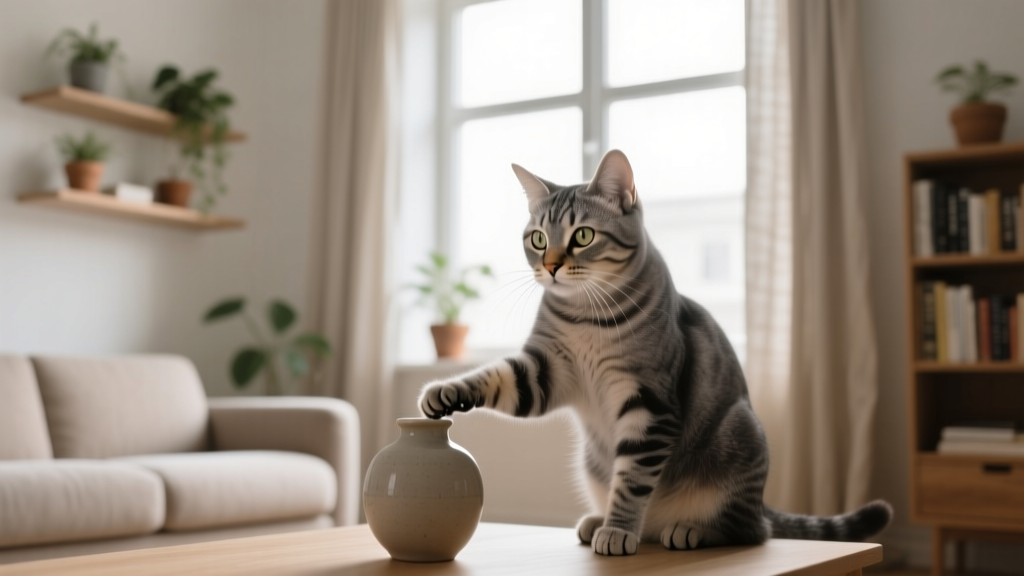
Assuming behavior is intentional or goal-directed. Cats don’t ‘act out’ or ‘seek attention’ in the human sense. Their behaviors serve evolutionary functions: resource guarding, threat mitigation, thermoregulation, or sensory regulation. When your cat knocks things off counters, it’s rarely ‘spite’—it’s likely testing object stability (a hunting reflex) or responding to visual stimuli (shadows, reflections). Reframing behavior as functional—not moral—shifts your entire study approach from judgment to curiosity.
Common Myths About Studying Cat Behavior
Myth 1: “Cats are aloof and don’t bond—they’re just using us for food.”
False. Neuroimaging studies (2022, University of Tokyo) confirm cats form secure attachment bonds with caregivers comparable to dogs and infants—measured via proximity-seeking, distress vocalization reduction, and social referencing (looking to humans in novel situations). They express it differently: through synchronized sleeping, scent-marking, and subtle gaze interactions—not constant physical contact.
Myth 2: “If my cat purrs, she must be happy.”
Incorrect—and potentially dangerous. Purring occurs across a wide physiological spectrum: during labor, fracture healing, and terminal illness. It’s a vibrational self-regulation tool (25–150 Hz frequencies promote tissue repair and pain relief), not an emotion meter. Always pair purring with posture, pupil size, and context to interpret meaning.
Related Topics (Internal Link Suggestions)
- Feline Stress Signals Checklist — suggested anchor text: "subtle signs your cat is stressed"
- How to Introduce a New Cat Without Conflict — suggested anchor text: "safe multi-cat household guide"
- Best Enrichment Toys for Indoor Cats — suggested anchor text: "indoor cat enrichment ideas"
- When to See a Veterinary Behaviorist — suggested anchor text: "cat behavior specialist near me"
- Understanding Cat Body Language — suggested anchor text: "what does my cat's tail mean?"
Your Next Step Starts Today—No Lab Coat Required
You now hold a field-tested, veterinarian-endorsed framework for how to study cat behavior vs relying on instinct, folklore, or outdated myths. This isn’t about turning into a scientist—it’s about deepening trust, preventing avoidable suffering, and honoring your cat’s innate intelligence. Your very first action? Grab your phone, open your Notes app, and spend 90 seconds today documenting *one* thing: what your cat did immediately after waking up. Was she stretching? Sniffing the air? Gazing out the window? That tiny observation is your first data point—and the beginning of a relationship built on understanding, not assumption. Ready to go deeper? Download our free 7-Day Cat Behavior Baseline Tracker (PDF with printable logs and video tutorial links) at [YourSite.com/cat-baseline]. Because when you see your cat clearly—you love her more wisely.