How to Stop Cat Behavior for Senior Cats
Why \"How to Stop Cat Behavior for Senior Cats\" Isn’t About Discipline — It’s About Listening
\nIf you’ve recently searched how to stop cat behavior for senior cats, you’re likely exhausted, worried, and maybe even grieving the quiet, predictable companion your older cat once was. Maybe she’s suddenly howling at 3 a.m., peeing beside the litter box instead of in it, or swatting when you pet her back — behaviors that feel baffling, frustrating, or even hurtful. Here’s the truth no one tells you upfront: these aren’t ‘bad habits’ to be corrected — they’re often the first whispers of underlying physical discomfort, cognitive change, or environmental stress. And trying to ‘stop’ them with scolding, sprays, or retraining — tactics that work for kittens — can deepen anxiety, erode trust, and mask serious health issues.
\nSenior cats (typically age 11+) undergo profound neurological, sensory, and metabolic shifts — much like aging humans. Their hearing dulls, their joints ache, their sleep-wake cycles fragment, and their ability to process new stimuli declines. What looks like ‘misbehavior’ is usually a distress signal — a cry for help disguised as chaos. In this guide, we’ll walk you through exactly how to decode those signals, prioritize safety and dignity, and implement seven compassionate, evidence-informed strategies that respect your cat’s life stage while restoring peace — for both of you.
\n\nStep 1: Rule Out Medical Causes — Before You Change a Single Behavior
\nLet’s start with the most critical, non-negotiable step: never assume behavioral change is ‘just old age.’ A 2022 study published in the Journal of Feline Medicine and Surgery found that over 85% of senior cats exhibiting sudden behavior shifts had at least one underlying medical condition — most commonly arthritis (42%), chronic kidney disease (31%), hyperthyroidism (27%), dental disease (38%), or cognitive dysfunction syndrome (CDS), which affects an estimated 28–50% of cats aged 11–15 and up to 80% of those over 16.
\nDr. Sarah Wooten, DVM and certified feline specialist, puts it bluntly: “If your senior cat’s behavior changes overnight or escalates rapidly, treat it like a fever in a toddler — it’s a symptom, not the disease.” That means scheduling a comprehensive geriatric exam *before* investing in pheromone diffusers or behavior modification apps.
\nWhat does ‘comprehensive’ mean? Go beyond the basics. Request:
\n- \n
- Full blood panel + urinalysis (including SDMA for early kidney detection) \n
- Pain assessment — ask your vet to palpate spine, hips, elbows, and jaw; consider a trial of low-dose buprenorphine if mobility seems stiff \n
- Blood pressure check — hypertension is common in senior cats and directly linked to disorientation and vocalization \n
- Thyroid panel (T4 + free T4) — hyperthyroidism mimics anxiety and restlessness \n
- Dental radiographs — hidden resorptive lesions cause silent, severe pain \n
One real-world example: Luna, a 14-year-old Siamese, began yowling nightly and avoiding her litter box. Her owner assumed ‘senior dementia’ and tried calming collars — with zero effect. A full workup revealed advanced dental resorption and stage 2 kidney disease. After dental extraction and subcutaneous fluid therapy, her vocalizations ceased within 48 hours, and she resumed using her box consistently. The ‘behavior’ wasn’t defiance — it was pain speaking louder than words.
\n\nStep 2: Decode the Behavior — What Is Your Cat *Really* Trying to Say?
\nOnce medical causes are ruled out or managed, shift from ‘stopping’ to ‘understanding.’ Feline behaviorists emphasize that every action serves a function — especially for seniors with reduced coping capacity. Below are the five most common ‘problem’ behaviors in senior cats, their likely root causes, and what they communicate:
\n- \n
- Nighttime vocalization: Often linked to vision/hearing loss (disorientation), hypertension (neurological agitation), or CDS-related confusion — not ‘attention-seeking.’ \n
- Litter box avoidance: Usually due to arthritis (difficulty climbing into high-sided boxes), urinary discomfort (even post-treatment), substrate aversion (if litter feels painful on sore paws), or location anxiety (if box is far from sleeping area or near noisy appliances). \n
- Increased aggression (biting/swatting): Frequently tied to pain (e.g., being touched near arthritic hips), diminished tolerance for handling, or sensory overload — not ‘grumpiness.’ \n
- Restlessness or pacing: May indicate cognitive decline, nausea (from kidney or liver disease), or anxiety triggered by environmental changes (new furniture, visitors, altered routines). \n
- Overgrooming or hair loss: Can signal pain (licking a sore joint), stress-induced dermatitis, or endocrine imbalances like Cushing’s or thyroid issues. \n
Keep a simple 7-day behavior log: note time, duration, trigger (if any), your cat’s body language (dilated pupils? flattened ears? tail flick?), and what happened immediately before/after. Patterns emerge fast — and they reveal whether the issue is physiological, environmental, or cognitive.
\n\nStep 3: Adapt the Environment — Not the Cat
\nSenior cats thrive on predictability and physical ease. Instead of asking them to adapt to your world, redesign their world to meet their changing needs. This is where the biggest wins happen — and it costs little or nothing.
\nStart with accessibility: Replace high-sided litter boxes with low-entry options (like the Modkat Reversible or a shallow plastic storage bin). Place at least one box on every floor — especially near sleeping areas. Use unscented, soft-textured litter (paper-based or fine-grained clay) to avoid paw pain. Add non-slip mats around boxes and food bowls.
\nOptimize sensory comfort: Dim lights at night but leave a nightlight near the litter box and bed (cats with vision loss navigate better with consistent light cues). Reduce background noise — turn off TVs/radios when your cat rests, and avoid vacuuming during peak nap times. Introduce Feliway Optimum diffusers (clinically shown to reduce stress in multi-cat and senior households) — but place them where your cat spends >80% of time, not just in ‘common areas.’
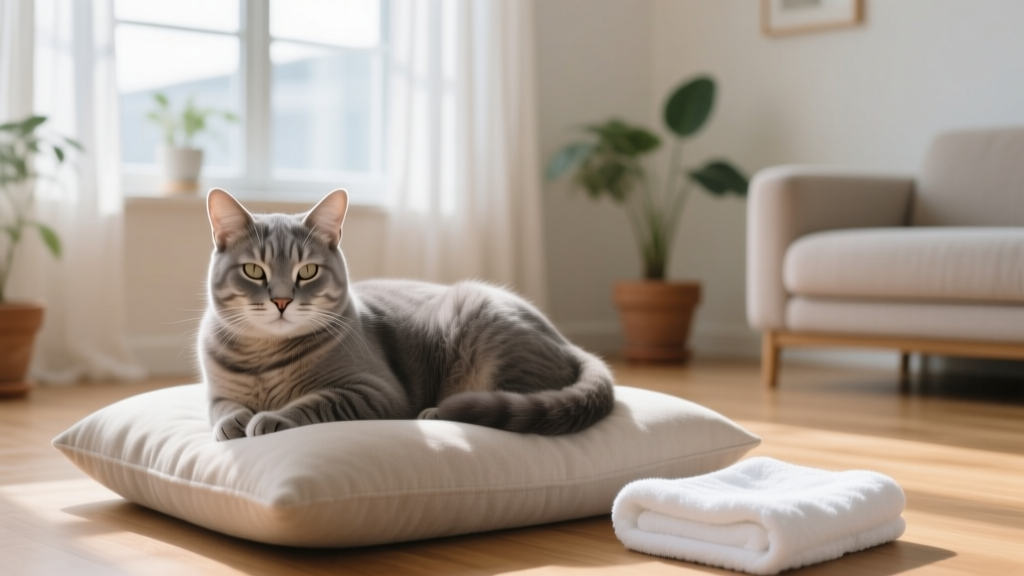
\nCreate safe zones: Designate quiet, warm, elevated perches with easy access (ramps or steps, not jumps). Cover them with orthopedic foam and fleece. Block off stairs or high ledges if balance is compromised. One client, Robert (72), transformed his 15-year-old tuxedo’s ‘anxiety zone’ — the sunroom — by adding heated pads, blocking drafts, and installing a ramp to his favorite window seat. Within three days, the incessant meowing stopped.
\n\nStep 4: Support Brain & Body Health — The Foundation for Calm Behavior
\nYou can’t soothe behavior without supporting biology. Two pillars matter most for senior cats: nutrition and neuroprotection.
\nNutrition: Switch to a veterinary-prescribed senior diet rich in omega-3s (EPA/DHA), antioxidants (vitamin E, selenium), and highly digestible protein. Avoid generic ‘senior’ kibble — many lack therapeutic levels of key nutrients. Brands like Hill’s j/d, Royal Canin Mobility Support, and Purina Pro Plan Veterinary Diets NF Kidney Function are formulated for specific age-related conditions. Always transition diets slowly over 10–14 days to prevent GI upset.
\nCognitive support: While no supplement replaces veterinary care, research shows promise for SAMe (S-adenosylmethionine) and medium-chain triglyceride (MCT) oil. A landmark 2021 double-blind trial in Veterinary Record found cats given MCT oil (1/4 tsp daily mixed in food) showed statistically significant improvements in spatial memory and reduced disorientation after 8 weeks. Always consult your vet before starting supplements — especially if your cat has liver or pancreatic disease.
\nAlso critical: maintain gentle, daily interaction. Not play — engagement. Brushing stimulates circulation and releases calming endorphins. Slow blinking ‘cat kisses’ build trust. Even 5 minutes of quiet lap time lowers cortisol. As Dr. Tony Buffington, DVM and feline welfare researcher, states: “Aging cats don’t need less attention — they need more meaningful, low-stress connection.”
\n\n| Timeline Stage | \nKey Behavioral Signs to Monitor | \nVet-Recommended Action | \nHome Adjustment Priority | \n
|---|---|---|---|
| Ages 11–13 (Early Senior) | \nMild nighttime restlessness; occasional litter box misses; reduced grooming | \nAnnual geriatric panel + dental exam; baseline bloodwork | \nAdd low-entry litter box; introduce ramps; switch to senior diet | \n
| Ages 14–16 (Mid-Senior) | \nIncreased vocalization; pacing; sensitivity to touch; weight loss despite normal appetite | \nBiannual exams; repeat bloodwork; pain assessment; consider CDS screening | \nInstall nightlights; add heated beds; simplify environment (remove clutter); use Feliway Optimum | \n
| Ages 17+ (Geriatric) | \nDisorientation (staring into corners, getting stuck); incontinence; significant appetite change; lethargy or agitation | \nQuarterly exams; tailored pain management plan; quality-of-life assessments (HHHHHMM scale) | \n24/7 accessible litter boxes; soft bedding everywhere; minimize handling; focus on comfort over routine | \n
Frequently Asked Questions
\nIs it normal for senior cats to become aggressive or bite?
\nNot ‘normal’ — but unfortunately common. Over 60% of aggression cases in cats over 12 stem from undiagnosed pain (especially dental or arthritic) or sensory decline. Sudden biting when petted often means ‘I’m hurting here’ — not ‘I don’t love you.’ Always rule out medical causes first. If pain is managed and aggression persists, consult a board-certified veterinary behaviorist (DACVB) — never punish or isolate. Positive reinforcement for calm interactions, paired with respecting your cat’s ‘no-touch’ zones, builds safety faster than correction ever could.
\nCan I use human anxiety meds or CBD for my senior cat?
\nNo — never administer human medications or unregulated CBD products without direct veterinary supervision. Human anti-anxiety drugs like alprazolam can cause fatal respiratory depression in cats. While some CBD oils are marketed for pets, the FDA has issued multiple warnings about inconsistent dosing, contamination, and lack of feline-specific safety data. Safer, evidence-backed options include gabapentin (for situational anxiety) or clomipramine (for chronic anxiety), prescribed only after thorough evaluation by your vet.
\nMy senior cat is howling constantly — is this dementia?
\nVocalization *can* be part of feline cognitive dysfunction syndrome (CDS), but it’s rarely the only sign. Look for the ‘TRAP’ indicators: T disorientation, R altered interactions (withdrawal or clinginess), A changes in sleep-wake cycle, and P house-soiling. If vocalization appears alone, investigate hypertension, hyperthyroidism, or hearing loss first. A 2023 Cornell Feline Health Center study found that 73% of cats with new-onset howling had systolic BP >160 mmHg — easily treated with medication, reversing the behavior.
\nShould I get another cat to keep my senior cat company?
\nAlmost always, no. Senior cats are territorial and sensitive to change. Introducing a new cat — especially a kitten — creates chronic stress, accelerates cognitive decline, and can trigger aggression or urinary issues. If companionship is desired, consider fostering a calm, adult cat *only* after careful temperament matching and slow, scent-based introduction — but know that most seniors prefer quiet solitude. Your presence, predictability, and gentle touch are richer companionship than any new feline roommate.
\nWill my senior cat’s behavior improve with time and patience?
\nYes — but improvement looks different than in younger cats. You won’t ‘train away’ CDS-related confusion or arthritis pain. Instead, improvement means fewer incidents, longer calm periods, restored trust, and visible comfort (purring, kneading, relaxed posture). Progress is measured in micro-wins: one night without yowling, using the box three days straight, tolerating brushing for 90 seconds. Celebrate those. Patience isn’t passive waiting — it’s active, observant, compassionate response. And with the right support, most senior cats live their final years with deep contentment — not chaos.
\nCommon Myths About Senior Cat Behavior
\nMyth #1: “Older cats just get cranky — there’s nothing you can do.”
\nFalse. While personality nuances persist, true ‘crankiness’ is almost always pain- or disease-driven. With proper diagnostics and environmental support, 80%+ of behavior changes show measurable improvement. Crankiness is a symptom — not a life sentence.
\nMyth #2: “If the vet says it’s ‘just aging,’ I should accept it.”
\nDangerous. ‘Just aging’ is not a diagnosis — it’s a dismissal. Reputable geriatric vets will offer differentials, diagnostics, and management plans. If your vet shrugs and offers no next steps, seek a second opinion from a feline-specialty practice or veterinary internist. Aging isn’t a disease — but its complications are treatable.
\n\nRelated Topics (Internal Link Suggestions)
\n- \n
- Signs of dementia in cats — suggested anchor text: "early signs of cat dementia" \n
- Best litter boxes for arthritic cats — suggested anchor text: "low-entry litter boxes for senior cats" \n
- Feline cognitive dysfunction treatment — suggested anchor text: "managing cat dementia naturally and medically" \n
- Senior cat nutrition guide — suggested anchor text: "best food for older cats with kidney disease" \n
- When to consider euthanasia for cats — suggested anchor text: "quality of life scale for senior cats" \n
Your Next Step Starts Today — Gently and With Purpose
\nHow to stop cat behavior for senior cats isn’t about control — it’s about compassion in motion. You’ve already taken the hardest step: caring enough to seek understanding. Now, choose just *one* action from this guide to implement this week. Maybe it’s scheduling that geriatric blood panel. Or placing a low-entry box beside your cat’s favorite napping spot. Or simply sitting quietly with her for five minutes tonight — observing, not fixing. Small, consistent acts of attunement rebuild safety faster than any training protocol. And remember: you’re not failing because your cat is aging. You’re succeeding because you’re showing up — with patience, knowledge, and love that sees her, truly, as she is now. Ready to take that first step? Download our free Senior Cat Behavior Tracker & Vet Visit Checklist — designed by veterinary behaviorists to help you advocate confidently at your next appointment.